The bus fleet maintenance landscape transformed completely between 2024 and 2026. AI-powered predictive diagnostics moved from pilot projects to operational reality. Electric bus adoption crossed the inflection point where total cost of ownership advantage became undeniable. FMCSA compliance rules shifted dramatically, creating new reporting and data management demands. Mobile-first CMMS platforms replaced desktop software, enabling technicians to work from anywhere. Meanwhile, the maintenance labor shortage intensified: fleets report 40% difficulty recruiting qualified technicians in 2026, forcing automation investments that would have seemed premature three years ago. This comprehensive guide covers the 8 biggest bus fleet maintenance trends reshaping operations in 2026, explains what each trend means for your specific operation, and shows how early adopters are locking in competitive advantages through technology and process modernization. Understanding these trends—and acting on them—separates fleets that thrive in 2026 from those that get disrupted.
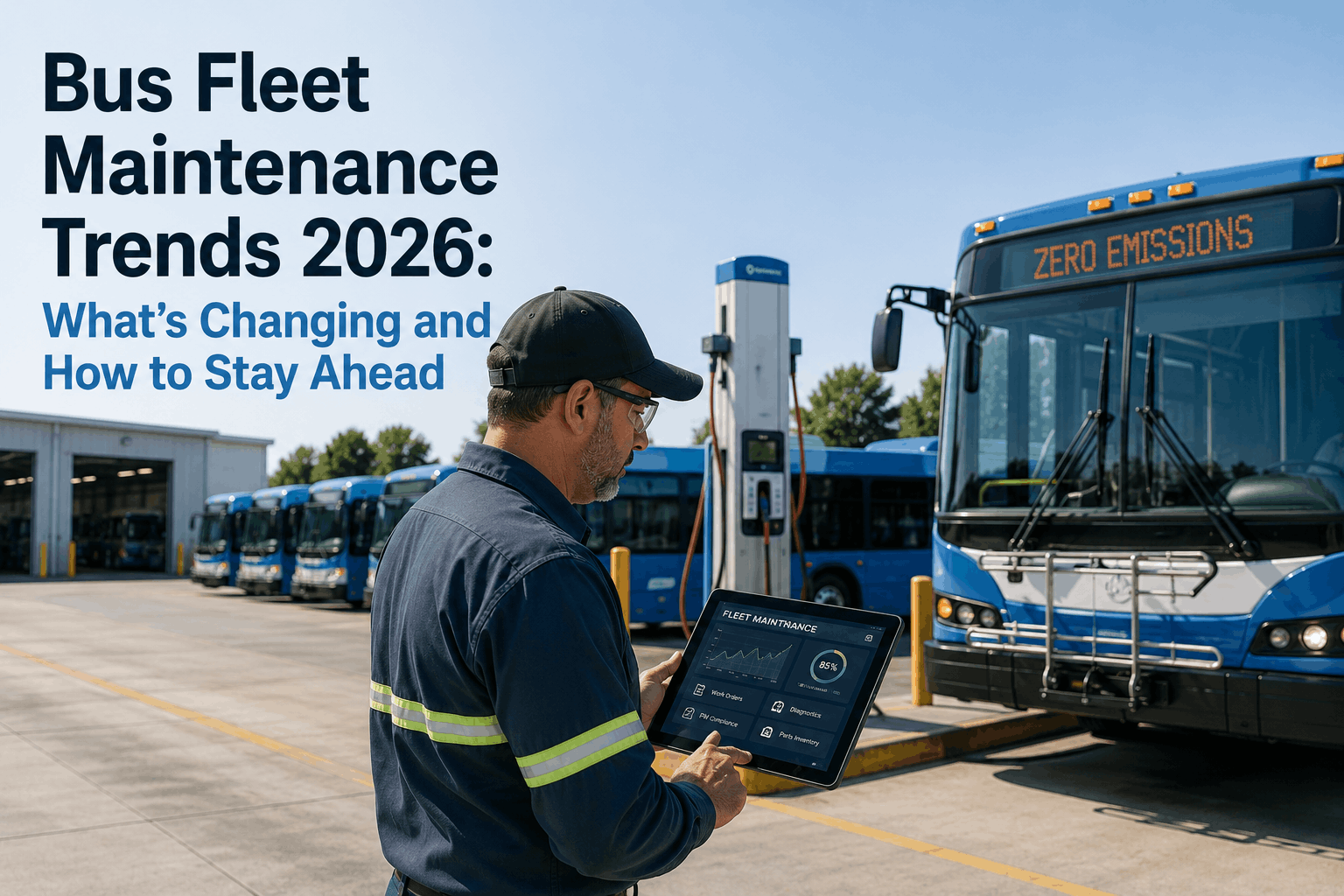
Bus Fleet Maintenance Trends 2026: What's Changing & How to Stay Ahead
The 8 biggest maintenance industry shifts reshaping bus operations: AI diagnostics, electric bus adoption, FMCSA overhaul, mobile CMMS, labor modernization, cybersecurity, predictive analytics, and regulatory compliance. How to future-proof your maintenance program in 2026.
The 2026 Bus Fleet Maintenance Landscape: Market Size & Adoption Rates
The global fleet management market reached $27 billion in 2025 and is projected to grow at 16.9% CAGR, hitting $122.3 billion by 2035. What's driving this explosive growth? Four converging forces: (1) Digital transformation demand from compliance regulations, (2) Electric vehicle adoption requiring entirely new maintenance expertise, (3) Predictive AI achieving 85–95% accuracy in failure prediction, and (4) Severe skilled labor shortage forcing automation investments. In 2026, adoption rates reveal a clear bifurcation: 53% of fleet managers research AI maintenance capabilities, but only 5.6% have deployed it broadly. This gap—nearly 50 percentage points between interest and action—isn't a technology gap. The technology works. The gap is a confidence gap and organizational change resistance. Fleets that solve this confidence problem in 2026 will own operational advantages that widen every quarter through 2028.
The 8 Biggest Bus Fleet Maintenance Trends in 2026
AI Predictive Maintenance Achieving Mainstream Operationalization
In 2025, AI predictive maintenance was a differentiator. In 2026, it's becoming table stakes. Machine learning models now achieve 85–95% accuracy predicting major component failures, surfacing risk 20–45 days before traditional diagnostics raise any alarm. The inflection point: payback period dropped to 3–6 months. When an investment pays for itself in a quarter, adoption accelerates. Fleets report: 62% fewer unplanned breakdowns, 30% lower maintenance costs, and full platform ROI within 90 days. The most expensive mistake in 2026 isn't deploying AI predictive maintenance—it's delaying deployment while competitors lock in 15–25% annual maintenance cost advantages.
Impact: Fleets still running 70%+ reactive maintenance face 20–35% cost penalties vs. AI-enabled competitors. Adoption becomes competitive necessity by 2027.
Electric Bus Adoption Crossing 20% Market Share Inflection
Electric buses crossed 20% global market share in 2025 and the trend is accelerating through 2026. For maintenance operations, this creates a critical challenge: electric buses require entirely different skillsets, diagnostic tools, and spare parts management. Thermal management, battery state-of-health monitoring, and regenerative brake systems demand technician training that doesn't exist in many fleets. Maintenance departments built around diesel engines face 18–36 month learning curves. Early movers—fleets transitioning 30–50% of their fleet to electric by 2027—are now investing in technician training, updated diagnostic tools, and hybrid maintenance strategies (keeping experienced diesel technicians while building electric expertise). By 2028, fleets without electric bus maintenance capability will struggle to recruit talent and meet compliance requirements.
Impact: Maintenance labor requirements shift from mechanical expertise to electrical systems knowledge. Training investment becomes competitive necessity.
FMCSA Compliance Overhaul & New Reporting Requirements
FMCSA guidance in 2026 dramatically expands recordkeeping and electronic reporting requirements. New rules demand: per-vehicle maintenance history documented in structured data formats, real-time driver vehicle inspection reporting (DVIR) linking specific defects to subsequent repairs, and predictive maintenance integration into compliance documentation. Manual spreadsheets no longer satisfy regulatory requirements—audits expect digital audit trails proving preventive maintenance execution. Fleets lacking CMMS compliance integration face audit findings and potential operational restrictions. Compliance cost: $8,000–$25,000 per fleet in systems upgrades and process changes. Non-compliance cost: audit findings, operational restrictions, even temporary out-of-service orders.
Impact: CMMS selection becomes compliance-critical, not just efficiency-optional. Digital maintenance documentation shifts from nice-to-have to legal requirement.
Mobile-First CMMS Replacing Desktop Software
In 2025, mobile CMMS was emerging. In 2026, it's becoming the standard. Technicians increasingly work from the vehicle bay, yard, or road—not at a desktop. Mobile-first platforms enable real-time work order execution, on-device diagnostics capture, photo documentation, and parts scanning directly from smartphones and tablets. Desktop-only systems force extra data entry steps, creating bottlenecks and error risks. Forward-thinking fleets report 25–35% faster work order completion, 40% fewer data entry errors, and significantly higher technician adoption (technicians resist manual follow-up office work). Legacy CMMS vendors are scrambling to add mobile capabilities, but retrofitted mobile apps can't compete with purpose-built platforms. Fleets deploying native mobile CMMS in 2026 gain operational velocity that separates them from competitors.
Impact: Mobile accessibility becomes must-have CMMS feature. Desktop-only platforms become competitive liabilities.
Maintenance Labor Shortage Driving Automation & Skill Development
The US faces 80,000+ commercial vehicle driver shortage in 2026—but the maintenance technician shortage is equally severe and less visible. Fleets report 40% difficulty recruiting qualified technicians. Average technician age is 48, with limited pipeline of younger workers. This creates urgent pressure for automation and productivity tools: AI diagnostics that reduce manual troubleshooting, guided repair procedures that enable junior technicians to perform senior-level work, and remote diagnostic support connecting experienced technicians to field teams. Fleets investing in technician productivity tools (AI diagnostics, remote support, guided maintenance) are positioning themselves to operate with fewer headcount while maintaining service levels. Fleets relying on manual expertise face severe capacity constraints and wage pressure (technician salaries accelerating 6–8% annually).
Impact: Labor-saving technology becomes existential for fleet viability. Fleets not automating face unsustainable technician scarcity and wage inflation.
Cybersecurity Threats Escalating Against Connected Fleet Systems
Upstream Security documented 494 automotive cyber incidents in 2025—and 2026 is seeing acceleration. Connected telematics, over-the-air vehicle updates, and mobile CMMS systems create attack surfaces. Ransomware targeting fleet operations hit record levels, with attackers locking CMMS systems and demanding payment. Major incident: a regional transit authority's CMMS was encrypted, disabling maintenance work order execution for 7 days at cost of $850,000 in emergency repairs and downtime. In response, fleets are implementing: multi-factor authentication on CMMS access, encrypted telematics connections, regular security audits, and cyber insurance. Cost of cybersecurity hardening: $15,000–$45,000 per fleet for implementation. Cost of a breach: $200,000–$2,000,000+ in ransom, recovery, and operational losses. 2026 trend: cybersecurity becomes a mandatory CMMS and fleet management requirement.
Impact: Cybersecurity investment becomes non-negotiable. Fleets risk catastrophic operational disruption without proper protections.
Real-Time Data & Live Telematics Enabling Continuous Optimization
In 2025, fleet data was largely retrospective—analyzed after-the-fact. In 2026, live data from OEM telematics and real-time CMMS integration enable instant optimization decisions. Example: a thermal sensor detects coolant temp trending upward; AI alerts maintenance team immediately; technician can schedule service during next scheduled downtime rather than waiting for a breakdown. Another example: parts inventory system integrates with predictive maintenance, auto-ordering components when failure risk reaches threshold—eliminating stock-outs. Real-time data dramatically improves maintenance scheduling efficiency and eliminates emergency sourcing. Early adopters report 15–25% reduction in unplanned downtime through live data optimization.
Impact: Real-time data integration becomes competitive advantage in maintenance optimization and uptime.
Sustainability Reporting Requirements Driving Operational Transparency
Corporate Sustainability Reporting Directive (CSRD) and similar regulations now require companies to track and report CO₂ emissions, energy consumption, and vehicle data with verified accuracy. Maintenance operations feed directly into sustainability reporting: electric vehicle adoption rates, emission-intensive repair processes, parts recycling, and fuel consumption patterns. Fleets lacking structured maintenance data struggle to meet reporting requirements. Forward-looking fleets are integrating maintenance records with sustainability analytics, enabling real-time reporting and identifying optimization opportunities (e.g., more frequent tire rotations reduce rolling resistance and fuel consumption; predictive maintenance reduces wasted miles before breakdowns). Sustainability data becomes a source of competitive advantage and risk management in 2026.
Impact: Maintenance data transparency becomes regulatory requirement and competitive differentiator.
How These 8 Trends Reshape Your Maintenance Operation
Each trend independently creates operational pressure. Together, they fundamentally restructure what modern fleet maintenance operations look like. In 2026, competitive fleets are:
Running 3–5 independent systems
Separate CMMS, telematics platform, compliance tracking, and diagnostic tools create data silos and manual integration work. Result: 20–30% labor overhead, compliance gaps, and limited AI insights.
Integrated maintenance ecosystem
Single platform combining CMMS, telematics, compliance, and AI diagnostics. Real-time data flows automatically. Result: 25–35% labor savings, compliance confidence, and predictive insights. This is the 2026 competitive standard.
2026 Maintenance Trends: FAQs & Implementation Guidance
Which maintenance trend should we prioritize first in 2026?
Start with AI predictive maintenance if your breakdown costs are high, or mobile CMMS if technician efficiency is limiting. Both deliver fastest ROI and create foundation for other trends.
How much does it cost to modernize a maintenance operation to 2026 standards?
CMMS + AI predictive maintenance + mobile: $35K–$85K first year for 50-bus fleet. Ongoing: $18K–$28K annually. Savings typically exceed costs by month 4–6.
What skills do technicians need for 2026 bus fleet maintenance?
Traditional mechanical knowledge remains essential. New additions: electrical systems diagnostics, battery management (electric buses), AI system interpretation, and software troubleshooting. Training investment: $2,000–$5,000 per technician.
Can we transition existing technicians to electric bus maintenance, or do we need new hires?
Experienced diesel technicians can transition with 40–80 hours of focused training on electric systems. Newer technicians learn electric-native and adapt to diesel. Mixed approach works best.
How do FMCSA compliance requirements impact CMMS selection?
Your CMMS must generate structured maintenance records, support DVIR digital documentation, and provide audit trails. Ask vendors: does it meet new FMCSA requirements? If they're unsure, move on.
What cybersecurity measures are essential for fleet maintenance systems in 2026?
Multi-factor authentication, encrypted data connections, regular security audits, and cyber insurance. Budget $8K–$15K for implementation. Cost of breach: $200K–$2M+. Math is obvious.
How does electric bus adoption change maintenance planning and budgeting?
Electric buses require different spare parts inventory, lower routine maintenance budget (no oil changes), but higher capital reserve for eventual battery replacement. Hybrid fleets need dual expertise and tools.
What's the timeline to implement these 8 trends across my operation?
Year 1 (2026): Implement CMMS + mobile + AI predictive (foundation). Year 2: Add electric bus capability + compliance hardening. Year 3: Optimize data integration + sustainability reporting. Phased approach reduces risk.
Industry Data: Fleet Leaders Are Already Moving
Customer Success: How Early Adopters Are Using These Trends
"Three years ago, our maintenance operation was completely manual—paper work orders, reactive maintenance, constant breakdowns. In 2024, we started evaluating modern CMMS systems but weren't sure about ROI. In 2026, we bit the bullet and implemented integrated CMMS + AI predictive + mobile-first operations simultaneously. The data alignment that followed was transformational. Where we used to spend 30% of technician time diagnosing problems, AI now surfaces the problem (and the solution) immediately. We've cut unplanned breakdowns from 2–3 per week to 2–3 per month. Maintenance costs dropped 31%. We're training technicians on electric bus systems now, preparing for next fleet modernization cycle. But here's what really changed: our operation went from crisis-reactive to proactive. We schedule maintenance around our routes, not around breakdowns. That's a completely different business."
Your 2026 Maintenance Modernization Roadmap
Q1–Q2 2026: Foundation
Assess current CMMS capability and compliance readiness
Evaluate AI predictive maintenance platforms
Plan mobile-first workflow implementation
Begin electric bus training for key technicians
Q3–Q4 2026: Deployment
Deploy new CMMS with mobile-first design
Implement AI predictive maintenance on 50% of fleet
Conduct FMCSA compliance audit
Deploy cybersecurity hardening measures
2027: Optimization
Scale AI to 100% of fleet based on Q4 2026 results
Add electric bus fleet to CMMS with specialized workflows
Integrate real-time data and predictive analytics
Operationalize sustainability reporting
2028: Competitive Advantage
Maintenance costs down 25–30% vs. industry baseline
Uptime exceeding 96% on fleet average
Technician productivity up 35–40% with AI support
Full compliance with evolving regulations
The 2026 Reality Check: You're Either Modernizing or Falling Behind
Fleet managers sometimes ask: "Can we wait another year before implementing these trends?" The data suggests otherwise. Fleets deploying AI predictive maintenance, mobile CMMS, and compliance-ready systems in 2026 are positioning themselves for 25–30% cost advantages by 2028. Fleets waiting until 2027 or 2028 face compressed timelines and competitive pressure from operators already running optimized systems. The confident, competitive move is to start your modernization in Q1–Q2 2026, pilot on a subset of your fleet, measure results, and scale based on proven ROI. BusCMMS schedule a demo to assess your current operation against 2026 standards and identify your most impactful first steps.
Future-Proof Your Bus Fleet Maintenance in 2026
Assess your operation against the 8 biggest 2026 trends. Identify gaps. Build your modernization roadmap. Schedule a consultation with our fleet experts to see how BusCMMS helps you implement these trends and stay ahead of the competition.