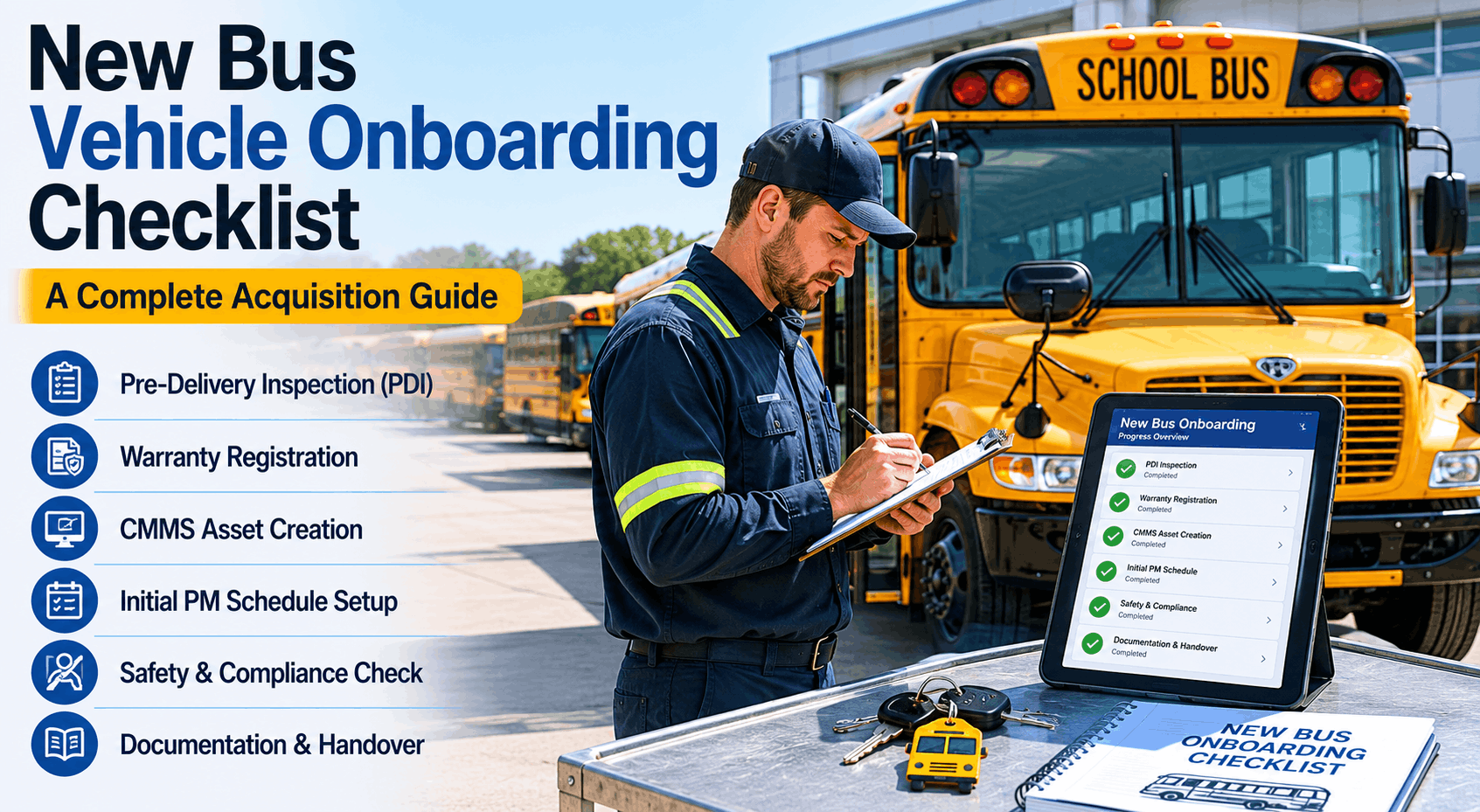
A new bus arrives at your depot. It's a beautiful piece of equipment: 40 seats, brand new, still smells like the factory. But before it can carry a single passenger, it needs to go through a structured onboarding process. Every new vehicle entering your fleet has unique vulnerabilities: factory defects that need to be identified immediately before you accept the asset, warranty paperwork that must be registered before coverage windows close, CMMS records that must be created so maintenance can be tracked systematically across the bus's entire service life, initial predictive maintenance schedules that must be set based on manufacturer specifications, and driver familiarization that must be established to prevent operational errors and accidents. Most fleets skip or shortcut this critical process. A new bus arrives, they do a basic walk-around inspection, they assign a driver, they start running routes immediately. Then 30 days later, a warranty-covered defect appears that should have been caught during proper onboarding. Or a critical component fails at 5,000 miles when the maintenance manual specifies the first service is due at 10,000 miles (operational error: you're running the wrong service schedule because initial configuration was incomplete). Or the driver discovers an ergonomic issue that should have been caught during a thorough pre-operation check, leading to driver complaints or potential safety issues. A structured onboarding checklist prevents these problems and ensures every new bus enters service properly configured, fully documented, and operationally safe. Here's the complete new-bus onboarding process that fleets should follow every single time a vehicle enters the fleet.
Fleet Operations & Asset Management
New Bus Vehicle Onboarding Checklist
Structured onboarding process before your bus carries passengers. Complete checklist for PDI inspection, warranty registration, CMMS asset creation, and initial PM schedule setup. Track progress as you complete each critical step in the onboarding workflow.
Overall Progress: 0% Complete
Pre-Delivery Inspection (PDI): The First Critical Step
Before a bus is even delivered to your depot, a qualified representative from your fleet should perform a comprehensive pre-delivery inspection (PDI) at the manufacturer's facility or dealer location. This is your critical window to catch factory defects before you accept the vehicle and take ownership of any issues. Once you sign off on delivery, you own the vehicle and any defects become your responsibility. While some defects may be covered under warranty, proving they're manufacturing defects rather than damage caused during transportation or initial operation requires detailed documentation from the PDI.
Why PDI is your most important leverage point: A manufacturing defect found during PDI is absolutely the dealer's and manufacturer's responsibility to fix. The manufacturer may provide a replacement bus, repair the bus before delivery, or negotiate compensation. A manufacturing defect discovered after you've accepted delivery becomes your problem. You may have warranty coverage, but the burden of proof is on you to demonstrate the defect existed at manufacture, not after you took possession. This becomes exponentially more difficult to prove after the vehicle has been in your operation. A scratch or ding found during PDI can be documented, photographed, and corrected before acceptance. The same scratch found three months later, after 2,000 miles of operation, is much harder to claim as a manufacturing defect. A brake issue found during PDI can be resolved before your drivers ever operate the bus. A brake issue discovered after delivery becomes a warranty claim (if approved) or your repair expense (if denied).
Timing and logistics of PDI: PDI should occur as close to delivery date as possible, ideally within 48 hours before the bus leaves the manufacturer. This timing ensures any issues can be resolved before the bus travels to your facility. Some manufacturers require PDI to be completed at their facility as a condition of the sale or warranty. Coordinate with the manufacturer to schedule your PDI inspector and ensure all required documentation and test procedures are available. If your fleet cannot send a representative, hire a third-party inspector who specializes in commercial bus inspections. The cost ($300-$600) is minimal compared to the potential savings from catching defects early.
PDI documentation and record keeping: The PDI should result in a detailed written report with photographs documenting the bus's condition at time of inspection. This report becomes part of your permanent vehicle record and is critical if any defects are discovered later. Include timestamps, inspector name, specific items tested, and detailed notes on any defects or concerns. Photograph the bus exterior from multiple angles, the interior of the seating area, the driver compartment, the engine bay, and any specific items that were tested or inspected. If any defects are found, photograph them clearly with close-ups and wide shots for context. This documentation creates an objective record of the bus's condition at the moment of inspection and is invaluable if disputes arise later about whether defects were pre-existing or caused by your operation.
Warranty Registration and Documentation
Every new bus comes with warranties from the manufacturer: standard manufacturer's warranty covering the entire vehicle (typically 2-3 years or specific mileage limits), powertrain warranty covering engine, transmission, and drivetrain components, and potentially extended warranties you can purchase for additional coverage beyond the standard period. These warranties represent significant financial protection if you use them properly. They're virtually worthless if you don't register them within the required timeframe or don't have documentation to back up claims when something fails.
The warranty registration imperative: A manufacturer's warranty only covers defects that occur during the warranty period—but only if you've actually registered the warranty within the manufacturer's required timeframe, which is usually 30 days from delivery. If you don't register within this window and a major component fails at month 6, the manufacturer can rightfully deny the claim because the warranty was never registered. This scenario has cost fleets thousands of dollars in unreimbursed repairs. The registration process is simple—usually a phone call or online form—but it must happen immediately upon delivery. Don't assume the dealer registered it. Don't assume you have time to do it later. Do it within the first week of delivery.
Understanding warranty scope and limitations: Read each warranty document carefully to understand what's covered and what's explicitly excluded. Most manufacturer warranties cover manufacturing defects and failures of components due to normal use. They typically don't cover damage caused by accidents, misuse, neglect, or modification. Some warranties require that you perform manufacturer-recommended maintenance at specified intervals using OEM (original equipment manufacturer) parts. If you skip a required maintenance service, the manufacturer can deny warranty claims for related components, arguing that the failure was caused by your failure to maintain the vehicle properly. This is why linking your CMMS to warranty documents and ensuring maintenance schedules are followed exactly is critical. A missed oil change at 5,000 miles can result in engine damage at 7,000 miles that the manufacturer refuses to cover because you didn't perform maintenance as specified.
Extended warranty evaluation and decision-making: Many dealers offer extended warranties at purchase time, extending coverage to 5+ years or higher mileage limits, often at costs ranging from $2,000 to $8,000 depending on the bus model and coverage level. For school buses and transit buses that operators plan to keep for 10+ years, extended warranties are often cost-justified because they reduce unpredictable major repair expenses after the standard warranty expires. For charter buses or fleets with shorter replacement cycles (5-7 years), extended warranties may not be cost-justified if the bus will likely be sold or retired before warranty expiration. Calculate the cost-benefit: If an extended warranty costs $4,000 and covers a transmission overhaul that typically costs $6,000, and your data shows a 40% probability of needing that repair, the expected value is $2,400 (40% × $6,000), making the warranty financially attractive. But if the probability is only 15%, the expected value is $900, making the warranty less attractive than self-insuring against the risk.
CMMS Asset Creation and Configuration
When a bus enters your fleet, it must be created as an asset in your CMMS (Computerized Maintenance Management System) with complete specifications and configuration. This might sound straightforward, but done incorrectly or incompletely, it creates operational and maintenance problems that compound for years. A bus that exists in dispatch software but isn't properly configured in the CMMS might be scheduled for routes but lack preventative maintenance tracking. A bus that has a CMMS record but isn't linked to required compliance inspections might operate for months without meeting legal inspection requirements. A bus that isn't linked to its warranty information might have expensive repairs paid out of pocket when the manufacturer would have covered them.
Asset identifier strategy and consistency: Choose a clear, unique naming scheme for every bus and use it consistently across all systems. Some fleets use sequential numbering (Bus 1, Bus 2, Bus 100). Others use route-based identifiers (Route-A-01, meaning Route A, vehicle 01). Some use location codes combined with sequence numbers (DEPOT1-42, meaning Depot 1, vehicle 42). The specific scheme matters less than consistency. If you name a bus "Bus 47" in CMMS but "47" in dispatch and "B47" in fuel management and "BUS047" in parts ordering, you've created data silos where information about the same bus doesn't connect. This leads to duplicate records, missed maintenance, and inability to track the bus's complete operational history. Whatever scheme you choose, document it and enforce it across all systems.
Specification capture and component tracking: The CMMS asset record should include complete specifications: bus model and year, VIN (Vehicle Identification Number) for regulatory documentation, engine type and size (Cummins ISB, Allison transmission, etc.), fuel type (diesel, CNG, electric, hybrid), seating capacity, overall length and weight, wheelbase, axle configurations. These specifications are critical because maintenance requirements vary dramatically by model and powertrain. A 2018 Cummins-powered bus has completely different maintenance intervals and component requirements than a 2015 Duramax-powered bus. A bus with disc brakes has different maintenance than a bus with drum brakes. The CMMS uses these specifications to recommend correct maintenance procedures, parts, and service intervals. If specifications are incomplete or incorrect, the CMMS might recommend maintenance for components that don't exist on your bus or fail to schedule maintenance for components that do.
Component-level tracking architecture: Beyond the bus-level asset, the CMMS should track major components that require regular maintenance as sub-assets or component records: engine (with service intervals), transmission (with fluid change schedules), air brake system (with brake pad monitoring), hydraulic systems, electrical system, HVAC (heating/cooling), doors (emergency and passenger doors), mirrors, seats, safety equipment. Each component gets its own maintenance record so failures and service history can be tracked at the component level. This allows you to identify patterns—for example, if three buses of the same model all fail their transmissions at similar mileage, this suggests a manufacturing issue or design flaw that should be reported to the manufacturer and considered when replacing those buses.
Warranty mapping and claim automation: Link the bus asset to its warranty records so that when components fail, the CMMS can automatically check if they're warranty-covered. Some CMMS platforms can flag warranty-covered repairs and automatically generate warranty claim documentation, significantly streamlining the claims process. This prevents the common scenario where a mechanic just orders a replacement part out of pocket without checking if the repair is warranty-covered, resulting in the fleet paying for repairs the manufacturer would have covered.
Initial Maintenance Schedule Setup and Break-In Service
New buses require specific maintenance at specific mileage and time intervals during the first thousands of miles of operation. These requirements are detailed in the manufacturer's service manual and must be followed precisely. Deviating from the manufacturer's break-in schedule can void warranty coverage and cause premature component failure. A new engine has extremely tight tolerances during manufacturing. Small particle contaminants from the machining and assembly process can remain in the engine oil. The break-in oil change at low mileage is specifically designed to flush these particles out before they can cause wear damage.
The physics of engine break-in: During the first few hundred miles, a new engine's piston rings are seating against cylinder walls. The rings haven't yet formed a perfect seal, so oil consumption will be higher than normal. Ring blow-by (combustion gases escaping past the rings into the crankcase) is elevated. If you don't change the oil at the manufacturer's break-in service interval, the accumulated combustion gases and residual manufacturing contaminants can create sludge and varnish that shortens engine life. The manufacturer specifies break-in intervals for good reason—they're based on decades of engine development and real-world failure data. Some manufacturers even void engine warranty if the break-in service isn't performed on schedule.
Transmission break-in and fluid conditioning: Similarly, transmissions require break-in service. New automatic transmissions have close tolerances and fresh fluid that needs to be conditioned through initial operation. The manufacturer specifies transmission service intervals to monitor fluid condition and replace the fluid if degradation is detected. Some manufacturers recommend light-duty operation during the first 500-1,000 miles—avoiding maximum speed, harsh acceleration, or loaded operation. This gives the transmission's internal components time to mate and settle before being subjected to full operational stress. Ignoring these recommendations can result in transmission wear that doesn't manifest as failure until 15,000-20,000 miles, but the damage was done during break-in due to insufficient fluid conditioning.
Documenting the schedule and automation: Create a maintenance calendar in the CMMS with specific dates tied to expected mileage accumulation. If a bus typically accumulates 500 miles per week, the first oil change scheduled at 2,500 miles should occur approximately 5 weeks after delivery. The CMMS should send automatic reminders when each service approaches so mechanics don't miss critical intervals due to forgetfulness or operational disruptions. The break-in period is not the time for your transportation department to maximize utilization. It's the time to protect your investment in the new asset by performing exact manufacturer-specified maintenance.
Driver Familiarization and Ergonomic Setup
A new bus is operationally unfamiliar to drivers. They don't know where critical controls are located. They don't know the vehicle's handling characteristics or how responsive the steering and brakes are compared to buses they've previously operated. They don't know if the seat position is ergonomically correct for their body, which can lead to driver fatigue or injury over extended routes. This combination of factors—operational unfamiliarity plus ergonomic issues—can lead to driver errors, accidents, or complaints about discomfort and safety.
The ergonomic imperative: Driver comfort is not a luxury—it's a safety and operational effectiveness issue. A driver who is uncomfortable because the seat doesn't fit their frame will be fatigued and less attentive after 4-5 hours of operation. Fatigue increases accident risk and reduces passenger safety. A driver who doesn't know how responsive the steering is might over-correct or under-correct in emergency maneuvers. A driver who doesn't understand door interlock systems might open doors at inappropriate times or damage the door mechanism. Familiarization is not optional training—it's a critical safety step that should be completed before any driver operates the bus with passengers.
Creating familiarization protocol and documentation: Develop a standardized familiarization checklist that every driver completes with new bus models. The checklist should include specific control locations, operational procedures, emergency protocols, and ergonomic setup steps. After completion, the driver signs a statement confirming they've been familiarized with the vehicle and feel comfortable operating it. This documentation creates accountability and evidence that proper training occurred. If an accident later occurs and a driver claims they didn't know how to operate a system, your documentation proves you provided proper training. This signature also creates psychological commitment—drivers are more likely to take the training seriously when they're signing off that they understand and accept responsibility.
Mentorship model for first routes: Assign an experienced driver as a mentor on the new bus's first route. The mentor isn't there to do the driving—the assigned driver still operates the bus with their usual responsibilities. But the mentor rides along to observe the driver's handling of the vehicle and identify any issues. The mentor might notice that the driver is uncomfortable with steering responsiveness, or isn't confident with door operation, or has difficulty seeing a particular blind spot. These observations can be addressed immediately through coaching or adjustments rather than waiting for a problem to develop during solo operation.
Integration with Operational Systems
Once the bus is registered in the CMMS with complete asset configuration, it needs to be integrated into your operational systems: dispatch software, GPS tracking and telematics, fuel management, incident reporting, driver assignment systems. A bus that exists in your maintenance system but isn't properly integrated into dispatch might be scheduled for routes it's not mechanically ready for. Or worse, it might not be scheduled for routes at all because dispatch doesn't know it exists. A bus that isn't integrated into the GPS tracking system means dispatch loses visibility into its location during operation, creating safety and communication problems.
Dispatch system integration: The new bus needs to be registered in your dispatch software with complete operational information: seating capacity, accessibility features (wheelchair lift, special accommodations), approved routes (not every bus is suitable for every route—some routes require specific features), availability calendar (when the bus is unavailable for maintenance or other reasons), driver assignments, and any special operational notes. The availability calendar is particularly important during the break-in period. If the bus is scheduled for major services at specific mileages, those dates should be marked as unavailable for passenger routes so dispatch doesn't accidentally schedule the bus when it's in the maintenance shop.
Fuel and telematics integration: Modern fleet operations require GPS tracking and fuel management integration. The new bus should be activated in your GPS/telematics system so that dispatch can locate it in real-time, monitor fuel consumption patterns, track driver behavior (acceleration, braking, idle time), and receive alerts if the bus deviates from approved routes or has mechanical issues. The bus should be added to your fuel management system with access to fleet fueling stations and fuel cards if applicable. Some fleets use restricted-access fueling to prevent drivers from using personal cards or fuel vendors not approved by the company.
Maintenance notification and knowledge distribution: Every mechanic and maintenance coordinator should know the new bus exists and have access to its specifications, service manual, and known issues. This is typically accomplished through a new-equipment notification or bulletin sent to the maintenance department. The notification should include the bus's ID, specifications, location, warranty information, any known quirks or service considerations, and a point of contact for questions. Without this notification, mechanics might be unaware of the bus when it arrives for service and could inadvertently perform incorrect maintenance due to lack of familiarity with the model.
Bus Onboarding Questions & Answers
Who should perform the PDI—our staff or the dealer?
The ideal approach involves both parties, though each plays a different role. The dealer performs factory functional testing to ensure the bus operates without mechanical issues before leaving the facility. Your fleet should send a qualified representative to conduct a detailed inspection focused on your specific operational requirements: seating configuration matches your needs, safety features function properly, integration compatibility with your systems, exterior condition without shipping damage. If your fleet cannot send a representative, hire an independent inspector specializing in commercial bus inspections. The cost ($300-$600) is minimal insurance against discovering defects after acceptance. Some manufacturers require fleet-conducted PDI as part of the warranty agreement, so verify contractual requirements before delivery.
How long can a new bus sit without being put into service?
Modern buses are designed for active use, not extended storage. Sitting unused for 3+ months causes several issues: battery discharge (even with low-draw electronics), tire flat-spotting (flat areas develop on the tire where it contacts the ground), fuel degradation (diesel fuel can develop algae growth and separation), and hydraulic fluid settling (components can separate). If a new bus won't enter service for more than 30 days, start and run it monthly at normal operating temperature. Battery should be fully charged. Fuel should be treated with biocide if storage extends beyond 6 weeks. Better practice: put the bus into service and begin the manufacturer's break-in maintenance schedule on the specified timeline rather than delaying service entry.
What if a defect is discovered after we accept delivery?
Contact the manufacturer and dealer immediately upon discovery. If the defect is factory-related and within the warranty period (typically 30-90 days from delivery for manufacturing defects), the manufacturer should cover the repair or replacement at no cost. Document when the defect was discovered, what symptoms it presents, and request warranty coverage with full explanation of the issue. If you have PDI documentation showing the defect didn't exist at inspection, this strengthens your warranty claim significantly. Without pre-delivery documentation, the manufacturer may argue the defect resulted from operation or transport after delivery, weakening your claim. This is why thorough PDI documentation is critical—it gives you leverage if defects appear later.
Do we need anything special for used buses entering our fleet?
Used buses require more extensive pre-acquisition inspection than new buses because you're inheriting maintenance history and potential hidden problems. Commission a comprehensive pre-purchase mechanical inspection from a trusted mechanic familiar with the specific model. Obtain complete maintenance and repair history from the previous operator—this tells you which components are wearing and which have been recently replaced. Verify odometer readings through title history to ensure they're accurate (odometer rollback fraud exists in used vehicle sales). Request warranty transfer documentation if warranties remain valid. Have the previous operator provide specifications and service manuals. Create a detailed CMMS asset record documenting the bus's age, cumulative usage, maintenance history, and any known issues. This complete history allows your maintenance team to plan appropriate service intervals and budget for anticipated major repairs.
Should we buy extended warranty on new buses?
The decision depends on your fleet's replacement cycle and risk tolerance. If you operate buses for 10+ years, extended warranty (3-4 years beyond manufacturer's standard) is usually cost-justified because it reduces unpredictable major repair expenses after the standard warranty expires. A transmission overhaul at year 7 of operation (after standard warranty) might cost $6,000-$8,000; extended warranty could cover this. If you replace buses every 5 years, standard manufacturer warranty typically covers the period you'll own the bus, making extended warranty unnecessary. Calculate the cost-benefit: Divide the extended warranty cost by the average major repair cost for that model. If the ratio is under 25% (extended warranty costs less than 25% of typical major repairs), it's usually worth purchasing. Document this calculation for budget justification.
How should we handle the bus's break-in period operationally?
Treat break-in buses gently during the initial operating period to allow components to properly seat and condition. Avoid maximum engine speeds, aggressive acceleration or braking, and heavy loads during the first 500-1,000 miles. Don't assign a new driver to a new bus simultaneously—this creates too many learning curves at once. Have experienced drivers operate the bus during break-in so they can recognize any unusual sounds, behaviors, or handling characteristics that might indicate problems. After 1,000 miles, the bus can operate under normal conditions. Check the manufacturer's service manual for any specific operational restrictions during break-in. Some manufacturers specify light-duty operation for the first 5,000 miles; others impose no restrictions after 1,000 miles. Follow the manufacturer's guidance precisely to avoid warranty issues.
What documentation should we keep after onboarding?
Maintain a complete onboarding file for every new bus containing: PDI checklist with detailed notes and photographs, warranty registration receipts and all warranty documents, CMMS asset creation documentation with configuration details, driver orientation training sign-offs from every driver who will operate the bus, initial maintenance schedule with completion records as services are performed, manufacturer documentation including service manuals, technical specifications, warranty terms, and any service bulletins. Store these records for the bus's entire service life. They become invaluable if disputes arise about whether defects were pre-existing or whether warranty service was properly performed. If you eventually sell the bus, provide these complete records to the new owner—they significantly increase resale value and demonstrate your professional maintenance approach.