The March 2, 2026 electronic submission deadline is the day every OSHA 300 log discipline gap becomes a compliance problem. Bus fleets in transit (NAICS 485) and mechanic operations (NAICS 811) both fall into OSHA's designated high-hazard categories, which means any depot with 100 or more employees now submits the full 300 log AND every 301 form -- not just the 300A summary. Miss a form and each violation runs $16,550 with repeats up to $165,514. This is the 2026 reconciliation checklist, coverage decision matrix, and the 8 log errors most bus fleet safety managers catch too late. See BusCMMS track OSHA 300 recordables per employee, per depot → book a 20-min demo.
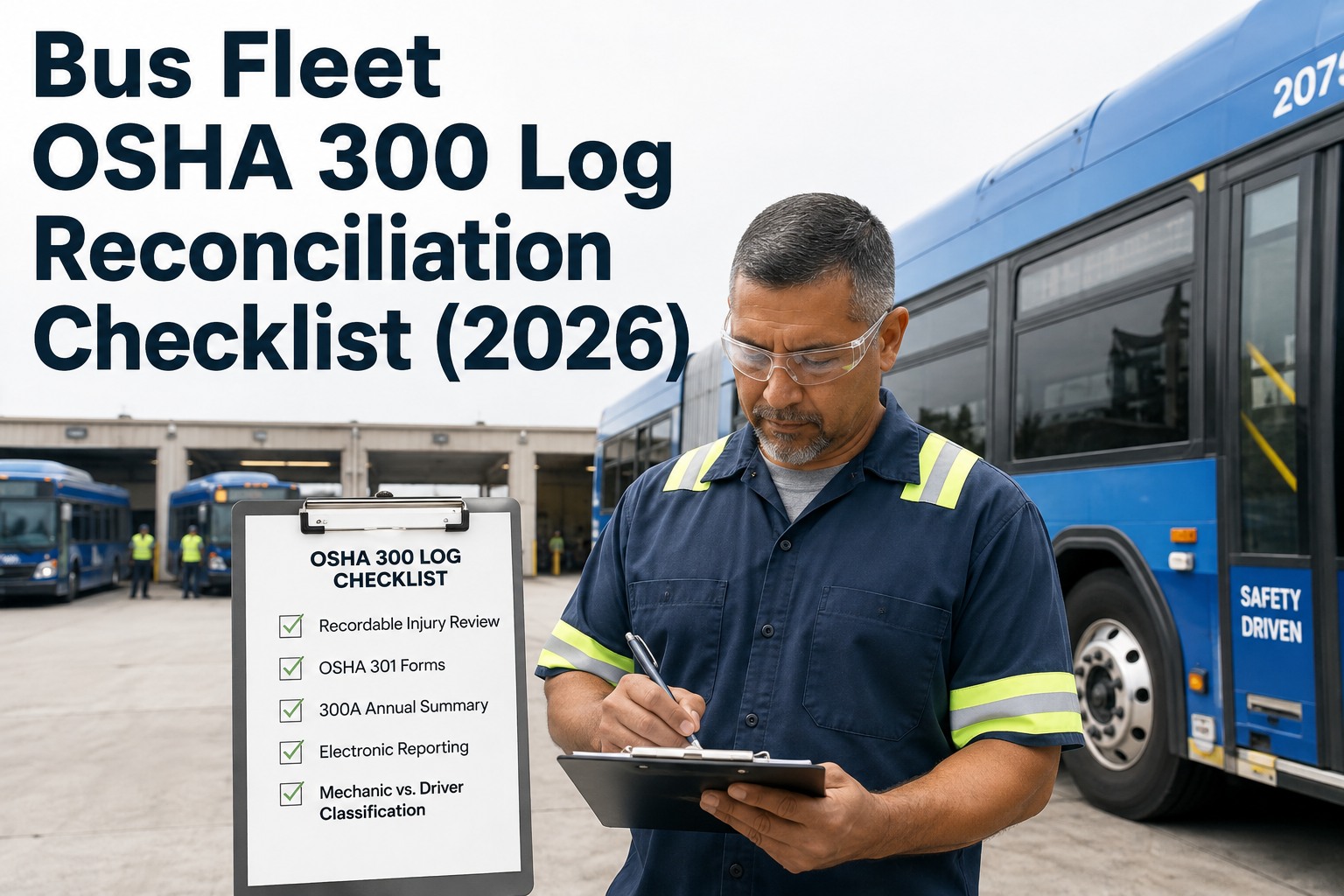
Bus Fleet OSHA 300 Log Reconciliation Checklist
The 3-form OSHA family, the 2026 deadlines that matter, and the 8-point reconciliation checklist that closes the compliance gaps most bus fleet safety managers catch too late.
300A Posting Begins
ITA Electronic Submission
300A Posting Ends
The 3-Form OSHA Family: 300, 300A, 301
Three separate forms. Each has its own purpose. Missing any one triggers its own violation.
The single most common OSHA recordkeeping mistake in bus fleet operations is treating Forms 300, 300A, and 301 as versions of the same document. They are not. Each serves a specific role in the compliance chain, each has its own deadline, and each has its own violation code if missing. A depot with a clean 300 log but no matching 301 forms fails an OSHA audit as easily as one that missed the 300 entirely.
Log of Work-Related Injuries and Illnesses
Annual Summary of Injuries and Illnesses
Injury and Illness Incident Report
One recordable event triggers three tasks: 300 entry, 301 form, and eventual 300A aggregation. Miss any of them and it becomes a paper trail that will not survive audit. See BusCMMS auto-generate matching 300/301/300A per event → book a demo.
Am I Required to Submit? The Coverage Decision Tree
Employee count is per physical location, not company total. Get this wrong and the whole compliance path shifts.
OSHA's submission tiers use the employee count at each specific establishment -- not the total company headcount. A bus operator with 350 total employees across five 70-employee depots may fall under different rules than one with a single 350-employee terminal. Bus fleet operations sit in NAICS 485 (transit and ground passenger transportation) and mechanic operations in NAICS 811 (auto repair) -- both are on OSHA's designated high-hazard industry list, which lowers the 100+ employee threshold for full 300/301 electronic submission.
Under 10 Employees (Small Depot)
10-99 Employees (Mid Depot)
100-249 Employees (Bus Fleet Threshold)
250+ Employees (Large Fleet)
Multi-depot fleets check each location separately. A 400-employee company with locations at 70, 90, 150, and 90 has different obligations per depot. See BusCMMS tag each depot's OSHA tier → book a demo.
The 8-Point Reconciliation Checklist
Every error below shows up at real bus fleet OSHA audits. Fix all 8 before Feb 1 posting.
- 01
Every 300 entry has a matching 301 form
Every case listed on the 300 log needs a separate 301 incident report. Missing 301s are the single most common OSHA citation on bus fleet audits.
- 02
Recordable vs first aid classified correctly
A bandage is first aid (not recordable). Stitches are medical treatment (recordable). Prescription medication is recordable, over-the-counter alone is not. Case-by-case judgment against 29 CFR 1904.7.
- 03
Days-away count starts the NEXT day
The day of injury does not count toward Days Away. Day 1 is the first calendar day after injury. Miscounts here shift case classification and trigger 300A totals errors.
- 04
Restricted work / job transfer logged separately
Light-duty assignments (dispatch, safety training, yard work) are Restricted Work under column J. Cannot be logged as Days Away. Common miscode in bus fleets running return-to-work programs.
- 05
300A totals match 300 log column sums
Each column on the 300A summary is a mathematical sum of the corresponding 300 log column. Manually compiled 300As frequently have arithmetic errors that OSHA audit software flags in seconds.
- 06
Blank 300A still posted for zero-incident year
Even with zero recordable cases in 2025, a blank 300A must still be certified and posted Feb 1 - Apr 30. Failing to post because "we had no injuries" is a violation.
- 07
Executive certification signed on 300A
The 300A must be certified by a company executive. Not the safety manager. Not HR. Must be an officer, owner, or highest-ranking manager at the reporting establishment.
- 08
Each depot has its own 300 log, 300A, and posting
Multi-depot fleets cannot maintain one company-wide 300 log. Each physical establishment maintains its own. Posting a company-wide 300A at every depot is a violation.
Eight simple checks. Each one is worth up to $16,550 in avoided penalties. See BusCMMS run the 8-point audit automatically → book a demo.
Bus-Fleet-Specific Recordable Scenarios
Two very different injury profiles under the same OSHA 300 log. Both trigger recordables the same way.
Bus fleets have a split workforce that most OSHA compliance guides do not address. Mechanics and technicians face industrial-shop injury patterns similar to auto repair. Drivers face passenger-service and vehicle-operation patterns closer to transit workers. Both are W-2 employees in the same establishment count. Both trigger recordables under the same 29 CFR 1904 criteria. Owner-operator contract drivers typically do not count in your employee total, but W-2 drivers absolutely do.
Shop and Maintenance Bay Injuries
- Back strain lifting brake drums, batteries, tires (single incident with medical treatment = recordable)
- Slip and fall on shop floor from fluid spill (any medical treatment = recordable)
- Chemical exposure to brake cleaner, DEF fluid, coolant (medical evaluation required)
- Struck-by dropped tool, closing hood (medical treatment triggers recordable)
- Puncture wound from screwdriver, needle-nose pliers (stitches or Rx = recordable)
- Compressed air injury from air line contact (medical evaluation likely required)
- Weld flash from arc welding without proper PPE (medical eval = recordable)
- Pit fall from bus lift or inspection pit (any medical treatment = recordable)
Route and Passenger-Service Injuries
- Slip/fall boarding or exiting the bus (any medical treatment = recordable)
- Motor vehicle accident resulting in any driver injury (medical eval = recordable)
- Wheelchair lift strain from operating the lift or securing tie-downs (single-event injury with medical treatment)
- Passenger altercation resulting in driver injury (medical treatment = recordable regardless of who initiated)
- Repetitive strain from steering, pedal work (physician-diagnosed condition = recordable)
- Fumes or exhaust exposure at depot idling (medical eval = recordable)
- Cold/heat exposure at pre-trip inspection in extreme weather (medical treatment = recordable)
Every scenario above requires a 300 log entry within 7 days and a matching 301 form -- or you have violations before you even start the annual 300A reconciliation. Sign up free and log OSHA incidents per employee →
Where BusCMMS Fits Your OSHA 300 Program
Six ways the OSHA compliance paper trail becomes daily discipline instead of a February scramble.
300 Log Per Employee, Per Depot
Every recordable case logged under the correct establishment. Multi-depot fleets get separate logs automatically instead of a company-wide roll-up.
Recordable Decision Tree
Guided intake distinguishes first aid, recordable, days away, restricted work, and severe reportable. Cuts the classification errors that surface at audit.
Auto 300A Aggregation
300A totals compute from the 300 log automatically. No arithmetic errors, no missed columns, ready for executive certification.
Multi-Depot Posting Reminders
Feb 1 and Apr 30 posting reminders sent to each depot lead. Certification workflow routes to the correct executive per establishment.
5-Year Retention with Instant Search
Every 300, 300A, and 301 stored 5 years with instant retrieval by employee, date, or case type. OSHA audit-ready without digging paper files.
CSV Export for ITA + 8-Hour Timers
ITA-formatted CSV export for the March 2 deadline. Fatality (8-hr) and amputation/hospital (24-hr) reporting timers built in.
We had four depots and four separate paper 300 logs. Every February the safety team spent two weeks reconciling. Last year OSHA found three missing 301 forms across two depots -- $16,500 apiece stacked up fast. And our largest depot's 300A had column totals that did not match the 300 log because someone had reclassified a case mid-year and never updated the summary. Moved into BusCMMS after that. Every recordable now has the 300 entry and 301 form auto-created from the same intake. 300A aggregates on its own. Executive certification workflow routes to the right officer per depot. The first Feb 1 posting cycle after we switched took two hours across four depots instead of two weeks.
March 2 is the day discipline gaps become citations. Fix the paper trail before then →
Frequently Asked Questions
What are the OSHA 300 log deadlines for bus fleets in 2026?
For 2025 calendar-year data, four dates matter. February 1, 2026 marks the deadline to certify Forms 300, 300A, and 301 for 2025, and it begins the required 3-month posting of the 300A summary at every physical establishment. March 2, 2026 is the electronic submission deadline via OSHA's Injury Tracking Application (ITA) for covered establishments -- 250 or more employees at any single location, or 100 or more employees at a location in a designated high-hazard industry (which includes bus transit NAICS 485 and auto repair NAICS 811). April 30, 2026 is when the 300A posting can come down at every location. Beyond the annual cycle, four ongoing deadlines apply year-round: every recordable case must be entered on Form 300 and matched with a Form 301 within 7 calendar days, work-related fatalities must be reported directly to OSHA within 8 hours, and inpatient hospitalizations, amputations, or loss of an eye must be reported within 24 hours. Failing any of these deadlines exposes the establishment to penalties up to $16,550 per violation and up to $165,514 for repeat offenses.
Which bus fleets have to electronically submit OSHA 300 and 301 data in 2026?
OSHA's expanded electronic submission rule (effective since 2024) requires establishments with 100 or more employees in a designated high-hazard industry to electronically submit the full 300 log and every 301 incident report -- in addition to the 300A summary -- via the ITA by March 2, 2026. Bus transit operations sit in NAICS 485 (transit and ground passenger transportation) and mechanic shops sit in NAICS 811 (automotive repair) -- both are on OSHA's high-hazard list per Appendix B to Subpart E of 29 CFR Part 1904. Establishments with 250 or more employees in any industry must submit the 300A electronically regardless of industry classification. The employee count is per physical location, not per company. A 400-employee bus operator with four separate 100-employee depots evaluates each depot separately -- each hits the 100+ high-hazard threshold and each submits its own full 300 log and 301 forms. Establishments under 20 employees are partially exempt from maintaining routine 300/300A/301 records but still must report severe events (fatalities within 8 hours, amputations within 24 hours). Use OSHA's ITA Coverage Application Tool to verify obligations per establishment.
What makes an injury or illness recordable on the OSHA 300 log?
Under 29 CFR 1904.7, a work-related injury or illness is recordable if it results in any of the following: death; days away from work; restricted work or job transfer; medical treatment beyond first aid; loss of consciousness; or a significant injury or illness diagnosed by a licensed health care professional. The first-aid-versus-medical-treatment distinction causes most classification errors. A bandage, ice pack, elastic wrap, or non-prescription medication at non-prescription strength is first aid and does not create a recordable. Stitches or sutures, prescription medication, physical therapy, an X-ray or MRI beyond initial diagnostic assessment, and any medical intervention beyond that threshold is medical treatment and does create a recordable. For bus fleets specifically, a mechanic strain treated with ibuprofen alone is not recordable, but the same strain requiring prescription-strength anti-inflammatory or physical therapy is recordable. A driver's slip during boarding treated with a Band-Aid is not recordable, but the same slip requiring stitches or a wrist X-ray with follow-up is recordable. The day of injury never counts toward Days Away -- day 1 begins the calendar day after the incident, and restricted work assignments (light-duty dispatch, safety training, yard work) are logged under Restricted Work, not Days Away.
What are the most common OSHA 300 log errors in bus fleet audits?
Eight errors appear repeatedly in bus fleet OSHA audits. First, missing 301 forms -- every 300 log entry must have a matching 301 incident report, and missing 301s are the single most common citation. Second, misclassification of first aid as recordable or vice versa -- the bandage-versus-stitches threshold is misjudged case-by-case. Third, days-away miscounts where the day of injury is incorrectly included in the Days Away column instead of starting the count the next day. Fourth, restricted work miscoded as Days Away -- light-duty dispatch assignments and safety training are Restricted Work under column J, not Days Away. Fifth, 300A column totals that don't match the 300 log column sums, usually from mid-year case reclassifications that never got reflected in the summary. Sixth, no 300A posted for a zero-recordable year -- a blank 300A is still required to be certified and posted Feb 1 through April 30. Seventh, the 300A is signed by a safety manager or HR representative instead of a company executive as required. Eighth, multi-depot fleets maintaining one company-wide 300 log instead of a separate log per physical establishment, which is an automatic violation regardless of case accuracy. All eight are catchable in reconciliation before the February 1 posting deadline.
How does BusCMMS help bus fleets manage OSHA 300 log compliance?
BusCMMS maintains a separate 300 log per employee, per depot -- automatically satisfying the multi-establishment requirement that trips up centralized paper systems. Incident intake uses a guided decision tree that distinguishes first aid, recordable, days away, restricted work, and severe reportable events, cutting the classification errors most audits surface. Every recordable event generates both the 300 log entry and a matching 301 form from a single intake, so 301s cannot go missing. The 300A summary aggregates from the 300 log automatically -- column totals compute from actual case data with no arithmetic risk, and the executive certification workflow routes to the correct officer per establishment for signature. Feb 1 and Apr 30 posting reminders send to each depot lead, and the required 5-year retention holds every 300, 300A, and 301 with instant search by employee, date, or case type. For the March 2 ITA submission, an ITA-formatted CSV export is generated from the year's data. Built-in reporting timers surface the 8-hour fatality and 24-hour amputation/hospitalization deadlines when an incident of that severity is logged. One 340-employee 4-depot Midwest transit fleet reported cutting their annual reconciliation window from two weeks to two hours after moving from paper 300 logs to BusCMMS -- and eliminating the missing-301 citations that had cost them $16,500 apiece the previous year.