An inventory audit at a 100-bus fleet uncovers a shocking number: $87,000 in parts that haven't been used in over 2 years. Not parts that might be used someday. Not spare inventory for rare situations. Dead stock. A transmission cooler ordered for Bus 23 five years ago, never installed, still on the shelf. Brake drums from a bus model you no longer operate. Fuel injectors for a component that was replaced with a newer design. Air filters that have degraded and are no longer safe to install. This obsolete inventory isn't just a loss of money. It's a waste of storage space. It's a liability (old parts can fail prematurely). It's a missed opportunity to invest in parts for the buses you actually operate. Yet most fleets don't track parts obsolescence. They order parts when needed, assume they'll be used, and never revisit whether the parts actually get installed. Here's how to identify obsolete inventory, remove it, and prevent accumulation of dead stock going forward.
Inventory Optimization
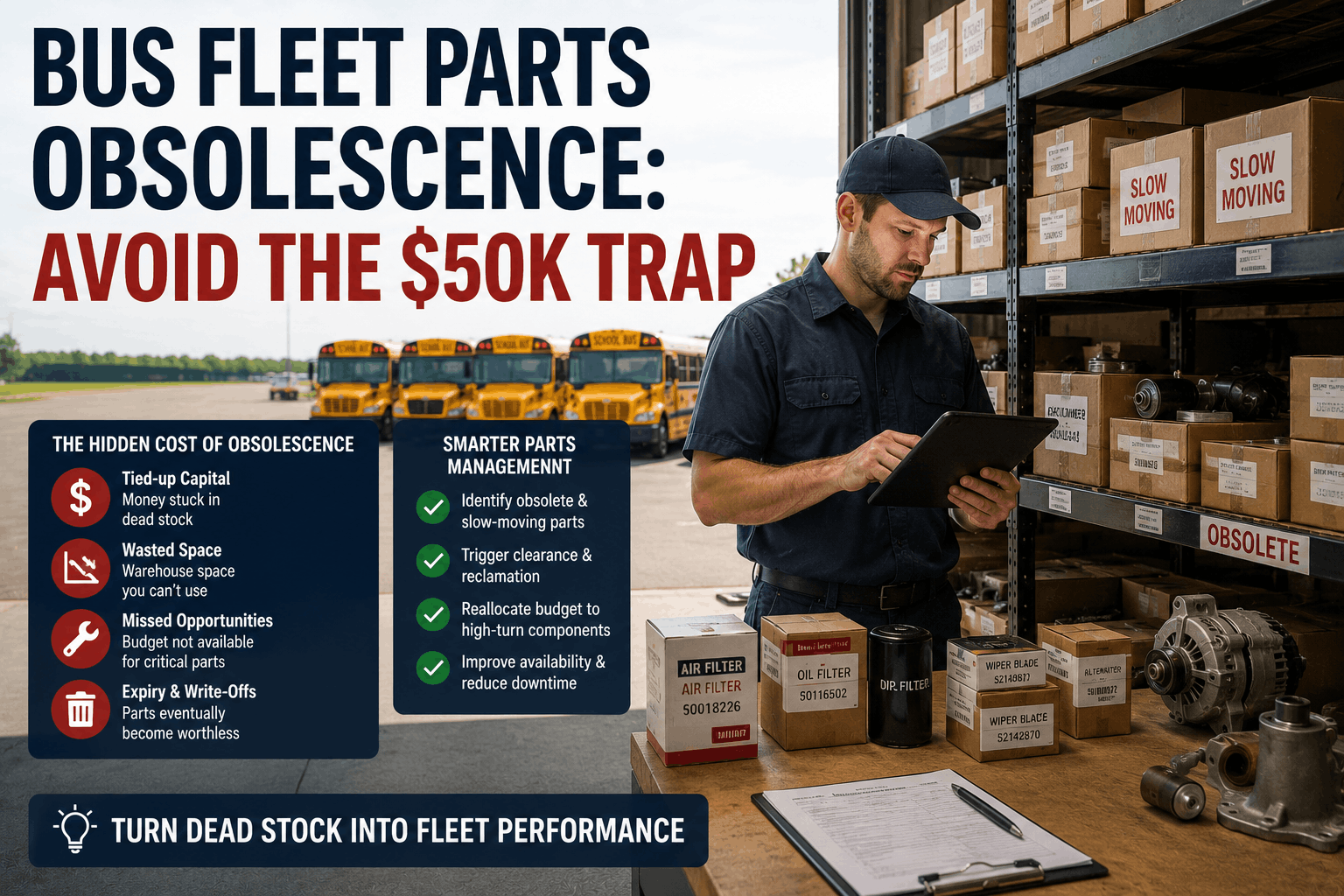
Bus Fleet Parts Obsolescence: Avoid the $50K Trap
The average 100-bus fleet carries $50K+ in obsolete or slow-moving parts. CMMS-driven obsolescence tracking identifies dead stock, triggers clearance, and reallocates budget to high-turn critical components. Complete guide to preventing parts waste and optimizing inventory spending.
1
The Hidden Cost of Obsolete Inventory: $50K per 100-Bus Fleet
A 100-bus fleet typically spends $200,000-$300,000 annually on parts and materials. Industry data suggests 20-35% of that spending is dead stock or parts that don't get used within 2 years of purchase. For a mid-size fleet, that's $40,000-$105,000 in wasted parts annually. Yet most fleets don't know this number. They don't track it. They just see parts sitting on shelves and assume it's normal.
How obsolete inventory accumulates: Scenario 1: A mechanic orders a transmission cooler for Bus 23, planning to prevent future overheating. The part arrives but is never installed because Bus 23's overheating issue was resolved by a cheaper solution (radiator flush). The transmission cooler sits in inventory for 3 years. Scenario 2: A fleet operates 15 Cummins-engine buses. They order brake drums for future maintenance. Then the fleet replaces those 15 buses with newer models that use disc brakes. The brake drums become obsolete overnight — they're no longer compatible with any bus in the fleet. Scenario 3: A parts vendor runs a clearance sale. The fleet buys 20 fuel injectors at a discount because they might be useful. 8 get used in the next year. 12 remain in inventory, slowly degrading on the shelf, eventually unusable.
Why obsolete parts become expensive liabilities:
(1) Storage cost: Maintaining a 4,000 sq ft warehouse for parts instead of 3,000 sq ft costs $3,000-$5,000 annually in rent, climate control, and security.
(2) Inventory shrinkage: Parts get lost, damaged by weather, or pilfered. An average 2-3% shrinkage rate on a $50,000 obsolete inventory = $1,000-$1,500 annual loss.
(3) Slow-moving capital: Money invested in parts sitting on shelves is money not invested in other needs (staff, equipment, preventative maintenance on active buses).
(4) Degradation: Old parts degrade. Rubber seals crack. Batteries lose charge. A part that cost $300 five years ago is now unsafe to install and becomes waste.
2
Identifying Obsolescence: The 90-Day, 1-Year, and 3-Year Thresholds
A CMMS system tracks parts inventory with dates: date ordered, date received, date last used, quantity on hand. By analyzing these dates, you can identify which parts are moving slowly or not at all.
The three categories of inventory health: (1) Fast-moving stock (used within 90 days of purchase): These are critical parts. Oil filters, air filters, coolant, brake pads, fuel filters. These should be ordered frequently and used quickly. If a fast-moving part has inventory aging beyond 90 days, it suggests overstocking. (2) Slow-moving stock (used within 1 year of purchase): These are routine maintenance parts. Belts, hoses, bearings, seals. They should have reasonable shelf life because they're needed for preventative maintenance cycles. Parts in this category that haven't been used in 12 months should be reviewed: Is the bus model still in the fleet? Is the maintenance strategy still current? (3) Dead stock (not used in 3+ years): This is obsolete inventory. It should be removed from inventory, sold, or disposed of. Keeping dead stock wastes resources and clutters inventory management.
How CMMS obsolescence tracking works: Every time a part is used (mechanic pulls it from inventory to install on a bus), the system records the date used. The system calculates "days since last use" for every part in inventory. When a part hits 365 days without use, it triggers a yellow flag: "This part has not been used in 1 year. Recommend review." When it hits 1,095 days (3 years), it triggers a red flag: "This part is obsolete. Recommend clearance." The maintenance director can review flagged parts and decide: keep it (if it's for a rare scenario), sell it (to a salvage vendor or used parts broker), or dispose of it.
3
Fleet Changes That Create Obsolescence: Retirements, Upgrades, and Consolidations
Obsolescence often isn't a gradual accident. It's a sudden event caused by fleet changes that nobody remembers to follow up on.
The retirement scenario: A fleet operates 12 Navistar buses from 2010-2015 model years. Over years, the fleet accumulates spare parts for these buses: Navistar-specific transmission filters, Navistar fuel injectors, Navistar cooling system hoses. In 2023, the fleet retires all 12 Navistar buses and replaces them with 12 newer Cummins buses. Suddenly, $8,000 in Navistar parts become obsolete. But nobody updates the parts inventory to reflect the retirement. The parts sit for 2-3 years before someone finally notices they're no longer needed. A CMMS can prevent this by linking parts to specific bus models. When a bus model is retired from the fleet, the system flags all parts designed for that model and recommends clearance.
The upgrade scenario: A fleet upgrades all 20 buses to include new telematics systems. The old telematics hardware is removed. The fleet has 20 old telematics units and 200+ spare connectors, cables, and modules for the old system. All of this becomes obsolete instantly. Without proper tracking, these parts clutter inventory for years.
The consolidation scenario: A smaller fleet is acquired by a larger fleet. The acquired fleet had different bus models, so they carried parts for those models. Now the smaller fleet's parts inventory is consolidated into the larger fleet's warehouse. Many parts don't fit any bus in the consolidated fleet. Obsolescence multiplies. A CMMS helps by immediately identifying parts that don't match any bus in the combined fleet.
Plan for obsolescence during fleet transitions — book a demo
4
Clearance Strategies: Selling, Donating, or Disposing of Dead Stock
Once you've identified obsolete parts, what do you do with them? Throwing away parts that still have resale value is wasteful. But storing them indefinitely is also wasteful.
Option 1: Sell to Used Parts Brokers Many companies specialize in buying used fleet parts. They'll purchase your entire lot of obsolete parts (often at 10-30% of original cost, but better than 0% if you donate). Common brokers work with Cummins, Allison, Duramax, and other major fleet components. Call a few brokers and ask: do you want Navistar transmission filters from 2012-2015 model buses? If yes, get a quote. The broker handles logistics and you recover some capital.
Option 2: Donate for Tax Write-Off Donate parts to vocational schools, nonprofits, or community colleges that work on transit buses. You can write off the donation at fair market value (not the original cost, but a reasonable current value). A $2,000 transmission cooler you can't use is worth $400 on the donation market, but you can write off $400 against taxable income. With a 25% tax rate, that's $100 in tax savings. It's not much, but it's better than zero.
Option 3: Scrap or Dispose For parts with no salvage value (broken, unsafe, or incompatible), dispose of properly. Many bus fleets generate hazardous waste (old batteries, fuel containers, oil). Work with a licensed hazardous waste disposal company. It costs money, but it's legally required and environmentally responsible.
Option 4: Clearance Sale at Salvage Value Host an internal clearance event: "Obsolete Parts Clearance — 50% Off." Offer parts to your own mechanics at deep discounts. They might find uses you hadn't considered. Anything that doesn't sell gets donated or scrapped.
See parts clearance and disposal best practices — book a demo
5
Prevention: How to Stop Accumulating Obsolete Parts
Prevention 1: Lean Inventory Principles Order parts only for known upcoming maintenance or repairs, not speculatively. If you know Bus 15 needs a brake overhaul in Q2, order brake components in Q1. Don't order parts "just in case" hoping they'll be useful someday.
Prevention 2: Fleet Change Notifications When a bus is retired or replaced, send a notification to the parts department: "Bus 12 (Navistar 2014) is being retired. All parts for this model should be cleared from inventory by [date]." Don't let retired bus parts sit unnoticed.
Prevention 3: Quarterly Obsolescence Reviews Every quarter, review parts inventory. How much inventory is over 1 year old? Over 3 years old? Set a goal: reduce obsolete inventory by 20% each quarter. Assign someone to track this metric and report to management.
Prevention 4: Standardized Parts Across the Fleet If possible, reduce the number of bus models. A fleet that operates 5 different bus models needs 5 different sets of spare parts. A fleet that standardizes on 2 models has 60% less complexity and 60% less risk of obsolescence from model retirement.
Prevention 5: Predictive Analysis Use historical data to forecast parts needs. If your fleet hasn't used a transmission cooler in 3 years, stop ordering them. If you use 12 air filters annually, order 12-15 (not 50). Let data, not guessing, drive purchasing.
We did an inventory audit and found $67,000 in parts that hadn't been used in over 2 years. It was shocking. We'd been ordering parts speculatively, assuming we'd use them eventually. When we implemented a CMMS with obsolescence tracking, we immediately identified slow-moving inventory. We liquidated $45,000 of dead stock over 6 months. We freed up warehouse space and recovered some capital. More importantly, we changed our ordering practices. Now we order parts based on actual maintenance schedules, not guesses. Our annual parts spending is down 12% because we're not wasting money on speculative inventory anymore. The CMMS forces discipline: every part has a purpose, every part is tracked, every part's usage is monitored.
Parts Obsolescence Questions
How much spare parts inventory should we maintain?
Industry standard: 3-6 months of projected usage for critical parts (filters, fluids, belts). 6-12 months for routine maintenance parts (pads, hoses, seals). 0-3 months for expensive components (transmissions, engines — order as needed). The balance prevents stockouts (can't do maintenance when you need the part) while avoiding excess inventory.
Should we maintain parts for buses we no longer operate?
No. The moment a bus model is retired, its parts become obsolete. Some fleets keep "just in case" a bus comes back into service, but this wastes warehouse space. Set a policy: when a bus model is retired from active service, its parts are cleared within 90 days. Exception: if you operate that model at another location, parts are transferred, not cleared.
What's the best way to value obsolete parts for tax purposes?
For tax write-offs, use fair market value (what a willing buyer would pay), not original cost. A $1,000 part that's been sitting for 5 years might have fair market value of $100-$200. Check with your tax advisor about proper valuation. Most fleets use a depreciation schedule: new parts at 100% of cost, 1-year-old parts at 60%, 3-year-old parts at 20%, 5+ year old parts at 0-10%.
How do we prevent mechanics from hoarding parts?
Implement a checkout system: mechanics request parts from inventory, not grab parts from shelves. Track what's checked out, what's installed, and what's returned unused. Mechanics who consistently check out parts they don't use should have inventory access restricted pending coaching. The discipline improves parts management and prevents waste.
Should we maintain a strategic reserve of hard-to-get parts?
Yes, but small. If a critical part (transmission, engine component) takes 4-6 weeks to source, maintain 1-2 units as backup. But this should be intentional and documented ("Strategic Reserve — Transmission XYZ, keep 1 unit minimum"). Don't mix strategic reserves with obsolete inventory. Mark them clearly so they're not forgotten.
How often should we conduct obsolescence reviews?
Quarterly at minimum, monthly is better. Set a standing meeting: first Tuesday of each quarter, review parts aging report. Identify slow-moving inventory. Make clearance decisions. Execute sales or disposal. This prevents the nightmare scenario where you discover $80,000 in dead stock all at once.
What if we order too much of a fast-moving part?
Fast-moving parts (filters, fluids) that expire or degrade should be used before shelf life ends. For consumables with expiration dates, maintain just-in-time inventory: order frequently in smaller quantities rather than bulk orders. For parts without expiration dates but with long storage life, bulk orders are fine as long as usage is predictable. The key is usage tracking: if a part has sat for 6 months and usage was 0, reduce future orders.
Eliminate $50K in Wasted Parts Inventory
Obsolescence tracking. Automatic aging alerts. Fleet change notifications. Clearance planning. Predictive ordering. The complete system that prevents dead stock accumulation and optimizes parts spending. See how mid-size fleets recover $30-50K annually by eliminating obsolete inventory.