Bus fleet reporting has become a critical compliance and strategic requirement in 2026. Whether you're managing a school bus fleet, transit agency, or charter operation, you face mandatory reporting to the Federal Transit Administration (FTA), Department of Transportation (DOT), insurance carriers, and your board of directors. Manual reporting processes consume 8-12 hours per report, introduce errors that trigger compliance violations, and delay decision-making by weeks. This guide explains how automated CMMS reporting transforms fleet operations, reduces compliance risk, and provides real-time visibility to leadership.
Compliance & Operations
Automated Bus Fleet Reporting: Generate Compliance Reports in 15 Minutes
Complete guide to automating DOT audits, FTA compliance, insurance documentation, and board presentations using modern CMMS. Reduce manual reporting time from 8 hours to 15 minutes while improving accuracy and compliance confidence.
1
Bus Fleet Reporting Requirements in 2026: What You Must Track
Federal Transit Administration (FTA) Compliance: Transit agencies operating under FTA guidelines must submit Transit Asset Management (TAM) plans and annual reports to the National Transit Database (NTD). FTA's TAM Final Rule divides agencies into tiers based on fleet size. Tier I agencies (100+ vehicles) must develop comprehensive TAM plans with nine required elements including asset condition assessment, maintenance history, and capital replacement projections. NTD reporting requires detailed data on maintenance spending, fleet age, vehicle condition, and safety performance. FTA triennial reviews examine 23 compliance areas, and maintenance documentation deficiencies are among the most common audit findings. Agencies that excel in triennial reviews share systematic preventive maintenance schedules, automated data collection, and audit-ready documentation.
Department of Transportation (DOT) Audits: DOT inspections examine vehicle maintenance records, driver qualification files, Hours of Service compliance, and safety inspections. DOT requires carriers to maintain documented inspection reports, repair records, and maintenance history for every vehicle. A single missing document can trigger violations. Manual recordkeeping creates gaps: inspection reports scattered across paper files, repair work orders in different systems, maintenance schedules existing only in a supervisor's notebook. When a DOT inspector arrives, locating specific maintenance records becomes a crisis. Automated CMMS systems generate complete audit trails showing every inspection, repair, and maintenance action with timestamps and technician documentation.
Insurance Company Documentation: Insurance carriers require proof of maintenance compliance before authorizing coverage. Many insurers request quarterly or annual maintenance reports as condition of renewal. Insurance audits often focus on brake inspections, tire maintenance, and emergency equipment checks. A fleet with documented preventive maintenance schedules, completed inspection reports, and repair work orders demonstrates insurance-worthy risk management. Fleets lacking documentation face higher premiums or coverage denial.
Board and Leadership Reporting: School district boards, transit agency boards, and fleet management executives need visibility into fleet performance, maintenance spending, compliance status, and capital planning. Board reports typically include fleet utilization rates, cost per mile, maintenance expense trends, safety metrics, and planned capital replacements. Manual reporting from disparate systems requires data consolidation, spreadsheet manipulation, and interpretation. Automated reporting delivers standardized dashboards updated in real-time, enabling leadership to monitor performance continuously.
Regulatory Compliance Risk: Agencies operating without systematic reporting face significant risks. Incomplete documentation during FTA reviews leads to corrective action requirements. Missing maintenance records during DOT audits result in violations and potential operating authority suspension. Inconsistent fleet data causes insurance disputes and coverage gaps. The cost of compliance failure extends beyond penalties to operational disruption: corrective action plans require management resources, insurance disputes delay claim payments, and operating authority restrictions halt service. Prevention through automated reporting is far more cost-effective than remediation.
2
The Manual Reporting Crisis: Why Spreadsheets Fail Fleet Managers
Time Consumption and Human Error: Typical manual reporting involves multiple spreadsheets maintained by different team members. A maintenance manager tracks repair work in one system, a compliance officer maintains inspection records in another, and a financial manager manages costs in a third system. Generating a single comprehensive report requires exporting data from all systems, manually consolidating information, verifying accuracy, and formatting for presentation. A moderate-sized fleet (50-100 buses) typically requires 8-12 hours to generate a quarterly compliance report. This time investment delays reporting deadlines and diverts maintenance supervisors from operational work. Manual consolidation introduces errors: transposed numbers, missing records, outdated data, and inconsistent definitions across team members.
Version Control and Documentation Gaps: When reports exist in spreadsheets, version control becomes problematic. A supervisor might send an email with an Excel file, another team member makes edits, and soon multiple versions exist with unclear which is current. Critical inspection records are sometimes omitted because a technician forgot to document work. Emergency repairs bypass formal work order processes because of time pressure. The result is incomplete fleet history: auditors discover missing maintenance records for critical repairs, inspection reports don't match work order dates, and cost data doesn't reconcile with actual expenses.
Audit Readiness Crisis: When FTA or DOT auditors arrive, manual reporting systems create panic. Finding documentation for a specific vehicle's maintenance history requires searching through paper files, emails, and multiple spreadsheets. Missing records become apparent during the audit rather than during preparation. Auditors observe inconsistencies between what you claim is maintained and what documentation actually exists. Result: audit findings, corrective action requirements, and regulatory scrutiny.
Leadership Blindness: Board members and executives lack real-time visibility into fleet performance. When asked about cost trends, maintenance efficiency, or compliance status, fleet managers must spend days assembling reports. Strategic decisions get delayed because data isn't readily available. Leadership cannot identify emerging issues (rising maintenance costs, increasing safety incidents, technician productivity problems) until quarterly reviews.
Compliance Confidence Loss: Manual processes create anxiety about whether you're actually compliant. Are all inspections documented? Is every repair recorded? Does maintenance history match work orders? These questions become obvious during audits when documentation cannot be found. The mental burden of not knowing whether you're compliant is significant for fleet managers.
3
Automated CMMS Reporting: The Complete Solution
Real-Time Data Collection: A modern CMMS captures data automatically as maintenance work happens. When a technician completes an inspection, they document findings directly in the system. When a repair is completed, work order closure triggers automatic documentation. When parts are used, inventory is updated in real-time. The result is a single source of truth: fleet-wide maintenance history automatically documented, timestamped, and searchable.
Automated Report Generation: CMMS systems generate reports on-demand in minutes. A compliance manager can generate a complete FTA TAM report pulling data from maintenance records, asset inventory, spending history, and safety metrics. The system formats data according to FTA requirements, calculates required metrics (vehicle availability rate, maintenance cost per mile, fleet age distribution), and produces a professional report ready for submission. Report generation time drops from 8 hours to 15 minutes. The report is current, accurate, and audit-ready.
Audit Trail and Documentation: CMMS systems maintain complete audit trails showing every action taken on every vehicle. An inspector can trace maintenance history for any bus: when inspections were performed, what was found, what repairs were completed, parts used, labor hours, and costs. This level of documentation is impossible in manual systems but essential for DOT and FTA compliance. The system proves you maintain your fleet according to regulations.
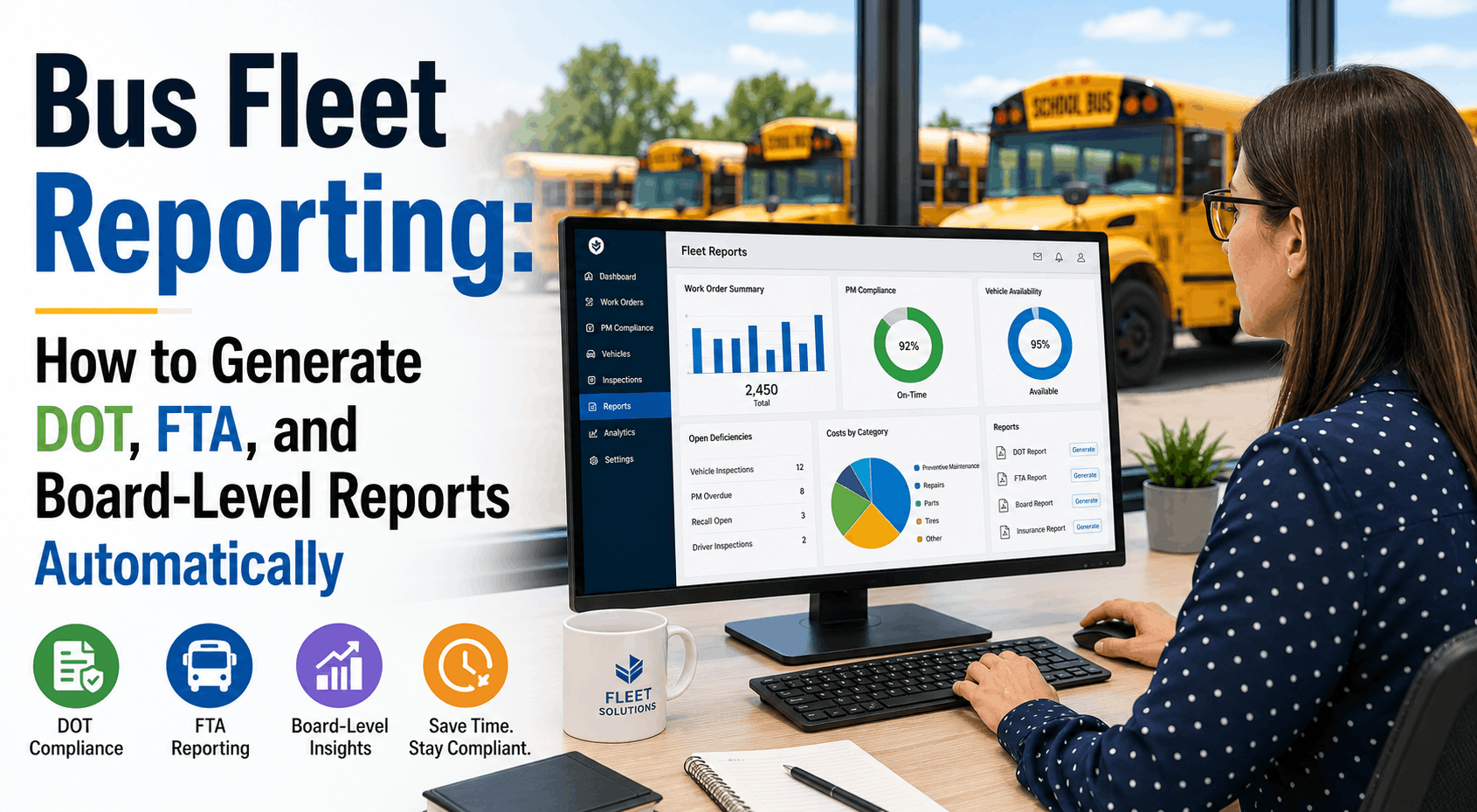
Compliance Dashboard: Leadership can monitor compliance status in real-time. A dashboard shows fleet-wide compliance metrics: percentage of vehicles with current inspections, compliance status by vehicle, trending violations, cost per mile, and capital replacement needs. Board members and executives see current status without waiting for quarterly reports. Fleet managers can identify compliance risks before they become audit findings.
Multi-Report Capability: A single CMMS generates multiple reports for different audiences: FTA compliance reports formatted according to NTD requirements, DOT audit documentation organized by vehicle and date, insurance compliance summaries showing maintenance completion, and board dashboards with strategic metrics and trends. Different stakeholders receive customized reports meeting their specific needs from the same underlying data.
4
Implementation: Transitioning From Manual to Automated Reporting
Phase 1: System Setup and Historical Data: The first step is implementing a CMMS with proper configuration for your fleet. This includes setting up vehicle inventories with unique identifiers, defining inspection templates matching your compliance requirements, establishing maintenance categories, and configuring report templates. Historical data requires consolidation: importing vehicle inventory, existing maintenance records where available, and prior inspection documentation. This phase typically requires 2-4 weeks for a 50-100 vehicle fleet depending on data availability.
Phase 2: Technician Adoption and Training: Technicians must be trained on CMMS data entry procedures. This includes documenting inspections in the system, closing work orders with completion notes, recording parts usage, and capturing labor hours. Initial adoption requires discipline and training investment. Most teams achieve consistent CMMS usage within 2-4 weeks. The key is establishing expectation that all work must be documented in the system before completion.
Phase 3: Report Verification and Refinement: Initial reports require verification for accuracy. Compare CMMS data against known maintenance history to validate system accuracy. Identify any gaps in data and supplement as needed. Refine report templates to match specific compliance requirements. For FTA agencies, ensure NTD data submissions align with CMMS reports. This phase typically requires 4-8 weeks.
Phase 4: Leadership Integration and Ongoing Use: Once reports are verified, establish regular reporting schedules. Generate monthly or quarterly compliance reports automatically. Provide board dashboards and leadership summaries. Integrate CMMS reporting into existing board meeting packages. Establish processes for addressing compliance issues identified by reports.
Manual vs. Automated Reporting: Time and Accuracy Comparison
Report Generation Time
Data Accuracy Rate
Compliance Audit Readiness
Automated Reporting Capabilities
FTA Compliance Reports: Transit Asset Management (TAM) reports, National Transit Database (NTD) submissions, asset condition assessments, maintenance spending analysis, vehicle replacement projections, triennial review documentation.
DOT Audit Documentation: Vehicle maintenance history reports, driver qualification verification, Hours of Service compliance records, safety inspection documentation, violation tracking, corrective action status.
Insurance Compliance Reports: Maintenance completion summaries, inspection compliance verification, safety performance metrics, claims documentation support, policy renewal requirements.
Board and Leadership Reports: Fleet utilization metrics, cost per mile analysis, maintenance spending trends, safety performance dashboards, capital replacement planning, operational efficiency metrics, compliance status overview.
Automated Fleet Reporting Questions
How much time does automated reporting actually save compared to manual spreadsheets?
Automated CMMS reporting reduces generation time from 8-12 hours to 15 minutes, saving approximately 40+ hours monthly per fleet manager. For a transit agency, this translates to 480+ hours annually—equivalent to a full-time FTE focused entirely on reporting.
Will automated reports satisfy FTA audit requirements or do we need additional documentation?
CMMS-generated reports with complete audit trails fully satisfy FTA requirements. The system's automatic documentation of inspections, repairs, and maintenance decisions provides the comprehensive evidence FTA expects. No additional manual documentation is typically required.
Can we integrate existing maintenance data from paper records into the CMMS?
Yes, historical data can be imported during implementation. Most CMMS systems support bulk data import for vehicle inventory, maintenance history, and prior inspection records. The import process typically requires 1-2 weeks of preparation and validation.
What happens if technicians don't properly document work in the CMMS?
Establish clear procedures requiring CMMS documentation before work order closure and equipment return. Supervisors verify documentation completeness daily. Most teams achieve 95%+ documentation compliance within 2-4 weeks through proper training and accountability processes.
How do we ensure CMMS data is accurate for compliance reporting?
Implement data validation procedures during initial setup, train technicians on accurate data entry, and conduct monthly data quality reviews. Compare CMMS reports against actual maintenance history for verification. Most systems flag incomplete or inconsistent data automatically.
Can board members and executives access CMMS reports directly or do fleet managers need to prepare them?
Modern CMMS systems provide role-based access allowing board members and executives to view pre-built dashboards directly. Reports can be scheduled for automatic email delivery weekly or monthly. Leadership gains real-time visibility without requiring fleet manager interpretation.
How much does CMMS implementation cost and what's the return on investment?
CMMS implementation costs vary but typically range $3,000-$8,000 for 50-100 vehicle fleets including setup and initial training. Return on investment occurs within 6-12 months through avoided compliance penalties, reduced insurance premiums, and labor time savings. Many agencies recover costs through audit avoidance alone.
USA Based - Are there specific CMMS reporting requirements for school bus fleets versus transit agencies?
School bus fleets focus on regulatory compliance (DOT) and insurance documentation, while transit agencies emphasize FTA compliance (TAM, NTD). Both require maintenance history and safety documentation. CMMS configuration differs slightly but underlying requirements are similar. BusCMMS provides specialized templates for both school bus and transit agency workflows.
After implementing BusCMMS automated reporting, our compliance audit time dropped from three weeks of preparation to a single afternoon of data review. We generated FTA reports that auditors described as among the most comprehensive they've reviewed. Most importantly, we now know at any moment whether we're compliant across all our buses.
Transform Your Fleet Reporting From Manual to Automated
Automated CMMS reporting eliminates the reporting burden from your team while improving accuracy and compliance confidence. Stop spending weeks preparing reports manually. Start generating audit-ready documentation in minutes. Leadership gets real-time visibility. Compliance teams work strategically rather than reactively.