Bus fleet maintenance does not happen in isolation. Every fleet manager operates within an ecosystem of external service partners: specialized repair shops, parts suppliers, emission testing vendors, tire rotation specialists, transmission builders, and collision repair facilities. Most fleets treat these relationships as transactional: get a quote, pick the lowest price, and move on. This approach routinely results in inconsistent service quality, missed deadlines that strand buses, inflated charges that exceed initial quotes, and escalating frustration that leaves you searching for new vendors every 18 months. The most operationally mature US bus fleets—the ones that maintain the highest uptime, the most predictable maintenance costs, and the highest technician retention—manage vendors and service partners using a structured vendor scorecard system, documented service level agreements, preferred vendor partnerships with volume discounts, and CMMS integration that tracks external work order status in real time. This guide covers everything you need to establish vendor relationships that actually work: how to evaluate and score vendor performance objectively, how to negotiate contracts that protect your fleet and incentivize quality, how to integrate vendor work orders into your CMMS so supervisors have complete visibility, how to measure vendor compliance with SLAs, and how to build long-term partnerships that transform unreliable external service into a dependable extension of your maintenance operation.
Bus Fleet Vendor Management Framework: Scorecards, SLAs, Preferred Partnerships, CMMS Integration. Complete System Ready to Deploy This Month.
Why Professional Bus Fleets Use Vendor Scorecards: Turning Transactional Relationships Into Strategic Partnerships
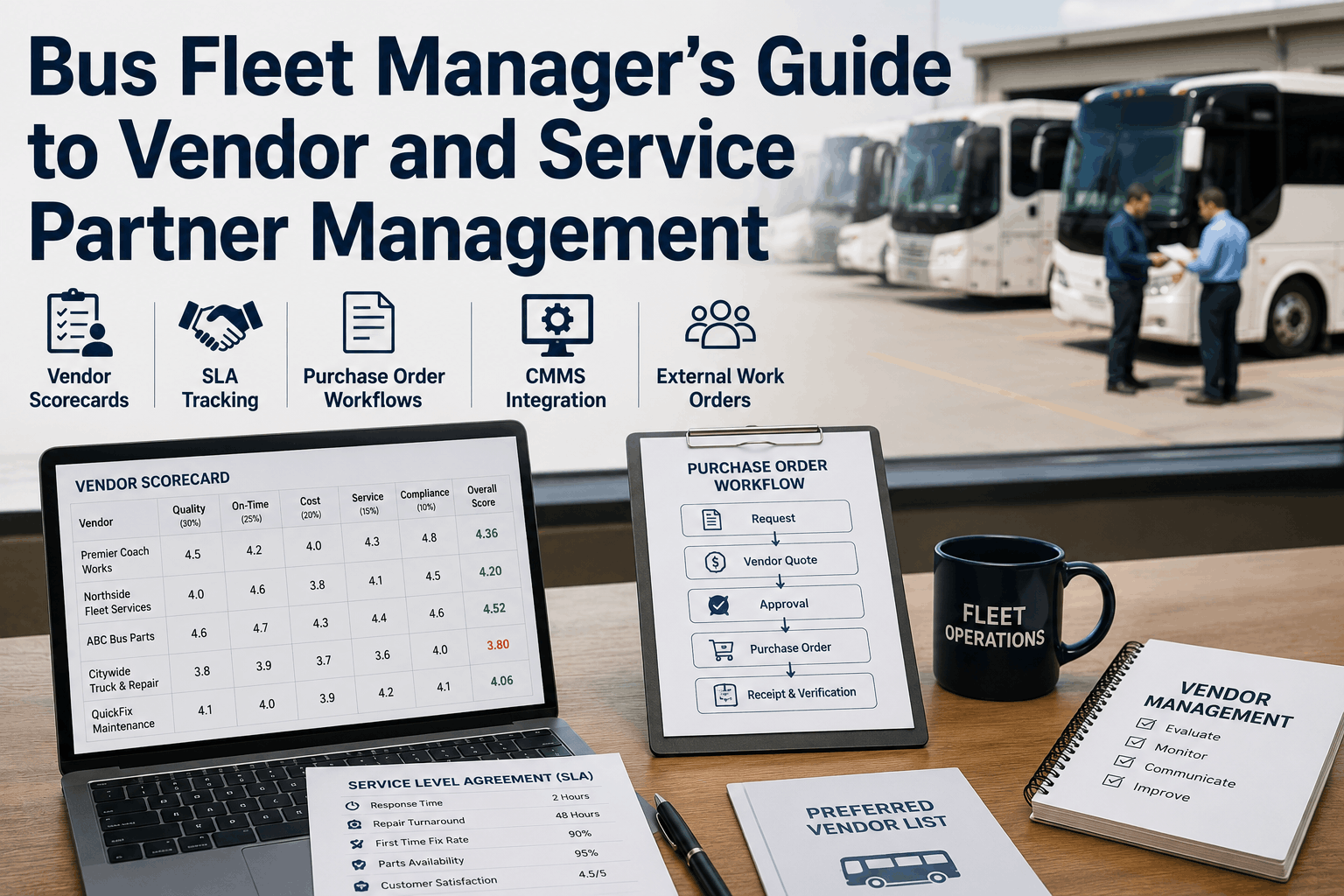
A vendor scorecard is a structured evaluation system that measures vendor performance across multiple dimensions: quality (defect rate, rework required), reliability (on-time delivery, adherence to promised timelines), cost (price competitiveness, surprise charges), communication (responsiveness to questions, proactive updates), and safety compliance. Instead of relying on anecdotal impressions or sporadic complaints, scorecard systems provide objective data that shows which vendors consistently perform at high standards and which ones create operational problems. This data drives two critical fleet management outcomes: first, it gives you evidence-based justification for consolidating business with your top-performing vendors and negotiating volume discounts, and second, it creates accountability—vendors know their performance is measured and reported, which changes behavior immediately. Fleets that use vendor scorecards report 20 to 30 percent improvement in on-time delivery rates, 15 to 22 percent reduction in rework and quality issues, and 12 to 18 percent lower external maintenance costs through competitive bidding and volume negotiations.
Percentage of work completed correctly on first attempt without requiring rework. Calculated as (jobs completed satisfactorily / total jobs completed) × 100. Target: 96 percent or higher. Rework indicates poor quality control and costs you schedule delays and additional labor.
Percentage of work orders completed by promised deadline. Calculated as (jobs completed by due date / total jobs) × 100. Target: 95 percent or higher. Late completion delays your buses and creates cascading maintenance schedule problems.
Percentage of invoices that match the original quote without surprise charges. Calculated as (invoices within quote / total invoices) × 100. Target: 98 percent or higher. Surprise charges indicate poor cost estimation and erode budget reliability.
Vendor responsiveness to status questions, proactive notifications of delays, and transparency about obstacles. Measured on a 5-point scale based on supervisor feedback. Target: 4.2 or higher out of 5.0. Poor communication leaves you guessing about your buses and creates operational uncertainty.
Adherence to applicable safety regulations, proper documentation, certification currency, and incident-free record. Measured as yes/no across documented compliance checkpoints. Target: 100 percent. Safety violations expose your fleet to liability and regulatory penalties.
The Four Categories of Bus Fleet Service Vendors and How to Manage Each Differently
Not all service vendors are equal, and the management strategy that works for a high-volume parts supplier fails for a specialized transmission rebuilder that you visit once every two years. Effective vendor management requires categorizing your vendors by frequency of engagement and criticality of service, then applying different management intensity to each category. This approach prevents you from over-managing low-risk vendors and under-managing mission-critical partners.
Parts suppliers, tire rotation shops, routine service providers that you use weekly or monthly. These vendors have the highest impact on operational costs and schedule reliability because you depend on them constantly. Management approach: Establish preferred vendor partnerships with written agreements, implement detailed scorecard tracking with monthly reviews, negotiate volume discounts in exchange for business consolidation, integrate into CMMS with automatic work order routing, and hold quarterly business reviews to address performance issues and adjust terms.
Example: Brake component supplier, primary tire rotation facility, oil and fluid distributor.
Transmission builders, engine rebuilders, specialized electrical shops, HVAC specialists that you visit 2 to 6 times per year. These vendors perform high-value, technically complex work and have significant schedule impact because extended timelines pull buses from service for weeks. Management approach: Establish multi-year relationships with defined service level agreements, create scorecards focused on quality and timeline adherence, require detailed quotes and progress updates, document technical specifications and expected timelines before authorization, and conduct comprehensive post-service audits of work quality.
Example: Transmission rebuild facility, diesel engine specialist, air conditioning overhaul service.
Annual state DOT inspections, FMCSA compliance audits, emissions testing, certifications, and regulatory-mandated services used 1 to 4 times per year. These vendors have high-impact regulatory consequences if service is inadequate (failed inspection means bus cannot operate). Management approach: Verify compliance certification and regulatory authority before engaging, establish defined service schedules aligned with regulatory deadlines, require detailed documentation of findings and recommendations, implement documented follow-up procedures for any identified defects, and maintain complete regulatory audit trails for FMCSA compliance.
Example: State vehicle inspection station, emissions testing facility, DOT safety audit service.
Roadside assistance, emergency collision repair, emergency mobile mechanic services, and specialized services used infrequently in crisis situations (fewer than 2-3 times per year). These vendors are less predictable and harder to scorecard because engagement is rare and often reactive. Management approach: Pre-identify and pre-contract with emergency vendors during non-crisis periods so you have relationships established before you need them, establish agreed-upon pricing and response time standards in advance, maintain contact information and service agreements readily accessible to supervisors, and post-incident communicate lessons learned and document actual performance for future reference.
Example: Roadside repair service, collision repair facility, emergency diesel mechanic.
Structuring Service Level Agreements That Protect Your Fleet and Create Accountability for Vendors
A service level agreement (SLA) is a written contract between your fleet and a vendor that specifies what work will be performed, when it will be completed, what quality standards must be met, and what consequences apply if the vendor fails to meet commitments. Without written SLAs, you are negotiating with the vendor every single time you submit work, pricing is unpredictable, timelines are aspirational, and quality standards are undefined. Professional bus fleet operators always use written SLAs for vendors in Categories 1 and 2 (recurring and specialized service), and increasingly for Category 3 (compliance vendors). SLAs transform vendor relationships from informal handshake agreements to professional business partnerships with clear expectations and measurable accountability.
Specify exactly what services the vendor will provide, which defect categories they will address, what parts they will use (original equipment or equivalent), and what documentation they will provide. Example: "Transmission rebuild shall include complete disassembly, inspection of all components, replacement of all wear items per manufacturer spec, reassembly, pressure testing, and delivery of itemized parts list with serial numbers and completion date."
Define turnaround time for standard work ("routine transmission rebuild 14-18 business days from receipt"), emergency work ("emergency roadside repair 2 hours from dispatch call"), and special circumstances. Include what happens if the vendor cannot meet the timeline (notification requirements, daily delay penalties, buyout provisions). Timeline commitments drive accountability and prevent work from sitting in the vendor's shop for months.
Specify what quality standards apply (zero defect expectation is standard for critical components), what warranty period covers the work (6 months to 2 years depending on component), and what happens if the work fails during the warranty period (rework at vendor cost, replacement component, refund). Written quality standards eliminate subjective disputes about whether work is "acceptable."
Lock in pricing for standard work ("routine oil change $65 per bus", "transmission rebuild $4,200-$5,200 depending on damage"). For work with unpredictable scope (damage assessment required), establish a process where the vendor provides detailed estimates before proceeding and has authority limits (cannot exceed $X without approval). Cost caps prevent surprise bills that exceed your authorized budget.
Define how the vendor will report status (daily email for jobs over X days, immediate notification for delays, weekly progress summaries). Specify communication channels (who to contact with questions, escalation procedure if issues arise). Clear communication requirements prevent information gaps and allow you to communicate status to your operations team.
Document consequences if the vendor misses commitments (delay penalties of $X per day if completion exceeds deadline, rework at vendor cost if quality is inadequate, automatic price reduction if preventive performance bonus if vendor completes early and within budget). Penalties and incentives create financial motivation for compliance.
Integrating Vendor Work Orders Into Your CMMS: Real-Time Visibility Into External Service Work and Vendor Performance
When a bus is sent to an external vendor (transmission builder, collision repair shop, specialized diagnostic facility), it disappears from your maintenance visibility until it returns. In the interim, supervisors cannot answer the question "where is bus number 47?" without calling the vendor. Maintenance schedules cascade because you do not know when the bus will return. And performance issues are discovered retroactively when the bus returns and the work is audited. CMMS integration of vendor work orders solves this problem by creating a single system of record where internal maintenance work orders and external vendor work orders are visible side-by-side, with real-time status updates, expected return dates, and integrated vendor scorecard tracking.
When a bus is dispatched to a vendor, a work order is created in the CMMS and automatically routed to that vendor. The vendor updates status (received, in progress, awaiting parts, completion scheduled) through the CMMS portal or via your supervisor's request. You always know where the bus is and when it will return without making phone calls.
Your supervisor can see that bus 47 is at the transmission shop returning in 18 days, so they can schedule the DOT inspection and oil change to occur the day after arrival, maximizing the downtime window. Without this visibility, you make schedule assumptions and create inefficiencies.
The CMMS automatically calculates whether the vendor met the promised completion date, what quality issues were found upon return (rework required), and what the final cost was versus the estimate. Scorecard metrics populate automatically from this data without manual data entry or vendor follow-up calls.
Vendors log into your CMMS portal, pull queued work orders, update status as work progresses, and upload photos or documentation directly to the work order. This eliminates email chains, reduces miscommunication, and creates a permanent audit trail of what the vendor did and when.
When a bus returns from a vendor, your technician audits the work (quality inspection, verification that promised components were installed, review of work documentation) and records findings in the CMMS. Any rework requirements are automatically logged and the vendor is notified of quality issues, creating accountability.
Your fleet management dashboard shows vendor performance metrics: on-time delivery rate, quality issues rate, average cost variance from estimate, communication responsiveness rating. These metrics roll up automatically from completed work orders and feed your vendor review and renewal decisions.
Case Study: Transit Authority Implemented Vendor Scorecard System and Recovered $140,000+ in Annual Transmission Rebuild Costs
A mid-sized transit authority in Illinois operating 187 buses with multiple external vendors for specialized work (transmissions, engines, collision repair) was spending approximately $580,000 annually on vendor services with no systematic way to evaluate whether they were getting quality work at reasonable prices. Transmission rebuilds varied wildly in cost ($3,800 to $6,200 for the same model bus) and timeline (12 to 42 days depending on the shop). Quality was inconsistent—rework was required on 8 to 12 percent of jobs returned from vendors. The authority had no documented service level agreements and no vendor scorecards, so negotiations were adversarial and vendor relationships were transactional. Implementation of a structured vendor management system included: establishing written SLAs with all Category 1 and Category 2 vendors, implementing vendor scorecards that tracked quality, on-time delivery, cost control, and communication, integrating vendor work orders into the CMMS for real-time tracking, and consolidating transmission business with the two highest-performing vendors in exchange for volume discounts. Within 90 days, transmission rebuild pricing standardized at $4,400 per unit (down from $5,100 average), on-time delivery improved from 74 percent to 96 percent, quality issues (rework) dropped from 10 percent to 2 percent, and average turnaround time decreased from 24 days to 16 days. Annual transmission rebuild savings alone totaled $140,000 to $160,000. Total three-vendor cost reductions across all categories exceeded $280,000 annually.
Bus Fleet Vendor Management: Frequently Asked Questions
Best practice is 2-3 preferred vendors per service category (parts, transmission, engine). This creates volume consolidation for discounting while maintaining backup capacity if your primary vendor cannot meet demand. Single-vendor relationships create schedule risk if that vendor goes down.
Written SLAs should specify consequences: daily delay penalties ($X per day), rework at vendor cost, or price reduction. Document the failure in the vendor scorecard. If performance becomes persistent, review the vendor partnership and escalate to contract renegotiation or vendor replacement. Enforcement matters—vendors respond to clear consequences.
Yes, always. Warranty periods vary by work type (6 months for routine service, 12-24 months for major rebuilds). Warranty clauses specify what happens if the work fails within the warranty period (rework at vendor cost, replacement component, refund). Warranties create vendor accountability and protect your fleet from defective work.
Request itemized breakdown showing labor, parts, and overhead. Compare to baseline pricing from SLA. If variance exceeds 15 percent, require pre-approval from fleet manager before proceeding. If surprise charges appear on the invoice, reject them or require vendor to renegotiate. Document variances in vendor scorecard to track pricing reliability over time.
Conduct formal vendor reviews quarterly. If a vendor drops below 85 percent overall scorecard rating (weighted across quality, timeliness, cost, communication), initiate performance improvement discussion. If performance does not recover in 60 days, assign new work to backup vendors. Annual reviews determine whether to renew agreements or pursue new vendors.
Yes, most modern CMMS platforms (including BusCMMS) provide vendor portals where external service partners log in, access work orders, update status, and upload documentation. This creates real-time visibility into external work and eliminates email-based status tracking. Vendors can see which buses are queued for their services and plan capacity accordingly.
Establish post-service audit procedures where your technician inspects the work, verifies promised components were installed, reviews work documentation, and tests the repair if possible. Document findings in the CMMS and flag any quality issues immediately. This prevents paying for poor work and creates evidence if warranty coverage applies.
Professional Bus Fleet Vendor Management System Ready to Implement. Scorecards, SLAs, Preferred Partnerships, CMMS Integration, Performance Tracking.
Consolidate vendors, negotiate better pricing, eliminate quality issues, gain real-time visibility into external service work. Start using structured vendor management immediately and save 15 to 25 percent on external maintenance costs.