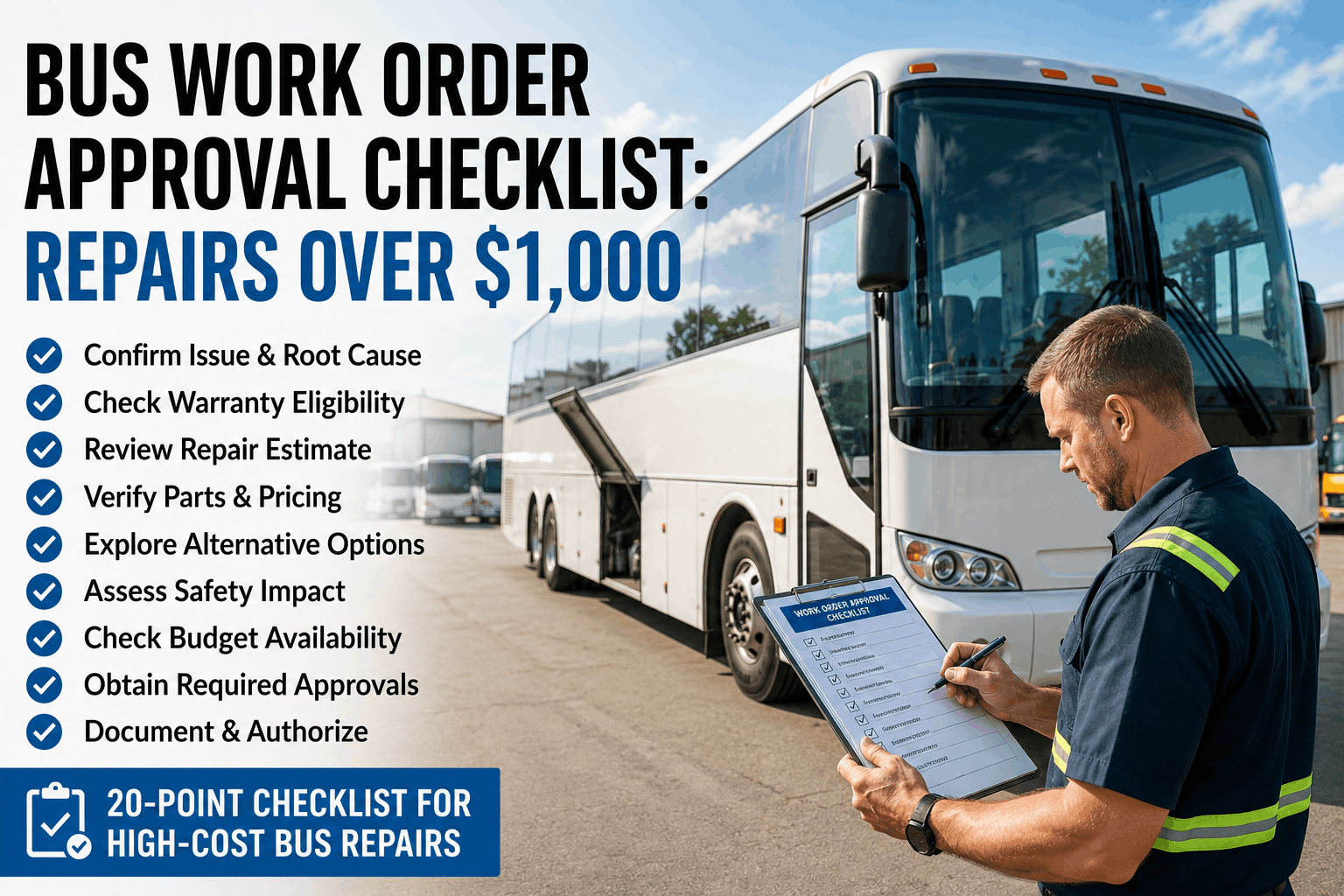
Bus Work Order Approval Checklist: Repairs Over $1,000
Every high-cost bus repair over $1,000 deserves the same 4-minute review before authorization. Not because mechanics and supervisors make bad decisions -- but because no individual making a repair decision has all the information they need: the vehicle's cumulative repair history, its current fleet book value, whether the warranty still applies, whether the root cause has been correctly identified, and whether a replacement decision would be more economical than another repair. This 20-question checklist puts every critical data point in front of the decision-maker before a work order is signed. Complete it for every repair authorization over $1,000. Use it for vendor quotes over $500. Make it part of your Tier 2 and Tier 3 approval workflow in BusCMMS. The 4 minutes it takes to complete this checklist is the difference between approving a $1,800 repair on a bus that should have been replaced six months ago and making the right call before the invoice arrives.
Bus Work Order Authorization Checklist
For repairs and work orders estimated over $1,000 -- complete before signing
20 Questions
4 min to complete
How to use this checklist: Check each item only when you have confirmed the answer is "yes" or "verified." Items marked CRITICAL should stop the approval if you cannot check them -- they indicate an authorization gap that could result in approving an uneconomical repair. Complete the Decision Summary at the bottom after reviewing all 20 items. BusCMMS automates this workflow and presents all 20 data points automatically at every Tier 2 and Tier 3 approval.
A
Vehicle History and Cost Context4 questions -- establishes whether this repair is economically rational for this specific vehicle
B
Warranty, Recall, and Prior Coverage4 questions -- confirms no coverage exists that would make this a $0 repair
BusCMMS automatically surfaces all warranty, recall, and prior repair data at the point of approval.Before any Tier 2 or Tier 3 work order is signed, the approver sees the vehicle's complete service history, open recall status, and warranty coverage -- without searching filing cabinets or calling the dealer.
Root Cause and Diagnosis4 questions -- confirms the proposed repair addresses the actual failure, not just the visible symptom
D
Parts, Pricing, and Vendor Scope4 questions -- ensures pricing is competitive and scope is fully defined before commitment
E
Budget Impact and Post-Repair Plan4 questions -- confirms financial authorization and documents what happens after repair
Authorization Decision Matrix
Count your checked items above and apply the appropriate action below
18-20 ✓
Approve
All critical items confirmed. Proceed with authorization. Ensure BusCMMS work order includes PO number for any vendor work and post-repair inspection requirement before vehicle returns to service.
13-17 △
Review Before Approving
Unchecked items represent information gaps. Identify which items are unchecked and resolve before signing. Do not approve if any CRITICAL item remains unchecked. Request additional information from the mechanic or vendor on unchecked items before authorization.
8-12 △
Return for Investigation
Significant information gaps. Return the work order to the initiating mechanic for additional diagnosis, vendor quotes, or vehicle history review. A work order with fewer than 13 of 20 items confirmed is not ready for authorization at any spend level.
Under 8 ✗
Do Not Approve
Insufficient information to make a responsible authorization decision. Do not approve this work order. Return with a specific list of what information must be provided before resubmission. A work order without basic vehicle history, warranty check, and root cause analysis is not authorizable regardless of amount.
Run This Checklist Automatically in BusCMMS
BusCMMS presents all 20 data points automatically at every Tier 2 and Tier 3 approval. Vehicle repair history, warranty status, cumulative cost vs book value, and parts pricing comparison are surfaced before the approver sees the work order -- no manual checklist required. Configure your approval thresholds once. BusCMMS handles the rest.
Vehicle YTD cost shown at every approval point
Repair-vs-replace flag when cumulative cost exceeds threshold
Warranty and recall check integrated at authorization
Vendor PO controls prevent unauthorized invoice processing
Post-repair inspection requirements enforced before dispatch
Unchecked items requiring resolution before approval:
Authorization conditions or limitations:
Approver signature & date:
Frequently Asked Questions: Bus Work Order Approval
What dollar threshold should require a formal approval checklist for bus repairs?
Most bus fleet operations set the formal review threshold at $1,000 -- below this, routine parts and maintenance proceed under mechanic authority. Above $1,000, the repair is significant enough to warrant confirming vehicle cost history, warranty status, and root cause before committing budget. BusCMMS supports configurable thresholds at four tiers, with the checklist data points surfaced automatically at each approval level rather than requiring manual document review.
Why is the NHTSA recall check a critical step before approving any high-cost repair?
A recall for the failing component means the manufacturer is responsible for the repair cost, not your fleet budget. Bus fleets occasionally spend $2,000-$5,000 on repairs covered by an open NHTSA recall simply because nobody checked the database before authorizing the work. Recalls are searchable by VIN at nhtsa.gov in under 60 seconds and can be integrated directly into BusCMMS's vehicle profile to surface open recalls at every work order creation point.
What is the 40% of book value threshold for repair-vs-replace decisions?
When a vehicle's cumulative annual repair cost exceeds 40% of its current fleet book value, each additional repair is economically questionable: you are spending money to preserve an asset worth less than the maintenance it requires. The 40% threshold is a starting point used by fleet operations managers to trigger a formal repair-vs-replace analysis. BusCMMS tracks this ratio automatically and flags any vehicle that crosses the threshold so the next approval decision includes the full financial context.
What does "open-ended scope" mean in a vendor quote, and why is it dangerous?
An open-ended scope typically appears as language like "additional parts may be required upon disassembly" or "final price subject to diagnostic findings." This language shifts financial risk entirely to the fleet -- a $1,200 quoted repair can become a $3,800 invoice if the vendor finds additional items once they have the vehicle disassembled. For any vendor quote with open-ended language, require a specific secondary authorization limit in writing before authorizing the initial scope.
How does BusCMMS enforce post-repair acceptance criteria before a bus returns to service?
BusCMMS work orders include a "Return to Service" certification step that the mechanic must complete and sign before the vehicle is available for dispatch. The certification can include configurable required fields -- post-repair road test, pressure test result, temperature reading, or any other verification criteria defined at work order creation. Until the return-to-service certification is complete, BusCMMS maintains a dispatch hold on the vehicle that prevents route assignment in the scheduling module.
What is the difference between a symptom and a root cause in bus repair diagnosis?
A symptom is what failed (overheated, wouldn't start, pulling left). A root cause is why it failed (thermostat stuck closed, battery discharged due to 73% capacity battery on a cold morning, left front caliper seized due to seized slide pin from lack of lubrication at last brake service). Approving a repair based only on symptom description almost always results in a repeat failure because the causal mechanism is left in place. BusCMMS work order templates include required root cause fields that must be completed before a Tier 2 or higher work order routes to approval.
Should labor warranty on prior repairs be checked before authorizing a repeat repair?
Yes. Most shops and vendors offer a 90-day to 12-month labor warranty on completed repairs. If the same component fails again within the warranty window, the original repairing shop is typically responsible for the labor cost of the repair. Checking prior repair records before authorizing any same-system failure is a standard authorization step -- failing to do so means paying twice for work that should have been covered. BusCMMS records prior repair history per component, making this check available in seconds at the point of work order creation.
How do you handle urgent repairs that need same-day authorization without completing the full checklist?
BusCMMS's Safety-Critical fast-track allows a 15-minute SMS approval for genuine emergency repairs -- brake failures, steering faults, cooling system critical failures -- where waiting for a full checklist review creates safety risk. Even in fast-track mode, the vehicle cost history and warranty status are shown in the SMS approval summary so the approver has the most critical context. Fast-track approvals are logged with the abbreviated review noted, and the full checklist should be completed retroactively within 24 hours for audit trail purposes.