A bus mechanic who spends two hours diagnosing and repairing a failed air compressor on a 40-foot transit coach has done excellent technical work. If the work order he closes out says "fixed air system" with no parts listed, no labor hours logged, no technician signature, and no notation about warranty eligibility — that work order has just created audit exposure, destroyed warranty recovery opportunity, and made it impossible for the next technician who sees that bus to understand what was done, when it was done, and what parts were used. Across a fleet of 20, 50, or 200 buses, this documentation failure multiplies into tens of thousands of dollars in lost warranty reimbursements, failed FTA triennial reviews, FMCSA recordkeeping fines of up to $1,544 per day, and maintenance decisions made on incomplete data. The work order is not bureaucracy. It is the primary evidence document that proves your fleet is maintained, safe, and compliant. This guide delivers the complete bus fleet work order documentation checklist that U.S. transit agencies, charter operators, and school district transportation departments need to build audit-ready maintenance records every time a repair is performed.
Fleet Maintenance Documentation
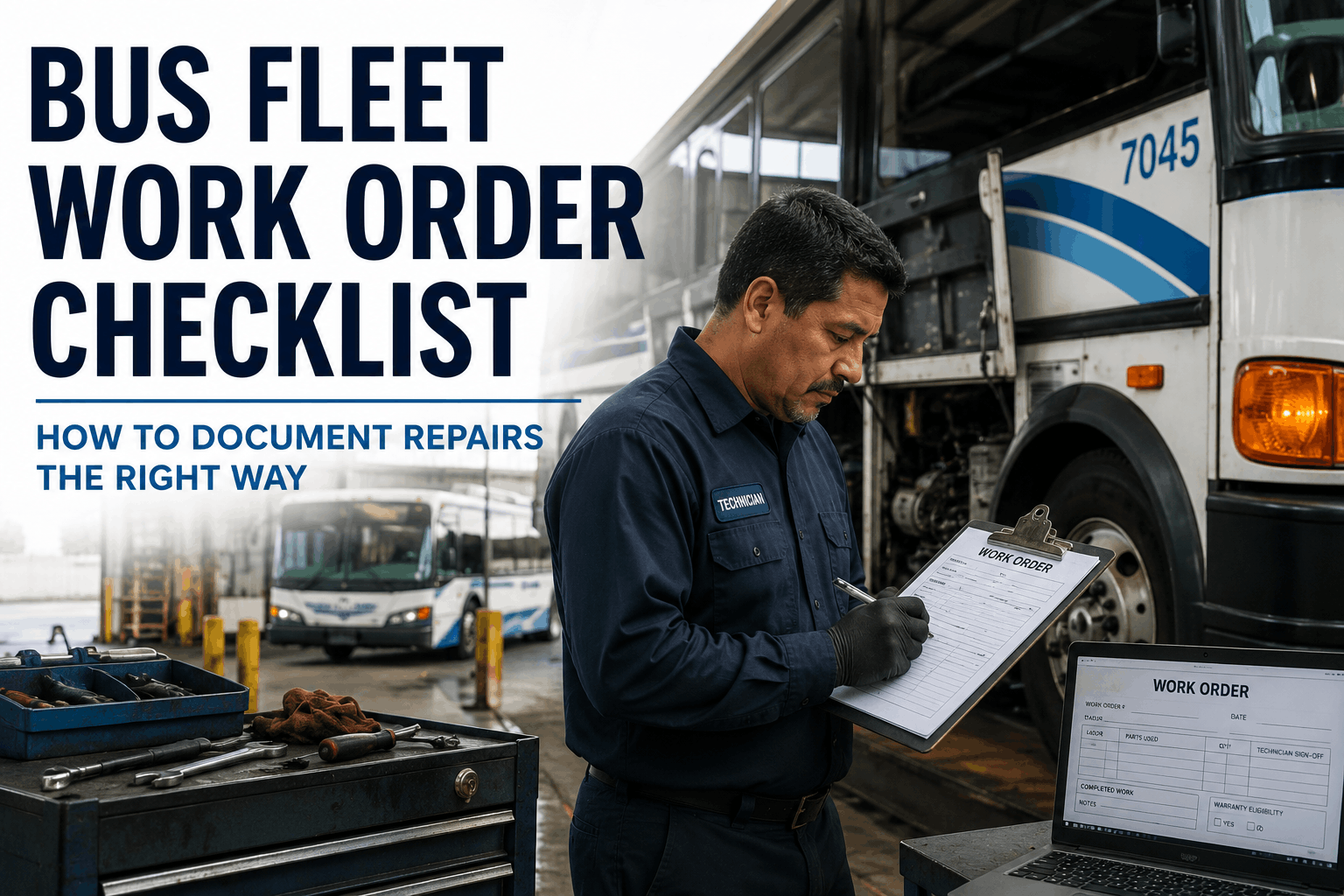
Bus Fleet Work Order Checklist: How to Document Repairs the Right Way
The definitive work order documentation standard for U.S. bus fleet maintenance teams. Covers work order creation, diagnosis, parts documentation, labor hours, warranty eligibility, technician sign-off, and post-repair quality verification. Reduce audit failures, recover warranty costs, and build compliant maintenance records at every repair.
Overall Checklist Progress
0% Complete
80%
Reduction in audit failures with complete documentation
$1,544
FMCSA fine per day for recordkeeping violations
14 mo.
Minimum federal record retention period (49 CFR 396.21)
$85K
Average annual loss per fleet from poor documentation
Work Order Completion Quality: What Gets Documented vs. What Gets Missed
Percentage of work orders containing each required field — Paper vs. Digital CMMS Fleets
Paper / Manual Process
Vehicle ID
82%
Parts Used
51%
Labor Hours
47%
Warranty Check
28%
Tech Sign-Off
59%
Root Cause
34%
BusCMMS Digital Platform
Vehicle ID
100%
Parts Used
97%
Labor Hours
99%
Warranty Check
94%
Tech Sign-Off
100%
Root Cause
91%
1
Work Order Creation: Getting the Header Right Before Any Wrench Turns
Every work order in a bus fleet maintenance operation must be created before work begins, not after. This sequencing discipline — create the work order first, then perform the work — is the foundation of defensible maintenance documentation. When an FTA triennial reviewer or FMCSA safety auditor reviews your maintenance records and finds work orders with creation timestamps after the repair was completed, they have reasonable grounds to question whether the records accurately reflect what was actually done. Work orders created retroactively are legally weaker than contemporaneous records and are treated with skepticism during audits.
The work order header must capture the who, what, when, and where of the repair with enough specificity that a different technician — or a compliance reviewer with no fleet background — can understand the context of the repair without asking follow-up questions. Bus number, current odometer or mileage, date and time of work order creation, the name of the person who requested the work, the priority level, and the location where work will be performed are all required fields. Fleets using BusCMMS digital work orders auto-populate vehicle ID, current mileage, and warranty status from the asset record — eliminating the manual data entry errors that compromise paper work order accuracy.
Work order numbering must be sequential and unique across your fleet's entire maintenance operation. Work Order WO-2025-00847 is an unambiguous reference that can be cited in FTA reports, warranty claims, insurance documentation, and legal proceedings. "The repair from last March" is not. If your fleet does not currently use sequential, unique work order numbering, implementing this standard through a CMMS platform is the single highest-value documentation improvement available to you.
Work Order Header Requirements
2
Problem Description and Diagnosis: The Technical Foundation of Every Work Order
The complaint description section of a work order is where most maintenance documentation fails. "Driver complained about brakes" is a complaint description. It tells the technician almost nothing about what the driver actually experienced — whether the brake pedal felt spongy, whether the coach pulled left during braking, whether an air brake warning light activated, or whether the driver heard a grinding noise. A work order that begins with an inadequate complaint description sets the technician up for inefficient diagnosis and the documentation up for audit failure.
A properly documented complaint description answers four questions: what system was affected, what specific symptom was observed or reported, under what operating conditions the symptom occurred, and how long the symptom has been present. "Driver reported brake pedal travel exceeding halfway to floor during service brake application at highway speeds, observed over the past three operating days, no warning lights activated" is a complaint description that a different technician can act on without calling the driver. This level of specificity also supports warranty claims — manufacturers require detailed symptom documentation to evaluate whether a failure is covered under the powertrain or component warranty. BusCMMS guided intake forms prompt technicians with structured fields that capture all required complaint information automatically.
The diagnosis section must document the root cause determination — not just the symptom and repair. "Replaced brake shoes" documents the repair. "Inspection revealed brake lining worn below minimum thickness on right rear axle, left position — 3/32 inch measured, minimum 4/32 inch required. Root cause: standard wear at 142,000 miles, consistent with expected lining service life for this route profile. No defect identified" documents the repair and establishes why it was needed and whether it indicates a broader issue. This diagnostic documentation is the foundation of your fleet's predictive maintenance capability.
Complaint and Diagnosis Documentation
3
Parts and Materials Documentation: Inventory Accuracy and Warranty Protection
Parts documentation is the most financially consequential section of a work order for U.S. bus fleet operators. Every part used in a repair has three separate financial implications: it depletes your parts inventory (which must be tracked for reorder purposes), it represents a direct cost that must be captured for true cost-per-mile analysis, and it may be warranty-eligible (representing a reimbursement opportunity that is permanently lost if not captured at the time of repair). Fleets that do not document parts at the work order level lose an average of 12% to 18% of potential warranty reimbursements because warranty claims cannot be substantiated without documented parts evidence.
The parts documentation standard requires four data points for every component used: part number (OEM or aftermarket), description, quantity, and cost. Using an OEM part number creates an unambiguous record that satisfies manufacturer warranty documentation requirements. Using a description like "brake shoe" without a part number creates ambiguity that manufacturers use to deny warranty claims on the grounds that a non-approved component may have been used. If your mechanics are pulling parts from inventory without part numbers on the work order, you are losing warranty money on every qualifying repair. BusCMMS integrates parts inventory with work orders — technicians select from the parts catalog, automatically decrement inventory, and create the warranty-ready documentation trail simultaneously.
Fluids, lubricants, and consumables must also be documented with specification, quantity, and brand. When a manufacturer's warranty requires the use of OEM-specified fluids — Allison TES 389 transmission fluid, for example — documentation that the correct fluid was used is required to support warranty claims on transmission failures. "Changed transmission fluid" without documenting the fluid type and specification is insufficient for warranty purposes and may result in claim denial.
Parts and Materials Required Documentation
4
Labor Hours and Technician Documentation: Compliance and Cost Accuracy
Labor documentation serves two equally important purposes in bus fleet work order management. For compliance purposes, technician identification on a work order creates legal accountability — the named technician certifies that the work described was performed to the documented standard. FMCSA and FTA reviewers specifically look for technician signatures on maintenance records because unsigned records cannot be attributed to a qualified individual. An FTA triennial reviewer who finds maintenance records without technician identification has grounds to question whether the work was performed at all, or whether it was performed by a qualified mechanic. This documentation gap has caused transit agencies to receive adverse FTA triennial findings even when the maintenance work was actually completed correctly.
For cost management purposes, labor hour documentation enables the true cost-per-mile and cost-per-repair analysis that bus fleet directors need to make informed decisions about bus replacement, route assignment, and maintenance program investment. A fleet that knows that Bus 47 has accumulated $14,200 in engine-related labor costs over 36 months can make an informed decision about whether to authorize a $6,000 engine rebuild or accelerate replacement. A fleet that only knows "Bus 47 has had some engine work" cannot make that calculation. BusCMMS cost analytics build this repair history automatically from work order labor records — giving fleet directors the data to justify maintenance budgets and replacement cycles to boards of directors, city councils, and grant auditors.
Labor Documentation Requirements
5
Warranty Eligibility Review: Recovering Costs Most Fleets Leave on the Table
Warranty recovery is one of the highest-value, most consistently underperformed functions in American bus fleet maintenance operations. Industry data suggests that the average 20-bus fleet leaves $8,000 to $22,000 per year in unclaimed warranty reimbursements on the table — not because components failed outside the warranty period, but because the work order process did not include a warranty eligibility check before the repair was approved and performed. Once a repair is completed with non-OEM parts or without warranty claim documentation, the reimbursement opportunity is permanently lost.
The warranty eligibility check must occur at work order creation, not after the repair is complete. The sequence is: identify the failing component, check the asset record for active warranty coverage on that component, determine whether the failure mode qualifies under warranty terms, and — if eligible — contact the warrantor for claim authorization before ordering parts or beginning labor. Performing warranty work without prior authorization is the most common reason warranty claims are denied. Manufacturers require that warranty work be performed by an authorized facility or pre-approved by their warranty department. A mechanic who replaces a warrantied transmission at his shop without prior authorization from the manufacturer will find that claim denied, and the fleet absorbs the full cost. BusCMMS warranty tracking flags warranty coverage automatically when a work order is created for a component under active warranty, eliminating the manual check that most paper-based fleets skip.
Warranty Eligibility Verification
6
Work Performed Documentation and Repair Narrative
The work performed section is the technical heart of the work order — the section that an auditor, a future technician, or a warranty adjuster will rely on to understand what was done to the bus. This section must describe work in enough detail that a qualified mechanic who was not present during the repair can understand exactly what was replaced, adjusted, or serviced without examining the bus. Vague entries like "fixed brakes" or "adjusted steering" are documentation failures that create audit exposure and make future maintenance planning impossible.
For every major repair, the work performed narrative should include: the system and specific component worked on, the specific procedure performed (replaced, rebuilt, adjusted, cleaned, lubricated), the specification or standard the work was performed to, and the post-repair measurement or verification that confirms the work was done correctly. "Replaced right rear brake shoes, both positions. New lining measured at 14/32 inch. Slack adjuster stroke measured at 1.5 inches, within FMCSA limit. Road test performed, no brake pull or unusual noise" is a complete repair narrative. It documents what was done, to what standard, and how it was verified. BusCMMS repair templates provide pre-built narrative structures for the most common bus repair types — technicians complete structured fields rather than writing free text, ensuring documentation completeness on every work order.
Work Performed Narrative Requirements
7
Technician Sign-Off and Quality Verification: The Compliance Signature
The technician sign-off is the legal certification that the work described in the work order was actually performed by the identified individual to the specified standard. Under FMCSA regulations and FTA oversight requirements, maintenance records must be attributable to qualified personnel. An unsigned work order cannot be attributed. FMCSA safety auditors who find unsigned maintenance records during a compliance review treat those records as incomplete — they cannot verify that a qualified mechanic performed the work, which creates grounds for citing the fleet for inadequate maintenance documentation under 49 CFR 396.3.
Quality verification — a second review of the completed work by a supervisor or lead technician before the bus is returned to service — is best practice for any repair involving safety-critical systems: brakes, steering, tires, emergency exits, and fuel systems. This verification step catches errors before the bus carries passengers, not after. It also creates a second documented reviewer on the work order, which strengthens compliance documentation significantly. Fleets that implement mandatory quality verification on safety-critical repairs consistently achieve higher DOT pass rates because the verification catches defects that the original technician may have overlooked. Configure BusCMMS approval workflows to require supervisor sign-off before safety-critical work orders can be closed.
Technician Sign-Off Requirements
"We manage 67 buses across three depots in the Chicago metro area. Our previous work order process was a mix of paper forms and a basic spreadsheet — technicians would fill out what they felt like filling out, and warranty checks never happened systematically. In our last FTA triennial review before BusCMMS, we had 14 documentation findings. After implementing BusCMMS work order workflows with required fields, automated warranty flagging, and digital technician sign-off — our follow-up review had zero documentation findings. The warranty recovery alone covered the platform cost in the first six months."
Work Order Documentation Impact: KPI Comparison
Fleet performance metrics before and after structured work order implementation
Warranty Recovery Rate
Audit Pass Rate
Work Order Completeness
Before BusCMMS After BusCMMS
Bus Fleet Work Order Documentation: Questions & Answers
What fields are required on a work order for FMCSA compliance?
FMCSA 49 CFR 396.3 requires that maintenance records include the date of inspection or repair, vehicle identification, nature of the deficiency discovered, and work performed to correct the deficiency. Technician identification is required to attribute the record to a qualified individual.
How long do we need to keep completed work orders?
FMCSA 49 CFR 396.21 requires inspection and maintenance records to be retained for a minimum of 14 months. FTA grantees should retain records through the useful life of the asset plus any applicable audit period, which may extend to seven or more years.
Can a work order that lacks a technician signature still pass an FMCSA audit?
No. An unsigned maintenance record cannot be attributed to a qualified mechanic, which FMCSA auditors treat as incomplete documentation. Unsigned records create findings during compliance reviews and can result in recordkeeping violation citations with fines up to $1,544 per day.
What is the most common warranty documentation mistake U.S. bus fleets make?
The most common mistake is performing warranty-eligible repairs without obtaining prior authorization from the manufacturer or warranty administrator. Once repairs are completed without authorization, most manufacturers deny reimbursement regardless of whether the failure was a covered defect.
Does BusCMMS generate work orders automatically for scheduled PM?
Yes. BusCMMS automatically generates PM work orders based on mileage triggers, calendar intervals, or both, and routes them to the assigned technician with pre-populated vehicle data, maintenance scope, and parts recommendations based on the bus's OEM service schedule.
How should we document repairs performed by outside vendors?
Outside vendor repairs must be documented with the vendor's invoice attached to the work order, the technician name and certification from the vendor's shop, all parts and labor costs captured in your CMMS, and a warranty eligibility review completed before authorizing the vendor to proceed.
Can poor work order documentation affect our FMCSA safety rating?
Yes. Inadequate maintenance records are a scored category in FMCSA safety audits. A pattern of incomplete documentation can result in a Conditional or Unsatisfactory safety rating, increased audit frequency, and elevated insurance premiums that follow the carrier for 24 to 36 months on the SMS record.
How many work orders does the average 20-bus fleet process annually?
A 20-bus fleet running typical U.S. transit or charter service generates between 400 and 800 work orders per year, including scheduled PM, corrective repairs, inspections, and warranty claims. At this volume, a digital CMMS pays for itself in labor time savings on documentation alone within the first three months.
Transform Your Work Order Process with BusCMMS
BusCMMS is purpose-built for U.S. bus fleet maintenance operations. Digital work orders with required fields, automated warranty flagging, technician digital sign-off, parts inventory integration, and FTA and FMCSA-ready audit reports — all in one platform designed for transit agencies, charter operators, and school district transportation departments. Stop losing warranty money. Stop failing audits. Start documenting repairs the right way.