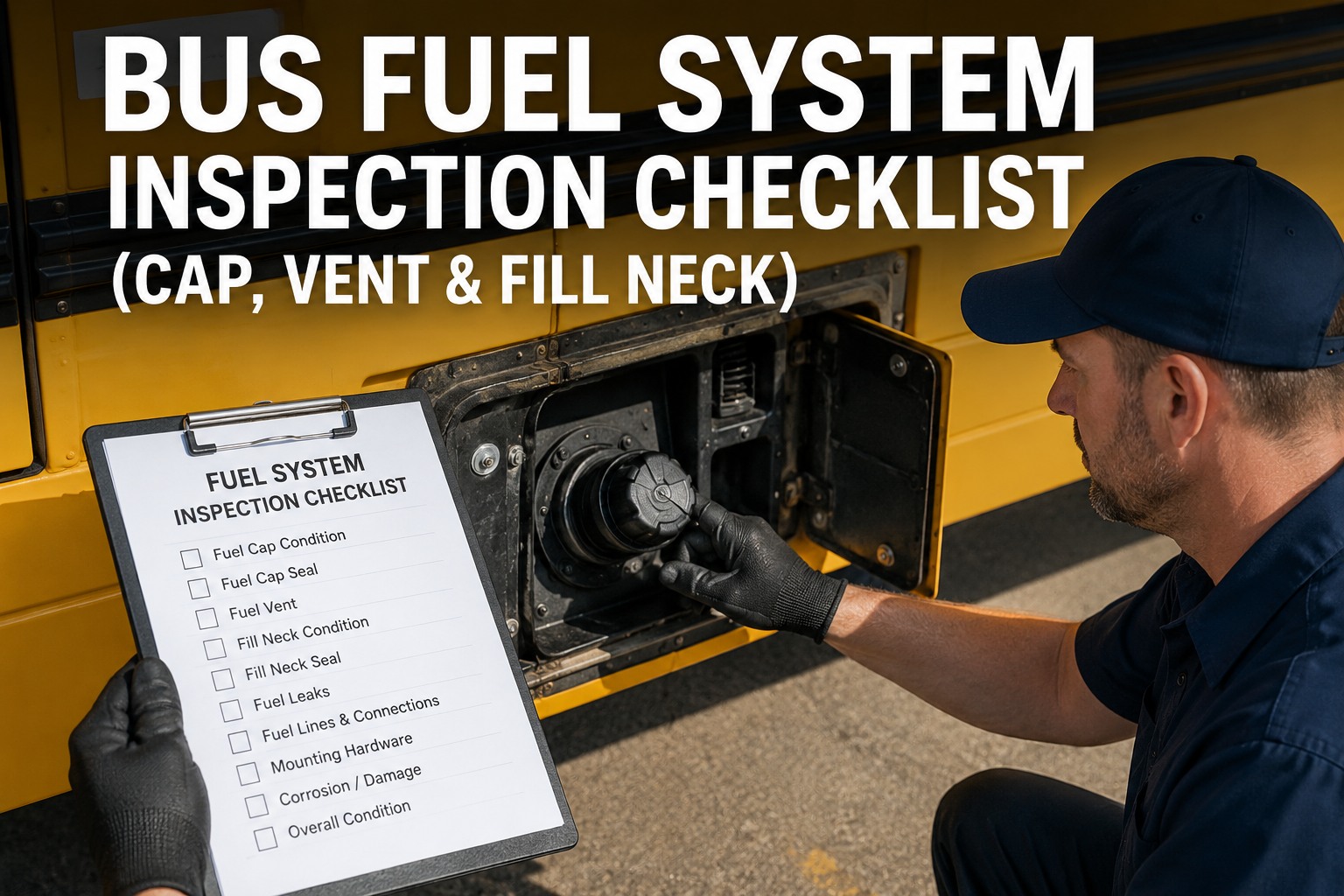
A single failed fuel cap sent a bus fleet through a $12,000 EPA remediation. The cap had a hairline crack in the pressure-relief valve. Evaporative emissions at the state annual inspection read three times the allowed limit. The fleet manager did not know a cap could cause that -- because everyone assumes a cap either seals or it does not. Between "seals" and "does not seal" is a wide gray zone where evap emissions leak silently, fuel disappears overnight, and check-engine lights refuse to clear. This is the reference for inspecting the cap, vent, fill neck, seals, and fuel lines that quietly determine whether your fleet passes emissions inspection.
Bus Fuel Cap, Vent & Fill Neck Inspection Checklist
The 2026 reference for the fuel system's containment components -- the cap, gasket, filler neck, anti-siphon device, vent line, rollover valve, and cap-to-neck seal that determine whether fuel stays in the tank and whether your bus passes state emissions inspection.
- 7Components inspected
- 4Test methods covered
- 8Diagnostic symptoms mapped
The 4 Fuel Cap Types on Modern Buses
Every cap type fails differently. Know which type your fleet runs before designing the inspection cadence.
How it works: Small vent hole in cap allows air in as fuel level drops. Prevents vacuum.
Common failures: Vent hole clogs with dirt, gasket ages hard, plastic yellows and cracks.
Where: Older diesel and gasoline buses without EVAP compliance.
How it works: Fully sealed. Pressure/vacuum relief valve inside. Venting through EVAP canister.
Common failures: Relief valve stuck, gasket hardens, cap-to-neck seal fails EPA smoke test.
Where: Modern buses with EVAP emissions systems.
How it works: Key or code lock over standard cap. Same seal function underneath.
Common failures: Lock mechanism seizes, key wear, cover breaks and standard cap underneath still works.
Where: Transit fleets, high-theft depots, hub-and-spoke charter operations.
How it works: Spring-loaded internal flap. No removable cap. Fuel nozzle pushes flap open.
Common failures: Flap spring fatigues, dirt jams flap open, seal degrades with age.
Where: Newest coaches and school buses (2018+).
The 6 Internal Components in the Filler Assembly
Vertical cross-section showing what sits between the fill nozzle and the tank. Every failure on this page traces to one of these six.
- 1Cap Body + Pressure Relief Valve · primary containment; venting for over-pressure
- 2Cap Threads · sealing engagement with neck
- 3Gasket Seal Ring · primary seal surface between cap and neck
- 4Filler Neck Housing · tube from filler door to tank
- 5Anti-Siphon / Overfill Limiter · screen or ball valve to prevent siphon and overfill
- 6Vent Line + Rollover Valve · vapor path to EVAP canister; rollover safety
Fuel In. Vapor Out. Two Pathways, Two Failure Modes.
The assembly handles two completely different flows. Each has its own failure mode. Diagnosing the wrong flow wastes an afternoon.
Cap Opens → Neck → Tank
- 1. Nozzle opens filler door + inserts
- 2. Fuel flows down filler neck
- 3. Anti-siphon device allows one-way flow
- 4. Overfill limiter cuts nozzle at capacity
- 5. Fuel settles in tank
Tank → Rollover Valve → Canister
- 1. Fuel evaporates in tank headspace
- 2. Vapor rises to rollover valve
- 3. Rollover valve allows vapor, blocks liquid
- 4. Vent line routes vapor to EVAP canister
- 5. Canister absorbs vapor; releases during purge
Book a demo to see EVAP-code triggered work orders auto-generated in BusCMMS.
4 Tests. Each Finds a Different Failure.
Which test to reach for depends on the symptom. Do not smoke-test a bus that just needs a $12 cap.
| Test | What It Finds | Equipment | Time |
|---|---|---|---|
| Visual Inspection | Cracks, hardened gaskets, external corrosion, dirt in vent | Eyes + bright light | 2-5 min |
| Cap Pressure Test | Cap seal integrity · gasket + relief valve function | Cap tester tool | 5-10 min |
| Fuel System Smoke Test | EVAP leak anywhere: cap, neck, vent, canister, hoses | Smoke machine | 15-20 min |
| OBD-II Scan | EVAP fault codes (P0440-P0455 family) with size hint | Scan tool | 5 min |
Book a demo to see test-method-to-checkpoint mapping tracked per bus.
7 Components. Wear Signs. Replacement Trigger. Verification Test.
One row per component. Everything a technician needs to decide "keep it, tag it, or replace it."
Fuel Cap
Body + gasket + relief valveSigns of Wear
- Cracked plastic shell
- Hardened rubber gasket
- Yellowed or discolored liner
- Cap will not tighten normally
Replace When
- Any visible crack
- Fails cap pressure test
- Preventatively every 5 years
Gasket Seal Ring
Rubber ring under capSigns of Wear
- Hardened or brittle rubber
- Cracked or missing sections
- Deformed from over-tightening
- Chemical staining from fuel
Replace When
- Fails press-test (fingernail impression)
- Any visible damage
- Fuel weep visible at cap
Filler Neck Housing
Tube from door to tankSigns of Wear
- External corrosion
- Weld cracks at tank interface
- Deposits blocking flow
- Physical damage from filler nozzle
Replace When
- Any perforation
- Weld crack (welder repair possible)
- Deposits reduce flow rate
Anti-Siphon Device
Screen or ball inside neckSigns of Wear
- Debris blocking screen
- Ball stuck or missing
- Screen mesh torn
- Slow fillup (fuel backs up)
Replace When
- Screen torn or missing
- Fillup rate drops noticeably
- Anti-theft function compromised
Vent Line + Fittings
Neck to canisterSigns of Wear
- Kinks or crimps
- Chafing where line crosses frame
- Hardened rubber sections
- Loose fittings at both ends
Replace When
- Any restriction to airflow
- Damage worse than surface wear
- Fittings leak per smoke test
Rollover Valve
Tank-top safety valveSigns of Wear
- Sticky operation
- Contamination inside housing
- Cracked housing
- Fuel odor at vent line
Replace When
- Any sticking
- Visible contamination or crack
- Fuel weeping past valve
Filler Door + Retention
External access panelSigns of Wear
- Rusted or seized hinge
- Missing or broken retainer
- Door does not close flush
- Weather seal degraded
Replace When
- Hinge fails to hold door
- Weather seal missing
- Retention hardware broken
Customer Complaint → Cause → First Test
The most common driver complaints and shop findings, mapped to root cause and first diagnostic test.
| Symptom / Complaint | Most Likely Cause | First Test |
|---|---|---|
| Check engine light · P0442 (small EVAP leak) | Cap seal degraded or vent line small leak | Cap pressure test + smoke test |
| Check engine light · P0455 (large EVAP leak) | Cap missing, loose, or major seal failure | Verify cap installed · replace · smoke test |
| Fuel smell after fillup | Cap not fully seated or seal deteriorated | Cap pressure test |
| Cap will not tighten normally | Damaged threads on neck or cap | Visual inspection of both |
| Bus loses fuel overnight (parked) | Cap leak or vent stuck open | Cap test + smoke test |
| Whistle noise from filler area | Vent line kinked; pressure venting through cap | Visual + vent line inspection |
| Cap difficult to remove (hisses) | Vent system blocked; pressure buildup | Vent air flow + smoke test |
| Slow to fill (fuel keeps backing up) | Anti-siphon device blocked or filler neck restricted | Visual + borescope inspection |
Book a demo to see driver-complaint-to-diagnosis workflow in BusCMMS.
Fleet-Wide Fuel Cap & EVAP Compliance Status
Preview of the compliance dashboard. See which buses passed emissions, which need cap replacement, which have active EVAP codes.
- Bus #08 P0442 active 4d · Cap age 6 yr · Next state test 12 Jul EVAP FAULT
- Bus #22 P0455 active 1d · Cap installed 2019 · Suspect gasket EVAP FAULT
- Bus #14 Cap installed 2020 · 5-year rotation due CAP DUE
- Bus #29 Cap installed 2020 · Preventive replacement CAP DUE
- Bus #47 Passed EPA test 03 Jul · Cap installed 2024 PASSING
The dashboard tracks cap age, EVAP codes, and state test dates per bus. Nobody has to remember which cap is due for preventive replacement. Book a demo to see EPA compliance tracked on your real fleet data.
What is the P0440-P0455 fault code family and which cap should we replace?
The P0440-P0455 fault codes are the OBD-II EVAP leak family. P0442 is a small leak (typically loose or degraded cap), P0455 is a large leak (cap missing or major seal failure), P0440 is a general EVAP fault, and P0446 is a vent control circuit fault. First step for any of them: verify the cap is installed and hand-tighten to the click, drive one cycle, and see if the code clears. If it does not clear, run a cap pressure test. If the cap passes, do a full smoke test to find the leak in the neck, vent line, or canister. Do not replace the cap based on a fault code alone -- confirm the test result first.
How often should we preventively replace fuel caps as a fleet policy?
Industry practice for bus fleets is a 5-year preventive rotation on non-locking sealed caps. The gasket rubber hardens after that window even without visible damage, and the pressure relief valve inside sealed caps can develop hairline cracks that only smoke tests catch. Locking caps often need earlier replacement (3-4 years) because the mechanism collects grit. Capless systems can typically go longer (7+ years) but the internal flap spring should be tested every annual inspection. Log cap install date against the bus asset and let the CMMS surface the rotation schedule.
Can a bad cap actually cause an EPA state inspection failure?
Yes. Modern state emissions programs test evaporative emissions on any bus with EVAP-required model year and configuration. A degraded cap seal is the most common single cause of EVAP inspection failure because it looks fine visually but leaks under vacuum test. Cost of a failed inspection: re-inspection fee, potential remediation cost, downtime, and in some states a fine. Cost of a preventive $30 cap replacement: $30. The math is not close. This is why the compliance dashboard in Section 07 tracks cap age against the state test schedule.
Do the newest capless fuel systems still need inspection?
Yes, though the failure modes shift. Capless systems have a spring-loaded internal flap that seals the neck. Inspection focuses on: (1) does the flap return fully and seal after the nozzle removes, (2) is the spring showing fatigue (slow return), (3) is dirt or debris jamming the flap open, and (4) is the gasket ring around the flap intact. Capless systems typically pass smoke test better than traditional caps early in life, then fail suddenly when the spring fatigues at 5-7 years. Add the flap-return test to your monthly PM.
Where does inspection history live for state emissions and DOT audits?
Paper checklists and shop clipboards lose lineage between inspection and audit. The audit-safe approach is a bus-specific CMMS that files each inspection against the bus asset -- inspector, date, per-component wear status, test results, cap install date, EVAP fault history, and any corrective work orders. When the state emissions inspector asks for the fuel system inspection history on bus #22, the record exports in seconds instead of being reconstructed from memory. BusCMMS is purpose-built for this workflow. Book a 20-minute demo to see compliance-ready reporting live, or start a 30-day free trial and log your first inspection today.