It's 6:15 AM and one of your drivers is standing next to bus 14 with a clipboard, breath fogging in the cold, trying to remember if the crossing gate check happens every day or just on Mondays. Behind her, six more buses are waiting for the same walkaround before the first route rolls out. This is the moment where a good bus inspection checklist either saves your morning or costs you a route. Daily checks catch the brake pad that's about to fail. Weekly checks catch the belt that's fraying before it snaps on the highway. Monthly checks catch the slow leak that would've turned into a $4,000 repair if nobody looked underneath the bus for four weeks straight. Most fleets know they need all three tiers. Very few have a system that keeps drivers and technicians from mixing them up, skipping one, or losing the paper trail the day a DOT inspector asks for it.
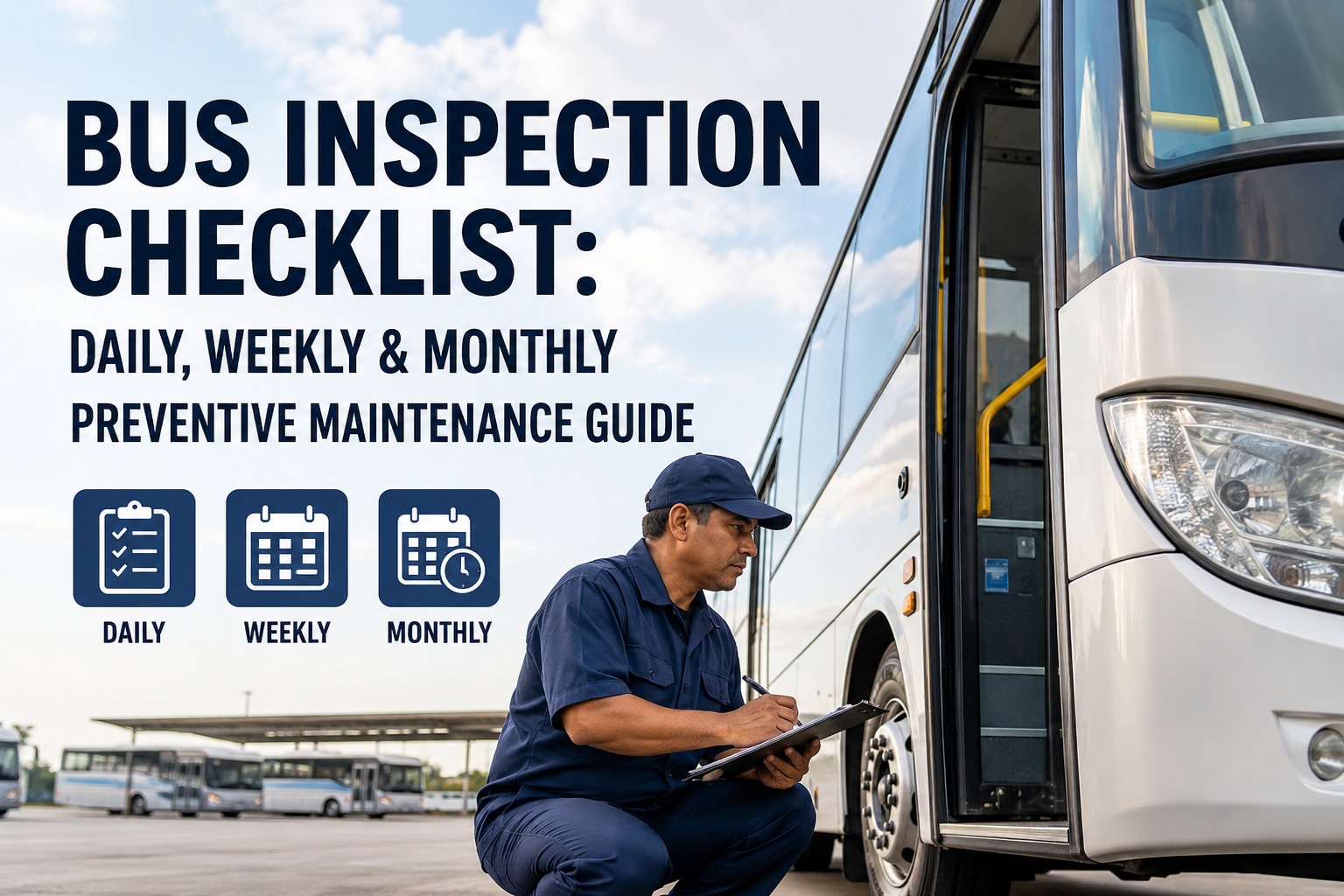
Bus Inspection Checklist: Daily, Weekly & Monthly Preventive Maintenance Guide
The complete bus inspection checklist your drivers and technicians actually need -- organized by how often each item really has to be checked, not one long list nobody finishes.
Why a Single Bus Inspection Checklist Isn't Enough
Under 49 CFR 396.13, every driver has to be satisfied the bus is safe before pulling out of the lot -- that's the daily layer. But federal rules also require emergency exits, push-out windows, and marking lights to be checked every 90 days under 49 CFR 396.3, and a full annual inspection covering brakes, steering, suspension, and more than 100 points under 49 CFR 396.17. Weekly and monthly checks are what keep a fleet from lurching from one deadline to the next -- they catch the slow-developing problems long before the 90-day or annual inspection would ever find them.
Here's the part that gets missed: a driver rushing a pre-trip in five minutes isn't lazy, they're usually just handed one long list that mixes daily items (tire pressure, lights) with things that only need checking once a week (belt tension, u-joint play). When everything looks equally urgent, nothing gets the attention it needs. Recent CVSA Roadcheck data puts brake violations at 41% of all out-of-service orders and tire issues at over 21% -- both categories where a properly tiered checklist, not a rushed one, is the difference. Book a demo to see how BusCMMS separates daily, weekly, and monthly items automatically so your drivers only see what's due today.
Daily Bus Inspection Checklist: The Pre-Trip Walkaround
This is the one every driver does before the engine even turns over, and it's the layer FMCSA cares about most directly. Break it into zones so a driver moves around the bus once instead of bouncing back and forth.
- Tire tread depth and pressure on all wheel positions, including inner duals
- Headlights, tail lights, brake lights, turn signals, and 8-light warning system
- Body damage, loose panels, and clean windshield with working wipers
- Fluid leaks under the bus -- oil, coolant, or transmission fluid on the ground
- Mirrors adjusted -- 2 flat cross-view and 2 convex cross-view mirrors
- Stop arm and crossing gate extend, lock, and retract fully
- Service brakes and parking brake hold before the bus moves an inch
- Steering play -- no more than 10 degrees of free movement at the wheel
- Horn, defroster, and heater functioning for driver visibility and comfort
- Gauges reading normal on startup -- oil pressure, air pressure, temperature
- Seatbelts, driver seat, and instrument panel warning lights
- Radio or two-way communication device powers on and connects
- Emergency exits -- rear door, roof hatches, and push-out windows open freely
- Fire extinguisher charged and in its mounted bracket
- First aid kit and body fluid cleanup kit stocked and accessible
- Reflective triangles or warning devices present
- Wheelchair lift cycles fully with no unusual noise (if equipped)
- Student check system (child check alarm) resets and triggers correctly
Under FMCSA's March 2026 eDVIR rule, electronic pre-trip and post-trip reports with timestamped driver signatures are fully compliant -- you no longer need a paper form in the glovebox to satisfy 49 CFR 396.11. Sign up free to move your daily walkaround to a digital format that time-stamps every item the moment your driver taps it.
Weekly Bus Inspection Checklist: What the Pre-Trip Skips
These are the items that don't fail overnight, so a daily walkaround won't catch them going bad -- but wait a month to look and you're already into a breakdown. Assign this to a technician or a senior driver on a fixed day, not "whenever there's time."
- 1
Belt & Hose Condition
Check serpentine belt tension and cracking, and squeeze coolant hoses for soft spots or bulging.
- 2
Battery & Terminals
Clean corrosion off terminals, confirm hold-down is secure, and test voltage under load.
- 3
Wheel Lug Torque
Re-torque to spec, especially on buses that recently had tire or brake work done.
- 4
Air System Leak-Down
Build air pressure, shut off the engine, and confirm pressure holds within spec over time.
- 5
Wheelchair Lift Cycle Test
Full weighted cycle test and manual backup crank check, not just the daily quick-open.
- 6
Interior Deep Clean Check
Seat anchor points, floor mats for trip hazards, and aisle handrail security.
A shop foreman running 40 buses can lose track of who did the weekly pass on which bus if it's tracked on a whiteboard. Book a demo to see recurring weekly PM tasks auto-assigned to the same tech every cycle, with a record of who signed off and when.
Monthly Bus Preventive Maintenance Checklist
This is the full-system sweep -- the layer that catches what's building up slowly enough to hide from both the driver and the weekly tech. It should feel like a mini version of the annual inspection, done under a lift with more time and better lighting.
Undercarriage & Suspension
Bushings, shocks, springs, and frame rails checked for cracks, rust-through, or loose fasteners.
Brake System Deep Check
Drum or rotor thickness measured, not just visually checked -- cracks over 50% of width are an out-of-service condition.
Exhaust & Fuel System
Full run from tank to tailpipe checked for leaks, loose clamps, and DEF system faults on diesel buses.
Electrical & Wiring
Chafed wiring, corroded grounds, and battery box drainage checked before a short becomes a road call.
Fluid Analysis & Filters
Oil and coolant sampled or changed on schedule, filters replaced per mileage or engine-hour triggers.
Fuel type changes what belongs in this list. A diesel bus needs DEF and DPF checks here; an electric bus needs high-voltage cable insulation resistance testing and battery state-of-health review instead -- items a generic monthly PM template usually doesn't include at all.
Retention Rules: How Long Each Inspection Record Must Live
A checklist only protects you if the record survives long enough to matter during an audit. Retention periods differ by inspection type, and mixing them up is a common way districts get dinged during a review.
| Record Type | Interval | Retention |
|---|---|---|
| Daily DVIR (pre/post-trip) | Every day of use | 3 months |
| Weekly PM checklist | Weekly | 1 year recommended |
| Monthly PM sweep | Monthly | 1 year recommended |
| Emergency exit/window check | Every 90 days | 1 year recommended |
| Full annual inspection | Every 12 months | 14 months |
A missing daily DVIR signature can run $1,270 per day in penalties, and dispatching a bus with a known, unrepaired defect has been cited around $15,420 per occurrence in enforcement actions -- numbers that make a lost paper form an expensive habit. Districts and transit agencies preparing for an FTA triennial review or an NTD submission need these records organized by date and bus, not scattered across binders in a shop office.
From an Experienced Fleet Manager
"We used to run one master checklist for everything, and drivers would just check the same boxes every day out of habit whether they'd actually looked or not. Once we split it into daily, weekly, and monthly, our weekly guy started catching belt wear and battery corrosion before it ever hit the road. Our road calls dropped noticeably in the first two months. The other thing that changed -- when the state auditor asked for our last six months of pre-trip records, I pulled them up in under a minute instead of digging through a filing cabinet."
Why a Generic Fleet App Can't Run This Checklist Properly
Trucking and construction fleet software wasn't built with stop arms, crossing gates, wheelchair lifts, or student check systems in mind, so those items get bolted on as generic "custom fields" instead of pre-loaded, compliance-mapped checks. BusCMMS ships with bus-specific daily, weekly, and monthly templates already built in, and routes a failed item straight into a work order without a supervisor having to re-type it from a paper form.
Pre-Loaded Bus Templates
Daily, weekly, and monthly checklists arrive ready to use -- no weeks of custom setup.
Defect-to-Work-Order
A failed item auto-generates a prioritized work order instead of waiting for a supervisor to notice.
Auto-Scheduled Intervals
Weekly and monthly tasks trigger by calendar or mileage, matched to each bus's fuel type.
Audit-Ready Records
Every signature and timestamp stored and searchable by bus, date, and inspection type.
BusCMMS reports that fleets running its pre-loaded inspection templates reach 95%+ fleet availability and see maintenance cost reductions in the 25-35% range within 12 months, largely from catching weekly and monthly items before they become road calls. Book a demo to see the full inspection-to-work-order flow on a fleet your size.
Building Your Bus Inspection Checklist: The Bottom Line
A bus inspection checklist only works when it matches how problems actually develop -- some things need eyes on them every single morning, some need a technician's hands on them once a week, and some only reveal themselves under a lift once a month. Split your checklist into these three tiers, assign clear ownership for each, and keep the records long enough to survive an audit. Get that structure right and the daily walkaround stops feeling like a formality and starts doing what it's supposed to do: keeping 40+ students, a driver, and your compliance record safe every single route.
If you're still running this on paper or a spreadsheet, the gap between what should be checked and what's actually getting checked is probably wider than you think. Sign up free and load your fleet's daily, weekly, and monthly checklists in one afternoon.
What is required on a daily bus inspection checklist?
A daily bus inspection checklist covers brakes, tires, lights, mirrors, stop arm and crossing gate function, fluid leaks, and emergency exits, satisfying the driver's obligation under 49 CFR 396.13 to confirm the bus is safe before operating. It should take 15-20 minutes and end in a signed, timestamped DVIR.
How is a weekly bus checklist different from a daily one?
A weekly checklist covers items that degrade slowly enough to hide from a daily walkaround, such as belt tension, battery terminal corrosion, wheel lug torque, and air system leak-down. These typically need a technician rather than a driver and are best assigned to the same person each cycle for consistency.
What should a monthly bus preventive maintenance checklist include?
Monthly checklists go under the bus: suspension and frame condition, brake drum or rotor thickness measurements, exhaust and fuel system integrity, wiring and electrical grounds, and fluid or filter service. Electric buses substitute high-voltage cable and battery state-of-health checks for diesel-specific items like DEF and DPF service.
Are electronic (digital) bus inspection checklists legally compliant?
Yes. FMCSA's 2026 eDVIR framework explicitly authorizes electronic driver vehicle inspection reports, provided they include a timestamped driver signature, itemized defect documentation, and supervisor certification when repairs are made. Digital checklists satisfy 49 CFR 396.11 the same as paper forms.
How long do bus inspection records need to be kept?
Daily DVIRs generally need to be retained for 3 months, while full annual inspection reports under 49 CFR 396.17 must be kept for 14 months. Many fleets keep weekly and monthly PM records for at least a year to support FTA triennial reviews or state DOT audits, and digital systems can retain them indefinitely at no added cost.