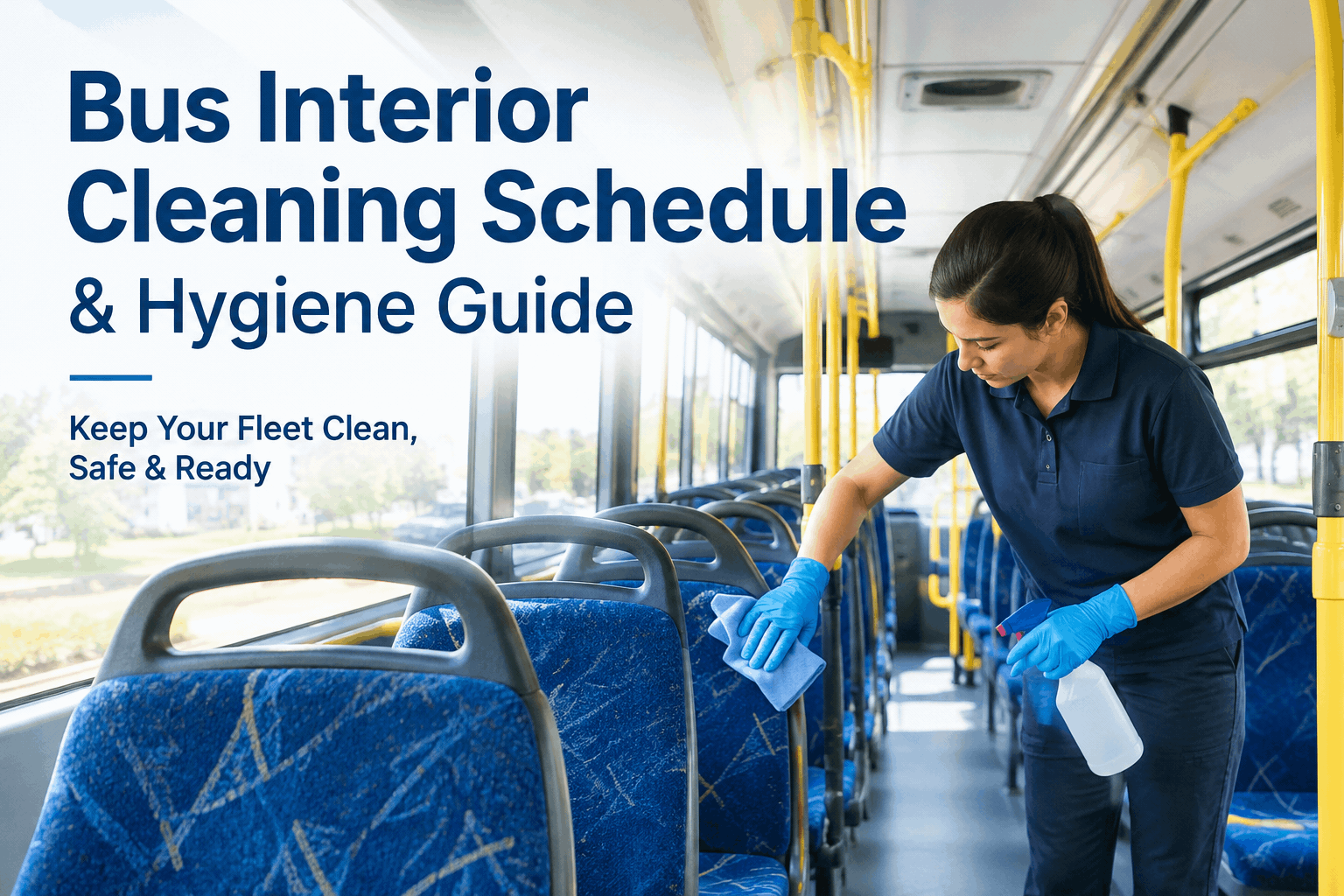
Cleaning happens on every bus, every day — the problem is almost never whether it gets done. It's whether anyone can prove it got done, on which bus, to what standard, three weeks later when a parent, a health inspector, or your own supervisor asks. Here's how to turn daily wipe-downs into an actual cleaning programme with a record behind it.
BUS INTERIOR CLEANING & HYGIENE PROGRAMME
A Cleaning Schedule Every Bus Actually Follows — and Proves
Daily, weekly, and deep-clean cycles scheduled per bus, with completion logged the same way a PM service is.
Daily cleaning gets done because drivers notice the mess. Monthly and quarterly deep cleans get skipped because nobody notices the gap — until an inspection, a complaint, or a bad flu season makes it obvious. Put the whole cadence on a schedule — start free.
The Four-Tier Cleaning Cadence Most Programs Never Write Down
A real cleaning programme isn't one task repeated — it's four different cycles running at four different frequencies, each catching something the one before it doesn't. Most fleets run the first tier well and let the other three slide, because only the first one is visible every single day.
DAILY
Wipe-Down & Trash
Trash removal, high-touch surfaces, floor sweep. Fast, visible, and almost always done — because skipping it shows immediately.
WEEKLY
Deep Surface Clean
Floors mopped, seats and grab bars disinfected, windows cleaned inside and out. The first tier that quietly starts slipping without a schedule.
MONTHLY
Upholstery & Hard-to-Reach
Under-seat vacuuming, upholstery treatment, vents and overhead panels. Easy to defer indefinitely when it isn't tied to a due date.
QUARTERLY
Full Sanitization
Complete interior disinfection, HVAC and undercarriage attention. The tier most likely to only happen after a complaint, not before one.
Which of Your Four Cleaning Tiers Is Actually on a Schedule?
See how BusCMMS schedules daily, weekly, monthly, and quarterly cleaning as recurring tasks per bus — with completion tracked the same way a PM service is.
"The bus got cleaned" and "the cleaning program is on track" are two different claims. One is a single task. The other is a number you should be able to produce for the whole fleet in seconds. Put a real number behind your cleaning program — start free.
Daily tasks on schedule
Monthly deep cleans on time
Quarterly sanitization on time
Illustrative example of what a fleet typically sees before scheduling deep-clean tiers the same way it schedules PM — completion rate drops the further out the frequency.
Which tier was completed — daily, weekly, monthly, or quarterly — not just "bus was cleaned."
Who completed it and when — a name and timestamp, not an unsigned box checked at the end of a shift.
Any issue found during cleaning — a torn seat or failing vent found while cleaning should route to a repair work order, not get mentioned and forgotten.
Products or method used, where relevant — especially for sanitization cycles that need to meet a specific health standard.
Next due date, set automatically — the cycle resets itself instead of relying on someone remembering to rebook it.
Expert Perspective: The Tasks That Quietly Disappear
Daily cleaning takes care of itself in most fleets — it's visible, it's fast, and a dirty bus gets noticed the same day. What I watch fleets lose track of is everything with a longer cycle. Monthly upholstery treatment, quarterly deep sanitization — those don't have a built-in reminder the way a dirty floor does. They just quietly stop happening, and nobody notices until a parent complaint, a health inspection, or flu season makes it obvious all at once. The fix isn't working harder on cleaning. It's treating the longer cycles exactly like you'd treat a PM interval — scheduled, due-dated, and flagged the moment it's missed, instead of left to memory.
Conclusion: A Programme Is a Schedule That Doesn't Depend on Memory
Every fleet cleans its buses. What separates a real cleaning programme from a collection of good intentions is whether the longer cycles — weekly, monthly, quarterly — run on a schedule that flags itself, or on someone remembering. The daily wipe-down will always get done. It's the tiers behind it that need a system holding them accountable. Walk through a cleaning schedule built for your fleet — book a demo. If you can't say right now which buses are overdue on their monthly or quarterly clean, that's the clearest sign the programme needs a schedule behind it, not more reminders. Start your free BusCMMS account and set up your first cleaning cycle today.
Run Your Cleaning Programme Like a PM Schedule
BusCMMS schedules daily, weekly, monthly, and quarterly cleaning per bus, flags what's overdue, and keeps a defensible record of every completed cycle.
What should a bus interior cleaning programme include?
A real programme covers four cadences — daily wipe-downs, weekly deep surface cleaning, monthly upholstery and hard-to-reach areas, and quarterly full sanitization — each scheduled and logged per bus rather than treated as one repeated task.
How often should a bus get a deep clean versus a daily wipe-down?
Daily cleaning handles trash and high-touch surfaces. Weekly deep cleans cover floors and disinfection. Monthly and quarterly cycles address upholstery, vents, and full sanitization — frequencies that should scale with ridership and route type.
Why do monthly and quarterly cleaning tasks get missed most often?
They lack a built-in reminder. A dirty floor is noticed the same day; a skipped upholstery or sanitization cycle isn't, which is why these tiers need a due date and a flag, not memory.
Can cleaning records support a health or compliance audit?
Yes, when each completed task logs who did it, when, and what tier was covered. A clipboard rarely survives long enough to answer an audit question asked weeks later; a scheduled, logged record does.
How long does it take to set up a cleaning schedule in BusCMMS?
Most fleets set up their first recurring cleaning cycle the same day they sign up. Full fleet rollout across all four cadences typically takes a couple of weeks for larger operations.