The tech was 20 minutes into a wheelchair-lift hydraulic repair when the second-shift driver came in early, hit the master switch to warm the cab, and the lift cycled unexpectedly. The tech's hand was under the frame. He kept his fingers. He almost did not. The lock that should have been on the master disconnect was still hanging on the tool cart. That is the split-second reality of hazardous energy on a bus, and it is exactly what a proper Lockout/Tagout (LOTO) program prevents. This 2026 template gives bus maintenance shops the actual log format, the OSHA-aligned fields, and the workflow to document energy isolation the right way.
Bus Lockout/Tagout (LOTO) Log Template for Maintenance Shops
The energy-isolation log, verification steps, and audit-ready format aligned with OSHA 29 CFR 1910.147 -- built for school district, transit, and motorcoach shops (including EV bus HV work).
- OSHA 1910.147 aligned
- 6 energy types
- EV HV compatible
Why a Written LOTO Log Is Not Optional for Bus Shops
OSHA's Control of Hazardous Energy standard (29 CFR 1910.147) was ranked the #4 most-cited standard in FY2025 with 2,177 citations. The most common single citation across all industries is the same year after year: failure to develop and document machine-specific energy control procedures under 1910.147(c)(4)(i). Generic wall-poster policies do not satisfy the standard. What OSHA looks for is a written, equipment-specific record showing that the isolation happened, which locks were applied, and who verified zero-energy state before the wrench came out.
- #4 1910.147 rank on OSHA's Top 10 in FY2025
- $16,550 Max fine per serious violation (2026)
- 50,000 Injuries prevented per year by proper LOTO
- 1 lock Uniquely identified, per authorized employee
On bus shops specifically, the exposure runs higher than most general industry sites: high-voltage EV battery packs, hydraulic lifts and wheelchair mechanisms, air suspension holding 100+ psi, and multiple 12V/24V systems that can all be live simultaneously on a single unit. One good log format, filled out every time, is the difference between a routine repair and a citation. Book a demo to see digital LOTO logs auto-attached to every work order.
The 6 Hazardous Energy Types on a Bus
OSHA recognizes six categories of hazardous energy. A single bus has all six live at once. The template captures each one so nothing gets isolated by memory.
-
Electrical
EV battery (600V+), 12V/24V starter, alternator, HVAC blower.
Isolate: master disconnect + HV service switch -
Mechanical
Compressed springs (leaf, coil), driveline inertia, gravity-loaded parts.
Isolate: block, chock, restrain, dissipate -
Hydraulic
Wheelchair lifts, hydraulic doors, power steering, some brake circuits.
Isolate: shut valve + relieve line pressure -
Pneumatic
Air brakes, air suspension (100+ psi), air doors, kneel systems.
Isolate: drain reservoirs + lock supply valve -
Thermal
Hot engine, exhaust after run, radiator coolant, DPF during regen.
Isolate: cool-down wait + PPE -
Chemical
DEF fluid, coolant, refrigerant, battery electrolyte, lithium thermal event.
Isolate: shut valve + PPE + spill kit
Every LOTO procedure needs to identify which of these six energies applies to the specific job -- and how each one is isolated on that specific bus. That is the "machine-specific" requirement OSHA cites most often when it is missing. Book a demo to see machine-specific LOTO procedures built into every work order.
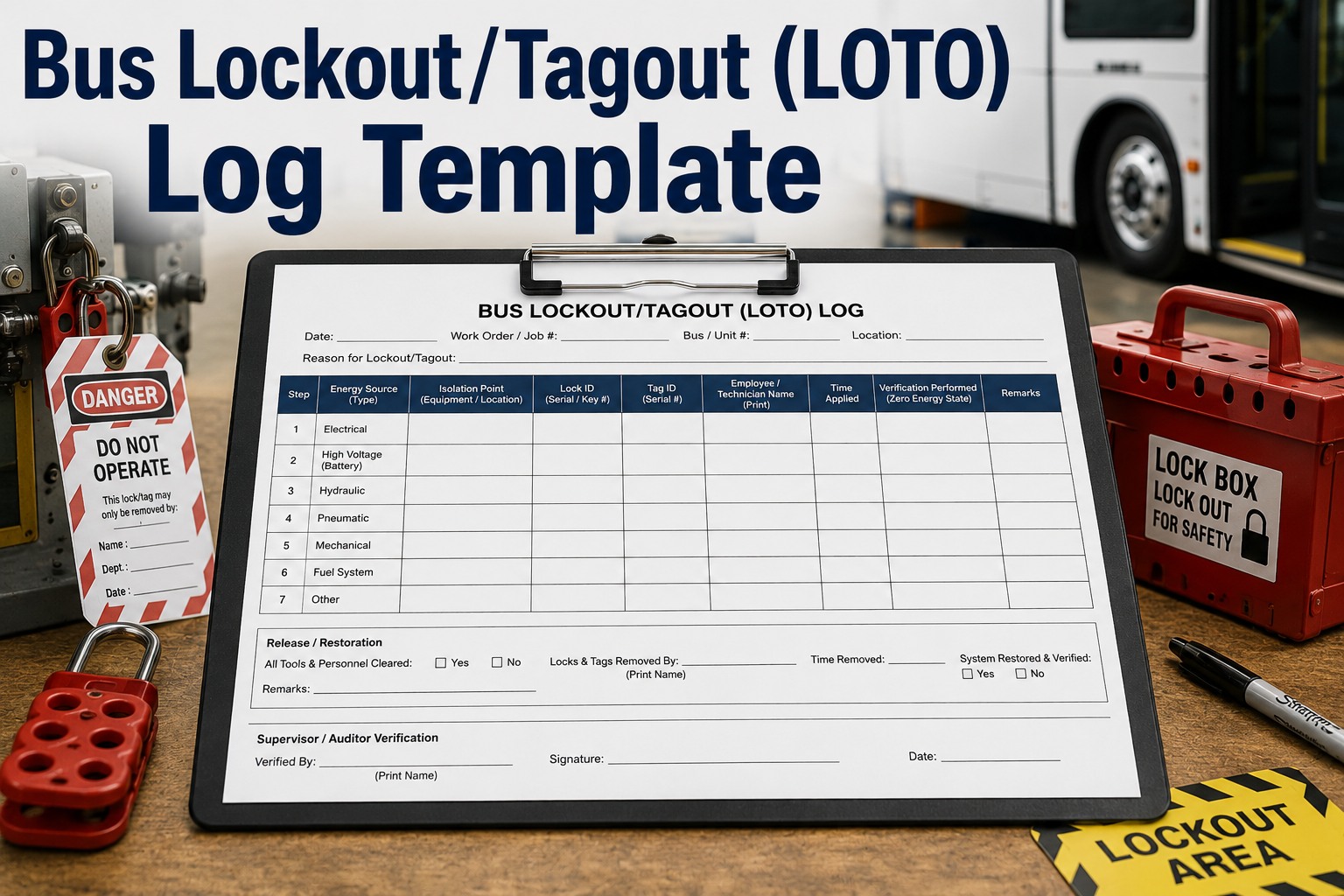
Inside the Template: What Every LOTO Log Entry Captures
Below is what a filled-out entry looks like in the template. Every field maps to an OSHA 1910.147 requirement. Sign up free to use the digital version in BusCMMS.
- Electrical -- master disconnect locked
- Hydraulic -- lift supply valve, pressure released
- Pneumatic -- air reservoir drained
- Mechanical -- lift arm blocked in raised position
The 7-Step LOTO Procedure Every Shop Follows
These seven steps come directly from 1910.147(d) and (e). Miss any one of them and the isolation is not valid.
-
1
Preparation
Identify every energy source on the specific bus, review the procedure, gather locks and tags.
-
2
Notify Affected Employees
Drivers, dispatchers, cleaners, anyone in the area needs to know the bus is going out of service for LOTO work.
-
3
Machine Shutdown
Normal stop procedure -- shut down engine or systems using the standard controls.
-
4
Isolation
Operate the energy-isolating device for each source: master disconnect, HV service switch, air valve, hydraulic valve.
-
5
Apply Lock & Tag
Each authorized employee applies their own uniquely identified lock and tag to each isolating device. No shared locks.
-
6
Control Stored Energy
Release, block, or dissipate residual energy -- air reservoirs, capacitors, springs under tension, raised loads.
-
7
Verify Zero Energy (Try-Out)
Attempt to start the equipment, test circuits, confirm no energy. This is the most commonly skipped step -- and one of the most frequently cited violations.
Release procedure runs in reverse -- inspect the work area, confirm all employees clear, remove each lock by its owner, and re-energize. Every step gets logged. Book a demo to see the 7-step flow enforced by the CMMS.
Top 5 LOTO Compliance Mistakes on Bus Fleets
These are the same five failures OSHA cites over and over. Fix them before an inspector finds them.
-
1910.147(c)(4)(i)
Generic Procedures Instead of Machine-Specific
A wall poster is not a procedure. Each bus type needs its own written energy control procedure listing every source and every isolation point.
Fix: Build a template per bus configuration and store per unit. -
1910.147(c)(7)(i)
Missing or Stale Training Records
Authorized, affected, and "other" employees each need training. Retraining is required after any procedure change.
Fix: Track LOTO training cert per employee with expiration alerts. -
1910.147(c)(6)(i)
Skipped Annual Periodic Inspections
Each procedure needs an annual inspection by an authorized employee not the one using the procedure. Undocumented = cited.
Fix: Schedule annual LOTO procedure audits in the CMMS. -
1910.147(d)(6)
Skipping the Try-Out / Verification Step
Applying locks without attempting restart or testing circuits leaves the shop exposed to unexpected energization mid-repair.
Fix: Require verification signature before work begins. -
1910.147(c)(5)(ii)
Shared or Unidentified Locks
Each authorized employee must have their own uniquely identified lock. No sharing, no combination locks, no unmarked padlocks.
Fix: Assign personal color-coded lock ID and track in the log.
All five mistakes have the same root cause: the log format was not built for OSHA, and the shop was relying on memory instead of a system. A digital LOTO log solves all five in one workflow. Sign up free and get OSHA-aligned LOTO tracking on day one.
A Shop Foreman's Take on LOTO Discipline
We had one incident, ten years ago, that we still talk about. A tech pinched a finger because someone reset a breaker while he was in the lift. Nobody died, but everybody remembered. Since then, our rule is nobody touches a bus until the LOTO log is signed and photographed. When we went to a digital system three years ago, the audit hits dropped to zero. Not because we changed the procedure -- we always did it right. Because now we can prove it.
What is a bus Lockout/Tagout (LOTO) log template and who needs it?
A LOTO log template is a standardized form used by bus maintenance shops to document the energy-isolation steps performed before servicing or maintaining a bus. Every shop performing servicing or maintenance where unexpected energization or release of stored energy could cause injury needs to comply with OSHA 29 CFR 1910.147. That includes school district transportation departments, transit agencies, motorcoach operators, and third-party bus maintenance contractors. The template captures the bus ID, work order, energy sources isolated, lock and tag numbers, verification steps, and sign-offs -- everything OSHA looks for in an inspection.
What are the 6 types of hazardous energy on a bus?
OSHA recognizes six categories: electrical (12V/24V systems and high-voltage EV battery packs), mechanical (compressed springs, driveline inertia, gravity-loaded parts), hydraulic (wheelchair lifts, hydraulic doors, power steering), pneumatic (air brakes and air suspension holding 100+ psi), thermal (hot engine surfaces, exhaust, coolant, DPF during regen), and chemical (DEF fluid, coolant, refrigerant, battery electrolyte, lithium-ion thermal-runaway risk). A single bus routinely has all six live at once, which is why LOTO discipline on a maintenance floor is more critical than on most general industry sites.
Does LOTO apply to EV bus high-voltage battery work?
Yes, and more strictly than most work. EV bus battery packs typically operate at 400-800V DC, well above the lethal threshold. High-voltage service requires an OSHA-compliant LOTO procedure that includes the manufacturer's HV service disconnect, verified de-energization with a properly rated multimeter, and only technicians with documented HV certification performing the work. Beyond OSHA 1910.147, NFPA 70E requirements for arc-flash PPE also apply. Fleets running EV buses need a separate machine-specific LOTO procedure for the HV system in addition to the standard bus procedure.
What are the OSHA penalties for LOTO violations in 2026?
As of January 2025 (still the effective rate for most of 2026 until the next inflation adjustment), the OSHA maximum civil penalty is $16,550 per serious or other-than-serious violation, and $165,514 per willful or repeated violation. Failure-to-abate penalties add up to $16,550 per day beyond the abatement deadline. A single inspection can generate multiple citations -- one per machine without a written procedure, one per untrained employee, one per missed annual inspection -- so total exposure adds up quickly. LOTO citations frequently trigger placement in OSHA's Severe Violator Enforcement Program.
How does a bus CMMS improve LOTO compliance?
A bus-specific CMMS enforces LOTO in four ways that paper cannot. First, every work order automatically prompts for a linked LOTO log entry so nothing gets skipped. Second, authorized employee training cert dates are validated at sign-off -- an expired cert blocks the entry. Third, lock IDs get tracked to the individual employee so shared or unmarked locks cannot be logged. Fourth, annual periodic inspections auto-schedule for each machine-specific procedure and produce a documented inspection record. All of it exports as an audit-ready packet in seconds instead of a scramble through folders.