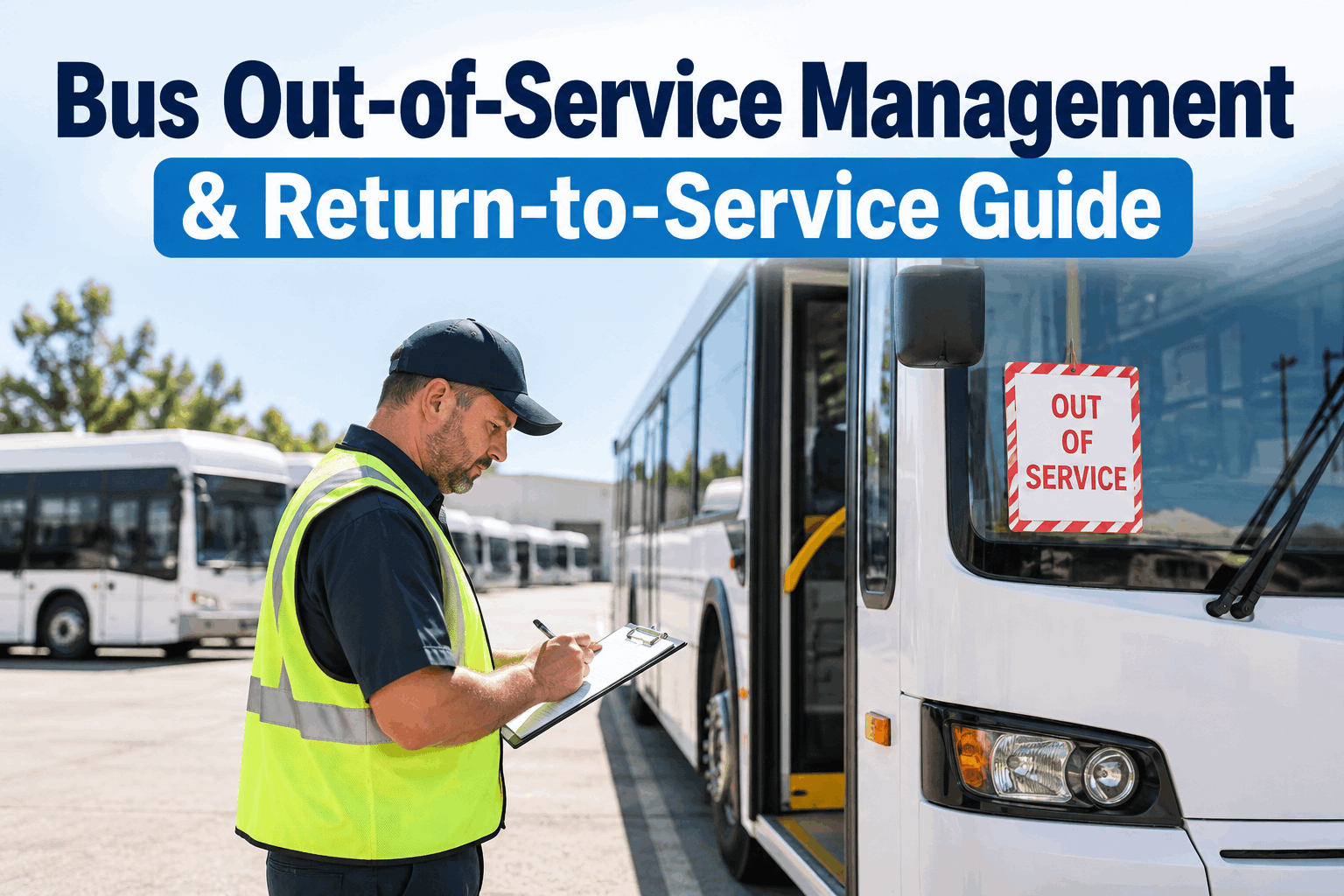
A bus gets pulled for a brake defect, a tech works on it, and by the afternoon it is back on a route. The question an auditor asks later is simple and unforgiving: who confirmed the repair was actually done, and where is the record. If a bus can go from bus out of service back to carrying passengers without a verified, documented sign-off, you do not have a return-to-service process — you have a hope.
Bus Out-of-Service Management: A Controlled Return to Service
Taking a bus out of service is easy. Putting it back safely — with the defect fixed, verified, signed off, and documented — is where compliance is won or lost. Here is how to build a return-to-service gate no bus can slip past.
Step 4 is the gate. Skip it and a bus returns on trust; enforce it and every return is documented and defensible.
Why an uncontrolled return to service is a risk
When a bus can go back on the road without a verified sign-off, three things can go wrong — and each one is a safety and compliance exposure, not just a paperwork gap.
The defect isn't actually fixed
A bus marked repaired that still has the fault is the worst case — a known safety defect back in passenger service. Without a verification step, a rushed or incomplete repair can send it out anyway.
No record of who cleared it
If an auditor asks who confirmed the repair and when, and the answer is a verbal "the tech said it was done," there is no defensible record. Accountability that lives in memory is accountability you cannot prove.
The out-of-service status gets lost
When OOS lives on a paper tag or in someone's head, a bus can quietly drift back onto the available board before its repair is confirmed — dispatched by someone who never saw the defect.
Each risk disappears with the same control: a defect cannot be cleared, and a bus cannot return to service, until the repair is verified and signed off in the record. You can book a walkthrough of an enforced return-to-service gate to see the control in action. That status should ride with the bus — the same way a daily availability report keeps dispatch from pulling a bus that is not truly ready.
What 49 CFR 396.9 requires for out-of-service buses
Federal rules set a hard line around out-of-service equipment. Under 49 CFR 396.9, once a vehicle is declared out of service, the path back is defined — and documented.
No operation until repairs are done
No carrier may require or permit anyone to operate a vehicle marked out of service until all repairs required by the out-of-service notice have been satisfactorily completed.
The sticker stays until repairs are complete
No person may remove the out-of-service sticker before all repairs required by the notice are completed — the physical control that keeps a bus grounded until it is truly fixed.
Certify and keep the record
The carrier must certify that corrections were made — signing the form — and retain the completed form for twelve months at the principal place of business or where the vehicle is housed.
The rule makes the point plainly: return to service is not just doing the repair, it is proving it was done and keeping that proof. A system that enforces the sign-off and stores the record turns the regulation into a workflow instead of a worry. You can see a documented return-to-service flow on a live fleet to picture it.
A return-to-service checklist no bus should skip
A controlled return is five steps, in order, every time. Enforce them and a bus never goes back on trust — only on proof. You can start free and set the gate up for your fleet.
Mark it out of service, visibly
The moment a disqualifying defect is found, the bus is flagged out of service in the system and physically tagged — so no one can dispatch it by mistake.
Open a work order for the defect
The defect becomes a work order tied to the bus, so the repair is tracked from the fault that caused it to the fix that clears it.
Complete and verify the repair
The repair is done and then checked — a second set of eyes or a confirmation step — so a bus is never cleared on an assumption that the work was finished.
Sign off and certify
A named person certifies the repair is complete and the defect cleared — the accountability record 49 CFR 396.9 expects, captured at the moment of return.
Return to service and retain the record
Only now does the bus go back on the available board, with the full OOS-to-return record kept on file for the required period and findable at audit.
No bus returns on trust
BusCMMS holds a bus out of service until its defect is repaired, verified, and signed off — then returns it with the full record attached, so every return to service is documented and audit-ready.
How BusCMMS controls bus out-of-service and return to service
A return-to-service gate only works if the system enforces it — and that is what a bus-specific inspection and work-order platform does that a paper tag cannot.
Automatic out-of-service status
A failed DVIR or a disqualifying defect flags the bus out of service and off the available board, so it cannot be dispatched until its repair is cleared.
Enforced repair verification and sign-off
A bus cannot return until the work order is completed and a named person signs off the repair — the gate that makes return-to-service a control, not a courtesy.
Complete audit trail retained
The whole sequence — defect, OOS, work order, verification, sign-off, return — is kept with the bus, so the record 49 CFR 396.9 requires is already on file.
Because BusCMMS is built for buses, out-of-service control sits with DVIRs, PM, and compliance records — one system from the defect to the documented return. You can start a free account and set up your return-to-service gate.
The scariest words in my shop used to be "I think it's fixed." A bus would come out of service, get worked on, and go back out because someone assumed the job was done. Now nothing comes off out-of-service status until the work order is closed and someone signs their name to it. If a bus is on the road, I can show exactly who cleared it and when. That is the difference between telling an auditor we have a process and showing them one.
Key takeaways on bus out-of-service management
Taking a bus out of service is easy; the risk is the return — a bus going back on the road without a verified, documented sign-off.
An uncontrolled return risks an unfixed defect in service, no record of who cleared it, and a bus drifting back onto the board before its repair is confirmed.
49 CFR 396.9 draws the line: no operation until repairs are satisfactorily completed, the sticker stays until then, and the carrier must certify and keep the record for twelve months.
The fix is a gate: mark OOS, open a work order, verify the repair, sign off, then return — with the full record retained and audit-ready.
A bus out of service is a safety decision that only reverses on proof. Build a return-to-service gate that no bus can skip, and the question "who cleared this one" always has an answer — keeping buses safe, returns defensible, and audits uneventful. To see it on your own fleet, a quick demo is the fastest way in.
Make every return to service provable
Set up BusCMMS to hold buses out of service until repairs are verified and signed off, with the full record retained per bus — so no bus returns on trust and no audit catches you short. Rollout typically takes two to four weeks.
Bus out-of-service and return to service: frequently asked questions
What does it mean for a bus to be out of service?
A bus is out of service when a defect or condition makes it unsafe or non-compliant to operate, so it is pulled from service and must not carry passengers until repaired. An out-of-service declaration can come from a driver DVIR, a shop inspection, or an enforcement inspection, and under federal rules the vehicle cannot be operated until all required repairs are satisfactorily completed.
What does 49 CFR 396.9 require for returning a bus to service?
It prohibits operating a vehicle marked out of service until all repairs required by the out-of-service notice are satisfactorily completed, prohibits removing the out-of-service sticker before those repairs are done, and requires the carrier to certify the corrections by signing the form and retain the completed form for twelve months at the principal place of business or where the vehicle is housed.
Who can return a bus to service after a defect?
A bus should only return once the required repairs are completed and verified, and a responsible person certifies that the defect is cleared. The exact roles depend on your agency's policy, but the principle is constant: return is an accountable, signed decision — not an informal "it's done" — so there is always a named person and a record behind every bus back on the road.
Why is a documented sign-off important for return to service?
Because the record is what proves the bus was safe to return. If a defect recurs or an audit asks who cleared the bus, a verbal assurance is no defense — a signed, dated verification tied to the work order is. The sign-off also enforces the discipline: if someone has to put their name to it, the repair gets confirmed rather than assumed.
How does BusCMMS manage out-of-service buses?
BusCMMS flags a bus out of service on a failed DVIR or disqualifying defect, opens a work order for the repair, and holds the bus off the available board until the work order is completed and a named person signs off the repair. The full sequence — defect, out-of-service, repair, verification, sign-off, return — is retained with the bus, so the record 49 CFR 396.9 requires is already on file and audit-ready.