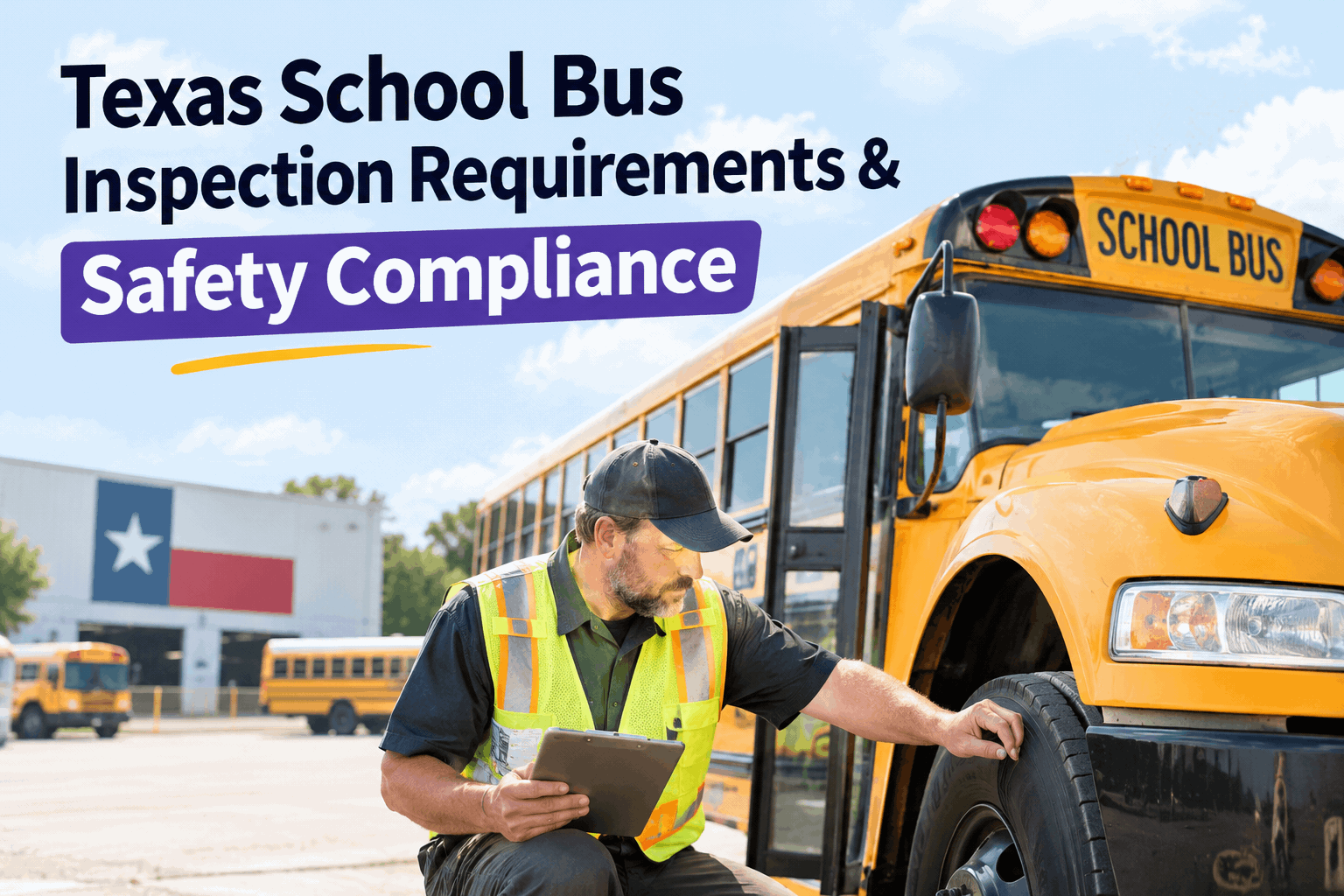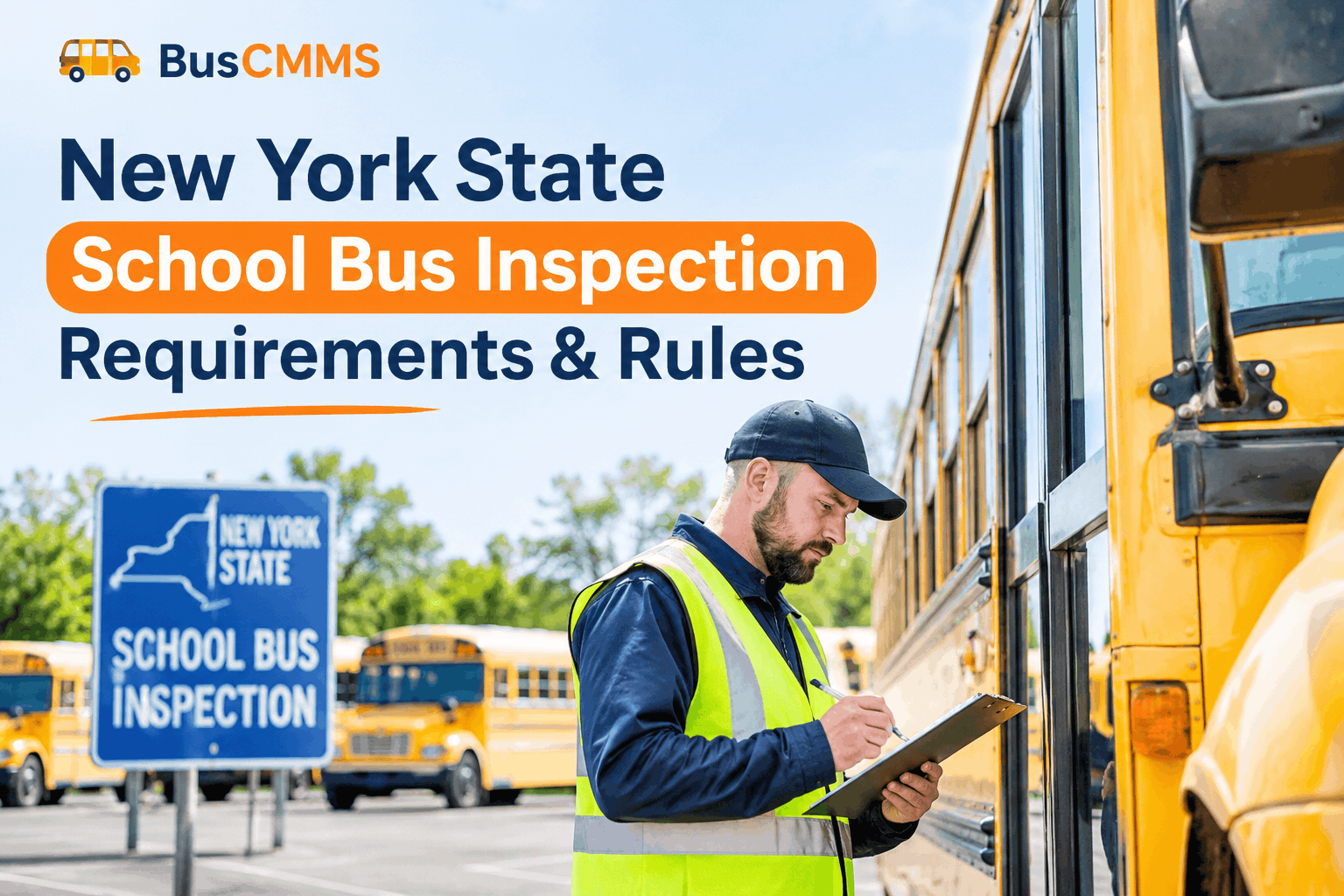
Most states inspect a school bus once a year. New York does it twice, every six months, on the nation's largest and strictest inspection program. A New York school bus inspection runs roughly 198 checkpoints, and a single critical defect can pull a bus off its route on the spot. If you would rather catch those defects first, book a BusCMMS demo and see how fleets stay six-month ready.
New York State School Bus Inspection Requirements & Rules
In New York, NYSDOT inspects every school bus at least every six months, and drivers run a separate qualification program under Article 19-A. Here is how both work, plus the checklist that keeps you ready for either knock on the door.
How New York school bus inspection works
New York built its reputation on frequency and detail. The Department of Transportation inspects every school bus at least twice a year, feeds the results into a statewide system that profiles every operator, and holds buses to a long, itemized standard. That system, known as BUSNET, has tracked each operator's safety record for decades, so a pattern of defects follows a fleet from one inspection to the next. For a fleet manager, that means readiness is never a once-a-year event — it is a constant.
Every 6 months
NYSDOT inspects every school bus, plus unannounced roadside checks
~198 points
Items scored in a typical New York state bus inspection
Largest in the US
Roughly 50,000 buses carrying about 2.3 million students
i A bus must pass NYSDOT inspection before the DMV will even register it — which is exactly why continuous records matter, and why a purpose-built bus CMMS earns its place in a New York shop.
What out of service really means in New York
When a bus fails on a critical item, the inspector applies an out-of-service sticker, and that bus is done until it is fixed and re-inspected. Here is the part that catches operators off guard: only a NYSDOT inspector can clear it. You cannot sign off your own repair and roll.
Every day that sticker is on the bus is a route you are covering some other way. A reject you catch yourself is an afternoon in the shop; an out-of-service pull is a bus you cannot move and a route you have to backfill before the first bell. The fleets that barely notice out-of-service findings are the ones catching worn brakes and bad lights on a schedule, long before an inspector does, and you can walk through that scheduling in a demo.
Your New York school bus inspection checklist
With a visit coming every six months, this list should be a routine, not a cram session. The red items are the critical defects that put a bus out of service; the amber items are the habits that keep you clear of them between inspections.
- CRITICALBrakes, steering, suspension and tires within out-of-service limits.These are the top items that pull a New York bus off the road.
- CRITICALStop arm, 8-light warning system and crossing gate all functional.Student-safety equipment failures are scored as serious defects.
- CRITICALEmergency exits, lights and body panels secure and undamaged.Loose or protruding body parts and blocked exits are defect items.
- PLANPreventive maintenance scheduled by mileage and calendar.Two inspection windows a year means readiness has to be continuous.
- PLANDaily driver inspection reports logged and kept at least six months.New York requires these reports on file by vehicle number.
- PLANDriver 19-A qualification dates tracked before they lapse.A lapsed medical or road test grounds a qualified driver.
Almost every out-of-service finding traces back to something a scheduled check would have caught first, weeks before an inspector ever saw it. That gap between a planned fix and a roadside failure is the whole reason to keep this list in a system instead of someone's memory.
Article 19-A: the other half of New York compliance
A perfect bus with an unqualified driver still cannot roll. After the 1972 Congers crash, New York created Article 19-A, a battery of recurring driver requirements that no other state matches. Each one has its own clock, and missing any of them disqualifies the driver. Between the medical exam, the road test, the written test, the annual defensive-driving review and the yearly physical, a single driver can have five or six separate renewal dates running at once.
Six separate clocks across every driver is a tracking problem, not a driving problem. BusCMMS keeps 19-A dates alongside each driver and warns you before one expires, so you can start tracking driver qualification free.
Records that keep a New York fleet ready
Two inspections a year plus a six-clock driver program is a records job as much as a wrench job. BusCMMS ships with bus-specific inspection forms on day one and ties every record to the right bus and driver, instead of the weeks of setup a generic trucking tool would need. When an inspector or an auditor asks for a vehicle's history, you want it in one click, not a folder someone has to rebuild from paper.
Fuel-type PM
Separate preventive schedules for diesel, propane and electric buses, by mileage or date.
Work orders from defects
A failed item auto-creates a work order and tracks the repair through to closed.
19-A & sticker alerts
Expiration reminders for inspection certificates and every driver qualification date.
i BusCMMS reports districts saving an average of about $2,800 per bus a year and holding 95%+ fleet availability — its own published customer figures, worth testing against your own in a quick demo.
In New York the inspection is never far off, so we stopped treating it as an event. Scheduled maintenance, logged pre-trips, driver files that update themselves — when the inspector comes, there is nothing to prepare. That is the whole game here.
Fleet Supervisor, upstate New York school district
The short version
6 mo
NYSDOT inspects every bus at least every six months, plus roadside checks.
198
Checkpoints in a typical state inspection — readiness has to be constant.
19-A
Driver program with six recurring clocks, annual and biennial.
1
System to tie inspections, PM, repairs and driver files to each bus.
A clean New York school bus inspection record is really just steady maintenance and current driver files, written down where you can find them. Put the inspections, PM, repairs and 19-A dates in one place, and two NYSDOT visits a year stop being a scramble. The fleets that run clean in New York are not lucky; they just made readiness a system. You can set up your fleet free and start building that record today.