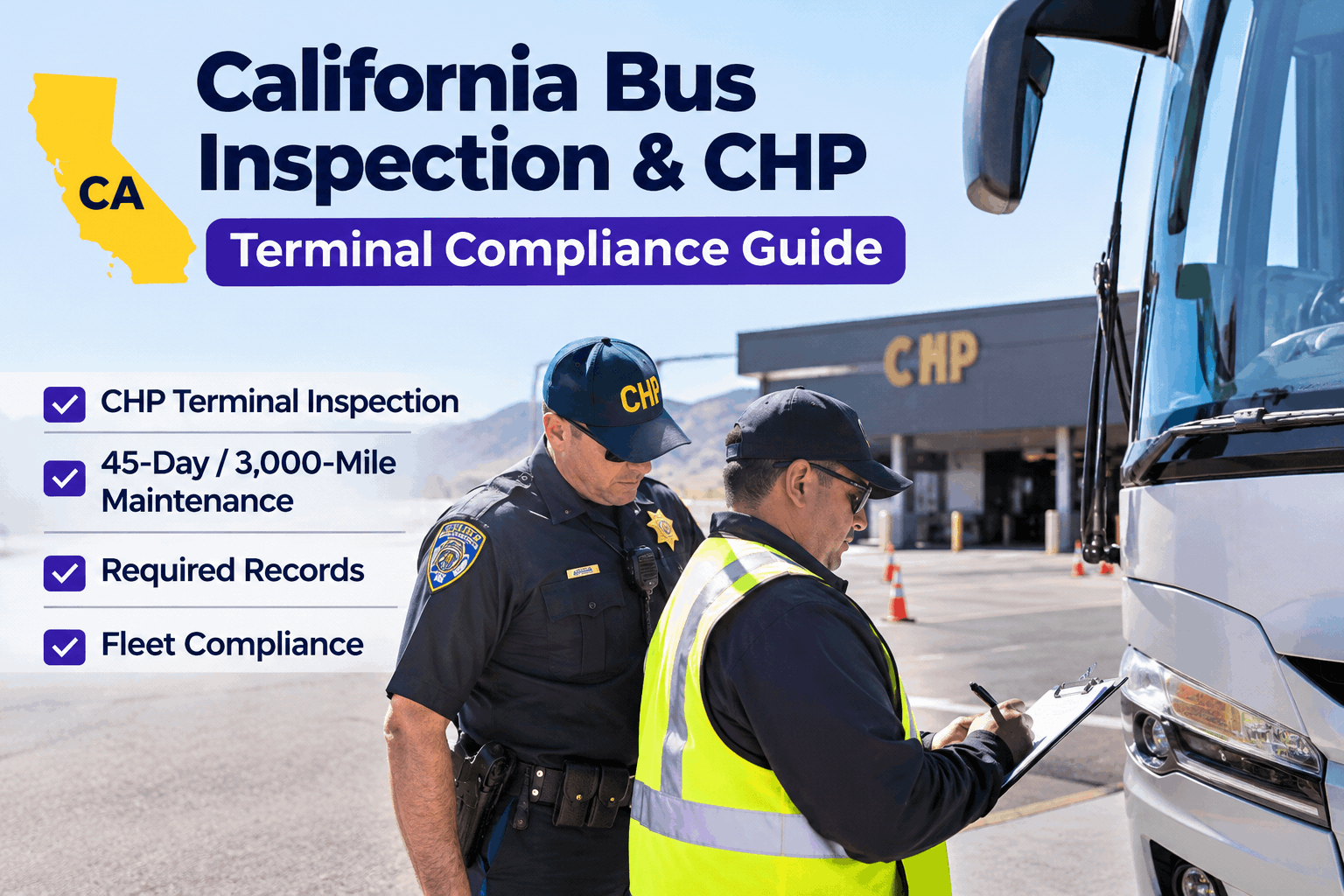
No state watches a school bus like California does. A California bus inspection is not one check on a calendar — it is a CHP terminal inspection, an annual certificate on every bus, a 45-day-or-3,000-mile maintenance cycle, and a records trail behind all of it. The CHP rating you earn is published for the public to see. If you would rather keep every clock ready, book a BusCMMS demo and see how fleets do it.
California Bus Inspection & CHP Terminal Compliance Guide
When the CHP inspects your terminal, it hands down a safety rating — and posts it where parents, boards and the public can look it up. One rating decides how the world sees your operation. Here is how to land on the right one.
What California bus inspection actually involves
California does not rely on a single annual sticker. The California Highway Patrol inspects your terminal at least once every 13 months — without notice if you run more than 100 buses — and reviews your maintenance records while they are there. On top of that, each bus carries an annual CHP certificate, and your own shop runs a tight maintenance cycle in between. Four layers, all live at once, and none of them covers for another — a bus can be freshly maintained and still cost you a rating if the paperwork behind it is thin. The CHP is not just checking the buses; it is checking whether your program is real.
Every 13 mo
CHP terminal inspection, unannounced for larger fleets
45 days / 3k mi
Maintenance inspection on every bus, whichever first
Annual cert
A CHP inspection certificate displayed in each bus
i Four overlapping clocks on every bus is more than a wall calendar can hold — which is exactly where a purpose-built bus CMMS earns its place in a California yard.
California stacks more checks on a bus than anywhere else
Lay the requirements on a single year and the picture is striking. The maintenance inspection fires roughly every six weeks, the commercial 90-day inspection four times a year, the bus certificate once, and the CHP terminal inspection on its own 13-month cycle. Each one has its own records to produce.
That density is why California compliance is really a tracking problem. A clock you cannot see is a clock you will miss, and in California there are four of them per bus. You can see all four on one dashboard in a demo.
The 45-day or 3,000-mile rule that trips fleets up
Of the four, the maintenance inspection is the one that catches people, because it runs on two counters at once. Every school bus must be inspected every 45 calendar days or every 3,000 miles, whichever comes first — and then both counters reset. A high-mileage route can hit 3,000 well before day 45, so the calendar alone will not save you. One long field-trip week can pull a bus's mileage ahead of its date without anyone noticing, and the next inspection quietly becomes overdue.
This is the clock a mileage-blind system always misses, and a missed maintenance inspection is exactly what a CHP terminal review flags. Tracking both counters on every bus is the difference between a clean rating and a conditional one. You can see both counters tracked per bus in a demo.
Your California bus inspection checklist
This list spans all four layers — the CHP terminal review, the annual certificate, the maintenance cycle, and the records behind them. The red items can stop a bus or sink a rating; the amber items keep you ahead of every interval. Work it per bus, because each one carries its own mileage, its own set of dates, and its own separate stack of records.
- CRITICALA current CHP inspection certificate in every bus.Each school bus must display its annual CHP approval.
- CRITICALEvery bus inspected within 45 days or 3,000 miles.Whichever comes first — a missed cycle is a terminal-rating risk.
- CRITICALDefects corrected and attested before a bus runs.California bars a bus from service until repairs are signed off.
- PLANMaintenance, lubrication and repair documented per bus.These are the records a CHP terminal inspection reviews first.
- PLANMileage and daily driver inspection reports kept on file.California requires mileage records and documented DVIRs.
- PLANDriver certificates and training records current.California layers a special certificate on top of a CDL.
Almost every conditional rating traces back to a record that was not there or an interval that slipped. You can start keeping all of it in one place free instead of hoping a binder is current when the CHP arrives.
The records that earn a satisfactory rating
A CHP terminal inspection is, more than anything, a records audit. The inspector reads your maintenance, inspection and repair documentation, and your rating follows what they find. BusCMMS ships with bus-specific inspection forms and ties every interval, repair and certificate to the right bus — so the answer to any question is a screen, not a search through the shop.
Miles + days PM
Tracks the 45-day and 3,000-mile cycle on every bus and flags whichever hits first.
Audit-ready records
Keeps maintenance, lubrication and repair history a CHP inspector can read in minutes.
Interval & cert alerts
Reminders for every inspection interval, certificate and driver record before it lapses.
i BusCMMS reports districts saving an average of about $2,800 per bus a year and holding 95%+ availability — its own published customer figures, worth testing against the numbers for your own fleet.
The CHP showed up unannounced last fall. Five years ago that would have been a bad week. This time I pulled up every bus's maintenance history and interval on one screen, handed it over, and we kept our satisfactory rating without breaking a sweat.
Director of Transportation · California unified school district
Four clocks, one rating
CHP terminal
Every 13 months, rated and published publicly.
Annual certificate
A CHP approval displayed in each bus.
45 days / 3,000 mi
The maintenance cycle, whichever comes first.
The records
What the CHP reads to set your rating.
Strong California bus inspection compliance comes down to keeping four clocks and their records ready for one public rating. Put the intervals, repairs and certificates in one place, and a CHP terminal inspection becomes a formality instead of a fire drill. In a state where that rating is public, the quiet confidence of always being ready is worth more than any single inspection. You can set up your fleet free and start building that record today.