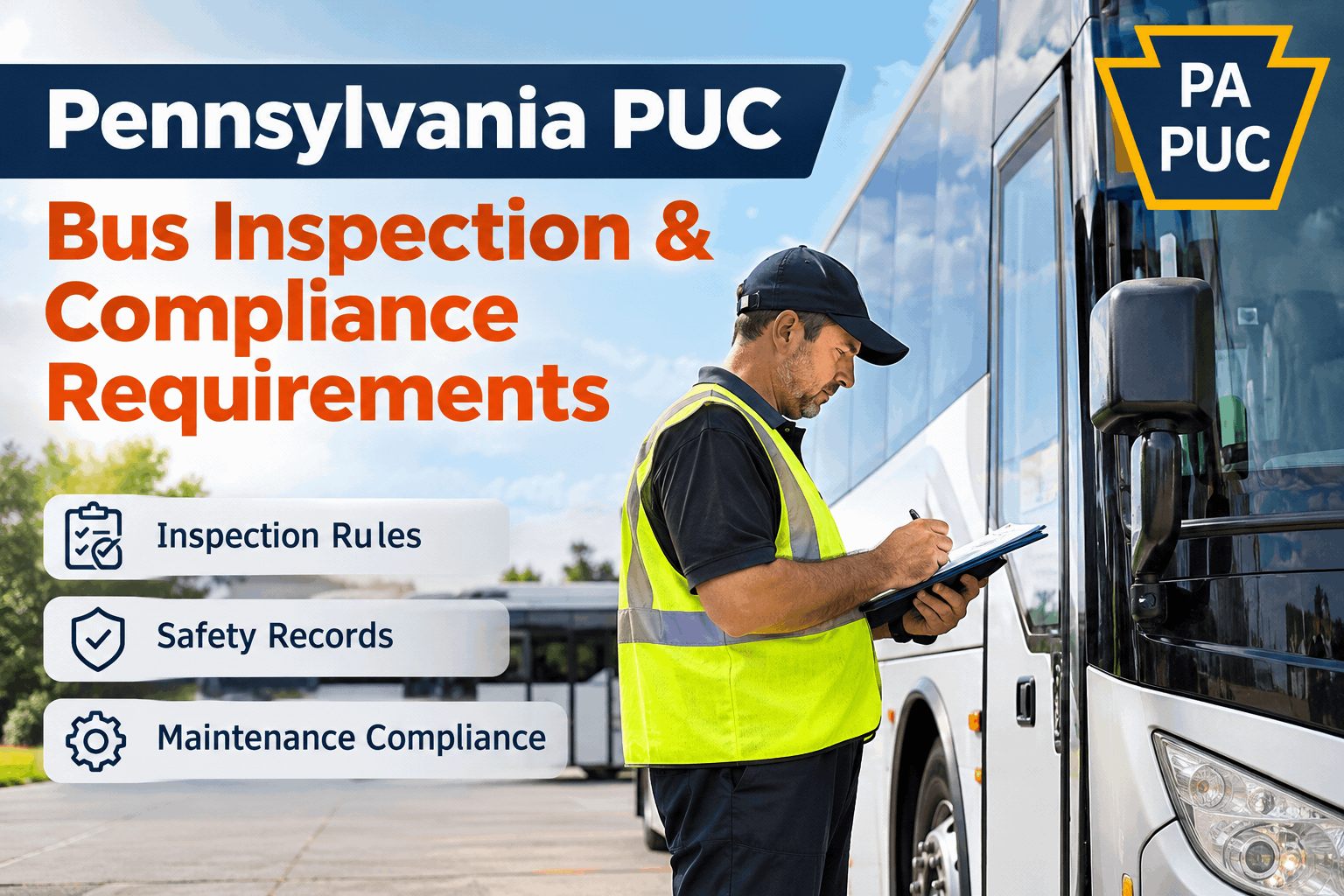
In most states, keeping a bus legal means passing an inspection. In Pennsylvania it means clearing two separate authorities. A Pennsylvania PUC bus inspection and compliance program covers the economic side — who is allowed to run buses for hire — plus the safety inspection every bus must pass twice a year. Charter and coach operators feel both. If you would rather keep both review-ready, book a BusCMMS demo and see how.
Pennsylvania PUC Bus Inspection & Compliance Requirements
Running a bus for hire in Pennsylvania is a stack, not a single step. You need PUC operating authority at the top, a passing semiannual safety inspection in the middle, and the maintenance records that hold the whole thing up underneath.
What Pennsylvania PUC bus inspection and compliance covers
The piece that surprises new operators is that no single agency owns the whole picture. The Public Utility Commission handles the right to operate — it regulates roughly 7,500 motor carriers statewide and certifies passenger carriers for safety and insurance. The safety sticker on the bus comes from somewhere else entirely — the State Police for school buses, or an official inspection station for everything else. Mixing the two up is how operators end up perfectly inspected but out of compliance, or fully authorized with a lapsed sticker. Here is who owns what.
Swipe sideways to see all columns
i Two regulators means two sets of records, two clocks, and two ways to fall out of compliance — which is exactly where a purpose-built bus CMMS earns its keep.
The semiannual inspection every PA bus must pass
Under the Vehicle Code, buses and heavy vehicles in Pennsylvania are inspected twice a year, not once. That is double the cadence most states run, and it is a deliberate choice for vehicles that carry people rather than freight. School buses are inspected under 75 Pa.C.S. 4705 and certified by the Pennsylvania State Police; other buses and vehicles over 17,000 pounds fall under 67 Pa.C.S. 175.5 and are inspected at official inspection stations. Either way, the clock runs on six months.
Every 6 months
Semiannual safety inspection for buses and heavy vehicles
17,000 lb +
Weight threshold that pulls vehicles into semiannual inspection
Two certifiers
State Police for school buses, inspection stations for the rest
Twice a year sounds manageable until a certificate lapses mid-season and a bus is suddenly illegal to run. A lapsed certificate does not just risk a fine; it means a bus you cannot legally put on a route until it is re-inspected and the sticker is renewed. The fleets that never cut it close are the ones with the next inspection date already on a dashboard, which you can see in a quick demo.
Safety Fitness Reviews: the PUC's real leverage
The PUC adopted the Federal Motor Carrier Safety Regulations for its certificated carriers, and its Motor Carrier Enforcement Division runs Safety Fitness Reviews and roadside checks to back them up. A review grades your records and your vehicles on the federal safety-rating scale, and a poor grade puts your operating authority itself at risk.
A review does not care how good your intentions are — it reads your paperwork. An unsatisfactory rating can lead to penalties, closer oversight, and in the worst case the loss of the authority your whole operation runs on. Clean maintenance files, logged inspections and closed work orders are what move a rating toward satisfactory, and they are exactly what a generic clipboard cannot produce on demand.
Your Pennsylvania PUC bus inspection checklist
Because two regulators are watching, this list spans both the vehicle and the paperwork. The red items can stop a bus or an operation cold; the amber items are the habits that keep you clear of a bad review. Print it if you like, but it works best built into a system that watches the dates for you so nothing slips between the two agencies.
- CRITICALCurrent semiannual inspection certificate on every bus.An expired certificate makes the bus illegal to operate, full stop.
- CRITICALPUC operating authority active and insurance on file.Lapsed insurance cancels your authority to carry passengers.
- CRITICALBrakes, steering, tires and safety equipment within limits.These are the defects that fail a semiannual inspection.
- PLANPreventive maintenance scheduled by mileage and calendar.Two inspection windows a year means readiness has to be continuous.
- PLANMaintenance and repair records kept review-ready.A PUC Safety Fitness Review reads these files first.
- PLANDaily driver inspection reports logged and retained.Required under the FMCSRs the PUC enforces.
Almost every compliance gap is a date someone forgot or a record no one could find. You can start tracking all of it free instead of hoping a binder is current.
Records that keep a Pennsylvania fleet compliant
Two regulators and a semiannual clock make compliance a records job as much as a wrench job. BusCMMS ships with bus-specific inspection forms on day one and ties every record to the right bus, so you are not rebuilding a trucking tool to fit a passenger fleet. When an enforcement officer or a reviewer asks for a vehicle's history, it is one click away instead of a folder someone has to reconstruct.
Fuel-type PM
Separate preventive schedules for diesel, CNG and electric buses, by mileage or date.
Work orders from defects
A failed item auto-creates a work order and tracks the repair through to closed.
Authority & cert alerts
Reminders for inspection certificates, insurance and operating-authority dates.
i BusCMMS reports districts and operators saving an average of about $2,800 per bus a year and holding 95%+ availability — its own published customer figures, worth testing against yours in a quick demo.
The inspection I could always handle. It was the PUC paperwork — insurance dates, the safety review, the records they ask for — that used to keep me up. Having all of it in one place with alerts changed that completely. A review is just a login now.
Owner, Pennsylvania charter and coach operator
The short version
Operate
Hold PUC authority and keep insurance on file.
Inspect
Pass the semiannual safety inspection on every bus.
Maintain
Run scheduled PM and keep records review-ready.
Prove
Produce it all on demand for a Safety Fitness Review.
A clean Pennsylvania PUC bus inspection and compliance record is just those four habits, kept current where you can find them. Put authority dates, inspections, PM and records in one place, and two regulators stop being two headaches. The operators who stay calm in Pennsylvania are not doing less work; they just stopped keeping it all in their heads. You can set up your fleet free and start building that record today.