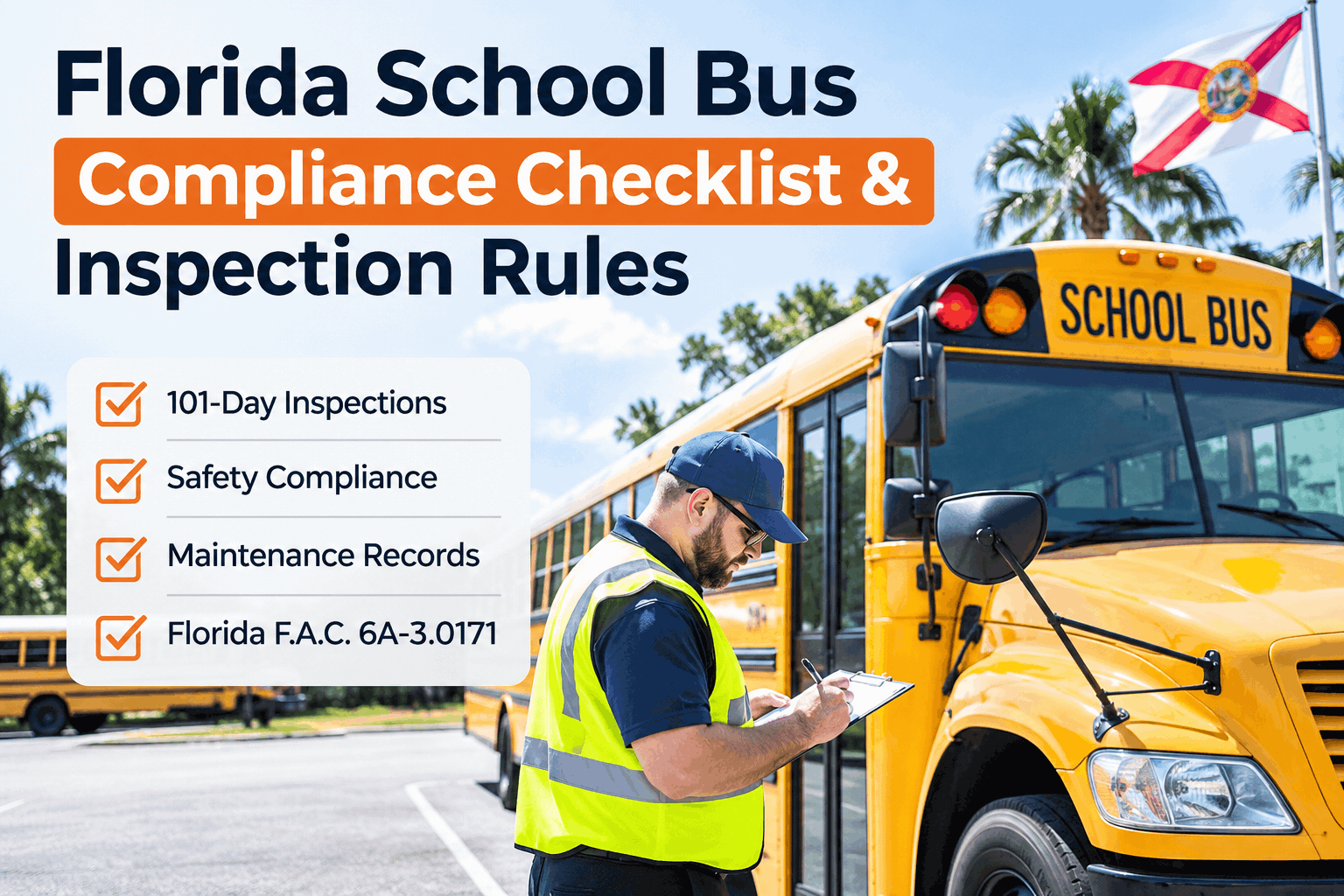
Florida just changed the clock on you. School bus inspections used to run every 30 school days; the state has now moved to a quarterly cycle with a hard ceiling of 101 calendar days. Staying inside that window is the core of Florida school bus compliance — and it only counts if an FDOE-certified inspector signs the state form. If you would rather track every bus's interval automatically, book a BusCMMS demo and see how.
Florida School Bus Compliance Checklist & Inspection Rules
Under Rule 6A-3.0171, Florida districts now inspect on a quarterly cycle instead of every 30 school days. The number that matters is the ceiling: no bus can go more than 101 calendar days between safety inspections.
How Florida school bus compliance works
Florida runs pupil transportation through the Department of Education and the Florida Association for Pupil Transportation, and the rulebook is 6A-3.0171. Every safety inspection follows the State of Florida School Bus Safety Inspection Manual and is recorded on the state inspection form. A bus that does not pass is withdrawn from service immediately — not at the end of the route, not tomorrow — until it meets the requirements again. The move to a quarterly cycle was meant to cut redundant inspections and line Florida up with industry practice, but a longer window is a double-edged thing: it gives you more room, and more room to forget. The state also keeps the right to inspect any bus itself to verify a district is holding the standard.
101 days
Maximum interval between safety inspections, quarterly cycle
Certified only
Inspections must be done by an FDOE-certified inspector
Immediate
A non-compliant bus is pulled from service on the spot
i A quarterly interval sounds generous until you are juggling it across a whole fleet with different last-inspection dates — which is where a purpose-built bus CMMS keeps you honest.
Only a certified inspector can sign the state form
This is the Florida detail that catches people. The inspection is not valid just because a good mechanic did it. Skill is not the same as certification here, and the state draws a bright line between the two. It has to be performed by a technician certified through the State of Florida School Bus Safety Inspector Program, and their seven-digit FDOE certification number goes on the form. The same form carries the road test, the repair order, and the return-to-service date. Miss any of those and the inspection is incomplete on paper, even if the bus is mechanically perfect. It is a reminder that in Florida, compliance is as much about documentation as it is about wrenches — the record is the proof, and the record has rules of its own.
Because the certification sits with the person, not the shop, you also have to track who on your team is current — certifications have to be renewed. Lose your last certified inspector to a lapsed credential and the whole schedule stalls, no matter how healthy the fleet is. You can see how inspector and bus records live together in a demo.
Your Florida school bus compliance checklist
This list covers the interval, the sign-off, and the paper trail — the three places a Florida district gets dinged. The red items can pull a bus or invalidate an inspection; the amber items keep you ahead of the 101-day ceiling. Work it per bus, because the quarterly window means no two buses in the yard are due on the same day.
- CRITICALNo bus more than 101 calendar days since its last inspection.This is the hard ceiling under the updated 6A-3.0171.
- CRITICALEvery inspection performed by an FDOE-certified inspector.An uncertified sign-off does not satisfy the rule.
- CRITICALAny non-compliant bus withdrawn from service immediately.Florida requires it off the road until it meets the standard.
- PLANInspector certifications tracked and renewed before they lapse.The certification is tied to the technician, not the garage.
- PLANInspection form, repair orders and return-to-service dates on file.Districts must keep inspection records for every bus.
- PLANDaily driver pre-trip inspections logged every service day.Required of every Florida school bus driver.
Nearly every compliance miss in Florida is a bus that slipped past its date or a record no one could produce. A reminder you set once is not the same as a system that counts every day on its own. You can start tracking intervals and records free instead of trusting a spreadsheet.
Records and intervals in one place
Florida compliance is a records discipline on a timer. Districts keep an inspection record for every bus, report their fleet through the Online Bus Inventory Application, and have to prove the interval was never exceeded. That is three obligations stacked on one timer, and they tend to fail quietly, one forgotten date at a time. BusCMMS ships with bus-specific inspection forms and ties every date and document to the right bus, instead of a trucking tool bent to fit a district. A fifty-bus fleet is fifty separate 101-day clocks, each started on a different day, and no spreadsheet reminder survives contact with a busy shop for long. When the state asks a district to show a bus was inspected on time, the answer should be a date, not a search.
Interval countdown
Counts days since last inspection on every bus and flags it before 101.
Work orders from defects
A failed item auto-creates a work order and tracks the repair to return-to-service.
Cert & record alerts
Reminders for inspector certifications and the records a district must keep.
i BusCMMS reports districts saving an average of about $2,800 per bus a year and holding 95%+ availability — its own published customer figures, worth testing against yours in a quick demo.
Fleet Services Manager · Florida school district
The quarterly change actually made it easier to lose track, because the window is longer and the dates all drift apart. The system counts the days for me now. I open it, I see which buses are coming up, and nothing crosses 101 by accident.
The rules in four lines
- Inspect every bus within 101 calendar days, on a quarterly cycle.
- Use an FDOE-certified inspector and document it on the state form.
- Withdraw any non-compliant bus from service immediately.
- Keep inspection records per bus and report your fleet inventory.
Strong Florida school bus compliance comes down to watching one interval per bus, using the right inspector, and keeping the paperwork where you can find it. Put the dates, forms and certifications in one place, and the longer quarterly window stops working against you. The districts that never scramble simply always know which bus is next, and who is cleared to sign for it. You can set up your fleet free and start building that record today.