Sixty minutes into evaluating the second of five bid responses, you notice the specification that was crystal clear in your RFP has been interpreted three different ways by the three vendors. Vendor A quoted a 4-year/300K-mile powertrain warranty. Vendor B quoted 5-year/500K. Vendor C quoted "manufacturer standard" and buried the actual terms in an appendix. The lowest-priced bid is $180,000 per bus. The highest is $240,000. But the 12-year TCO on the low-price option, once you back out its 4-year battery warranty, runs $60,000 higher per bus than the mid-price option. This is the reality of bus procurement -- the sticker price is the smallest number in the decision. This playbook covers the full lifecycle -- needs assessment, RFP specification, vendor evaluation, contract award, pre-delivery inspection, fleet acceptance, and Day 1 maintenance planning -- with the frameworks a procurement officer actually needs to make defensible decisions on multi-million-dollar fleet purchases.
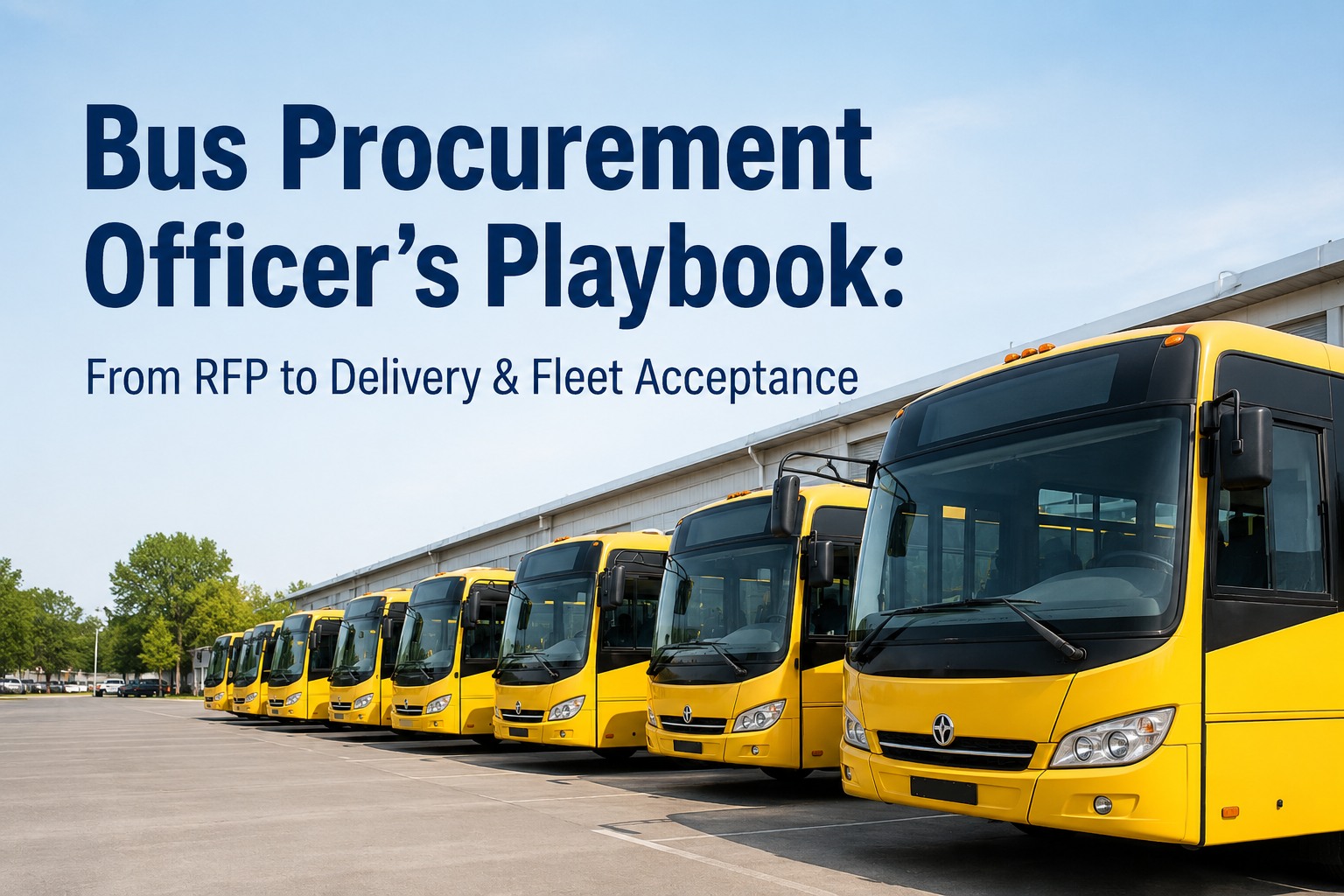
Bus Procurement Officer's Playbook: From RFP to Delivery & Fleet Acceptance
A full-lifecycle guide for procurement teams. Every stage from needs assessment through Day 1 fleet CMMS setup, with the frameworks and checkpoints that keep multi-million-dollar bus purchases defensible.
The lowest bid is not the lowest cost. Every framework, checklist, and template below is engineered to produce defensible bid recommendations that hold up in board meetings, audits, and bid protests.
Book Demo -- Day 1 Fleet CMMS from Acceptance5 Reasons Bus Procurement Is Not Fleet Purchasing Scaled Up
Procurement officers who treat a school bus like a big car, or a transit bus like a big truck, get burned within three years. The scale, compliance environment, vendor landscape, and lifecycle math are all different. Hover any card to see why it matters.
-
Scale
Multi-million-dollar single purchases
5-50 vehicles at $150K-$400K each. Every specification decision compounds by fleet size. A $2K per-bus mistake on 30 buses is $60K over the fleet lifecycle -- and one bad procurement can cascade for a decade.
-
Compliance
Public procurement rules apply
Buy America Act, FTA circulars for transit, state procurement code for schools. Defensibility of the process matters as much as vendor selection. Documentation is what protects you when audits and bid protests arrive.
-
Vendors
Concentrated manufacturer landscape
Very few manufacturers (Blue Bird, Thomas Built, IC Bus for schools; New Flyer, Gillig, Nova for transit). Long lead times (12-18 months). Options and configurations matter enormously in the specification.
-
Lifecycle
12-15 year service life expected
12-year FTA minimum for transit; 12-15 years typical for school buses. Purchase price is 25-30% of total lifecycle cost. Fuel, maintenance, and parts dominate the TCO conversation from year 2 onward.
-
Integration
Must integrate with existing fleet ops
New buses cascade into fleet management, DVIRs, GPS/telematics, fuel systems, and maintenance CMMS from Day 1. Procurement decisions become operations decisions for a decade+.
Bus Procurement in 8 Stages (Click Any Stage to Expand)
Every bus procurement follows the same 8-stage arc from needs assessment to fleet acceptance. Click each stage to see what happens, the key deliverable, and the pitfall that costs procurement teams money or credibility.
-
01 Needs Assessment 2-4 wk
Document the current fleet composition, average age, mileage, retirement schedule, and route/service demand. Identify the actual gap -- replacement, expansion, or fuel-type transition. Engage operations, maintenance, and finance stakeholders before writing a single specification.
Deliverable: Fleet needs memo + budget authorization from governing bodyPitfall: Skipping stakeholder alignment leads to mid-RFP spec changes that reset the clock -
02 Specification Development 4-6 wk
Draft the technical specification package. Cover chassis, body, powertrain, safety, seating, ADA/wheelchair, warranty, delivery terms, and every option/add-on. Reference industry standards (SAE J-standards, FMVSS, NHTSA). Include acceptance criteria -- how will you verify each spec at delivery?
Deliverable: Complete technical specification (60-120 pages typical)Pitfall: Vague warranty terms invite bid interpretation disputes downstream -
03 RFP Release 2 wk
Publish the RFP through required public channels (state procurement portal, FTA-required advertisement, local newspaper if applicable). Host a pre-bid conference for vendor Q&A. Document all vendor questions and issue written addenda -- verbal answers do not survive a bid protest.
Deliverable: Public RFP + pre-bid conference minutes + written addendaPitfall: Answering a vendor question privately voids the bid process -
04 Vendor Bid Submission 6-8 wk
Vendors prepare and submit proposals. Enforce the deadline strictly (late = disqualified). Verify each proposal meets minimum requirements before scoring: bid bond, insurance certificates, financial disclosures, technical proposal, price proposal, and required certifications (Buy America, DBE participation, etc.).
Deliverable: Compliant bid packages ready for evaluationPitfall: Accepting an incomplete bid opens the process to protest -
05 Evaluation & Scoring 4-6 wk
Convene the evaluation committee. Score each proposal against the pre-published weighted rubric (see Section 04). Document scoring rationale for every criterion. Conduct vendor interviews or best-and-final-offer (BAFO) rounds if the RFP permits. Never change the scoring criteria mid-evaluation.
Deliverable: Scored evaluation matrix + written justification per criterionPitfall: Undocumented scoring cannot survive an audit or protest -
06 Contract Award 2-4 wk
Board or governing-body approval. Notice of intent to award. Debrief unsuccessful vendors per applicable rules. Handle any bid protests before finalizing. Execute the contract with performance bond, warranty terms, delivery schedule, and change-order procedures explicit.
Deliverable: Executed contract + performance bond on filePitfall: Ambiguous change-order terms invite scope-creep disputes -
07 Pre-Delivery Period 12-18 mo
Bus manufacturer builds to specification. Procurement officer coordinates milestone reviews: chassis production, body integration, paint and finish, interior installation, safety systems integration, final quality inspection at the factory. Approve or reject each milestone. Schedule pre-delivery inspection at manufacturer's facility.
Deliverable: Milestone approval records + delivery schedulePitfall: Waiving factory inspection means finding defects at your lot -
08 Fleet Acceptance 2-4 wk
Buses arrive at your facility. Run the full pre-delivery inspection checklist (see Section 06). Verify VIN, weight/dimension compliance, all specifications met, all safety systems functional, all documentation received. Sign acceptance ONLY when all items pass or exceptions are documented. Begin CMMS enrollment on Day 1.
Deliverable: Signed acceptance + warranty registration + Day 1 CMMS setupPitfall: Accepting with open defects weakens warranty position
Total lifecycle: 12-24 months from needs assessment to fleet on the road. Book a demo to see how BusCMMS captures every lifecycle stage in one platform.
The 6 Specification Categories Every Bus RFP Must Cover
Weak specifications produce ambiguous bids. Click each category to see the minimum spec items procurement should include in every bus RFP.
A Chassis & Powertrain
- Chassis manufacturer + model
- Engine (diesel/CNG/electric/propane)
- Transmission type + gear ratios
- Axle configuration + capacity
- Suspension type
- Braking system (air/hydraulic + ABS)
- Fuel tank capacity + type
- Emissions compliance (EPA year)
B Body & Structure
- Overall length + wheelbase
- Roof height + structural rating
- Body material (steel/composite)
- Floor + ceiling construction
- Window specifications
- Emergency exits (per FMVSS)
- Undercarriage protection
- Paint + finish requirements
C Passenger Compartment
- Seat count + configuration
- Seat material + fabric
- Seatbelt configuration (lap/3-point)
- Aisle width + step configuration
- Interior lighting (LED preferred)
- HVAC capacity + zones
- PA / speaker system
- Wheelchair positions + securement
D Safety Systems
- Stop arm + crossing gate (schools)
- 8-light warning system + strobes
- Backup camera + alarm
- Interior + exterior cameras
- Student mirror system
- Fire suppression / detection
- Emergency lighting
- First aid + reflective triangles
E Electrical & Telematics
- Alternator + battery capacity
- Wiring standards (SAE J1939)
- GPS/AVL system + provider
- Engine diagnostic ports
- Data logger / event recorder
- USB / power outlets
- Radio + communication systems
- OBD-II accessibility
F Warranty & Service
- Bumper-to-bumper term + mileage
- Powertrain warranty (5-yr/500K typical)
- Battery warranty (EV specific)
- Structural warranty (10+ years)
- Paint + corrosion warranty
- Parts availability guarantee
- Service technician training
- Documentation + manuals
The Vendor Evaluation Scoring Rubric
Publish the weighted scoring rubric inside the RFP itself. Every evaluation committee member scores against the same rubric. Total score determines award recommendation. Typical weight allocation below -- adjust for your priorities, but publish before bids open.
Price
35%Total bid price + optional add-ons + freight. Score inversely -- lowest bid = highest score in this category. Adjust for TCO-relevant factors only if publicly disclosed in advance.
Technical Compliance
30%How completely does the proposal meet the RFP specification? Score per category from Section 03. Deductions for "or equivalent" language, missing options, or non-compliant sub-systems.
Warranty & Service
15%Bumper-to-bumper coverage, powertrain terms, battery warranty (EV), local service availability, parts inventory, technician training. Depth of coverage often determines 10-year TCO more than sticker price.
Delivery Schedule
10%Committed delivery date and reliability of the schedule. For fleet expansions with route launch dates, schedule reliability may weigh higher. Late delivery penalty terms should be defined in the contract.
Local Support & Financial Stability
10%Regional service dealer network, parts distribution proximity, response-time commitments, and vendor financial stability (recent audited statements). Small operational advantages compound across 12 years.
Purchase Price Is What You See. TCO Is What You Actually Pay.
The classic procurement blind spot: sticker price is 25% of what a bus costs over 12 years. The other 75% -- fuel, maintenance, parts, insurance -- lives below the waterline. Optimizing procurement for sticker price alone routinely inflates lifecycle cost by 30-40%.
A specification that optimizes fuel efficiency by 10% saves $21,000 per bus over 12 years. A warranty that covers powertrain 5-year/500K vs 3-year/300K saves $8,000-$15,000 per bus in out-of-warranty repairs. This is where the procurement officer's leverage lives. Book a demo to see per-vehicle TCO tracking in action.
Fleet Acceptance Inspection Checklist
Every bus is inspected against the spec before acceptance. Defects found now are covered under contract; defects found later fight through warranty claims. Below is the minimum inspection scope for every bus at acceptance.
Documentation
- VIN matches bill of sale
- Odometer reading captured
- Weight certificate + GVWR
- Emissions compliance certificate
- FMVSS conformity certification
- Warranty registration documents
- Owner's + service manuals
- Parts book + wiring diagrams
Chassis & Powertrain
- Engine start + idle inspection
- All fluids at level
- No visible leaks under vehicle
- Transmission shifts through gears
- Brake performance (loaded + empty)
- Steering play + alignment
- Tire specs + DOT date codes
- Exhaust system inspection
Body & Interior
- Paint quality + finish
- Panel gap + fit inspection
- Interior fit and finish
- Seats installed per specification
- Seatbelts on every seat operational
- Windows + emergency exits
- HVAC output + zone control
- Flooring + step tread condition
Safety & Electrical
- Stop arm + crossing gate deploys
- 8-light system + strobes
- All exterior + interior lighting
- Backup camera + alarm
- Camera system channels active
- GPS/AVL online + tracking
- OBD-II diagnostic scan pass
- Fire suppression charged
Any item that fails becomes a "conditional acceptance" line item -- the bus is not accepted (or is accepted with a written punch list and financial holdback) until resolved. This is procurement's leverage moment. Book a demo to see acceptance inspections captured directly in BusCMMS.
The 12-Year Fleet Lifecycle Starts on the Day You Sign Acceptance
The moment acceptance is signed, the 12-year fleet-lifecycle clock starts. Every mile driven, every PM completed, every warranty claim filed becomes a data point that supports the next procurement cycle -- if you capture it. Fleets that skip Day 1 CMMS enrollment lose 30-40% of the warranty leverage they paid for in the specification.
-
Day 1
Enroll bus in CMMS
Create asset record: VIN, spec sheet, warranty terms per category, dealer contact, service manual. Baseline the odometer + engine hours. Assign to route/service.
-
Week 1
Configure PM schedule
Enter manufacturer PM intervals. Configure alerts at 80% of interval so no PM is ever missed and warranty position is preserved.
-
Month 1
Driver DVIR training
Every driver trained on digital DVIR for the new bus type. Pre-trip inspection items match bus-specific systems (stop arm, wheelchair lift, camera diagnostics).
-
Year 1
Warranty claim tracking
Every warranty-covered repair filed with the manufacturer and captured in CMMS. Documentation trail supports dispute resolution and informs next-cycle procurement priorities.
-
Year 5-6
Mid-life inspection + refresh
Full inspection halfway through service life. Data from CMMS informs refurbishment vs continued operation vs early replacement decisions.
-
Year 10-12
Retirement + next procurement
End-of-life data (actual maintenance cost, MPG history, downtime, parts usage) feeds the specification for the next procurement cycle. Real data replaces guesswork.
A well-configured fleet CMMS pays for itself within the first 18 months of a single new-bus deployment through warranty capture alone. Book a demo to see the full procurement-to-retirement workflow live.
How long does a bus procurement cycle actually take?
Total elapsed time from needs assessment to delivery is typically 12-24 months for a first-time or complex procurement. The RFP-through-award portion is 4-6 months. The manufacturer's build lead time is another 12-18 months for school buses and can stretch further for transit or electric buses. Districts that have a repeat-buy relationship with the same manufacturer and a pre-approved specification can shorten the process by 4-8 months. Complex procurements (electric fleets, unusual configurations, multi-year contracts) can extend to 30+ months. Plan around the delivery date working backwards, not the RFP release date working forward.
What is the Buy America Act and does it apply to school bus procurement?
The Buy America Act (49 USC 5323(j)) applies to any purchase using FTA (Federal Transit Administration) funds, which primarily affects public transit agencies. It requires that iron, steel, and manufactured products used in the vehicle be produced in the United States. School district procurement is generally NOT subject to Buy America unless the district uses federal funds (like the EPA Clean School Bus Program, which does have domestic content requirements). Always verify with your state procurement office. When in doubt, include a Buy America compliance certification in the RFP -- it does not hurt and it protects federal-funds eligibility.
Should we weight price higher or lower than 35% in vendor evaluation?
Depends on procurement policy and category depth. Weights above 40% for price tend to select the lowest bidder regardless of quality signals, which optimizes short-term budget but can inflate 12-year TCO. Weights below 25% for price invite challenges from vendors who lost narrowly on non-price factors. Most public procurement processes settle in the 30-40% price weight range with the remainder split among technical, warranty, delivery, and support. Whatever weighting you choose, publish it in the RFP and document the rationale in your procurement file.
What is the biggest procurement mistake that costs money later?
Accepting vague warranty terms. Vendors will use language like "manufacturer standard warranty" or "industry standard powertrain coverage" without specifying years, mileage, or component-specific coverage. When a 4-year-old bus has an injector failure and the vendor cites the fine print, procurement has no leverage. The fix: require the RFP to include an explicit warranty specification table with years, mileage, systems covered, deductibles, and dispute resolution process. Do not accept "or equivalent" language on warranty terms.
How does BusCMMS support the procurement lifecycle?
BusCMMS captures the full 12-year fleet lifecycle in ways that feed back into procurement. Acceptance inspection results, warranty terms per specification category, PM schedules aligned to manufacturer intervals, warranty claim documentation, actual maintenance cost per vehicle, MPG history, downtime tracking, and end-of-life data all live in one platform. When the next procurement cycle begins, procurement pulls real per-vehicle TCO data instead of estimating. Specifications get sharper, vendor evaluation becomes more informed, and TCO projections become defensible. Book a 20-minute demo to see the procurement-to-retirement workflow live, or start a 30-day free trial.