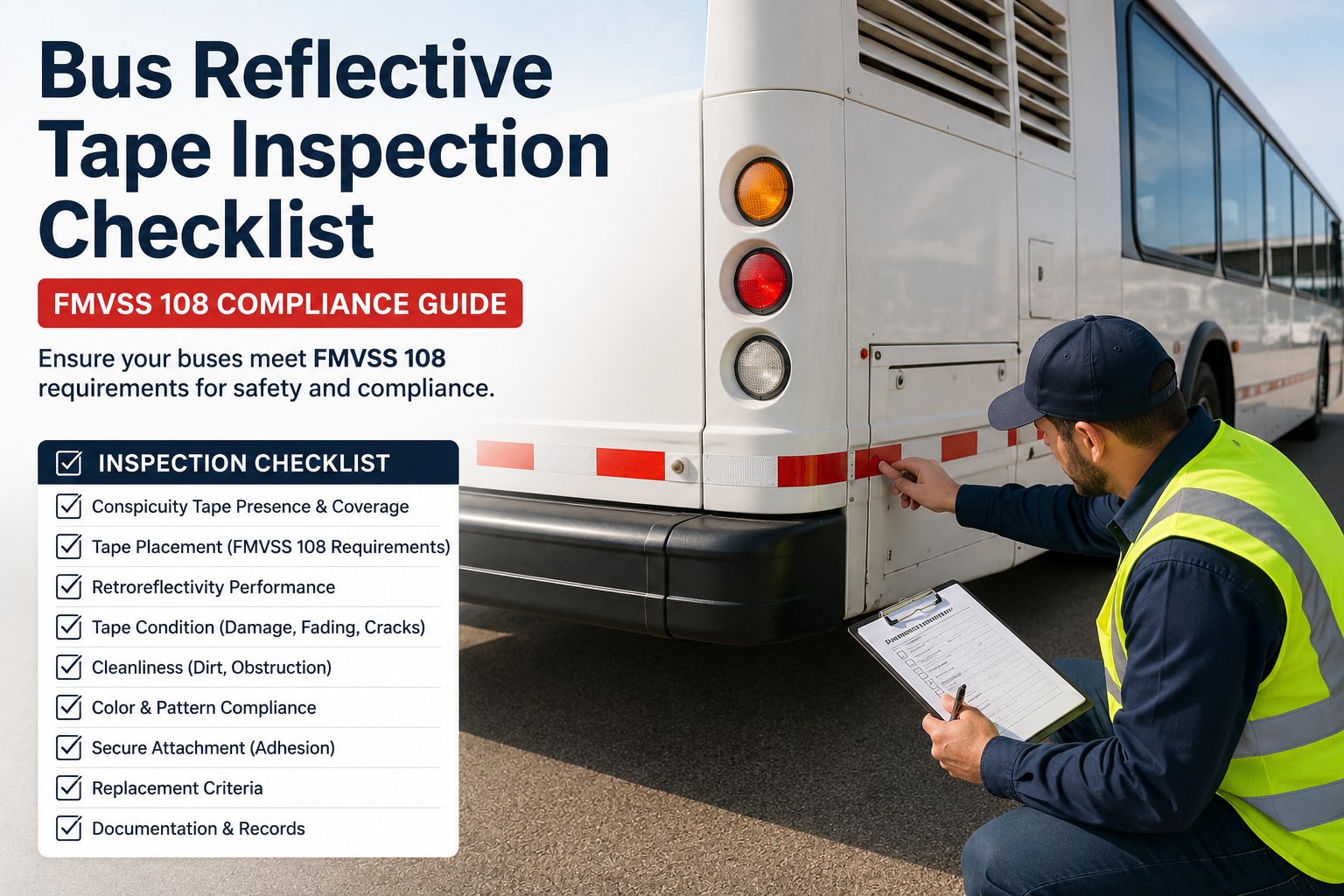
Your bus fails a state DOT inspection because the reflective tape on the rear bumper faded past FMVSS 108 minimum retroreflectivity. The out-of-service order costs a full day of routes plus $150-$500 in fines per violation. Multiply that across a 60-bus fleet and one bad audit becomes a $30,000 problem. Reflective tape inspection is the cheapest compliance win in fleet maintenance -- 5 minutes per bus per PM cycle prevents the fines, keeps the buses on route, and creates the documentation trail every state DOT audit demands.
Bus Reflective Tape Inspection Checklist (FMVSS 108 Compliance Guide)
The complete 2026 inspection checklist for bus conspicuity markings -- FMVSS 108 requirements, DOT-C2/C3/C4 rating verification, retroreflectivity standards, damage indicators, and the documentation trail that protects the fleet during state DOT audits.
Why FMVSS 108 Compliance Matters
Faded, damaged, or missing reflective tape is one of the top 5 findings on state DOT bus inspections. The math on ignoring it is bad.
Per violation fine
State DOT fines for FMVSS 108 non-compliance per bus, per violation. Multiple violations on the same bus can compound.
Out-of-service
Serious FMVSS 108 violations trigger immediate out-of-service orders. Bus does not leave the yard until repaired and re-inspected.
Night visibility loss
Faded tape loses 50-70% of retroreflective capability. Buses become significantly harder to see at night on rural routes and roadside stops.
Compliance record
Repeat FMVSS 108 violations flag the fleet for enhanced state DOT audits, increased inspection frequency, and public compliance scores.
Book a demo to see how BusCMMS logs FMVSS 108 inspections per bus with photo evidence.
DOT-C2, DOT-C3, and DOT-C4 Rating Standards
Not all reflective tape is created equal. FMVSS 108 requires specific retroreflectivity ratings depending on vehicle width and application. Verifying the correct rating during inspection prevents non-compliance from "wrong tape" purchases.
Straight trucks + small vehicles
- Minimum retroreflectivityHighest tier
- Common widthUnder 80" (2 in)
- Best forSmall activity buses, shuttles
Standard commercial vehicles
- Minimum retroreflectivityHigh tier
- Common widthUnder 96" (3 in)
- Best forTransit buses, medium buses
Wide vehicles (most school buses)
- Minimum retroreflectivityWide-vehicle tier
- Common width96" and wider (4 in)
- Best forFull-size school buses, coaches
Always verify the DOT rating printed on the edge of the tape during inspection. Cheap unrated aftermarket tape looks identical to certified tape but fails retroreflectivity testing within 12-18 months. Book a demo to see how BusCMMS tracks tape brand + DOT rating + install date per bus.
Complete FMVSS 108 Reflective Tape Inspection Checklist
Organized by bus area. Each item includes what to check, PASS criteria, and the failure mode most likely to catch you at DOT inspection.
Rear of Bus (Highest DOT Focus)
-
A1 · Rear horizontal strip
Inspect the horizontal red/white alternating strip across the rear body panel. Continuous, unbroken, extending as wide as practical.
PASS: Continuous strip, no gaps >2 inches, red/white pattern visible, DOT rating stamped FAIL: Faded, peeling, missing sections, or replaced with wrong DOT rating -
A2 · Rear vertical strips at corners
Vertical strips at both rear upper corners. Should extend from the top of the rear cap to the top of the rear window.
PASS: Both corners marked, aligned with body edges, no delamination FAIL: Only one corner marked, tape pulling away from body, dirt/road grime obscuring retroreflectivity -
A3 · Rear bumper corner markers
Small corner markers at the outer edges of the rear bumper. Often the first to fail from parking impacts and salt exposure.
PASS: Both markers present, undamaged, retroreflective at flashlight test FAIL: Scratched, gouged, missing, or non-reflective under flashlight
Sides of Bus
-
B1 · Upper conspicuity strip (both sides)
Horizontal strip running along the upper body of both left and right sides. Marks the outline of the bus for oncoming drivers.
PASS: Continuous strip both sides, DOT-C4 rating verified, retroreflective under flashlight FAIL: UV-faded to pale/yellow, peeling at seams, or replaced sections mismatched -
B2 · Lower rocker panel strip
Horizontal strip along the lower body panel. Most exposed to road salt, splash, and parking damage.
PASS: Continuous both sides, no salt crust or road film blocking reflectivity, no peel at edges FAIL: Salt corrosion under edges, sections replaced with wrong color pattern, dirt buildup obscuring reflective surface -
B3 · 4 corner markers (front + rear, both sides)
Small markers at each of the four upper corners of the bus body. Wrap-around corners typically require both side and rear coverage.
PASS: All 4 corners marked, undamaged, aligned with body edges FAIL: Missing any corner, sun damage on driver-side markers, tape lifting
Emergency Exits (School Bus Specific)
-
C1 · Emergency door red border
Solid red retroreflective border framing the rear emergency exit door. Must be uninterrupted and clearly define the exit.
PASS: Continuous red border, no gaps, no color fading toward orange/pink FAIL: Faded to orange or pink, sections missing at corners, door frame flexing broke tape seal -
C2 · Side emergency exit borders
Side emergency exits (windows or doors) also require red retroreflective borders. Often overlooked because they are used less often.
PASS: All side emergency exits marked with visible red border FAIL: Any side emergency exit missing border, weather-worn corners, ripped by student use -
C3 · Roof escape hatch markings
Some jurisdictions require reflective markings around roof escape hatches. Verify state requirements before inspection.
PASS: Markings present per state requirement, undamaged from weather exposure FAIL: Missing where required, sun-damaged, water intrusion under tape edge
Bumpers & Auxiliary Zones
-
D1 · Front bumper corner markers
Corner markers on the front bumper edges. Often damaged by parking, curb strikes, or low-speed impacts.
PASS: Both front corners marked, clean surface, retroreflective at flashlight test FAIL: Scratched or gouged from parking, corrosion under edge, missing on one side -
D2 · Stop arm reflective panel (school bus)
The stop arm itself carries reflective panels. Inspect during the stop arm PM cycle for cracking, delamination, and reflectivity loss.
PASS: Both stop arm faces reflective, no cracking, mounting hardware intact FAIL: Fading, cracked laminate, dirt buildup, hardware corrosion -
D3 · Crossing gate reflective (school bus)
Front crossing gate uses reflective panels. Regularly damaged by low-speed impacts and student contact during boarding.
PASS: Reflective panels intact, gate motion tested, no mounting damage FAIL: Impact damage, missing panels, torn edges, mounting hardware loose
How to Verify Retroreflectivity in the Field
A DOT inspector's flashlight test is the fastest field check for retroreflectivity. Use the same method on every PM cycle.
-
01
Position 20-30 feet away
Stand back from the bus in a dimly lit area or after dusk. Distance matches typical driver observation range.
-
02
Shine a bright flashlight directly at the tape
Use a high-lumen flashlight held at eye level, aimed at the reflective surface. Simulate a car headlight approach.
-
03
Observe the return brightness
Good tape returns bright white light almost like a mirror. Faded tape returns dim yellow or dull white. Failed tape shows almost no return.
-
04
Compare against known-good sections
Check faded suspects against tape sections that were recently replaced. Side-by-side comparison surfaces marginal failures.
-
05
Document with photo evidence
Capture flashlight-test photos as proof of inspection. Attach to the digital DVIR for the audit trail.
Decision Matrix: Replace, Repair, or Leave Alone
Not every tape blemish is a violation. Not every faded section needs a full replacement. This decision matrix keeps the shop focused on what matters.
Minor cosmetic issues
- Minor surface dirt (wipe with soap + water)
- Small edge lift under 1/2 inch (monitor)
- Slight scuff marks (still reflective)
Localized damage
- Corner missing on one marker
- Section under 6 inches damaged
- Single emergency exit border torn
- One rear bumper corner marker damaged
Systemic failure
- UV fade across multiple sections
- Damage over 12 inches on any strip
- Wrong DOT rating throughout
- Peeling along the entire strip length
- Retroreflectivity failed on flashlight test
When in doubt, replace. FMVSS 108 tape material costs run $8-$25 per foot. A single out-of-service order costs $500-$2,000 in fines plus a lost route. The economics almost always favor replacement. Book a demo to see how BusCMMS logs replacement history + parts cost per bus.
Turning the Checklist Into Audit-Ready Documentation
A paper checklist filled in at end-of-shift is not documentation. It is a signature exercise. Digital DVIRs make the inspection real and the audit trail bulletproof.
Bus-specific DVIR forms
FMVSS 108 items pre-loaded into the digital DVIR alongside other bus-specific inspection points (stop arm, crossing gate, emergency exits, wheelchair lift). Technician sees the reflective tape checklist for the right bus type on Day 1.
Photo attachment per item
Failed items can be documented with a photo from the technician's mobile device. Faded tape, damaged bumper corner, torn emergency exit border -- all captured with the inspection record.
Auto-generated work orders
A failed tape inspection item automatically creates a work order for replacement. Parts, labor, and material cost tracked against that bus's compliance record.
Compliance reporting
State DOT and FMCSA audit reports pull directly from the digital DVIR history. Every FMVSS 108 check date, technician sign-off, photo evidence, and repair record in one export.
Reflective tape inspection is a five-minute check. The value shows up when a state inspector asks "when was this last inspected?" and the answer is a specific date, technician name, and a photo -- not a shrug. Book a demo to see the digital DVIR + compliance reporting workflow live.
What is FMVSS 108 and does it apply to my school bus?
FMVSS 108 (Federal Motor Vehicle Safety Standard 108) covers lamps, reflective devices, and associated equipment on motor vehicles. It applies to trucks, trailers, and buses over 10,000 pounds GVWR manufactured after December 1, 1993. Every full-size school bus, transit bus, and coach in the US falls under FMVSS 108. Compliance is verified during annual state DOT inspections, roadside inspections, and post-accident investigations.
How often should reflective tape be inspected?
Every preventive maintenance cycle, plus every 90-day compliance inspection. Best practice is to include reflective tape as a line item on the daily driver DVIR (visual check for obvious damage), the monthly technician inspection (flashlight retroreflectivity test), and the annual state DOT preparation inspection (full FMVSS 108 audit). Missing tape damage between PM cycles is a common cause of DOT violations.
How long does FMVSS 108 compliant tape last?
Certified DOT-C2, C3, and C4 tapes typically last 5-7 years under normal fleet conditions before retroreflectivity drops below FMVSS 108 minimums. Buses running heavy salt-belt routes (Northeast, Upper Midwest) or high-sun-exposure regions (Southwest, Southeast) can see 3-4 year replacement cycles. Track install date per bus in the CMMS to catch replacement windows before the annual DOT inspection.
Can I use non-DOT-rated reflective tape on my bus?
No. FMVSS 108 requires DOT-certified reflective sheeting -- specifically DOT-C2, DOT-C3, or DOT-C4 rated products depending on vehicle width. Non-certified tape may look identical but does not meet minimum retroreflectivity requirements and will fail state DOT inspection. The DOT rating is printed on the edge of certified tape. Always verify the rating during inspection and always source replacement material from certified suppliers.
How does BusCMMS help with FMVSS 108 compliance?
BusCMMS includes FMVSS 108 inspection items in its bus-specific digital DVIR forms. Every inspection is logged per bus with date, technician, pass/fail per item, and photo evidence for failed items. Failed items automatically generate work orders for repair or replacement. Compliance reports pull the FMVSS 108 inspection history for any bus, any date range, for state DOT audits and FMCSA reviews. Book a 20-minute demo to see the compliance reporting workflow live, or start a 30-day free trial.