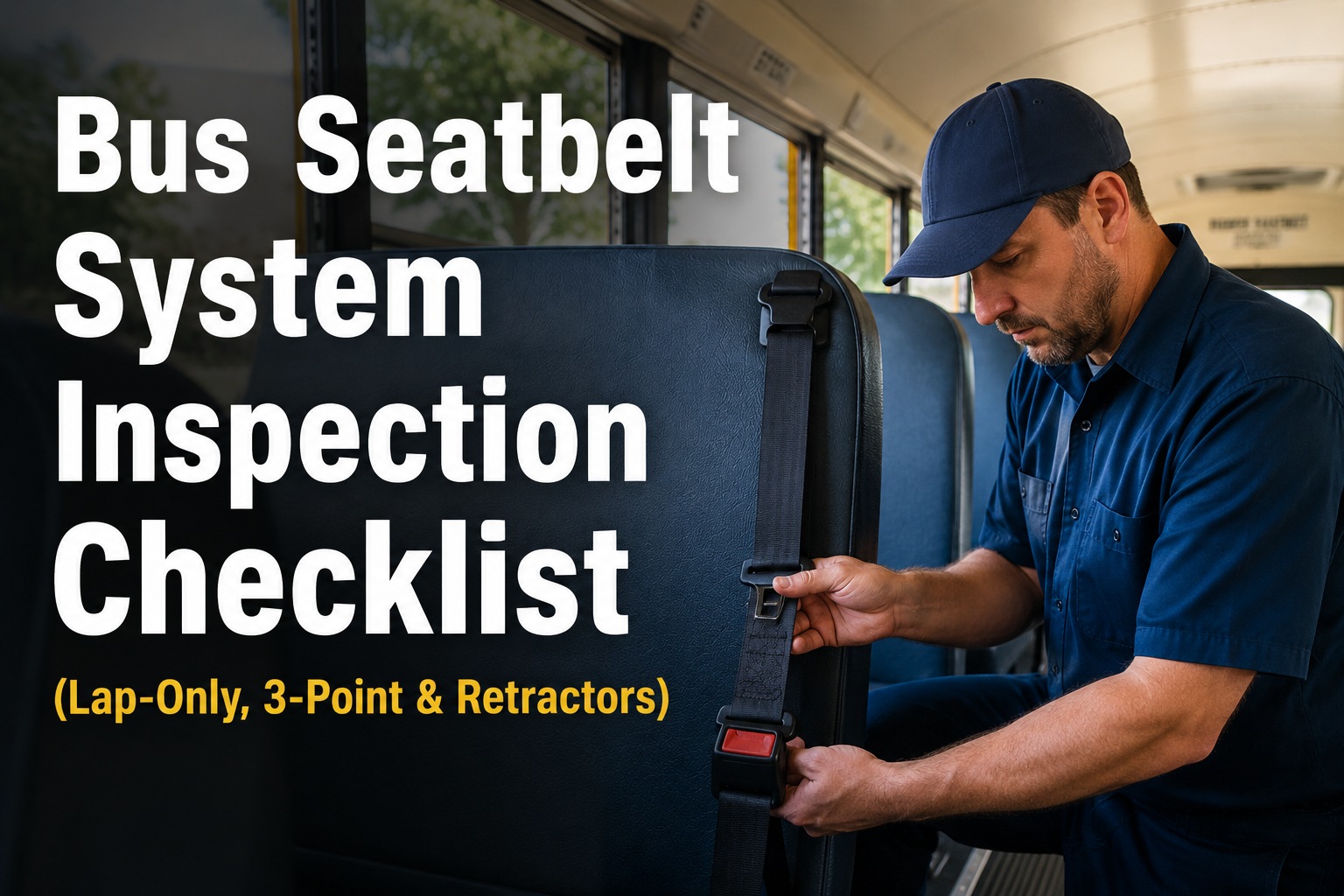
A driver caught a frayed shoulder belt on seat 14B during morning pre-trip. If they had not, the same defect would have failed the state DOT audit six weeks later. That is the seatbelt inspection problem in one sentence: three different cadences, four physical surfaces, one belt that has to work when a passenger goes hip-and-shoulder into it during a crash. This is not a form to fill in. It is the field reference for building a fleet inspection program that catches failures early instead of on audit day.
Bus Seatbelt Inspection: The Cadence-First Reference
A defect-severity, frequency-first, and audit-ready guide for lap-only, 3-point, and retractor belt systems on school, transit, and coach buses. Built for the fleet safety manager designing the program, not just the inspector holding the clipboard. Book a 20-min demo to see how BusCMMS runs this program at fleet scale.
Which Checks Belong at Which Frequency
Every belt on every bus needs four different depths of inspection. Design your program around this matrix.
- Visual on driver's own belt
- Spot check on 2-3 passenger belts
- Note any visible damage
- Belt functional (buckles + releases)
- All belts visible from aisle
- Sample buckle/release on 25% of positions
- Retractor function check on 3 belts
- Log any defects found
- Every belt: webbing full length
- Every buckle: latch + release test
- Every retractor: ELR + ALR function
- Visual anchor inspection
- All monthly items plus:
- Anchor torque check + logged value
- Photo of each seat position
- FMVSS 208/209/210/222 attestation
The Four Physical Surfaces Where Belts Fail
Every seatbelt on every bus fails at one of these four places. Know the surface, know its function, know what kills it.
-
Surface 1
Webbing
Function. Transfers crash load from the passenger's body to the anchor points.
How it fails. UV bleaching, chemical damage from cleaning products, cuts from sharp seat edges, sun rot after years of exposure.
Inspect for. Cuts, frays, discoloration, stiffness, mold on lap sections, illegible DOT stamps.
-
Surface 2
Buckle & Latch
Function. Locks the tongue in place under crash load. Releases cleanly under thumb pressure.
How it fails. Debris inside the housing (school buses: candy, coins, pens), worn internal latching, cracked plastic shell, weakened release spring.
Inspect for. Single audible click on engagement, clean release, no housing cracks, tongue slides freely on webbing.
-
Surface 3
Retractor Assembly
Function. Locks the belt under sudden deceleration (ELR) and cinches down for child seats (ALR). 3-point belts only.
How it fails. Worn internal pawl, dirt-bound spool, fatigued return spring, cracked housing from vibration.
Inspect for. Locks on sharp jerk, cinches when fully extended, smooth return, no visible wear at spool exit point.
-
Surface 4
Anchor Points & Hardware
Function. Holds crash load. FMVSS 210 requires anchors to withstand 3000 lbs static load.
How it fails. Vibration loosening, corrosion on coastal fleets, cracked mounting substrate, stripped anchor nut.
Inspect for. Torque to spec (40-55 ft-lbs typical), zero movement under load, no corrosion, no substrate cracks.
Webbing Defect Severity Reference
FMVSS 209 · 302The most common judgment call at inspection: "the webbing has a small fray, is that a fail?" This is the reference.
| What You See | Severity | Action |
|---|---|---|
| Surface fuzz, no fiber break | Minor | Note in log. Re-inspect in 7 days. |
| Chemical discoloration, no stiffness | Minor | Clean per OEM procedure. Re-inspect in 7 days. |
| Small cut under 1/8 inch | Major | Tag out. Replace webbing at next monthly. |
| Chemical stiffness or gummy feel | Major | Tag out. Replace webbing at next monthly. |
| Cut over 1/8 inch or through weave | Critical | Immediate out-of-service. Replace before next trip. |
| UV bleaching with fiber break | Critical | Immediate out-of-service. Replace assembly. |
| Missing or illegible DOT label | Critical | Immediate FMVSS 209 non-compliance. Replace. |
Book a demo to see auto-generated work orders from tagged webbing defects.
Buckle & Latch Defect Severity Reference
FMVSS 209Buckle mechanisms wear silently. The defect surfaces here are almost always inside the housing, not visible without a functional test.
| What You See or Feel | Severity | Action |
|---|---|---|
| Slight resistance on release | Minor | Clean housing with compressed air. |
| Debris visible inside housing | Minor | Clear with compressed air. Re-test 5 times. |
| Requires 2+ tries to latch | Major | Tag out. Buckle assembly replacement. |
| Release button feels stuck | Major | Tag out. Buckle assembly replacement. |
| No audible click on engagement | Critical | Immediate out-of-service. Internal latch worn. |
| Housing cracked or heat-damaged | Critical | Immediate out-of-service. Replace assembly. |
Retractor Defect Severity Reference
FMVSS 209 · 3-Point OnlyThe retractor is the most commonly misdiagnosed part. Any inconsistency in locking behavior means replace the assembly. Do not attempt internal repair.
| What You See or Feel | Severity | Action |
|---|---|---|
| Slight delay on spool return | Minor | Clean spool exit area. Re-inspect in 7 days. |
| Belt does not fully retract at rest | Major | Tag out. Retractor assembly replacement. |
| ALR does not cinch on full extraction | Major | Tag out. Retractor replacement. |
| ELR fails to lock on sharp jerk | Critical | Immediate out-of-service. Replace before next trip. |
| Grinding or clicking during extraction | Critical | Immediate out-of-service. Internal mechanism worn. |
| Housing cracked or fasteners loose | Critical | Immediate out-of-service. Replace mount + assembly. |
Book a demo to see retractor replacement tracking + warranty capture per bus.
Anchor & Hardware Defect Severity Reference
FMVSS 210Anchor failures are catastrophic. Any anchor movement under load, any thread issue, any substrate crack is critical.
| What You See or Feel | Severity | Action |
|---|---|---|
| Surface corrosion on bolt head | Minor | Clean, protect. Re-inspect in 30 days. |
| Torque within 10% of spec | Minor | Re-torque to spec. Log new value. |
| Torque under 90% of spec | Major | Tag out. Investigate for stripped nut. |
| Corrosion on anchor plate or bolt shank | Major | Tag out. Remove hardware, inspect substrate. |
| Any movement under pull test | Critical | Immediate out-of-service. Substrate compromised. |
| Bolt cannot torque to spec (spins) | Critical | Immediate out-of-service. Stripped anchor nut. |
| Mounting substrate cracked | Critical | Immediate out-of-service. Structural repair required. |
What a Per-Bus Coverage Map Looks Like
The output of an inspection program is not a completed form -- it is per-position status across every belt on every bus. This is what your fleet safety director needs to see the morning after monthly PM.
Open findings: Seat 7C -- webbing fray at buckle exit (Major). Seat 12D -- retractor lock intermittent (Critical, out-of-service). Seat 11B -- pending re-inspection after buckle cleaning.
A coverage map like this is the difference between "we inspected the bus" and "we can prove which belt on which seat was cleared by which inspector on what date." Book a demo to see live coverage maps generated from your fleet's inspection data.
How BusCMMS Runs This Program
The reference is the same on paper or on a tablet. The difference is what happens after a defect is found.
-
01
Inspector opens BusCMMS on tablet
Selects bus + inspection cadence (weekly/monthly/annual). The template pre-loads the belt count and configuration from the bus asset profile.
-
02
Per-position checks logged
Each seat position gets pass/major/critical status. Failed items prompt photo capture and severity classification per the reference tables above.
-
03
Failed checkpoints auto-generate work orders
A Critical finding creates an immediate work order tagged out-of-service. Major creates a work order due before next monthly. Minor logs a re-inspect trigger for 7 or 30 days.
-
04
Sign-off closes the inspection to bus asset
Inspector signs. The record files against the bus. Annual DOT audit exports the last four quarters in a compliance-ready format. Book a demo to see the audit export live.
The webbing has a small cut but the belt is still under load spec. Serviceable?
No. FMVSS 209 defines seatbelt webbing performance based on undamaged material. Any cut, fray, or damage reduces the effective cross-section and compromises tensile strength in a crash. The severity reference above is unambiguous: a cut over 1/8 inch or through the weave is critical and gets pulled out of service. When in doubt, replace. A webbing assembly costs a fraction of the liability exposure of a compromised restraint.
How often do we actually have to torque-check anchor bolts?
FMVSS 210 sets performance requirements but does not mandate re-torque intervals. Industry practice is: torque check at every annual inspection, and after any incident that could have loaded the anchor. High-vibration operations (rough roads, coastal fleets, older buses with sheet-metal fatigue) benefit from a quarterly torque check on random sample. The severity table treats "torque under 90% of spec" as Major -- because a slowly loosening anchor is a leading indicator of substrate fatigue.
The buckle needs two tries to latch after cleaning. Replace or keep?
Replace. Cleaning fixes debris. It does not fix a worn internal latch spring or fatigued receiver housing. If a buckle needs multiple attempts after being cleaned, the internal mechanism is at end of life and the assembly is Major severity per the reference. Tag it out and schedule the replacement at your next monthly inspection window -- unless it fails to latch at all, in which case it is Critical and immediate.
Do lap-only belts on older school buses still meet compliance in 2026?
FMVSS 222 requires seat belts on all school buses built after specific dates depending on GVWR. Older buses grandfathered under prior rules may still carry lap-only belts. State mandates vary: California, Nevada, Texas, New York, New Jersey, Florida, Louisiana, Arkansas, and Iowa require 3-point on new school bus purchases, with dates and phased-in requirements that vary by state. If your fleet still runs lap-only belts, all four defect surfaces still apply -- webbing, buckle, retractor (if fitted), and anchor -- and Section 05 of the reference tables is your compliance path.
Where does the coverage map + inspection history actually live for DOT audit?
Paper folders and shared drives are where DOT audit findings come from -- the inspection got done, the record got lost. The audit-safe approach is a bus-specific CMMS that files each inspection against the bus asset -- inspector, date, per-seat findings, photos, torque values, corrective work orders, and closure evidence. When the state DOT inspector asks for the last four quarterly inspections on bus #47, the record exports in seconds instead of being reconstructed from three binders. Book a 20-minute demo to see audit-ready reporting live, or start a 30-day free trial and log your first inspection today.