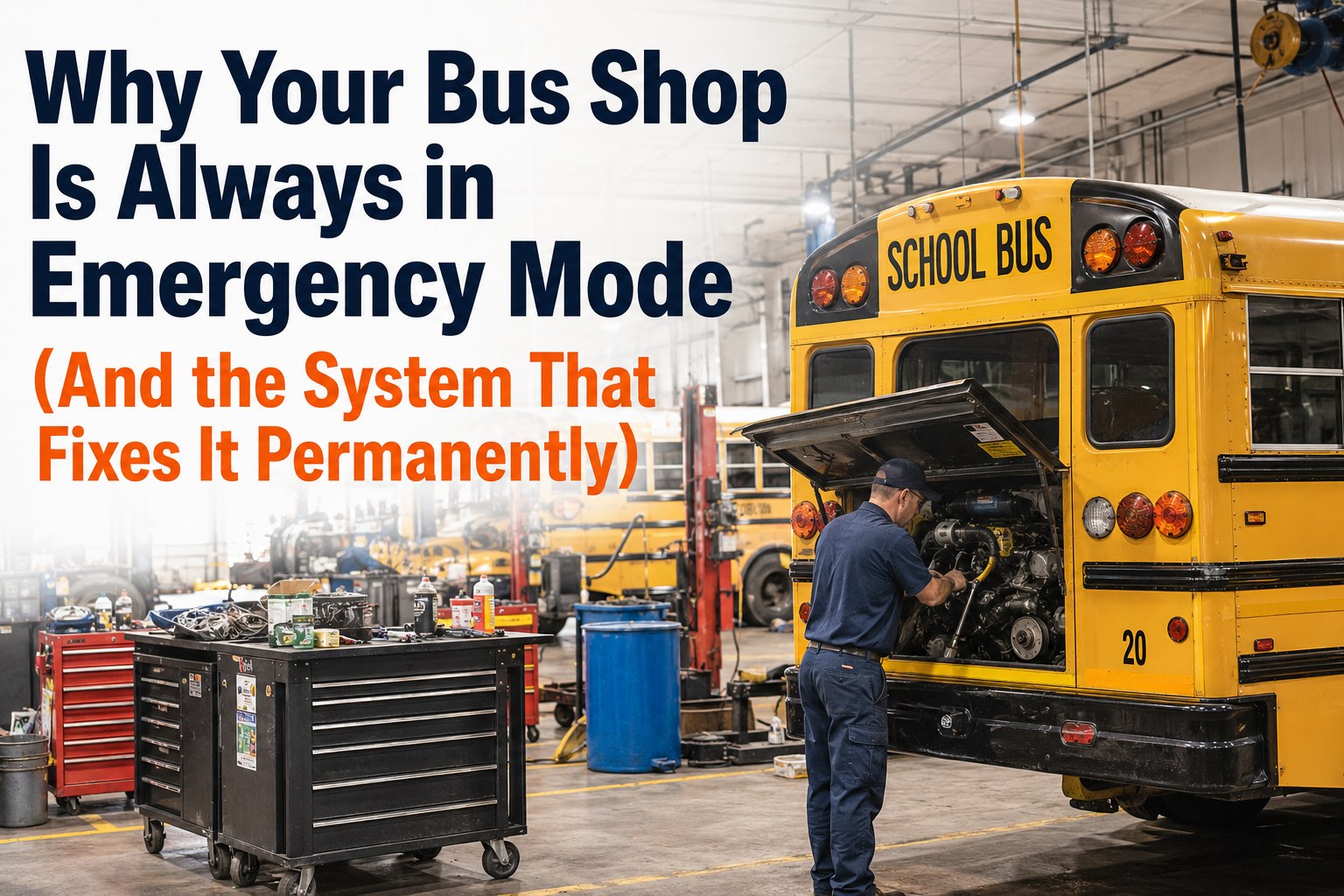
It's 6:14 AM. Bus #28 won't start — dead battery, but probably the alternator. Bus #15 has a brake warning light. Bus #41 came back yesterday with a fluid leak nobody logged. Your mechanic is already behind before the first student boards. He'll spend the morning triaging which bus can still run and which can't, then the afternoon chasing parts for the one that broke down on Route 7 at 3:15 PM. The PM on Bus #33? Pushed to next week. Again. This is your shop every day — not because your mechanic is bad, but because the system that's supposed to prevent emergencies doesn't exist. You don't have a maintenance program. You have a firefighting operation. And it's costing you $85,000 a year more than it should .
Why Your Bus Shop Is Always in Emergency Mode (And the System That Fixes It Permanently)
68% of bus fleet maintenance is reactive. The cost difference between reactive and proactive is 3–5x per repair. Here's the system that breaks the cycle.
Your Shop Right Now
$9,500/bus/yr
Where It Should Be
$5,500/bus/yr
The Emergency Mode Cycle (And Why It Gets Worse Every Month)
Emergency mode isn't random. It's a self-reinforcing cycle that accelerates the longer it runs. Here's how it works in your shop:
1
Breakdown happens — Bus #28 won't start. Route disruption. Emergency priority.
2
PM gets bumped — mechanic pulled from Bus #33's scheduled PM to fix #28.
3
Backlog grows — 3 PMs now overdue. No visibility into which are safety-critical.
4
Deferred PM fails — Bus #33's brake issue (the one from the skipped PM) fails at 3:15 PM. On a route.
5
Back to step 1 — now you have two emergencies. Tomorrow you'll have three.
Each cycle makes the next one worse. Deferred PMs compound — one skipped oil change becomes a turbo failure. One skipped brake check becomes a roadside OOS. The reactive shop spends 3–5x more per repair because every fix is an emergency: overtime labor, rush parts (35–60% markup), towing ($300–$1,200), and substitute buses.
BusCMMS breaks this cycle at Step 2. When a breakdown happens, the PM on Bus #33 doesn't disappear — it stays in the priority queue, flagged amber (approaching due) or red (overdue). Your mechanic sees both the emergency and the backlog. Your foreman makes a decision based on data — not on whoever is yelling loudest. The PM gets rescheduled to the next available window, not pushed to "someday."
See how the priority queue breaks the reactive cycle — book a demo
What Emergency Mode Actually Costs Your Fleet
Planned Brake Job
$420
Scheduled PM, parts in stock, standard labor rate
Emergency Brake Repair
$1,850+
Overtime labor, rush parts, tow, secondary damage
Planned Oil Service
$180
Parts staged, 45-min service, scheduled window
Engine Failure (Skipped PM)
$4,200+
Turbo failure from deferred oil, tow, 3-day downtime
Annual Cost Comparison — 50-Bus Fleet
Reactive fleet (68% emergency)
$475,000/yr
Proactive fleet (82% planned)
$275,000/yr
Annual savings from switching
$200,000/yr
That's $200,000 a year — not from buying new buses or hiring more mechanics. From doing the same work, in the same shop, with the same staff — just planned instead of panicked. Every 10-percentage-point shift from reactive to planned reduces total costs 8–12%. The system that creates that shift is a CMMS that schedules work, tracks completion, and makes the backlog visible.
BusCMMS is that system. Auto-scheduled PMs fire work orders based on mileage, calendar, and engine hours. Digital DVIRs catch defects before they become emergencies. Priority queues ensure safety-critical work happens first. Per-bus cost tracking shows you which buses are bleeding money. The shift from reactive to planned starts the week you sign up.
See the cost-per-bus dashboard that reveals where your money goes — book a demo
The 5-Part System That Ends Emergency Mode Permanently
You don't need more mechanics. You don't need a bigger budget. You need a system that prevents the emergencies your shop spends all day fixing. Here are the 5 parts — and how BusCMMS delivers each one:
1
Auto-Scheduled Preventive Maintenance
Without it: PMs live in a spreadsheet nobody updates. Services get missed. Breakdowns happen.
BusCMMS: Multi-trigger PM (mileage + calendar + hours) auto-generates work orders. Every bus, every interval, every time. Nothing gets missed because the system won't let it.
2
Digital DVIRs That Catch Problems Early
Without it: driver walks past a fluid leak every morning. Nobody logs it. It becomes a $2,800 repair.
BusCMMS: Guided mobile inspections with pass/fail gates and photo capture. Defects auto-create work orders. Your mechanic sees the leak on Day 1 — not Day 30 when the engine overheats.
3
Priority-Ranked Work Queue
Without it: the mechanic works on whatever broke last. Safety-critical PMs sit behind cosmetic requests.
BusCMMS: Work orders ranked by priority — safety-critical first, then overdue PMs, then scheduled work. Your mechanic opens the app and knows exactly what to do next. No guessing. No politics.
4
Parts Staging & Inventory Alerts
Without it: mechanic discovers the part isn't in stock mid-repair. Emergency order: 35–60% markup. Bus sits for 2 days.
BusCMMS: PM work orders include parts lists. Low-stock alerts fire before you run out. Parts staged the night before so the mechanic starts wrenching immediately.
5
Per-Bus Cost Visibility
Without it: you don't know Bus #41 costs $14,000/yr in repairs. You keep fixing a bus worth $8,000.
BusCMMS: Lifetime cost per bus with cost-per-mile trending. When repair costs exceed replacement threshold, the system tells you — so you stop pouring money into buses that should be retired.
See all 5 parts working together on a real fleet — book a 20-min demo
Your Shop Isn't Broken. It's Missing a System.
Auto-PM, digital DVIRs, priority queues, parts staging, per-bus cost tracking. Five features that shift your shop from 68% reactive to 82% planned. Same mechanic. Same budget. 42% less spending.
"Before BusCMMS, every morning was a crisis meeting. Which bus broke? Which PM got skipped? Which driver is complaining? We were running 70% reactive. Within 90 days of implementing BusCMMS, we hit 78% planned maintenance. Breakdowns dropped from 8 per month to 2. Our mechanic stopped putting out fires and started preventing them. Same guy, same shop, same buses — completely different results."
Every month in emergency mode is $7,000+ in avoidable emergency repairs, 4–6 deferred PMs compounding into future breakdowns, and a mechanic burning out from daily chaos. The system that fixes it takes one afternoon to set up. The ROI shows up in 60 days. The cost of waiting is another month of firefighting.
Fleet Expert Review
I've walked into 50+ bus shops over the last decade. The ones stuck in emergency mode all have the same thing in common: no visibility. The foreman doesn't know what's overdue. The mechanic doesn't know what's next. The director doesn't know what it costs. Everyone's busy — but nobody's working a plan because there is no plan. There's just today's fire.
The shops that run smoothly — 82%+ planned, under $6,000/bus/year — all have the same thing in common too: a CMMS that schedules PMs automatically, tracks completion, surfaces the backlog, and makes costs visible per bus. It's not a personality difference. It's a system difference. The best mechanic in the world can't prevent emergencies if nobody tells him what's coming due. BusCMMS tells him. Every morning. On his phone. Before the first fire starts.
The Bottom Line
Your bus shop is in emergency mode because it doesn't have a system — not because your mechanic isn't good enough. The cycle is self-reinforcing: breakdowns bump PMs, bumped PMs become breakdowns, and every month the backlog compounds. Breaking the cycle requires five things: auto-scheduled PM, digital DVIRs that catch defects early, a priority work queue, parts staging, and per-bus cost visibility.
BusCMMS delivers all five. The shift from 68% reactive to 82% planned starts the first week. Breakdowns drop 60–85%. Costs drop $200,000/year for a 50-bus fleet. Same mechanic. Same shop. Same buses. Different system. Different results.
Your shop deserves a system, not more chaos — book a demo and see it work
Same Mechanic. Same Shop. Completely Different Results.
The difference between a shop in emergency mode and a shop that runs smoothly isn't budget or staff — it's a system. BusCMMS is that system. Set it up in one afternoon. See results in 60 days.
Frequently Asked Questions
How much more does reactive maintenance cost?
Reactive repairs cost 3–5x more than the same work done preventively. A planned brake job costs ~$420. The same failure as an emergency costs $1,850+ (overtime, rush parts, tow, secondary damage). For a 50-bus fleet running 68% reactive, that's roughly $200,000/year more than a fleet running 82% planned. The cost gap isn't theory — it's documented across thousands of fleet implementations.
What percentage of maintenance should be planned vs reactive?
Best-in-class fleets maintain 80–85% planned (preventive + predictive) with only 15–20% reactive. The industry average is 55–60% planned. Each 10-percentage-point improvement reduces total maintenance costs by 8–12%. Most fleets implementing BusCMMS reach 78–82% planned within 90 days because auto-PM scheduling eliminates the most common cause of deferred maintenance: nobody scheduling it.
How quickly will I see results from a CMMS?
Measurable improvements within 30–60 days: fewer emergency repairs, better parts availability, higher PM completion rates. Full financial ROI typically materializes in 4–8 months as prevented breakdowns and reduced overtime compound. The first prevented breakdown ($1,700+ saved) and first avoided DOT violation ($2,000+) usually cover the first quarter of software cost.
My shop has one mechanic. Can a CMMS help that small an operation?
Especially a one-mechanic shop. When your entire maintenance operation is one person, every hour of wasted time matters more. BusCMMS eliminates planning time (auto-PM), paperwork time (digital work orders), parts hunting (inventory alerts), and inspection time (driver-completed DVIRs). A single mechanic using BusCMMS typically recovers 45–60 minutes per day of wrench time — equivalent to adding a part-time helper for free.
What if we're currently using spreadsheets?
Most BusCMMS customers migrate from spreadsheets. The transition takes about 1 week: Day 1 — add buses (VIN, mileage). Day 2 — set up PM schedules (auto-configured by fuel type). Day 3 — load driver profiles. Day 4 — drivers run first digital DVIR. Your spreadsheet data imports via CSV. Within a week, you have a functioning system that auto-schedules PMs, tracks work orders, and makes your backlog visible. The spreadsheet era ends permanently.