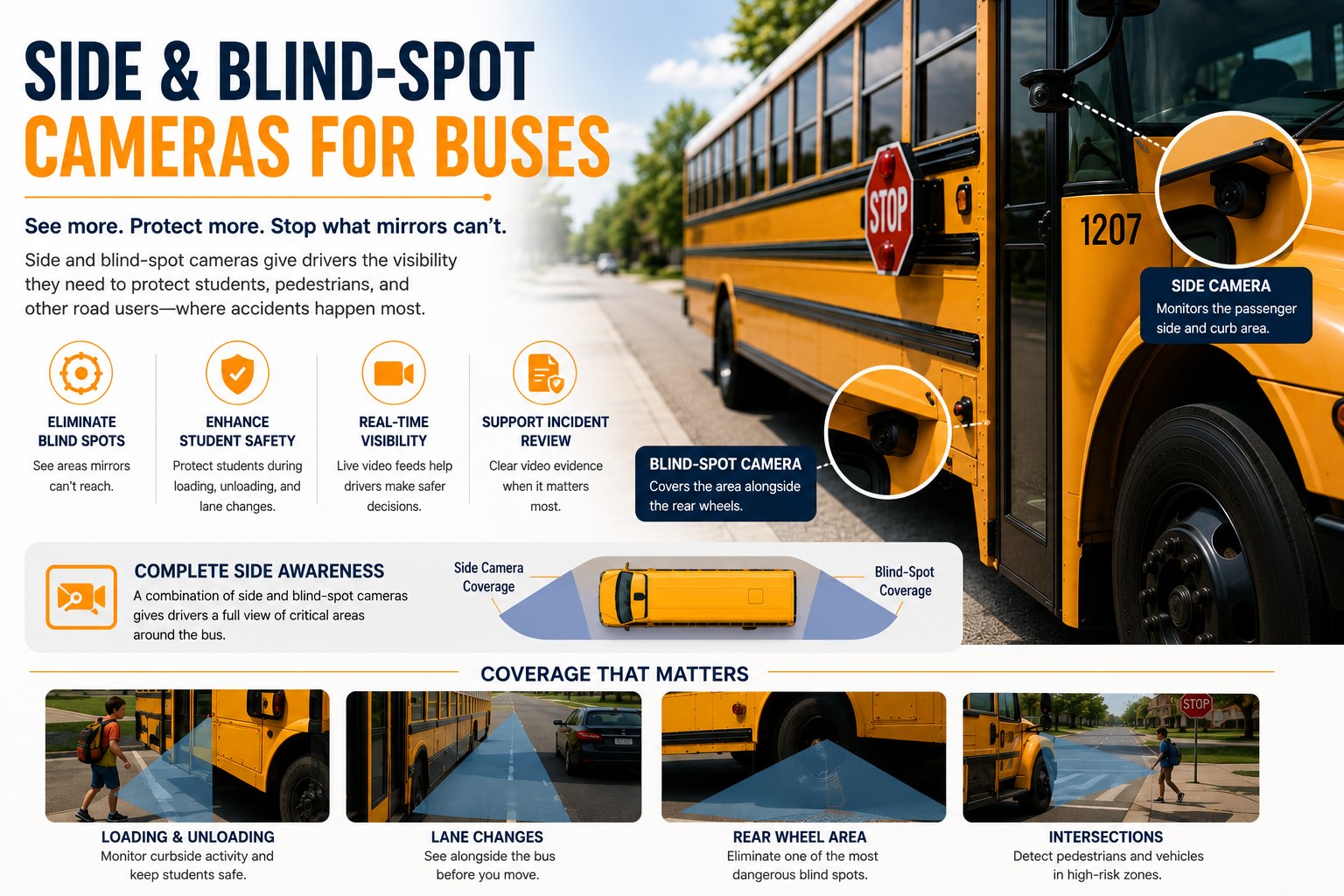
A right-turning transit bus with a cyclist in the mirror's dead zone is one of the most common serious-injury scenarios in urban transit operations — not because drivers aren't checking mirrors, but because a mirror physically cannot show what's directly beside the bus at wheel height. A bus blind spot camera closes exactly that gap, and under federal transit safety rules, closing it isn't just good practice anymore — it's something safety committees are now required to actively consider. See blind-spot coverage mapped on a live BusCMMS demo → book a demo.
Side and Blind-Spot Cameras for Buses
The exact mirror zones a side camera closes, why right-turn conflicts are the highest-stakes case, and where the loading door gets missed even on a "covered" bus.
What 49 CFR 673.25 Actually Requires
Not a camera mandate by name — a duty to consider mitigations, which side cameras concretely satisfy.
Under 49 CFR Part 673, the Public Transportation Agency Safety Plan regulation, section 673.25 requires large urbanized area transit providers and their safety committees to consider mitigations that reduce operator visibility impairments — explicitly including retrofits to vehicles already in revenue service, not just specifications written into future procurements (eCFR, current as of July 2026). The rule doesn't name "install a side camera" as the mandated fix. What it does is create an ongoing obligation for a safety committee to actively evaluate visibility gaps and document what mitigations were considered, which puts a side and blind-spot camera system squarely in scope as one of the concrete options a committee would be expected to weigh.
That distinction matters for how you frame a capital request: this isn't "we'd like cameras," it's "our safety committee reviewed visibility-impairment mitigations under 673.25 and side cameras were identified as addressing a documented gap." Walk through how that documentation looks on a BusCMMS demo before your next safety committee meeting.
Right-Turn and Cyclist Conflicts: Why This Case Gets Named Specifically
The scenario where a mirror blind spot and a moving cyclist intersect at the worst possible moment.
A bus initiating a right turn sweeps its rear wheels inward, closer to the curb than the front of the bus — a movement a cyclist approaching from behind in that lane may not anticipate, and one the driver often can't see happening in a side mirror once the cyclist is alongside the bus rather than behind it. This is the specific, high-consequence conflict that side and blind-spot cameras are most directly aimed at solving on urban transit routes, where mixed bus and bicycle traffic is common and the turning radius of a full-size transit bus is large enough that the "swept path" of the rear wheels genuinely surprises road users who aren't familiar with how buses turn.
Bus signals right turn
Cyclist approaches from behind in the same lane, outside the driver's direct sightline.
Cyclist enters mirror blind zone
Alongside the bus at wheel height — exactly where a standard side mirror can't reach.
Side camera shows the gap
A live feed covering that specific zone gives the driver visual confirmation a mirror never could.
The Loading Door: Covered on the Diagram, Missed in the Install
The single most common install failure with side cameras isn't a hardware problem — it's a mounting-angle problem.
Here's the failure worth naming directly: side camera install positions are frequently chosen for mounting convenience — wherever a bracket fits easily on the body panel — rather than for the field of view that actually matters. A side camera aimed for general right-side visibility during a turn can easily miss the loading door zone specifically, because that zone sits at a different angle and height than the general side sweep the camera was positioned to capture. A fleet can genuinely believe its side coverage is complete based on a spec sheet, while the one zone with the highest foot-traffic risk — where students board and exit — sits just outside the actual recorded frame.
Not assumed from the spec sheet — checked against a real recorded clip.
These are two different fields of view and often need separate cameras, not one doing both jobs.
The single most common root cause of a "covered" bus with an actual gap.
Pairing Side Cameras With Pedestrian Detection
A camera shows the zone. Detection tells the driver something's actually in it.
A side camera alone still requires the driver to actively look at a monitor and interpret what's there, during a maneuver that already demands attention on mirrors, traffic, and the road ahead. Pairing the camera with AI-based pedestrian or cyclist detection adds an active alert — a visual or audible warning when something is detected in the blind zone — rather than relying entirely on the driver noticing it on a screen. This combination matters most exactly in the urban, mixed-traffic routes where the right-turn conflict scenario is common, and matters less on rural or highway-adjacent routes with minimal pedestrian and cyclist traffic.
A Scenario From a Real Bus Operation
One safety committee review, one documented mitigation, one prevented incident three months later.
A transit agency's safety committee, conducting a routine visibility-impairment review under 673.25, identified right-turn cyclist conflicts as a documented gap on its downtown routes. Rather than treating the requirement as a paperwork exercise, the committee approved a side camera retrofit on the ten buses running those specific routes, paired with pedestrian detection alerts. Three months later, a driver on one of the retrofitted buses received an audible alert mid-turn for a cyclist who had entered the blind zone from behind — the driver held the turn, the cyclist passed safely, and the event logged automatically as a near-miss in the agency's safety record, feeding directly into the next safety plan review cycle without anyone manually documenting it after the fact.
Our safety committee treated 673.25 as a compliance checkbox for the first year — write down that we "considered" mitigations, move on. Once we actually retrofitted the downtown routes with side cameras and started logging near-misses instead of just incidents, the review stopped being paperwork. We can point to specific caught conflicts now, not just a policy statement saying we thought about it.
Not sure your current side cameras actually reach the loading door zone? Worth a quick check before your next safety review. Talk to the team about a coverage audit →
Quick Spec Reference
Scannable on a phone during a safety committee meeting or vendor call.
| Spec | What to actually check |
|---|---|
| Regulatory driver | 49 CFR 673.25 visibility-impairment mitigation duty for large urbanized transit |
| Primary use case | Right-turn cyclist/pedestrian conflicts in mixed urban traffic |
| Mount position | Verified field of view, not the easiest bracket location on the body panel |
| Loading door coverage | Confirmed separately from general side sweep — different angle and height |
| Pedestrian detection | Recommended pairing for urban, mixed-traffic routes specifically |
| Documentation | Retrofit decisions should be logged against the safety committee's 673.25 review |
Frequently Asked Questions
Does federal law require blind-spot cameras on transit buses?
Not by name. 49 CFR 673.25, part of the Public Transportation Agency Safety Plan regulation, requires large urbanized area transit providers and their safety committees to consider mitigations that reduce operator visibility impairments, including retrofits to buses already in service. Side and blind-spot cameras are one of the concrete mitigations a safety committee would be expected to evaluate under that ongoing duty, rather than a named, specific mandate.
What blind zones does a side camera close that mirrors can't cover?
Mirrors generally cover the rear and wide-side view effectively, but leave a front-quarter, wheel-height zone alongside the bus largely uncovered — exactly the area a cyclist or pedestrian occupies when moving alongside the bus rather than directly behind it. This gap is most consequential during right turns, when the bus's rear wheels sweep inward in a path that isn't always visible to the driver through a mirror alone.
Why are right-turn cyclist conflicts specifically named as a use case?
A bus initiating a right turn sweeps its rear wheels closer to the curb than a following road user might expect, and a cyclist alongside the bus at that moment sits in the exact mirror blind zone a side camera is designed to cover. This scenario is common on urban transit routes with mixed bus and bicycle traffic, making it the highest-stakes and most frequently cited case for side camera coverage.
Why does the loading door get missed even on buses with side cameras installed?
Side camera install positions are often chosen for mounting convenience rather than verified field of view. A camera aimed for general right-side visibility during a turn can miss the loading door threshold entirely, since that zone sits at a different angle and height than the general side sweep. Confirming actual recorded footage covers the loading door, rather than assuming coverage from the spec sheet, is the only reliable way to catch this gap.
Should side cameras be paired with pedestrian detection technology?
For urban, mixed-traffic routes, pairing is generally recommended. A camera alone still requires the driver to actively look at a monitor and interpret what's shown, while pedestrian or cyclist detection adds an active visual or audible alert when something enters the blind zone, reducing reliance on the driver noticing it independently during an already demanding maneuver.