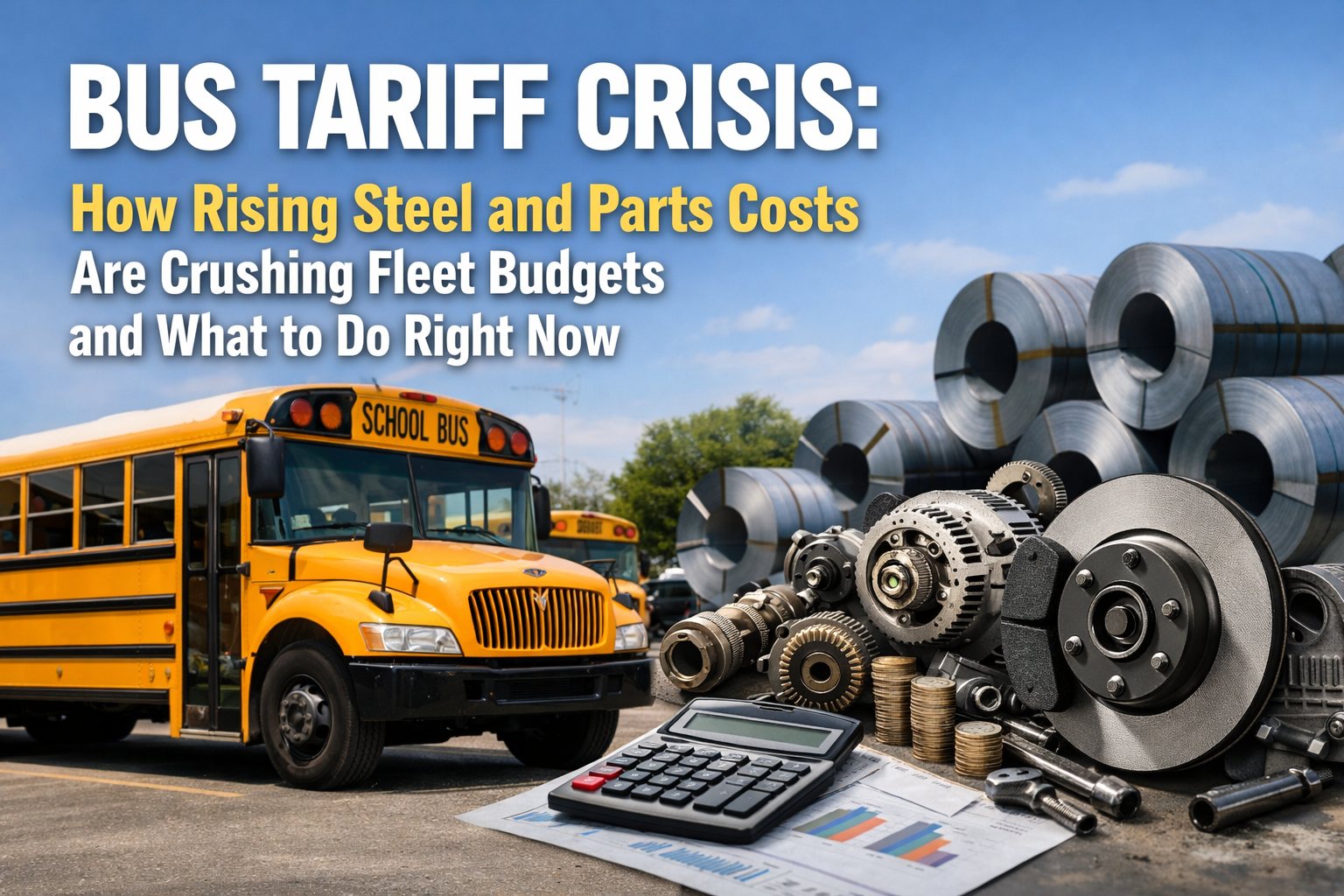
The call came in mid-April: your parts supplier just raised brake component prices 18%. Last month it was air filters. Before that, transmissions. Your maintenance budget was set in July—and now you're watching it evaporate faster than anyone planned. School districts are reporting bus price increases of $6,000 to $17,000 per vehicle. Steel and aluminum tariffs took effect in March. A 25% tariff on truck parts and 10% on buses hit in November. This isn't a temporary disruption—it's a structural shift in fleet economics. This guide shows exactly what's happening, which components are hit hardest, and the specific strategies that protect your budget without compromising safety.
Where the Cost Pressure Is Coming From
Tariffs don't hit evenly. Some components are getting squeezed from multiple directions—raw material tariffs, component tariffs, and supply chain delays all compounding at once. Here's where your budget is bleeding most.
Parts suppliers are raising prices with little warning—sometimes weekly. Without real-time visibility into your parts spend, you're flying blind. Sign up for BusCMMS to track parts cost trends across your entire inventory.
The Compounding Problem: Aging Fleets
Limited new vehicle availability has forced fleets to keep buses in service longer than planned. The average vehicle age hit a record 12.8 years in 2025. Older buses need more repairs—and those repairs now cost more.
Major component failures—engines, transmissions—typically hit between 150,000-200,000 miles. With fleets aging past planned lifecycles, these expensive repairs are becoming routine. Book a demo to see how BusCMMS predicts component failures before they strand your buses.
5 Strategies to Protect Your Budget Right Now
You can't control tariffs. But you can control how your fleet responds. These strategies are being deployed by the fleets weathering the crisis best.
The fleets surviving this crisis share one trait: visibility. They know what they're spending, where prices are moving, and which components need attention before failure. Sign up now to get complete visibility into your parts spend.
Expert Review: The Math of Prevention vs. Reaction
When parts cost more, every avoided breakdown delivers bigger savings. Here's how the numbers stack up in the current environment.
With tariffs adding 10-25% to parts costs, the ROI on preventing breakdowns has never been higher. Book a demo to see how BusCMMS automates PM scheduling and failure prediction.
The 9 Components to Stockpile Now
These are the high-failure, tariff-exposed components that justify strategic inventory reserves. Build 60-90 day supplies before the next price increase hits.
Inventory without visibility creates a different problem—capital tied up in parts you don't need. Sign up for BusCMMS to forecast parts demand based on your actual fleet data.
Frequently Asked Questions
How much are tariffs adding to bus parts costs?
The Section 232 tariffs impose 25% on truck parts including engines, transmissions, tires, and chassis, and 10% on buses themselves. Combined with steel and aluminum tariffs that took effect in March 2025, fleet managers are seeing 15-25% total parts cost increases since 2022. Individual components vary—transmissions have seen 18%+ increases, brake systems 12-18%, and electrical components 10-15%.
How much are new bus prices increasing?
School districts report price increases of $6,000 to $17,000 per vehicle on EV and propane units ordered in early 2025. Rising costs for steel, aluminum, and key materials—all driven by tariffs—are affecting all OEMs and powertrain types. One transportation coordinator noted that bus costs have doubled over the last 10 years while state funding has remained stagnant.
What components should we stockpile?
Focus on high-failure, tariff-exposed components: brake pads and shoes, air/oil/fuel filters, serpentine and V-belts, batteries, starters, alternators, water pumps, fuel pumps, and critical sensors (O2, MAP, temperature). Building 60-90 day supplies of these components provides buffer against price increases and supply disruptions while avoiding the capital burden of over-stocking.
How can we extend component lifecycles?
Tightening preventive maintenance discipline is the most effective strategy. Fleets achieving 80-85% planned maintenance spend 25-35% less overall than those operating reactively. This includes strict adherence to PM schedules, comprehensive fluid analysis programs, early intervention on developing issues, and driver training to reduce component stress. Digital CMMS systems enable this discipline through automated scheduling and failure prediction.
How does a CMMS help manage tariff impacts?
A properly configured CMMS provides real-time visibility into parts costs, tracks price trends over time, identifies which components are increasing fastest, forecasts parts demand based on actual fleet data, optimizes inventory levels to balance availability against carrying costs, and automates PM scheduling to extend component lifecycles. This visibility enables strategic procurement decisions—negotiating volume contracts, diversifying suppliers, and timing purchases—before costs spiral further.