A blowout at highway speed doesn't just strand your bus — it can cause loss of control, rollover, or collision with other vehicles. Many blowouts start with tires that drivers should have caught during daily inspection. Yet most drivers don't actually measure tread depth or check tire pressure with a gauge. They glance at tires, see they "look OK," and move on. DOT regulations set specific tread depth minimums, and roadside inspectors measure tires with precision gauges. A tire at 3/32" tread looks fine but is legally defective on a bus (minimum is 4/32" for steering tires, 2/32" for drive tires). This guide explains DOT tread depth standards, how to properly inspect tires with gauges, common wear patterns that signal problems, when replacement is legally required, and why tire compliance matters for roadside inspection pass rates.
Inspection Guide
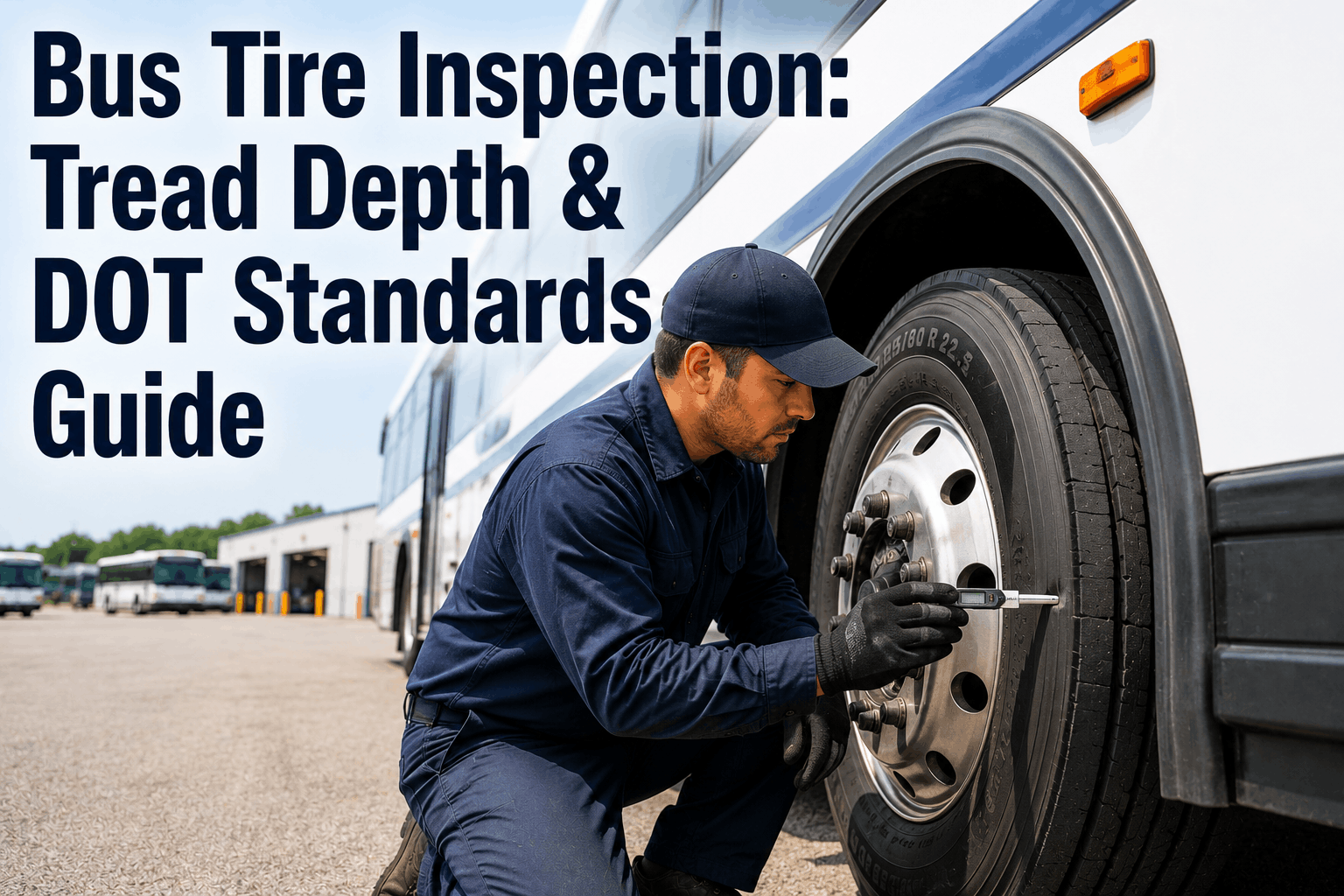
Bus Tire Inspection: Tread Depth & DOT Standards
Know the legal minimums. Master tread depth measurement. Inspect for wear patterns and damage. Stay roadside-inspection compliant.
DOT Tread Depth Minimums for Buses (2026 Standards)
Federal regulations (49 CFR 393.75) set specific minimum tread depth requirements for commercial motor vehicles including buses.
STEER TIRES (Front Wheels)
Minimum: 4/32 inches
Steer tires are most critical for control. Any less than 4/32" is out-of-specification. Roadside inspector will cite. Out-of-service risk if tread <2/32".
DRIVE TIRES (Rear, Main Axles)
Minimum: 2/32 inches
Drive tires can be lower than steer, but 2/32" is the floor. Many fleets aim for 4/32" on drive tires too for better traction and wear life.
TRAILER TIRES (If applicable)
Minimum: 2/32 inches
Same as drive tires. Some states have stricter rules (e.g., California). Verify state law.
How to Measure Tread Depth (The Right Way)
Method 1: Tread Depth Gauge (Most Accurate)
Purchase tread depth gauge (~$5–$15 at auto parts store)
Insert gauge probe into deepest grooves of tire tread (multiple locations)
Press down firmly until gauge bottoms out
Read measurement in 32nds of an inch
Record readings from multiple spots (center, sides) to identify wear patterns
✓ BEST: Objective, precise, repeatable, auditor-acceptable
Method 2: Penny Test (Quick Visual)
Insert penny into tire tread with Lincoln's head upside down
If you can see the top of Lincoln's head, tread is <2/32" (defective)
If tread covers top of head, tread is >2/32" (better)
⚠️ ROUGH: Not precise enough for commercial fleet compliance. Use gauge instead.
Five Tire Wear Patterns & What They Mean
1
CENTER WEAR (Tread worn in middle, edges normal)
Cause: Overinflation (too much air pressure)
Fix: Reduce tire pressure to spec. Rebalance if wearing
2
SHOULDER WEAR (Edges worn, center normal)
Cause: Underinflation (too little air pressure)
Fix: Increase tire pressure to spec. Monitor inflation weekly
3
CUP/SCALLOPING (Wavy edge, dips in tread)
Cause: Worn suspension (shocks, springs, bushings)
Fix: Inspect and repair suspension. Replace tire if cupping severe
4
ONE-SIDED WEAR (One side worn more than other)
Cause: Misalignment or sustained hard cornering
Fix: Check wheel alignment. Reduce aggressive cornering
5
DIAGONAL/FEATHERING (Tread worn at angle)
Cause: Alignment issue or harsh braking
Fix: Alignment check. Brake inspection if braking is harsh
Visual Defects: When to Replace Immediately
❌ Exposed Cords or Wires
OUT-OF-SERVICE. Replace immediately. Do not operate.
❌ Bulges or Blisters on Sidewall
OUT-OF-SERVICE. Structural failure. Replace immediately.
❌ Cuts >1/2 Inch Long
OUT-OF-SERVICE if cut exposes cord. Replace. Do not patch.
❌ Flat Tire or Slow Leak
Repair or replace depending on location/cause. Monitor for recurrence.
❌ Tread Separation (Chunks Missing)
OUT-OF-SERVICE. Safety hazard. Replace immediately.
"We had a technician who'd inspect tires visually but never actually measure with a gauge. Roadside inspector pulled one of our buses, measured tires at 3/32" on steer tires, wrote violation. We thought they looked fine. Turns out visual inspection is subjective. Now all techs carry depth gauges, measure tires monthly, record readings in CMMS. We've caught 15+ tires that looked fine but were just barely legal. With systematic measurement, we replace before they become roadside violations."
— Fleet Safety Manager, 45-bus school district, Michigan
Master Tire Inspection Standards
Use gauges, not guesses. Measure tread, track wear patterns, replace on schedule. Tire compliance keeps you roadside-inspection clean.