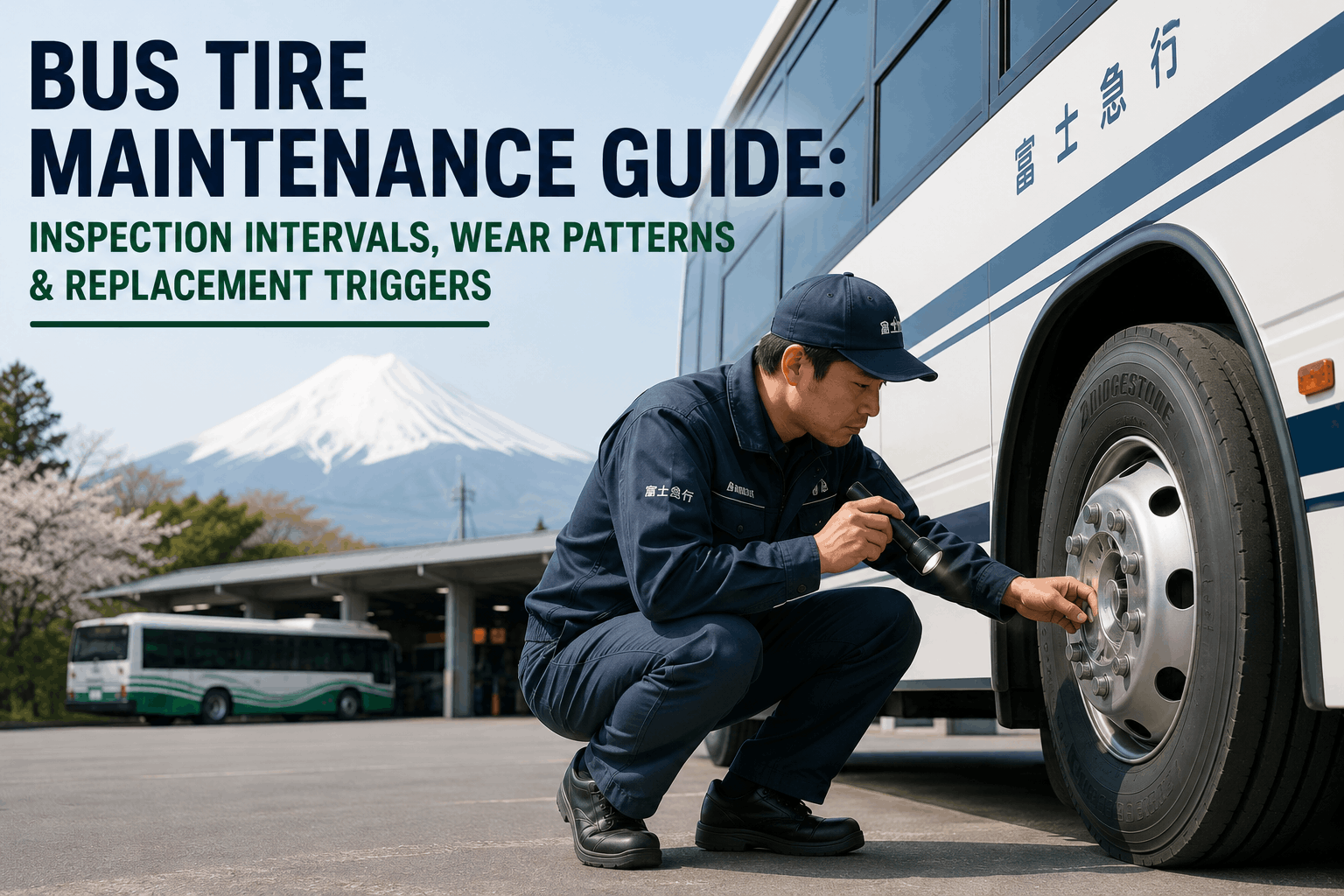
Your bus fleet has 600+ tires across 50 vehicles. Each tire is a critical safety component that directly impacts fuel efficiency, ride quality, and vehicle handling. Yet tire maintenance often gets overlooked until a tire fails. A single tire blowout at highway speed doesn't just cost $400–$800 to replace — it risks passenger safety, can ground a bus for days, and creates liability exposure. More insidiously, worn or improperly maintained tires silently reduce fuel economy by 10–15%, add excessive wear to suspension components, and increase stopping distance in wet conditions. Proper tire maintenance isn't complicated, but it requires systematic inspection, pattern diagnosis, and timely replacement decisions. This guide teaches fleet managers how to read tire wear patterns like a mechanic, establish inspection protocols that catch problems early, and make data-driven replacement vs. retreading decisions that balance cost and safety. Fleets implementing structured tire maintenance programs reduce tire-related breakdowns by 35–40% and extend tire life by 12–18 months .
Tire Management Guide
Bus Tire Maintenance Guide: Complete Inspection, Wear Pattern & Replacement Strategy
Read tire wear patterns, establish inspection protocols, and make replacement decisions that extend tire life 12–18 months while ensuring passenger safety and maximizing fuel efficiency.
The Economic Impact of Tire Maintenance: Why This Matters
Before diving into technical details, understand the financial stakes. A well-maintained tire costs $15,000–$25,000 over its useful life. A tire that fails prematurely due to neglect costs $800–$1,200 to replace, plus indirect costs of breakdown, towing, missed routes, and potential liability. More significant: underinflated tires reduce fuel economy by 3–5%, so a fleet running 750,000 miles annually with marginal tire maintenance wastes $18,000–$35,000 in excess fuel annually.
Cost of Tire Neglect vs. Maintenance
Proper tire maintenance (scheduled inspections, pressure checks, rotation)
$1,200–$1,600/tire over 5-year lifespan
Neglected tire (premature failure, fuel waste, breakdown costs)
$2,200–$3,400/tire + liability risk
Fuel waste from underinflated tires (annual, 50-bus fleet)
$18,000–$35,000 wasted annually
Tire Inspection Frequency: Daily, Weekly, Monthly Framework
Tire problems don't appear suddenly — they develop gradually. Catching them early requires tiered inspection at multiple frequencies.
DAILY (Driver Pre-Trip Inspection)
Visual inspection for obvious damage
Look for cuts, bulges, sidewall damage, debris embedded in tread. Takes 30 seconds per tire.
Feel tread with hand
Run hand across tread. Smooth spots or uneven wear indicate problems. If you feel smooth in one direction and rough in another, alignment is off.
Report anything abnormal
Driver must document in DVIR: unusual vibration, pulling to one side, soft appearance, visible wear. This triggers technician follow-up.
Driver inspection is the earliest warning system. Most tire problems are first noticed by drivers who feel them through the steering wheel.
WEEKLY (Technician Tire Pressure & Visual Check)
Check tire pressure when tires are cold
Always inspect tire pressure when the vehicle hasn't been driven for at least 3 hours. Cold pressure is accurate. Hot pressure (after driving) reads 2–3 PSI higher than actual resting pressure. Use a calibrated tire pressure gauge.
Verify pressure matches manufacturer specification
Don't use a generic specification. Check the vehicle's door jamb or fuel door for manufacturer pressure chart. Pressure varies by load and tire position (steer vs. drive vs. trailer).
Document pressure and tread wear pattern
Log pressure by axle position. Note if wear pattern has changed since last inspection. Is it center wear (overinflation), shoulder wear (underinflation), or cupping (suspension problem)?
Tires lose 2 PSI per month from heat, cold, and micro-leakage. Weekly checks catch slow leaks and pressure drift before they cause problems.
MONTHLY (Technician Detailed Tread & Wear Analysis)
Measure tread depth with gauge
Use a tread depth gauge, not the penny test (penny test is for emergency roadside assessment). Press gauge into multiple tread grooves across the tire and record depth. Track trend — is depth decreasing faster than expected?
Analyze wear pattern to diagnose problems
Wear patterns are diagnostic signals. Center wear = overinflation. Shoulder wear = underinflation. Cupping = suspension issue. Diagonal wear = misalignment. Fix the root cause, not just the symptom.
Inspect sidewalls and valve stems
Look for cracks, bulges, blisters on sidewalls. Check valve stems for damage or cracking. Sidewall damage is non-repairable — tire must be replaced.
Monthly detailed inspection catches developing problems before they become safety issues. Changes in wear patterns usually appear gradually — monthly monitoring reveals trends.
Reading Tire Wear Patterns: Diagnostic Guide
Tire wear patterns are like a fleet vehicle's health report card. They tell you what's wrong with the vehicle, not just the tire. Replacing a tire showing abnormal wear without fixing the root cause means the replacement will wear the same way.
CENTER WEAR (Excessive Wear in Middle of Tread)
Cause:
OVERINFLATION — tire pressure exceeds specification
✓ Reduce pressure to manufacturer spec for vehicle load
✓ Verify gauge is calibrated (test at tire shop)
✓ Inspect for slow air leak in compressor or storage tank
✗ Do NOT replace the tire if overinflation is the only problem
Establish inflation monitoring program. Check pressures weekly. Log trends. If pressures drift upward, air compressor may be over-pressurizing tank.
SHOULDER WEAR (Excessive Wear on Both Outer Edges)
Cause:
UNDERINFLATION — tire pressure below specification
✓ Increase pressure to manufacturer spec
✓ Check for slow leaks (one tire repeatedly losing pressure)
✓ Inspect valve stem and rim seal for damage
✗ Do NOT rotate tire to hide wear pattern
Underinflation is the most common tire problem. Every 5 PSI below spec reduces tire life by 25%. Driver training on importance of pressure checks prevents this.
CUPPING (Scalloped Depressions Across Tread)
Cause:
WORN SUSPENSION — shocks/struts failing, loose wheel bearings, tire imbalance, or mismatched dual tire diameters
✓ Inspect suspension: shocks, struts, bushings for wear
✓ Check wheel bearings for play (spin wheel, listen for grinding)
✓ Balance wheels — imbalance causes cupping
✓ For duals, verify tire diameters match within 4/32" and pressures within 5 PSI
✗ Replacing tire without fixing suspension issue = new tire cups the same way
Most critical: replace shocks on schedule, not just when they fail. Include suspension inspection in every PM-B service. Cupping on steer tires is a safety issue — address immediately.
ONE-SIDED WEAR (Excessive Wear on Inside or Outside Edge)
Cause:
MISALIGNMENT — toe-in or camber out of specification
✓ Schedule wheel alignment immediately
✓ Do NOT mount new tires until alignment is corrected
✓ If both tires on an axle show inside wear, front-end geometry is severely off
✓ After alignment, tire wear should become even
Misalignment develops gradually from road impacts, curb strikes, or suspension wear. Alignment check every 12–24 months prevents excessive one-sided wear.
DIAGONAL/ZIGZAG WEAR (Worn Spots in Regular Pattern Around Tire)
Cause:
TIRE IMBALANCE or worn tie-rods/drag links causing toe angle changes
✓ Balance tire using dynamic balancing machine
✓ Inspect steering linkage for wear or damage
✓ Check wheel runout (wheel wobble) — excessive runout causes imbalance
Dynamic tire balancing at installation and after retread prevents this. Inspect steering linkage during PM-C services.
Replacement vs. Retreading Decision Matrix
When a tire reaches end-of-life, you have two choices: replace with new tire or retread. The economics depend on tread depth, sidewall condition, and expected mileage remaining.
Tread depth 4/32" or greater, no sidewall damage
RETREAD (most economical)
Tread depth 4/32" is the retreading threshold. If tire meets this and has no sidewall damage, retreading costs 40–50% less than new tire and provides 80% of new tire life.
Tread depth 2/32"–4/32", no visible sidewall damage
EVALUATE (borderline case)
If tire has 5,000+ miles remaining before next scheduled replacement, retread makes sense. If you're near end-of-life anyway, replace new to extend next service interval.
Tread depth below 2/32", OR visible sidewall cracks, bulges, blisters
REPLACE (not repairable)
Sidewall damage is non-repairable. Tire cannot be retreaded. Must be replaced new. Cords are exposed and blowout risk is high.
Tire age 6–10 years (regardless of tread depth)
REPLACE (rubber deterioration)
NHTSA recommends replacing tires every 6–10 years regardless of tread depth, as rubber compounds degrade with age even in storage. Check DOT date code (last 4 digits on sidewall). If older than 6 years, replace regardless of tread.
Tire Rotation Schedule and Strategy
Rotating tires evens out position-specific wear patterns and extends tire life. However, rotation must be done correctly — and only after diagnosing wear cause.
Rotation Best Practices
Rotate tires every 5,000–8,000 miles
Align rotations with oil change intervals for easy remembering. Move steer tires to drive/trailer positions and vice versa.
DO NOT rotate to hide abnormal wear
If a tire shows center wear (overinflation) or cupping (suspension issue), rotating it to a different position won't fix the problem. Fix the root cause first (adjust pressure, replace shocks), then rotate.
Match dual tire diameters and pressures
On dual positions, mount tires of similar wear levels (within 4/32" tread depth). Maintain pressures within 5 PSI of each other. Mismatched duals accelerate wear on both tires.
Balance wheels after rotation
Mounting a tire on a new wheel may require rebalancing. Imbalanced wheels cause cupping and irregular wear.
Documenting Tire Data: Digital Inspection Systems
Paper tire checklists get filed and forgotten. Digital inspections with photo evidence, tread-depth measurements, and pattern documentation create searchable records for troubleshooting and audit defense.
What to Document for Each Tire Inspection
Vehicle ID, date, mileage, technician name
Tire position (FL, FR, RL, RR, or trailer tandem 1/2)
Tire pressure reading (cold)
Tread depth measurement (minimum in grove)
Wear pattern assessment (center/shoulder/even/cupped/diagonal)
Sidewall condition (cracks, bulges, damage)
Action required (none / adjust pressure / replace / rotate)
Photo evidence (optional but recommended)
Why Digital Documentation Matters
If a tire fails and causes an accident, investigation will examine maintenance records. Digital documentation with dates, measurements, and technician signatures demonstrates due diligence. Paper records are easy to lose; digital records are searchable and retained for liability protection.
Tire Replacement Trigger Points: When to Replace
Don't wait until a tire fails to replace it. Proactive replacement prevents breakdowns and extends vehicle uptime.
Tread depth reaches 2/32"
LEGAL MINIMUM — Federal regulation (FMCSA 49 CFR 396.19)
REPLACE IMMEDIATELY — operating with tread below 2/32" is a safety violation
Steer axle tread depth reaches 4/32"
Steer tires require more tread than drive/trailer tires because they control braking and steering response. Worn steer tires increase stopping distance in wet conditions.
REPLACE — don't wait for drive axle wear to reach 2/32"
Tire age exceeds 6 years (check DOT code)
Rubber compounds degrade chemically with age regardless of tread wear. A tire with 8/32" tread but 8 years old is more likely to fail than a 4-year-old tire with 4/32" tread.
REPLACE — don't exceed 6–10 years per NHTSA recommendation
Sidewall damage visible (cracks, bulges, blisters, cuts)
Sidewall damage exposes tire cords and creates blowout risk. Sidewall damage cannot be repaired or retreaded.
REPLACE IMMEDIATELY — continue operating is unsafe
Vibration or noise develops during operation
Vibration indicates imbalance or internal damage. Noise (thumping) indicates cupping or chunking (tread separating).
INVESTIGATE and likely REPLACE — internal damage often not visible from outside
Special Bus Considerations: Retreading & Regulations
Bus tires have specific regulatory and operational requirements that differ from other commercial vehicles.
Retreading Restrictions for Buses
FMCSA rule (Docket FMCSA-2025-0115) explicitly prohibits retreads on STEER axles of buses. Steer axles must always have new tires. Drive and trailer axles can use retreads if structurally sound and tread depth meets specification.
School Bus Tire Inspection Frequency
School buses often operate on routes with frequent stops and starts (urban driving), which accelerates tire wear. Inspect school bus tires weekly instead of monthly. The stop-and-go operation increases cupping risk.
Transit Bus Heavy-Duty Tires
Transit buses operate higher-mileage routes and benefit from premium heavy-duty tires with load ratings matching the vehicle's GVWR. Cheaper tires often fail prematurely under transit service.
"We had no tire management system — just reactive replacement when something failed. We'd get 30,000 miles per tire if lucky. Implemented monthly tire inspections, pressure monitoring, and wear pattern tracking using our CMMS. Within 6 months, average tire life was 38,000 miles. Within 12 months, we were getting 45,000 miles per tire consistently. We also reduced blowouts from 3–4 per year to zero. The investment in inspection discipline paid back in tire savings alone within 4 months."
Eliminate Tire Breakdowns with Systematic Maintenance
Tire management isn't complex — it requires discipline and data. See how other fleets extended tire life 12–18 months through systematic inspection.
Tire Maintenance FAQs
How often should we replace bus tires?
With proper maintenance, expect 35,000–50,000 miles per tire on drive/trailer axles and 25,000–40,000 on steer axles (higher braking wear). Actual life depends on route type, driver behavior, and inflation discipline. Monitor trend — decreasing miles per tire indicates maintenance issues.
What's the difference between 2/32" and 4/32" tread depth requirements?
2/32" is the legal minimum (FMCSA). Tires are illegal below this. However, steer axle tires should be replaced at 4/32" because steer tires control braking response. Waiting until 2/32" on steer tires increases stopping distance in wet conditions.
Is it safe to mix new and retreaded tires on the same bus?
Yes, if retreads are quality-controlled and structurally sound. However, best practice is consistency — if using retreads, use them on all drive/trailer axles. Never mix on steer axles (steer must always be new per federal regulation).
How do I check DOT date code on a tire?
Look on the sidewall for the DOT code (series of letters/numbers ending in 4 digits). The final 4 digits are the manufacture date: first two digits are week, last two are year. Example: 3209 = week 32 of 2009 (August 2009). Tire is 6+ years old and should be replaced.
What causes rapid tire wear on a specific bus?
Three main causes: (1) worn suspension (shocks, bushings), (2) tire misalignment, (3) consistent underinflation. Inspect suspension and do alignment check. Check driver behavior — some drivers accelerate/brake harder. If wear is uniform across all four tires, driver behavior is likely cause.
Can we rotate tires to extend life if wear is uneven?
Only after fixing the root cause. If wear is uneven due to misalignment, overinflation, or suspension wear, rotating tires will cause the new position to wear the same way. Always diagnose and fix first, then rotate.
How much does a quality retread cost vs. new tire?
Quality retread costs 40–50% less than new tire. New tire ~$800–$1,200, retread ~$400–$600. Retread provides 80% of new tire life. Most cost-effective for drive/trailer axles. Never retread steer axles (federal regulation prohibits it).
What's the best pressure monitoring tool?
Manual tire pressure gauge (accurate, inexpensive). Verify gauge is calibrated — compare reading against shop air compressor gauge. For ongoing monitoring, TPMS (Tire Pressure Monitoring System) on newer buses can alert to pressure drops. Best approach: combination of weekly manual checks + telematics/TPMS for continuous monitoring.