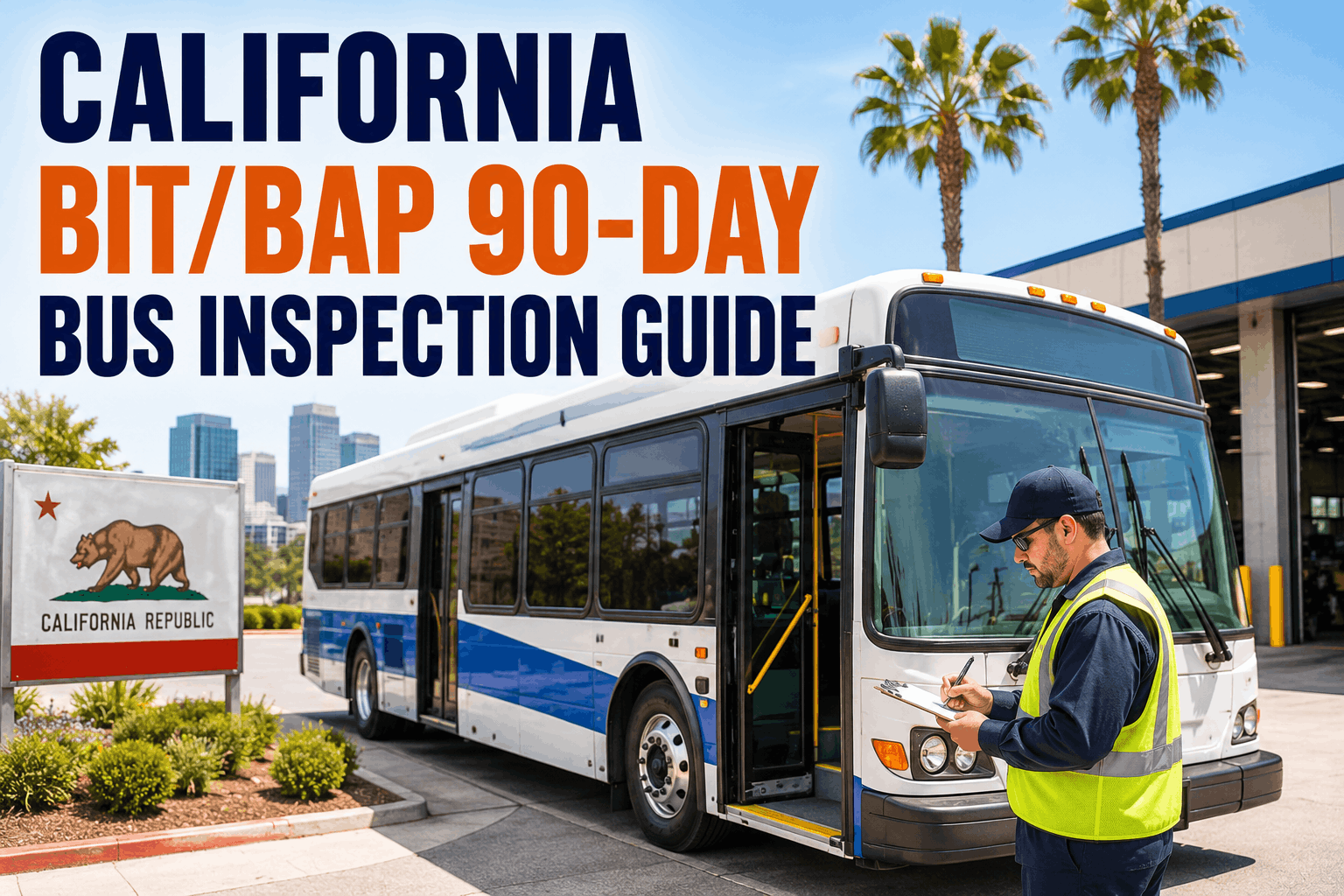
If your bus fleet operates in California with vehicles over 26,001 lbs GVWR, you face a requirement that doesn't exist in most other states: the 90-day periodic inspection, officially called the "Basic Inspection Terminal" (BIT) or "Brake and Axle Probe" (BAP). This is on top of the federal 49 CFR 396 annual inspection. California Highway Patrol (CHP) enforces this aggressively. Missing a 90-day inspection puts you out of compliance with California law, risks $500–$2,000 in state fines, and creates liability exposure if a defect is discovered after an accident. Yet many fleets operating in California don't fully understand this requirement or confuse it with federal rules. This guide explains California's 90-day periodic inspection mandate in detail: what triggers it, what must be inspected, how to document it for CHP compliance, and how to integrate it with your federal 49 CFR 396 annual inspection program.
State Compliance
California BIT/BAP 90-Day Bus Inspection: Complete Compliance Guide
California requires 90-day periodic inspections for buses over 26,001 lbs GVWR. Learn BIT/BAP rules, CHP enforcement, and how to stay compliant.
What Is California's 90-Day Periodic Inspection Requirement?
California Vehicle Code Section 34501.2 requires that certain commercial motor vehicles undergo a periodic inspection (also called a "terminal inspection") at least every 90 days. For buses, the requirement applies to vehicles with a GVWR exceeding 26,001 pounds. This inspection is separate from the federal 49 CFR 396 annual inspection — it's an additional state-level requirement.
What Triggers the Requirement
Bus GVWR (Gross Vehicle Weight Rating) > 26,001 lbs AND bus registered/operated in California
Frequency
Every 90 days (4 times per year minimum)
Who Can Perform
Certified terminal inspector (can be in-house if certified) or CHP official
Documentation
Written inspection report, signed by inspector, with pass/fail status and date
What Gets Inspected: BIT vs. BAP
BIT (Basic Inspection Terminal)
Comprehensive inspection covering:
Brakes (brake lines, slack adjusters, chambers, pressure)
Axles and suspension (springs, bushings, wear)
Tires and wheels (condition, pressure, tread)
Steering and front-end (tie rods, kingpins, alignment)
Lighting and reflectors (all bulbs, lenses)
Frame and body (cracks, damage, loose fasteners)
Emergency equipment (exits, fire extinguisher, etc.)
BAP (Brake and Axle Probe)
Abbreviated inspection focusing on:
Brakes only (most critical system)
Axles only
This is a reduced-scope option, not the default
⚠️ BAP is typically used as follow-up if BIT finds brake/axle issues and repair is underway. Full BIT is standard 90-day requirement.
How CHP Enforcement Works
Roadside Inspection Scenario
CHP officer pulls over your bus for routine inspection. First question: "Can you show me your 90-day inspection report?" You produce documentation showing inspection was completed within past 90 days. Officer verifies signature and date. Bus passes. No violation.
Violation Scenario: Missing Documentation
Officer asks for 90-day inspection report. You cannot produce one (last inspection was 100+ days ago). Violation issued. Citation: $250–$500. Bus may be placed out-of-service until current inspection completed.
Terminal Inspection Program (TIP) Audits
CHP conducts periodic terminal audits of fleet maintenance facilities. They request 90-day inspection records for entire fleet covering past 12 months. If records missing or pattern of non-compliance found, fleet receives notice of non-compliance and must submit corrective action plan.
Integration With Federal 49 CFR 396 Requirements
California's 90-day requirement is state law. Federal 49 CFR 396 annual inspection is federal law. You must comply with BOTH. They are separate, non-overlapping requirements.
49 CFR 396.17 Annual Inspection
Once per year
Federal (FMCSA)
Comprehensive inspection of all systems per Appendix A
California 90-Day Periodic (BIT)
Every 90 days (4x/year)
State (CHP)
Comprehensive inspection similar to BIT checklist
49 CFR 396.3 Emergency Exit (Bus-Only)
Every 90 days (4x/year)
Federal (FMCSA)
Pushout windows, emergency doors, exit lights only
Planning Tip: Your 90-day California BIT can be coordinated with (but doesn't replace) the federal 49 CFR 396.3 emergency exit inspection. They happen at same frequency but cover different items. You need both documented separately.
"We operated a 40-bus fleet in California but weren't tracking 90-day BIT inspections. Thought the annual federal inspection was enough. CHP pulled us over at scale house, asked for BIT documentation, we didn't have it. Citation issued. Officer explained California's 90-day requirement. We scrambled to get all buses current. Now we schedule BIT every 90 days in CMMS, same as federal annual. It's not hard once you understand it's a separate requirement from federal rules."
— Operations Manager, 40-bus charter fleet, California
Stay CHP-Compliant With Automated Scheduling
California's 90-day BIT is mandatory. Automate scheduling and documentation to stay ahead of CHP enforcement.