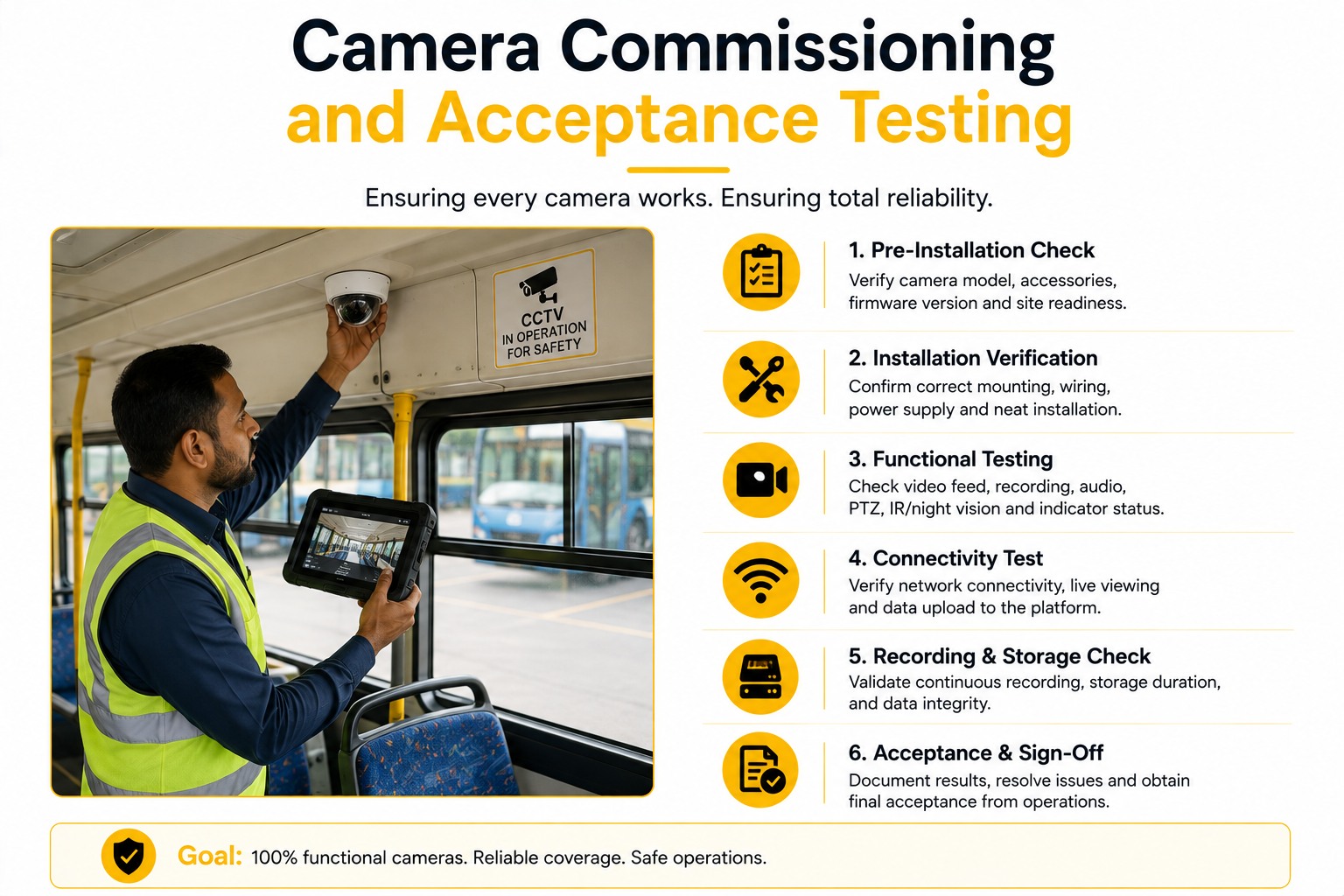
Camera acceptance testing is the difference between "the install crew says it's done" and "we verified every channel actually works." A per-bus checklist covering each channel, timestamp accuracy, plate legibility, and upload health — signed off and kept on file — is what turns an install into a documented, defensible record instead of an assumption. Talk to the BusCMMS team about a pilot on ten buses.
Camera Commissioning and Acceptance Testing
A per-channel acceptance checklist covering timestamp accuracy, plate legibility, upload health, and the sign-off record worth keeping on file for every bus.
About 480,000 yellow school buses carry roughly 26 million students every school day and cover some 4.4 billion miles a year — the largest passenger fleet in the United States (School Transportation News safety resources, retrieved Aug 2026). Without a repeatable acceptance process, that scale is exactly what makes "we assume it's installed correctly" an unacceptable standard.
Why Acceptance Testing Is a Separate Step From Installation
A completed install and a verified install are not the same thing.
No single federal mandate governs camera acceptance testing on buses; the compliance bar here is 49 CFR 396 maintenance record requirements and district policy, which means the acceptance process itself is entirely the fleet's own quality control mechanism. Installation confirms the hardware is physically mounted and wired. Acceptance testing confirms it actually does its job — the field of view is correct, the timestamp is accurate, footage is legible at the distances that matter, and data reaches wherever it's supposed to reach. Treating these as one combined step, rather than two distinct ones with separate sign-offs, is how a mounting error or a wiring fault goes unnoticed until an incident review months later.
Confirmed on all installed cameras individually, not just the primary channel.
Actual recorded frame checked against the intended coverage zone for each camera.
Camera clock checked against a known reference, not assumed correct from factory setting.
Forward-facing unit tested against an actual plate at typical stop-arm distance, not a bench test.
Event or bulk data successfully reaches its destination — cloud, depot Wi-Fi, or manual download.
Device status confirmed visible in the monitoring system, not just recording locally.
No visible slack, exposed connections, or contact with flexing panels.
Technician name, date, and bus ID recorded against this specific unit's maintenance file — not a general fleet install log.
Timestamp Accuracy and Plate Legibility: The Two Tests Most Often Skipped
Both are easy to overlook because the camera "looks" like it's working without them.
A camera can record clear, well-composed footage while still failing acceptance on either of these two points. Timestamp accuracy needs to be checked against a known reference — a phone clock, a synced dispatch system — rather than assumed correct because the camera displays a plausible-looking date and time on screen; a drifted clock produces footage that looks fine but can't be reliably placed on the correct day or hour later. Plate legibility needs an actual field test with a real vehicle at a realistic stop-arm distance, not a bench test in a shop bay, since resolution, frame rate, and lens quality all interact differently at that specific range than they do up close.
Upload Path and Health Reporting: Confirming the Data Actually Arrives
A camera recording locally with no confirmed upload path is a camera that might as well not be monitored at all.
Acceptance testing needs to confirm that footage or event data actually reaches its intended destination — whether that's a cloud upload triggered by an event, a bulk sync completed overnight on depot Wi-Fi, or a manual download process for a simpler setup. Confirming this at commissioning, rather than assuming it based on the vendor's product description, catches configuration errors before the camera has been silently failing to upload for weeks. Health reporting should be confirmed the same way: the device's status needs to be visible in whatever monitoring system the fleet uses, verified at commissioning rather than trusted to "just work" from the point of install onward.
The Install Mistake Acceptance Testing Is Meant to Catch
Field of view verification exists specifically to catch the loading door gap before it becomes permanent.
Here's the objection worth naming directly: install positions chosen for convenience rather than field of view, leaving the loading door uncovered, is exactly the kind of mistake that acceptance testing is designed to catch before a bus ever runs a route. A camera mounted at an angle optimized for general side visibility can pass a casual glance — "yes, there's a camera there, it's recording" — while still missing the specific zone that mattered most. The acceptance checklist's field-of-view step should require someone to actually pull up the recorded frame and compare it against the named coverage zone, not just confirm the unit is powered and blinking.
A Scenario From a Real Bus Operation
The acceptance step that turned a routine install into a documented, defensible record.
A district running 45 buses had previously treated a technician's verbal "yeah, it's installed" as sufficient sign-off for camera work. After adopting a formal per-bus acceptance checklist with individual sign-off, a routine commissioning test on one bus revealed the forward camera's timestamp had drifted nearly a full day off from the actual date — a factory default clock setting that had never been corrected during install. Because the checklist specifically required a timestamp accuracy check against a known reference, the issue was caught and fixed before that bus ran a single route, rather than being discovered later during an incident review where the wrong date on a clip could have created real confusion.
We used to just take the installer's word for it — camera's in, we're good. Once we started requiring an actual sign-off sheet per bus, we caught a clock that was off by almost a full day on our very first checklist run. That camera had been "working" for two weeks with a timestamp that would have been useless if we'd ever needed that footage for anything specific. Now nothing goes back on route without the sheet signed.
Not sure your current install process includes a formal acceptance sign-off? That's worth auditing on your next few installs. Talk to the team about acceptance testing →
Quick Spec Reference
Scannable on a phone during acceptance testing.
| Test | What confirms a pass |
|---|---|
| Channel recording | Every installed camera confirmed individually, not just the primary unit |
| Field of view | Recorded frame compared directly against the named coverage zone |
| Timestamp accuracy | Checked against a known reference, not assumed from factory default |
| Plate legibility | Field-tested at realistic stop-arm distance, not bench-tested |
| Upload path | Confirmed data actually reaches its intended destination |
| Sign-off record | Technician, date, and bus ID logged against that specific unit's file |
Frequently Asked Questions
What's the difference between camera installation and acceptance testing?
Installation confirms the hardware is physically mounted and wired. Acceptance testing separately confirms it actually functions correctly — field of view is verified against the intended zone, timestamp accuracy is checked, footage is legible at required distances, and data successfully reaches its destination. Treating these as one combined step is how installation errors go unnoticed until an incident review.
Why does timestamp accuracy need to be tested separately at commissioning?
A camera can display a plausible-looking date and time while its internal clock has actually drifted, which isn't visible from a casual glance. Testing timestamp accuracy against a known reference at commissioning — rather than assuming a factory default is correct — catches this before footage becomes unreliable for placing an event on the correct day or hour later.
Why should plate legibility be tested in the field rather than in the shop?
Resolution, frame rate, and lens quality interact differently at realistic stop-arm distances than they do in a close-up bench test. A camera that looks sharp on a shop bay test can still fail to produce a legible plate read at the actual distance an incident would occur, which is why acceptance testing should include a real field test with a vehicle at a realistic range.
What should be included in a camera acceptance sign-off record?
A sign-off should record the technician's name, the date, and the specific bus ID, logged against that individual unit's maintenance file rather than a general fleet-wide install log. This creates a documented, defensible record confirming each specific bus passed each specific test, rather than relying on a verbal confirmation that the work was done.
Is there a federal requirement for camera acceptance testing on buses?
No single federal mandate governs camera acceptance testing on buses. The compliance bar for bus records is set by 49 CFR 396 maintenance requirements and district policy, meaning acceptance testing is a voluntary but important quality control step each fleet implements as its own standard.