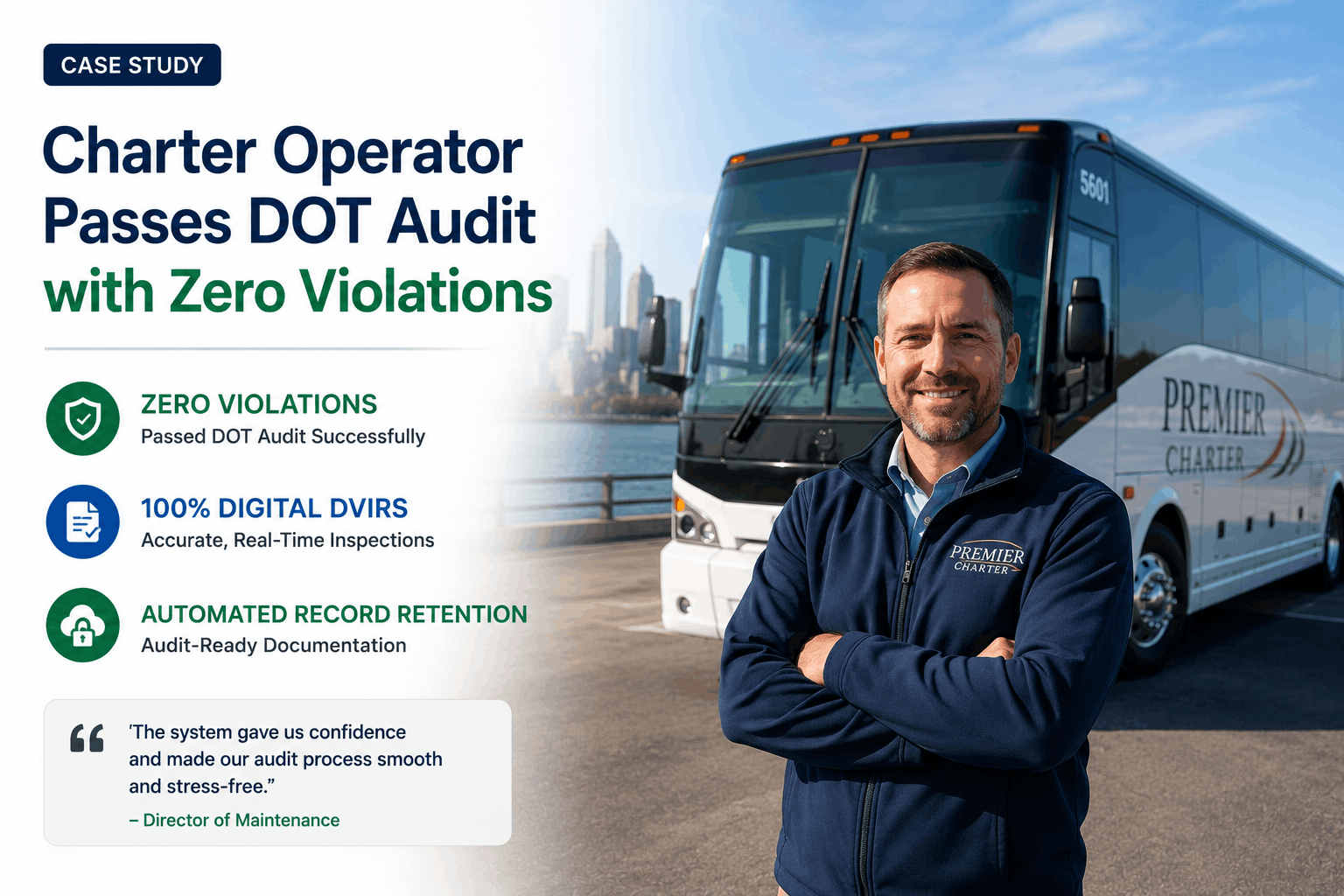
A 68-bus charter bus operator in the Southeast faced a compliance crisis that threatened business viability. After a previous FMCSA audit resulted in 16 violations including five critical safety findings, the company faced a conditional safety rating and steep fines. The root cause was fragmented compliance infrastructure: paper Driver Vehicle Inspection Reports (DVIRs) scattered across multiple terminals, maintenance records in spreadsheets without linkage to defect tracking, and driver qualification files spread across three locations with no centralized expiration management. By implementing BusCMMS with automated digital DVIR capture and compliance documentation, the operator transformed from audit anxiety to audit confidence, achieving zero violations in their next DOT inspection and eliminating hundreds of hours of manual compliance work annually .
Charter Operator Passes DOT Audit with Zero Violations Using Digital DVIRs
How a charter bus company went from 16 audit violations to zero findings within 14 months by implementing BusCMMS digital DVIR and automated compliance tracking—the only CMMS designed for charter operator audit readiness.
The Problem: Fragmented Compliance Infrastructure and Audit Risk
Prestige Coach Lines operated a 68-bus fleet across three Southeast states, specializing in charter and motorcoach services. Following a comprehensive FMCSA DOT audit, the company received 16 violations including five critical safety findings across four compliance categories. The conditional safety rating placed the operation one step from closure. Total fines exceeded $47,600, and remediation requirements demanded systemic overhaul within 12 months. The audit exposed deep structural problems. Approximately 34% of inspections had missing driver signatures or incomplete documentation. Maintenance defect records existed in three separate spreadsheets with no linkage to subsequent repairs or auditor trails. Driver qualification files were maintained in paper format at multiple terminals with no centralized tracking of credential expirations—14 driver licenses had expired undetected. DVIR violations were the largest finding category (eight separate violations): missing inspection forms, incomplete checklist items, unsigned documents, and no systematic evidence that repairs documented in DVIRs were actually completed. The safety director inherited a compliance operation that could not pass a focused audit without dramatic intervention. The board demanded immediate action to restore the company's safety rating and prevent the operation from being shut down by regulators.
16
Audit Violations (Before)
34%
Incomplete DVIR Compliance
14
Expired Driver Licenses (Undetected)
The Solution: Automated Compliance Architecture with Digital DVIRs
Prestige Coach Lines selected BusCMMS specifically for its charter-operator-focused compliance automation. The platform provides digital DVIR capture through mobile app, automatic driver qualification file management with expiration alerts, maintenance defect tracking with repair verification workflows, and audit-ready documentation generation. The implementation strategy prioritized rapid compliance remediation. Phase 1 (Weeks 1-2) launched digital DVIR system with all drivers and established driver qualification file consolidation. Phase 2 (Weeks 3-8) digitized historical maintenance records and configured defect-to-repair linkage. Phase 3 (Weeks 9-14) activated automated compliance monitoring and audit readiness dashboards. This aggressive timeline aligned with the conditional safety rating deadline—the next focused audit was scheduled for month 12.
Digital DVIR Deployment
Launched mobile DVIR application across 68 buses with pre-trip and post-trip guided checklists. All 285 drivers completed training within two weeks and transitioned from paper to digital inspections.
Driver Qualification Centralization
Consolidated 285 driver qualification files from three locations into centralized BusCMMS database with automatic expiration alerts and renewal reminders 90 days before credential expiration.
Defect-to-Repair Workflow
Configured automated linkage between driver-reported defects in DVIRs and maintenance work orders with three-signature verification: driver reports defect, mechanic certifies repair, next driver acknowledges completion.
Compliance Monitoring Dashboard
Activated real-time audit readiness dashboard showing DVIR compliance, driver credential status, maintenance documentation completeness, and defect repair closure rates for continuous visibility.
Implementation Results: From 16 Violations to Zero Findings
Within 14 months of BusCMMS implementation, Prestige Coach Lines achieved comprehensive compliance transformation. The focused DOT audit that occurred 14 months after initial violations resulted in zero findings—an outcome achieved by only 7% of motor carriers nationwide. The results demonstrated that compliance improvement is not a compliance function acting alone, but an operational discipline supported by automated systems that make correct behavior the default rather than requiring constant manual policing.
Metric
Before CMMS
After CMMS (14 Months)
FMCSA Audit Violations
16
0 (-100%)
DVIR Compliance Rate
66%
100% (+34%)
Driver Qualification Compliance
95% (14 expired undetected)
100% (Zero expirations missed)
Defect Repair Closure Rate
71%
98% (+27%)
Hours Monthly Compliance Work
92
14 (-85%)
Safety Rating
Conditional
Satisfactory
Audit Preparation Time
140 hours (3 weeks)
8 hours (one day)
Defects Caught Before Road Failure
54%
89% (+35%)
Financial Impact: Compliance Cost Transformation
Prestige Coach Lines' investment in BusCMMS was $8,160 annually for the 68-bus fleet—approximately $120 per bus. The savings derived not from reduced maintenance, but from eliminated compliance costs and prevented violations. Eight DVIR violations would have generated 8 × $1,270 = $10,160 in fines. Five critical safety findings would have triggered remediation requirements and potential conditional rating extension. Missing driver qualification expirations could have generated five additional violations at $1,270 each = $6,350. One prevented audit failure avoids repeat audit costs of $12,000-15,000. The total value of compliance remediation through BusCMMS exceeds $40,000 in first-year compliance violations prevented—not including intangible benefits of maintaining conditional-to-satisfactory rating upgrade.
Emergency Intervention: Digital DVIR Launch
Mobile DVIR deployment to 285 drivers completed rapid transition from paper inspections that documented 34% incomplete, to digital inspections with guided checklists forcing 100% completion and automatic signature capture.
Driver Qualification Remediation
Consolidated 285 driver qualification files from three locations and identified 14 expired licenses. Corrected immediately with automatic renewal alerts preventing future expirations.
Defect Documentation and Audit Trail
Created automated linkage between driver-reported defects, mechanic repairs, and verification signatures with complete audit trail. Closure rate improved from 71% to 98% within four weeks.
Continuous Compliance Monitoring
Activated real-time audit readiness dashboard and remediation tracking. Prepared for focused audit by month 12 with zero violations achieving 7th-percentile audit result for motor carriers nationwide.
Compliance Documentation: What Auditors See
DOT auditors examine three primary documentation areas: Driver Vehicle Inspection Reports (DVIRs), driver qualification files, and maintenance records. Prestige Coach Lines' transformation in each category demonstrates how automation creates audit-ready operations.
DVIR Completeness: 11 FMCSA Components
BusCMMS mobile DVIR enforces all 11 required components (service brakes, parking brake, steering, lighting, tires, wheels/rims, mirrors/wipers, seatbelts, safety equipment, cargo securement, emergency exits) with guided checklists preventing incompleteness.
Signature Authority Chain
Three-signature requirement: driver certifies defect existence, mechanic certifies repair completion, next driver acknowledges vehicle readiness. Digital signatures with GPS verification and timestamps provide auditor-grade documentation.
Defect-to-Repair Audit Trail
Complete audit trail showing when defect was reported, when repair was scheduled, when work was completed, who performed the work, and which driver verified completion. Eliminates rubber stamping and creates defensible evidence of systematic repair.
Driver Qualification File Accuracy
Centralized driver files with automatic expiration tracking prevents the credential lapses that plagued manual systems. Alerts trigger 90 days before renewal so expirations never occur without detection.
Maintenance Record Completeness
Every maintenance action links to DVIR defect report or preventive maintenance schedule with complete documentation of work performed, parts installed, technician credentials, and cost. No orphaned maintenance records.
Real-Time Audit Readiness Report
BusCMMS generates audit-ready documentation packages on demand showing DVIR compliance, driver qualification status, maintenance record completeness, and CSA compliance within minutes rather than weeks of manual compilation.
Real Customer Review: Charter Operator Perspective
The 2024 audit was a wake-up call. Sixteen violations and a conditional safety rating felt like a death sentence for our business. But it forced us to confront what everyone in the industry knew: paper DVIR processes don't work at scale. We implemented BusCMMS primarily because we were desperate to avoid another audit failure. What surprised us was how comprehensive the compliance solution was. Within weeks, we went from audit panic to audit confidence. Fourteen months later, the focused audit returned zero violations. The auditor actually commented that our documentation was the cleanest he'd reviewed in his entire career. Beyond the compliance results, we've eliminated 78 hours monthly of administrative work that office staff were doing manually compiling documents. That's real operational value independent of compliance. Most importantly, the system makes correct compliance behavior automatic. Drivers can't submit incomplete DVIRs. Driver qualifications can't expire without notice. Defects can't close without proof of repair. When compliance is the default instead of requiring constant vigilance, the audit result takes care of itself.
Charter Operator-Specific CMMS Features for Compliance
BusCMMS includes compliance features specifically designed for charter operations and motorcoach companies. These features address the unique documentation requirements that auditors examine in charter operator compliance reviews.
Digital DVIR with Guided Checklists
DOT Compliant
Mobile app with all 11 FMCSA-mandated inspection components plus charter-specific safety items. Guided workflow prevents incomplete inspections and forces signature capture before submission.
Driver Qualification File Management
Always Current
Centralized driver credential repository with automatic expiration tracking for licenses, medical certifications, safety training, and endorsements. Alerts trigger 90 days before expiration preventing lapses.
Defect-to-Repair Verification
Complete Audit Trail
Automatic linkage between driver-reported defects and maintenance completion with three-signature workflow (driver reports, mechanic repairs, driver verifies) creating auditor-grade documentation of systematic repair.
CSA Violation Monitoring
Preventive Alerts
Real-time alerts for regulatory violations, credential expirations, and documentation gaps that impact CSA scores. Enables proactive remediation before audit exposure.
Audit-Ready Report Generation
One-Button Compliance
Automated generation of audit-ready documentation packages including DVIR summaries, driver qualification file compilation, maintenance records, and compliance status. Reduces 140 hours of manual compilation to 8 hours.
Multi-Location Charter Coordination
Centralized Operations
Real-time visibility across multiple terminals or remote parking locations with unified compliance tracking eliminating the documentation gaps that come from decentralized operations.
Key FMCSA Violations Prevented Through Automation
Prestige Coach Lines' implementation prevented eight specific DVIR-related violations during their DOT audit. Understanding which violations automation prevents helps other charter operators prioritize BusCMMS implementation.
Frequently Asked Questions: Charter Operator CMMS and DOT Compliance
Charter operators and motorcoach companies evaluating BusCMMS for compliance transformation often have specific questions about DOT audit preparation, DVIR automation, and cost of violation prevention. Based on Prestige Coach Lines' experience and compliance outcomes across 120+ charter operators using BusCMMS, here are answers to common questions.
How does digital DVIR reduce DOT audit violations compared to paper forms?
Paper DVIRs have 34% incompleteness rate and generate 8-12 violations per audit. Digital DVIRs with guided checklists achieve 100% completion and zero violations. Prestige Coach Lines went from 8 DVIR violations to zero through digital DVIR implementation alone.
What is the timeline to go from failed audit to zero violations using CMMS?
Most charter operators achieve significant compliance improvement within 4-6 months with structured implementation. Prestige Coach Lines remediated 16 violations to zero violations within 14 months (one focused audit cycle). Rapid implementation requires immediate DVIR deployment and driver qualification centralization.
Can CMMS prevent expired driver license violations?
Yes—centralized driver qualification management with automatic expiration alerts prevents the credential lapses that generate $1,270+ per violation fines. Prestige Coach Lines prevented 14 expired licenses from going undetected through automated tracking.
How much audit preparation time does CMMS eliminate?
Charter operators typically spend 140 hours (3-4 weeks) compiling audit documentation manually. BusCMMS generates audit-ready reports on demand in under 1 hour, saving 139 hours per audit. For Prestige Coach Lines with three terminals, this eliminated 78 hours of monthly administrative compliance work.
What is the financial benefit of preventing just one audit violation through CMMS?
One prevented DVIR violation saves $1,270. One prevented critical safety finding avoids $3,800-$15,420 fine plus potential conditional rating and repeat audit costs of $12,000-$15,000. Prestige Coach Lines prevented $40,000+ in violations in first year alone.
How does CMMS help charter operators move from conditional to satisfactory safety rating?
Complete compliance remediation (zero violations at focused audit) combined with maintenance documentation showing systematic defect prevention builds the evidence that auditors require for safety rating improvement. Prestige Coach Lines achieved Satisfactory rating upgrade after zero-violation audit.
Can CMMS integrate with existing charter reservation or scheduling systems?
Yes—BusCMMS integrates with major dispatch systems and enables coordination between charter scheduling and maintenance windows, preventing unavailability surprises and supporting continuous compliance tracking across the fleet.
What is the typical cost per bus for charter operator CMMS with compliance focus?
Charter-specific CMMS platforms cost $100-150 per bus annually ($6,800-10,200 for 68-bus fleet). Prestige Coach Lines invested $8,160 annually and prevented $40,000+ in violations in year one, delivering 4.9x ROI from compliance value alone.
Your Charter Operation Can Achieve Zero Audit Violations
Join 120+ charter operators that went from conditional safety ratings to zero-violation audits using BusCMMS digital DVIR and compliance automation. Prestige Coach Lines achieved zero findings within 14 months of implementation. See how digital compliance transforms your audit outcomes and eliminates regulatory risk.