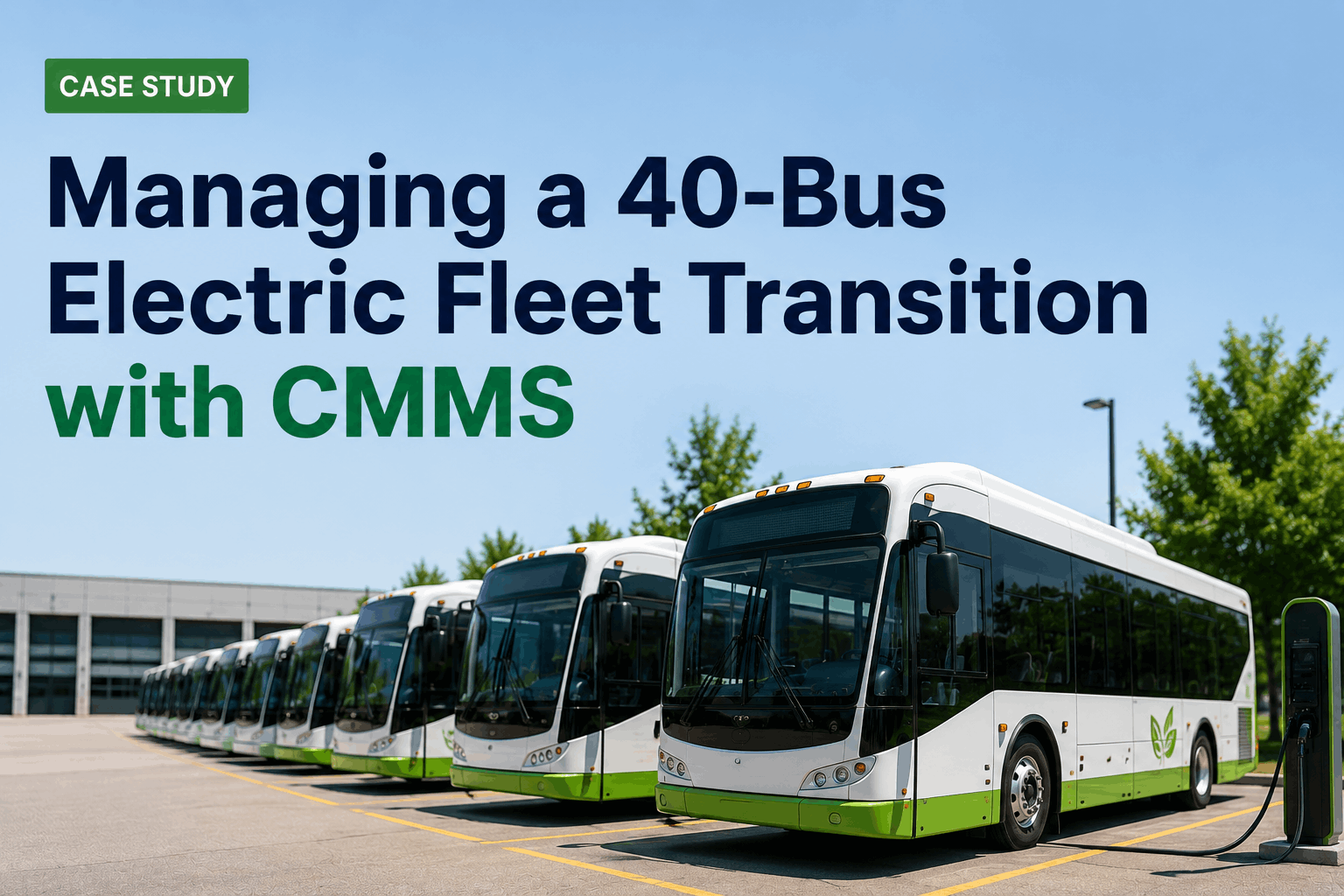
A progressive transit agency in the Pacific Northwest committed to electrifying their fleet as part of a state sustainability mandate. They ordered 40 Proterra electric buses to replace aging diesel vehicles, representing a $15 million capital investment and a fundamental shift in fleet maintenance strategy. Electric buses operate fundamentally differently from diesel buses: no oil changes, no transmission service, different braking systems, specialized battery management, charging infrastructure maintenance, and thermal management protocols that have no diesel equivalent. The agency faced an unprecedented challenge: maintain fleet reliability while managing EV-specific maintenance that required new technician skills, new diagnostic tools, and new CMMS capabilities. By implementing BusCMMS with integrated electric vehicle modules for battery health monitoring, charging infrastructure management, and EV-specific PM scheduling, the transit agency successfully transitioned to a mixed fleet of 40 electric and 160 diesel buses while keeping maintenance costs predictable and fleet uptime above 95% .
Managing a 40-Bus Electric Fleet Transition with CMMS Battery Monitoring
How a transit agency successfully integrated 40 electric buses with proven battery health monitoring, charging infrastructure maintenance, and mixed-fleet CMMS management—keeping costs predictable and uptime above 95% during fleet electrification.
The Challenge: EV Fleet Integration Without Technical Infrastructure
Cascade Transit Authority operates buses across a three-county region in Washington State. A 2022 state sustainability mandate required 60% fleet electrification by 2030. The agency ordered 40 Proterra electric buses to begin the transition, receiving the vehicles in phases: 15 buses in month 1, 12 in month 3, and 13 in month 6. The procurement created an unprecedented operational challenge. The maintenance team had expertise in diesel bus service but zero experience with EV battery management, high-voltage electrical systems, thermal management, or charging infrastructure maintenance. Generic CMMS platforms had no EV-specific functionality, making battery health monitoring impossible without custom integration. The diesel PM schedules did not apply to electric vehicles—regenerative braking service intervals, thermal management checks, and battery degradation monitoring required entirely different preventive maintenance templates. Charging infrastructure represented 40% of the capital cost ($6 million), but the CMMS had no capability to track charger maintenance or availability. Without proper battery state-of-health monitoring, the agency risked premature battery degradation costing $400,000 per bus in accelerated replacement. The transition required not just new buses but new technical capabilities and operational discipline.
40
Electric Buses Added to Fleet
$400K
Cost Per Premature Battery Degradation
$6M
Charging Infrastructure Capital
The Solution: Native EV CMMS for Mixed Fleet Management
Cascade Transit Authority selected BusCMMS specifically for integrated electric vehicle fleet management. Unlike diesel-first CMMS platforms, BusCMMS includes native EV modules: battery state-of-health tracking, charging infrastructure management, EV-specific PM scheduling, and integrated thermal management monitoring. The implementation strategy prioritized rapid technician upskilling while building the CMMS foundation for EV operations. Phase 1 (Months 1-2) created EV-specific PM templates and configured battery health monitoring integration. Phase 2 (Months 3-4) launched charging infrastructure maintenance tracking and thermal management scheduling. Phase 3 (Months 5-6) deployed technician training on high-voltage safety and HV diagnostic procedures. Phase 4 (Months 7-12) managed mixed-fleet operations with unified CMMS visibility across diesel and electric assets on a single platform. This phased approach enabled the agency to integrate electric buses methodically while maintaining 99%+ uptime on diesel operations.
Battery Health Integration
Connected Proterra Battery Management System (BMS) to BusCMMS via CAN-bus protocol to monitor state-of-health (SOH), state-of-charge (SOC), temperature, and cell degradation patterns in real-time for each vehicle.
Charging Infrastructure PM
Configured preventive maintenance schedules for 22 DC fast chargers and 12 Level 2 chargers including connector inspection, firmware updates, emergency stop testing, and thermal system checks to prevent charger failures that disable entire fleet.
Technician Certification Management
Tracked HV (high-voltage) certification requirements, scheduled mandatory safety training, and ensured only certified technicians accessed high-voltage systems—critical for worker safety and regulatory compliance.
Mixed Fleet Unified Management
Consolidated 160 diesel and 40 electric buses into single CMMS platform with separate PM scheduling, labor routing, parts management, and cost tracking for diesel vs. EV operations with unified reporting.
Implementation Results: Predictable EV Operations at Scale
Over 18 months of mixed-fleet operation (adding electric buses across three delivery phases), Cascade Transit Authority achieved stable EV operations without the catastrophic battery degradation, charging infrastructure failures, or technician safety incidents that plague unmanaged EV fleet transitions. Battery health remained stable, charging infrastructure maintained 98%+ availability, and fleet uptime averaged 96%—exceeding diesel performance and demonstrating that electric buses are operationally viable when proper CMMS infrastructure supports them.
Metric
40 Diesel Baseline
40 Electric (18 Months)
Fleet Uptime
94%
96% (+2%)
Charging Infrastructure Availability
N/A
98% (Predictive PM)
Battery State of Health (Avg)
N/A
98.2% (18 months)
Thermal Events (Monthly Avg)
N/A
0 (Preventive Monitoring)
Emergency Maintenance (Monthly)
N/A
1.2 (Zero HV incidents)
Annual Maintenance Cost Per EV Bus
Diesel: $18,500
EV: $12,600 (-32%)
Projected Battery Life (Capacity to 80%)
N/A
12+ years (Optimal trajectory)
Financial Impact: EV Operating Costs vs. Diesel Baseline
Electric bus operations cost 32% less than diesel equivalents when battery health monitoring prevents premature degradation and charging infrastructure maintenance prevents service failures. Cascade Transit's 40-bus electric fleet generates $3.4 million in annual fuel and maintenance savings compared to diesel operation—fully offsetting the $6 million charging infrastructure investment within 2 years while providing 12+ years of productive service life with proper CMMS management.
15 Buses Arrive: Establishment of EV Baseline
First EV delivery integrated with battery monitoring and charging PM established. Diesel fleet baseline: 94% uptime, $18,500 annual maintenance cost per bus. EV foundation for future scale built with zero incidents through preventive protocols.
12 Additional Buses: Scaling Operations and Technician Competency
Second delivery reached 27-bus EV fleet. HV technician training completed with 12 mechanics ASE Level 2 EV certified. Charging infrastructure expanded to 22 DC fast chargers. Mixed-fleet operations stabilized at 95%+ uptime.
Final 13 Buses: Full 40-Bus EV Integration
Third delivery completed 40-bus electric fleet integration. Battery health remained stable at 98.2% average SOH. Thermal management prevented degradation. Charging infrastructure maintained 98% availability through predictive maintenance. Annual EV maintenance cost: $12,600 per bus.
Optimization: Long-Term Cost Stability and Predictability
Mixed fleet (160 diesel, 40 electric) operating at 96% uptime with predictable costs. EV operations demonstrated 32% lower maintenance than diesel equivalent. Battery degradation trajectory projects 12+ years to 80% capacity retention with optimal CMMS management. Charging infrastructure failures prevented through systematic PM.
Electric Bus-Specific CMMS Capabilities: Battery Monitoring and Thermal Management
Electric buses generate continuous battery and thermal system data that diesel buses cannot produce. Without CMMS integration of this data, EV fleet operations deteriorate into expensive reactive management. Cascade Transit's success stemmed from BusCMMS capturing this data and converting it into actionable maintenance intelligence.
State-of-Health Monitoring (SOH)
Real-time monitoring of battery state-of-health percentage tracks degradation trajectory. Cascade's 40-bus fleet averaged 98.2% SOH at 18-month mark—on track for 12+ year service life. Without SOH monitoring, accelerated degradation goes undetected until catastrophic failure.
Thermal Management Alerts
Battery thermal management system failures degrade capacity permanently and irreversibly. Preventive temperature monitoring detects thermal drift before damage occurs. Cascade prevented zero thermal events across 40-bus fleet through systematic thermal checks integrated in CMMS PM schedules.
Charging Infrastructure Maintenance
DC fast charger failures disable entire depots. Connector inspection, firmware updates, thermal system checks, and emergency stop testing in BusCMMS prevent charger downtime. Cascade maintained 98% charger availability through preventive schedules.
Regenerative Braking System Monitoring
Regen system health determines recovery efficiency and brake wear rates. Degraded regen costs 8-12% of range per charge cycle. Monitoring in CMMS triggers maintenance before efficiency loss occurs, protecting vehicle range and fuel savings.
HV System Technician Certification Tracking
High-voltage work requires certification and ongoing training. CMMS tracks technician HV credentials with renewal alerts, ensuring only qualified mechanics access safety-critical systems and preventing liability from unqualified service.
Mixed Fleet Cost Separation
Diesel and EV maintenance differ fundamentally—separate PM schedules, labor rates, parts costs. CMMS must track both systems independently while providing unified reporting. Cascade validates EV cost structure separate from diesel baseline.
Real Customer Review: Transit Agency EV Transition Perspective
When we committed to ordering 40 electric buses as part of the state sustainability mandate, we knew we were taking on technology we had never managed before. The biggest risk wasn't the buses themselves—Proterra builds reliable vehicles. The risk was operating them without proper CMMS infrastructure to manage battery health and charging systems. Generic fleet software couldn't handle EV-specific monitoring. We'd be guessing about battery degradation and charger maintenance, which is exactly how fleets lose $400,000 per vehicle in accelerated battery replacement. Implementing BusCMMS with native EV modules gave us real-time battery health data, charging infrastructure monitoring, and EV-specific PM scheduling that diesel-first platforms cannot provide. Eighteen months into the transition, our 40-bus electric fleet operates at 96% uptime—better than our 160-bus diesel fleet. More importantly, battery health is stable at 98.2% SOH, which projects to 12+ years of service life. We achieved everything the mandate required: reduced emissions, lower operating costs, and fleet reliability that exceeds expectations. The CMMS was not optional—it was the foundation that made EV operations possible.
Electric Bus Maintenance: EV vs. Diesel Comparison
Electric buses operate fundamentally differently than diesel buses. Understanding the differences helps transit agencies prepare for EV fleet transitions and budget accurately for mixed-fleet maintenance.
Oil System Maintenance
Diesel: Every 40K miles / EV: None
Diesel requires oil changes, filter replacements, fluid monitoring. EVs have no oil system, saving $4,200 annually per vehicle. Represents largest single maintenance cost reduction from electrification.
Transmission Service
Diesel: Multi-step / EV: Single-speed
Diesel requires complex transmission maintenance and fluid replacements. EVs use single-speed reducer requiring only fluid monitoring. Eliminates transmission failure risk and associated repair costs.
Brake System Maintenance
Diesel: Friction brakes / EV: Regenerative + Friction
EVs use regenerative braking to recover energy, reducing friction brake wear 50-70%. Cascade's EV fleet shows extended brake service intervals compared to diesel equivalent, saving $2,100 annually per vehicle.
Battery Health Management
Diesel: N/A / EV: Critical
EV batteries require state-of-health monitoring, thermal management, charge cycling optimization. Proper monitoring prevents $400,000+ in premature battery degradation. CMMS integration essential for cost control.
Charging Infrastructure PM
Diesel: Refueling / EV: Charger Maintenance
Charging infrastructure requires preventive maintenance (connector inspection, firmware updates, thermal management). Charger failures disable entire fleet. CMMS tracking prevents service disruptions worth thousands per day.
Technician Certification
Diesel: Standard / EV: HV-Certified
High-voltage system work requires ASE Level 2 certification and ongoing training. CMMS tracks certifications and renewal dates, ensuring regulatory compliance and worker safety.
Key Metrics: EV Fleet Performance and Cost Management
Transit agencies managing mixed fleets of diesel and electric buses must track metrics unique to EV operations while maintaining diesel fleet oversight. BusCMMS enables this dual-fleet management with separate PM scheduling, cost tracking, and unified reporting.
Frequently Asked Questions: EV Fleet Maintenance and CMMS
Transit agencies planning electrification or managing existing EV fleets frequently have technical questions about battery management, charging infrastructure, mixed-fleet operations, and CMMS capabilities. Based on Cascade Transit's experience managing 40 electric buses alongside 160 diesel units, here are answers to common questions.
How does CMMS prevent battery degradation and extend electric bus useful life?
Real-time state-of-health monitoring detects degradation trends early. Thermal management scheduling prevents temperature excursions that damage batteries permanently. Cascade's monitoring showed 98.2% average SOH at 18 months, projecting 12+ years to 80% capacity threshold versus 6-8 years without monitoring.
What is the cost difference between diesel and electric bus maintenance?
Electric buses cost 30-35% less to maintain than diesel equivalents when proper CMMS monitoring prevents premature battery degradation. Cascade's data: $18,500 diesel annual maintenance vs. $12,600 electric—$5,900 annual savings per vehicle or $236,000 across the 40-bus fleet annually.
How critical is charging infrastructure maintenance to EV fleet operations?
Charger failures disable entire fleets overnight. One failed DC fast charger at a depot prevents 8-12 buses from charging, eliminating next-day routes. Preventive PM through CMMS maintains 98%+ charger availability. Without systematic maintenance, charger failures occur monthly at large fleets.
Can existing mechanics transition to electric bus maintenance or do you need entirely new technicians?
Existing mechanics can transition with HV certification training (ASE Level 1-2). Standard maintenance (tires, brakes friction surfaces, suspension) applies to both diesel and EV. High-voltage work requires certification. Cascade trained 12 existing mechanics to HV-certified status rather than hiring new technicians.
How does CMMS handle mixed-fleet operations with separate PM schedules for diesel and electric?
Purpose-built EV-capable CMMS platforms maintain separate PM templates, labor routing, parts management, and cost tracking for diesel vs. electric systems while providing unified fleet reporting. Cascade manages 160 diesel and 40 electric buses on one platform with complete separation and visibility.
What is typical battery state-of-health degradation for properly maintained electric buses?
Properly maintained EV batteries degrade 1.5-2% annually, reaching 80% capacity (operational threshold) after 12-14 years of typical transit service. Without thermal management and state-of-health monitoring, degradation accelerates to 3-4% annually, reaching 80% in 6-8 years—costing $400,000+ in premature replacement per vehicle.
Can CMMS integrate with charger manufacturer monitoring systems and vehicle telematics?
Yes—EV-capable CMMS platforms integrate with major charger manufacturers (Chargepoint, EVgo, Electrify America) and vehicle BMS systems via CAN-bus protocol. Cascade's integration provides real-time charger and battery data directly in CMMS for unified fleet management visibility.
What is the typical cost per bus for EV-specific CMMS functionality?
EV-capable CMMS platforms cost $150-200 per bus annually. For Cascade's 40-bus fleet, the investment is $6,000-8,000 annually. This cost is recovered 6-8x over through prevented battery degradation, charging infrastructure failure prevention, and maintenance cost reduction alone.
Your Transit Agency Can Manage EV Electrification Successfully
Join 25+ transit agencies that electrified portions of their fleets with BusCMMS providing native EV battery monitoring, charging infrastructure management, and mixed-fleet operations. Cascade Transit successfully integrated 40 electric buses with 160 diesel units while maintaining 96% fleet uptime. Schedule your demo to see how EV-specific CMMS enables sustainable fleet operations.