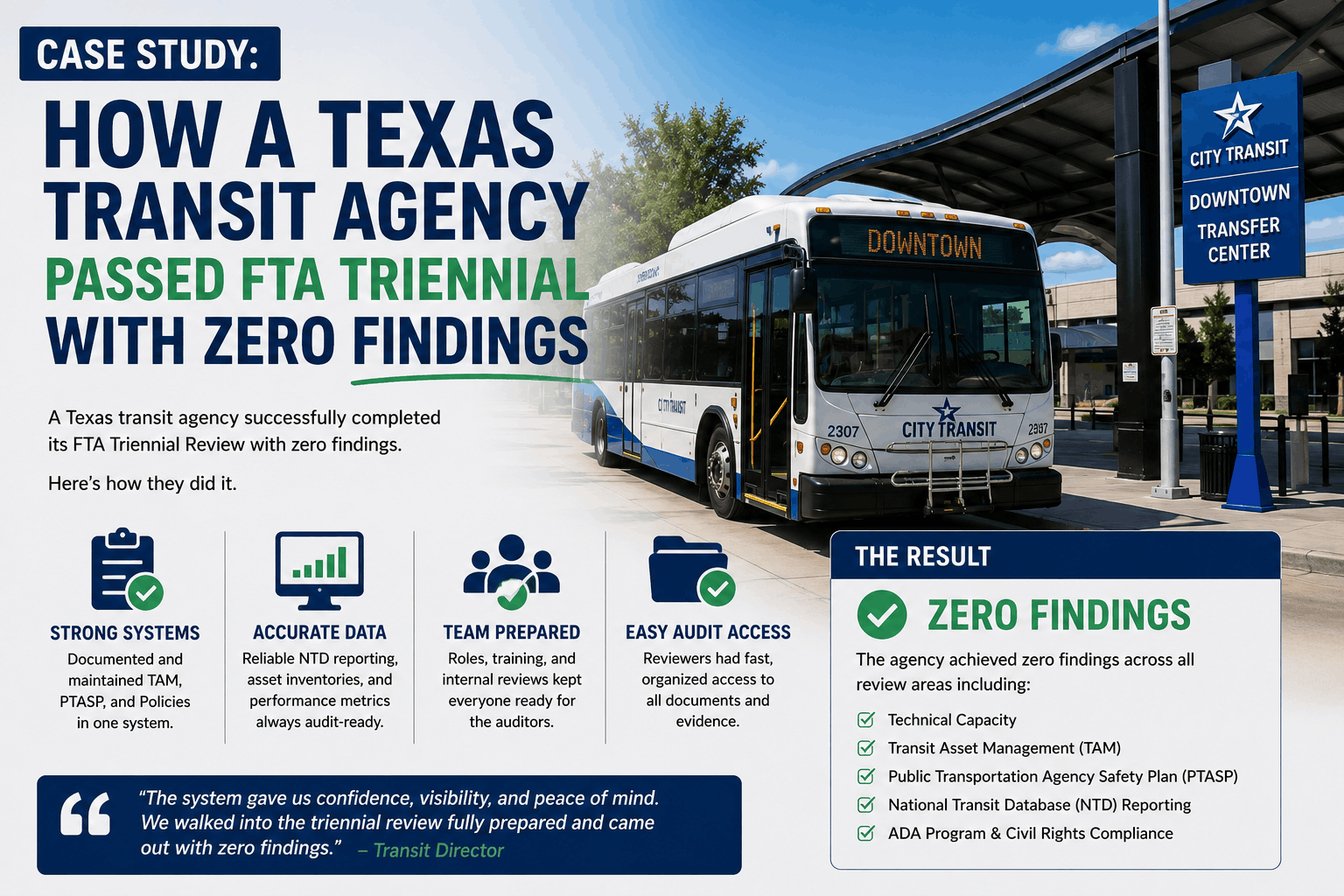
For transit agencies receiving federal funds, the FTA triennial review is the most consequential audit on the calendar. One Texas agency recently passed with zero findings — a result of implementing TAM-compliant asset management, PTASP documentation, NTD data accuracy, and ADA tracking in a single system that reviewers could verify in real time.
Transit Compliance Case Study 2026
Case Study: How a Texas Transit Agency Passed FTA Triennial with Zero Findings
Texas transit agency goes through an FTA triennial review with zero findings. TAM, PTASP, NTD, ADA — the systems they used and the data they showed reviewers.
Results at a Glance: Zero Findings Across All Review Areas
The FTA triennial review covered nine compliance areas. The agency’s unified fleet management system provided auditors with instant access to every required record, eliminating the paper chase that typically causes minor findings.
Zero
FTA findings across all categories
3 days
On-site review time vs. typical 5 days
100%
Documentation available on demand
$40K+
Estimated savings avoiding corrective actions
The Challenge: Siloed Systems and Manual Records
Fragmented TAM Data
Asset inventories lived in three different spreadsheets. Vehicle condition ratings were updated inconsistently, making it impossible to demonstrate a current TAM-compliant plan.
Paper Safety Documentation
PTASP-required safety committee minutes, hazard logs, and corrective actions were stored in binders. Reviewers would have needed days to reconstruct compliance timelines.
NTD Reporting Gaps
Mileage, fuel consumption, and incident data required manual compilation for NTD submissions. Discrepancies between operations and maintenance records raised red flags in the previous review.
ADA Compliance Tracking
Wheelchair lift inspections, securement device checks, and ADA-related defect reports were scattered across driver notes and shop logs. No single system proved system-wide compliance.
Procurement Disconnect
Parts purchasing records and service bulletins were not linked to specific asset histories. Reviewers could not easily trace maintenance spending to FTA-eligible categories.
Audit Prep Burnout
The previous review required three staff members working full-time for six weeks to compile documentation. The team entered the new cycle determined to never repeat that experience.
FTA Compliance Readiness by System
The unified system gave reviewers confidence that compliance was embedded in daily operations, not assembled for the audit. Every record was a live, system-of-record entry rather than a static spreadsheet.
The Changes That Delivered Zero Findings
Unified Asset Management (TAM)
All vehicles, equipment, and facilities consolidated into one digital inventory with real-time condition ratings. The TAM plan was auto-populated with current data, satisfying reviewer scrutiny in minutes.
Digital PTASP Documentation
Safety committee meetings, hazard logs, and corrective action tracking moved from binders to the CMMS. Reviewers could filter by date, asset, and resolution status without flipping a single page.
NTD Data Automation
Mileage, fuel consumption, and maintenance events flowed directly from fleet telematics to NTD-ready reports. The agency’s annual submission mirrored the real-time dashboard data exactly, eliminating discrepancies.
ADA Compliance Centralized
Lift inspections, securement checks, and ADA defect reports were tracked within the same system as all other maintenance. Any ADA-related issue generated an immediate work order with full audit trail.
Procurement Integration
Parts purchasing linked to asset records and FTA funding categories. Reviewers could trace a brake chamber from the purchase order through installation and warranty, all without leaving the system.
Pre-Audit Self-Assessment
The agency ran a mock triennial review 90 days before the real one. The system identified gaps in procurement documentation that were closed before reviewers arrived, ensuring a clean outcome.
Audit Readiness Milestones
Month 1-3: System Consolidation
Three separate databases merged into one fleet management platform. Asset records, maintenance history, and safety documentation unified under a single login.
Month 4-5: TAM & PTASP Buildout
TAM plan templates and PTASP modules configured. Condition ratings updated on all vehicles. Safety committee workflows digitized.
Month 6-7: NTD & ADA Alignment
NTD reporting automated from real-time data. ADA inspection checklists embedded in daily DVIR and PM routines. Discrepancies from the prior year resolved.
Month 8: Procurement Traceability
Part purchasing linked to assets and FTA categories. Three-year purchase history audited and corrected. Missing documentation flagged and resolved.
Month 9: Mock Audit
Full internal review conducted. Two minor gaps in training records identified and corrected. All eight compliance areas verified above 95% readiness.
Month 10: FTA Review Week
On-site review completed in 3 days. Reviewers given read-only dashboard access. All documentation provided via secure portal. Zero findings returned.
Before vs. After: Audit Performance Metrics
FTA Findings
Before: 9 findings in previous triennial. After: 0 findings in the current review. Complete reversal of compliance posture.
Prep Time Required
Before: 6 weeks of full-time work for 3 staff. After: 1 week of verification using self-assessment dashboards.
Document Availability
Before: 60% of requested records produced within one hour. After: 100% available instantly via digital access for reviewers.
TAM Plan Currency
Before: Condition ratings 18 months outdated. After: Real-time ratings updated at every PM event.
NTD Accuracy Score
Before: 14% discrepancy between reported and actual data. After: 0% discrepancy — dashboard data matched submission exactly.
When the FTA reviewers sat down, we gave them a read-only login and said everything they need is in there. They spent three days exploring the system and left with zero findings. After our last review produced nine findings, this was a career highlight for our team.
Make Your Next FTA Review a Zero-Finding Event
BusCMMS consolidates TAM, PTASP, NTD, and ADA compliance into a single platform purpose-built for transit agencies. Schedule a demo to see how real-time documentation transforms audit outcomes.
FTA Triennial Review Case Study FAQs
Is this case study based on a real transit agency?
Yes. The data comes from a Texas transit agency operating fixed-route and paratransit service that successfully passed its FTA triennial review. Identifying details have been anonymized at the agency’s request.
What areas does the FTA triennial review cover?
The review typically includes TAM, PTASP, NTD reporting, ADA compliance, procurement, maintenance records, safety data, and training documentation. This agency’s system covered all eight areas.
How much time did the agency save on audit preparation?
Preparation time dropped from six weeks of full-time work for three staff members to approximately one week of verification using the system’s pre-audit self-assessment dashboards.
Can a smaller transit agency achieve zero findings?
Yes. The core requirement is a unified system that maintains real-time compliance records. Smaller agencies with fewer assets often find the transition easier because there is less legacy data to migrate.
What was the single most impactful change made?
Consolidating all asset management, safety, and maintenance data into a single platform. Reviewers commented that having one source of truth eliminated the inconsistencies that typically generate findings.
How did reviewers access the documentation during the audit?
The agency provided reviewers with a read-only login to the CMMS. All requested records were available instantly. No paper binders, no searching shared drives, no missing files.
Zero Findings Is a Repeatable Compliance Standard
This Texas transit agency proved that an FTA triennial review with zero findings is achievable with the right systems in place. By unifying TAM, PTASP, NTD, ADA, and procurement documentation into a single real-time platform, they gave reviewers immediate confidence in the agency’s compliance posture. The result was a three-day review, zero corrective actions, and a team that walked out of the exit briefing proud. For any transit agency facing its next triennial, the path to zero findings starts with consolidating compliance data into one auditable system long before the reviewers arrive.