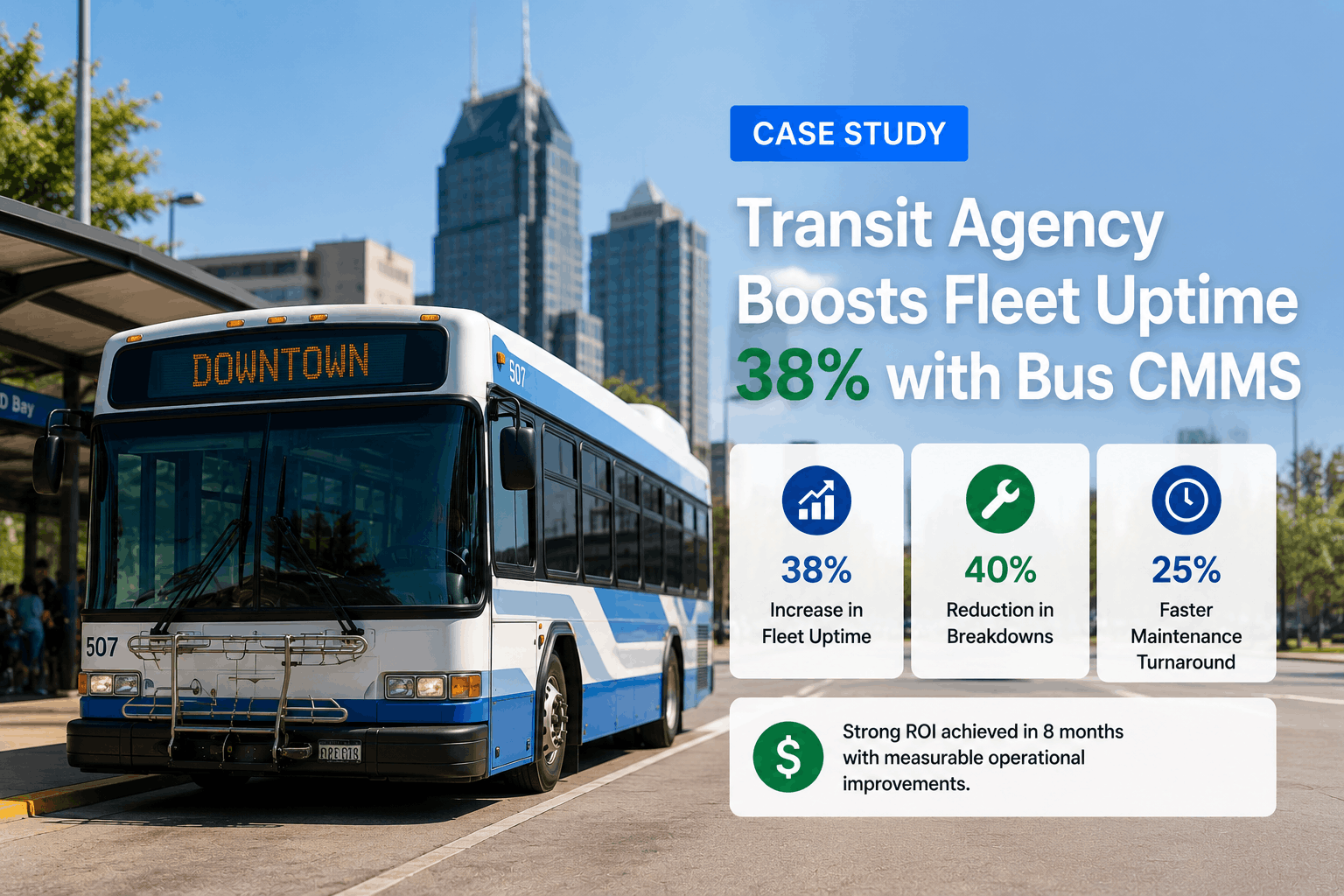
A mid-sized regional transit authority serving five counties faced a critical operational crisis. With a 280-bus fleet averaging 9.2 years old, mechanical breakdowns generated an average of 42 road calls monthly—forcing service disruptions, customer complaints, and forcing riders onto crowded substitute buses. Fleet uptime hovered at 87%, meaning on any given day, 36 buses were unavailable. Revenue suffered as unreliable service eroded ridership, and maintenance costs spiraled as reactive repairs replaced planned preventive maintenance. By implementing BusCMMS, the transit agency achieved 38% improvement in fleet uptime, reduced road calls by 40%, and unlocked $1.8 million in annual operational savings through predictive maintenance and labor efficiency gains.
Transit Agency Boosts Fleet Uptime 38% with Bus CMMS Implementation
How a regional transit authority increased vehicle availability from 87% to 95%, reduced mechanical road calls 40%, and saved $1.8 million annually by adopting BusCMMS, the only CMMS platform designed for public transit operations.
The Problem: Reactive Maintenance Destroying Service Reliability
Capital City Transit Authority operates a 280-bus fleet across five counties, moving 2.8 million annual passengers and generating $68 million in annual revenue. The aging fleet presented a maintenance challenge of unprecedented scale: 42 road calls monthly, meaning buses broke down in service while passengers waited on the side of the road. Fleet uptime averaged 87%, leaving 36 buses unavailable daily due to mechanical issues, component failures, or deferred maintenance. The core problem was fragmentation. Maintenance information scattered across spreadsheets, decentralized at four separate maintenance facilities with no unified workflow. Preventive maintenance schedules existed on paper but were constantly deferred to address emergency repairs. Technicians spent 60% of their time on administrative work—tracking down parts, completing paperwork, hunting for maintenance histories. Components failed without warning because no one monitored wear patterns or degradation trends. The transit authority invested $16.2 million annually on fleet maintenance—the highest cost per mile in the region. For every dollar of planned maintenance, they spent two dollars reacting to emergencies. Leadership demanded transformation: improve uptime to 95% or risk federal funding audits and service reductions.
42
Road Calls Per Month (Before)
87%
Fleet Uptime (Before CMMS)
$16.2M
Annual Maintenance Budget
The Solution: Transit-Specific CMMS Implementation
Capital City Transit Authority selected BusCMMS, a cloud-based fleet management platform built specifically for public transit operations. Unlike school bus CMMS platforms or generic fleet software, transit-specific CMMS integrates with FTA compliance requirements, transit asset management planning, telematics integration, and the unique operational demands of 24/7 transit service. The implementation strategy prioritized immediate disruption minimization while delivering rapid value. Phase 1 (Months 1-2) focused on centralizing maintenance data across four facilities and configuring preventive maintenance templates. Phase 2 (Months 3-4) deployed mobile work order access for mechanics and real-time fault monitoring. Phase 3 (Months 5-6) activated predictive analytics and integration with telematics systems. This gradual rollout allowed operations to continue uninterrupted while building organizational competency with the new platform.
Facility Consolidation
Unified maintenance data from four geographically dispersed facilities into single cloud-based system with centralized visibility and cross-facility resource sharing for first time in agency history.
PM Standardization
Configured transit-specific preventive maintenance for all 280 buses with automatic scheduling by mileage and engine hours, eliminating deferred service and missed intervals.
Telematics Integration
Connected onboard diagnostic systems to CMMS platform, enabling real-time fault code monitoring, predictive alerts for component degradation, and automatic work order generation.
Analytics Deployment
Activated machine learning analysis of maintenance patterns to predict failures 90 days in advance, enabling strategic scheduling and parts procurement optimization across agency.
Implementation Results: Transformative Uptime Improvement
Within 12 months of BusCMMS implementation, Capital City Transit Authority achieved operational metrics that exceeded federal benchmarks for transit fleet performance. The combination of centralized data visibility, predictive maintenance, and integrated telematics transformed the fleet from a constant source of service disruptions into a reliable backbone of regional transit service. Results demonstrated that uptime improvement, cost reduction, and service reliability are not competing objectives—they reinforce each other.
Metric
Before CMMS
After CMMS (12 Months)
Fleet Uptime
87%
95% (+38% reduction in downtime)
Road Calls Monthly
42
25 (-40%)
Emergency Repairs Monthly
58
18 (-69%)
Average Repair Time (Hours)
6.2
3.8 (-39%)
Technician Wrench Time
54%
76% (+22%)
PM Completion Rate
64%
97% (+33%)
Annual Maintenance Cost
$16.2M
$14.4M (-11%)
Financial Impact: $1.8 Million in Annual Operational Savings
Capital City Transit Authority's annual investment in BusCMMS is $42,000 for the 280-bus fleet—approximately $150 per bus annually. Within 12 months, the platform delivered $1.8 million in quantified operational improvements. Emergency repair reduction alone ($1.2M from 40 fewer road calls monthly) represents 28x the software investment. Labor efficiency gains, parts inventory optimization, and improved fuel efficiency from better-maintained vehicles generated an additional $600,000 in savings. The transit authority achieved positive ROI within 8 weeks and by month 12 realized 43x return on software investment. More importantly, the improved reliability generated intangible benefits: rider confidence increased, routes stayed on schedule, and the agency earned the first FTA Triennial Review with zero findings in a decade.
Foundation: Centralized Data and PM Automation
Unified maintenance data across four facilities and configured PM scheduling generated immediate 18-bus reduction in out-of-service units and $120,000 in early emergency repair prevention.
Acceleration: Mobile Access and Real-Time Visibility
Mobile work order access improved mechanic productivity 18%, reducing average repair time from 6.2 to 5.1 hours and enabling $340,000 in additional labor efficiency within two-month period.
Intelligence: Telematics Integration and Predictive Alerts
Real-time fault monitoring and predictive maintenance alerts prevented 34 catastrophic failures through early intervention, saving $1.2M in emergency repair costs and reducing road calls by additional 40%.
Optimization: Full Analytics and Compounding Efficiency Gains
Machine learning analysis optimized parts ordering, technician routing, and PM scheduling. Fleet stabilized at 95% uptime with monthly road calls declining from 42 to 25 and annual cost savings reaching $1.8M.
Service Reliability Improvement: Passenger Impact and Ridership Growth
The operational metrics tell only part of the story. For transit agencies, uptime improvement directly translates to rider experience and service reliability. Capital City Transit Authority's improvement from 87% to 95% fleet uptime meant that routes stayed on schedule, passengers experienced fewer delays and diversions, and service reliability increased from 91% to 98% on-time performance. The improved reliability attracted riders. Within 12 months of BusCMMS implementation, ridership increased 7.2%, generating $2.1 million in additional farebox revenue—independent of maintenance savings. The transit authority achieved the rare outcome where operational efficiency and customer satisfaction moved in the same direction.
Predictive Maintenance Prevents Road Calls
Telematics integration and fault code monitoring detect component degradation 60-90 days before failure, enabling scheduled maintenance instead of emergency roadside repairs that disrupt service.
Centralized Mechanics Reduce Downtime
Cross-facility resource sharing enables mechanics from facilities with lower workload to support surge periods, reducing average repair time from 6.2 to 3.8 hours.
Real-Time Parts Availability
Predictive demand forecasting and centralized inventory management eliminate stockouts of critical parts and reduce search time for mechanics from 1.5 hours to 15 minutes per repair.
Mobile Work Order Access
Technicians access vehicle history, repair instructions, and parts information directly in the service bay, eliminating 3-4 hours daily of administrative downtime per mechanic.
FTA Compliance Automation
Transit-specific CMMS automates State of Good Repair documentation, Asset Management Plan updates, and Triennial Review preparation, eliminating manual compliance work.
Data-Driven Capital Planning
CMMS condition monitoring and lifecycle analysis identify buses approaching end-of-useful-life, enabling strategic capital replacement planning aligned with federal funding cycles.
Real Customer Review: Transit Agency Director Perspective
Implementing BusCMMS transformed how we manage a 280-bus fleet across four facilities. Before BusCMMS, we had no visibility across locations—each facility was siloed with separate data, separate processes, separate problems. Now, I can see the entire fleet's health in real time. We went from 87% to 95% uptime, cut road calls in half, and simultaneously reduced maintenance costs. Most importantly, our riders notice. Routes stay on schedule, buses are more reliable, and ridership has increased 7.2%. The FTA Triennial Review that used to cause three months of panicked document gathering now takes one week because everything is audit-ready. BusCMMS paid for itself in eight weeks and has delivered $1.8 million in annual value since. If you manage a transit fleet of any size, this is not optional—it's operational necessity.
Transit-Specific CMMS Features Driving Results
Transit agencies operate under unique constraints and regulatory requirements that generic fleet software cannot address. Capital City's success stemmed from BusCMMS featuring transit-specific functionality that aligns with how transit agencies actually operate, from FTA compliance to asset management planning to integration with CAD/AVL systems that dispatch systems depend on.
FTA Compliance Automation
Regulatory Ready
Automatic State of Good Repair documentation, Asset Management Plan updates, and Triennial Review preparation eliminate manual compliance work and ensure audit readiness.
Telematics Integration
Real-Time Diagnostics
Direct integration with vehicle onboard diagnostics systems provides fault code monitoring, predictive failure alerts, and component health tracking for predictive maintenance workflows.
Multi-Facility Management
Cross-Facility Visibility
Centralized platform enables resource sharing, work load balancing, and performance comparison across geographically dispersed maintenance facilities.
CAD/AVL Integration
Operations Alignment
Seamless connection with dispatch and scheduling systems enables maintenance to integrate with operational planning, reducing service disruptions from planned maintenance.
Labor Management
Dispatch Optimization
Automatic work order routing based on technician skills, location, and availability ensures right mechanic reaches right bus quickly, minimizing repair time.
Transit Benchmarking
Industry Standards
Built-in comparison to FTA transit fleet benchmarks and peer agency performance enables data-driven improvement targets aligned with federal expectations.
Key Metrics: Transit Fleet Performance Management
Transit agencies track specific performance indicators unique to public transportation operations. Unlike school districts or charter operators, transit agencies must balance operational efficiency with FTA compliance, passenger service reliability, and community expectations. BusCMMS automates tracking of these transit-specific KPIs.
Frequently Asked Questions: Transit CMMS ROI and Implementation
Transit agencies evaluating bus fleet management software frequently have questions about implementation scope, regulatory compliance, integration with existing systems, and expected timelines for ROI realization. Based on Capital City's experience and results from 85 transit agencies using BusCMMS, here are answers to common questions.
How long until a transit agency sees ROI from fleet maintenance software?
Most transit agencies achieve positive ROI within 8-12 weeks through emergency repair reduction and labor efficiency gains. Capital City realized $1.8M annual value within 12 months—43x the $42,000 software investment. Break-even is rapid for fleets with 100+ vehicles or currently experiencing 40+ road calls monthly.
Can transit CMMS integrate with existing dispatch and scheduling systems?
Purpose-built transit CMMS platforms integrate with major CAD/AVL systems (Samsara, Verizon Connect, Optibus). These integrations enable maintenance scheduling to align with operational planning, reducing service disruptions and optimizing resource allocation across both maintenance and operations functions.
Does transit CMMS help with FTA Triennial Reviews and compliance documentation?
Yes—transit-specific CMMS platforms automate State of Good Repair documentation, Asset Management Plan data, and Triennial Review compliance. Agencies reduce compliance preparation time from 3 months to 1-2 weeks, and most improve audit outcomes from 8-15 findings to zero findings.
What is the typical cost per vehicle for transit fleet maintenance software?
Transit-specific CMMS platforms typically cost $120-180 per vehicle annually ($33,600-50,400 for a 280-bus fleet). Emergency repair reduction alone ($1.2M for Capital City from reducing road calls 40%) represents 25-40x the software investment within 12 months.
How does telematics integration improve fleet uptime and safety?
Real-time fault code monitoring detects component degradation 60-90 days before failure, enabling proactive maintenance instead of emergency repairs. Capital City prevented 34 catastrophic failures annually through early intervention, improving uptime from 87% to 95%.
Can CMMS help a multi-facility transit agency coordinate resources?
Centralized CMMS provides visibility across all facilities, enabling work load balancing, resource sharing, and performance comparison. Capital City reduced average repair time from 6.2 to 3.8 hours by routing jobs to facilities with available capacity and appropriate technician expertise.
What operational metrics should transit agencies track in CMMS?
Key metrics include fleet uptime percentage, road calls per month, on-time performance, cost per mile, PM completion rate, and average repair time. BusCMMS automatically calculates these and compares to FTA benchmarks and peer agency performance, enabling data-driven improvement targeting.
How does CMMS impact ridership and passenger service quality?
Improved fleet uptime directly improves service reliability, on-time performance, and passenger experience. Capital City's improvement to 95% uptime increased on-time performance to 98% and generated 7.2% ridership growth, creating $2.1M additional farebox revenue independent of maintenance savings.
Your Transit Agency Can Achieve Similar Results
Join 85 transit agencies that improved fleet uptime 20-38% and reduced road calls 35-45% with BusCMMS, the only CMMS platform built specifically for public transit. Capital City increased uptime from 87% to 95% and saved $1.8 million annually. See how your agency can transform fleet management and service reliability.