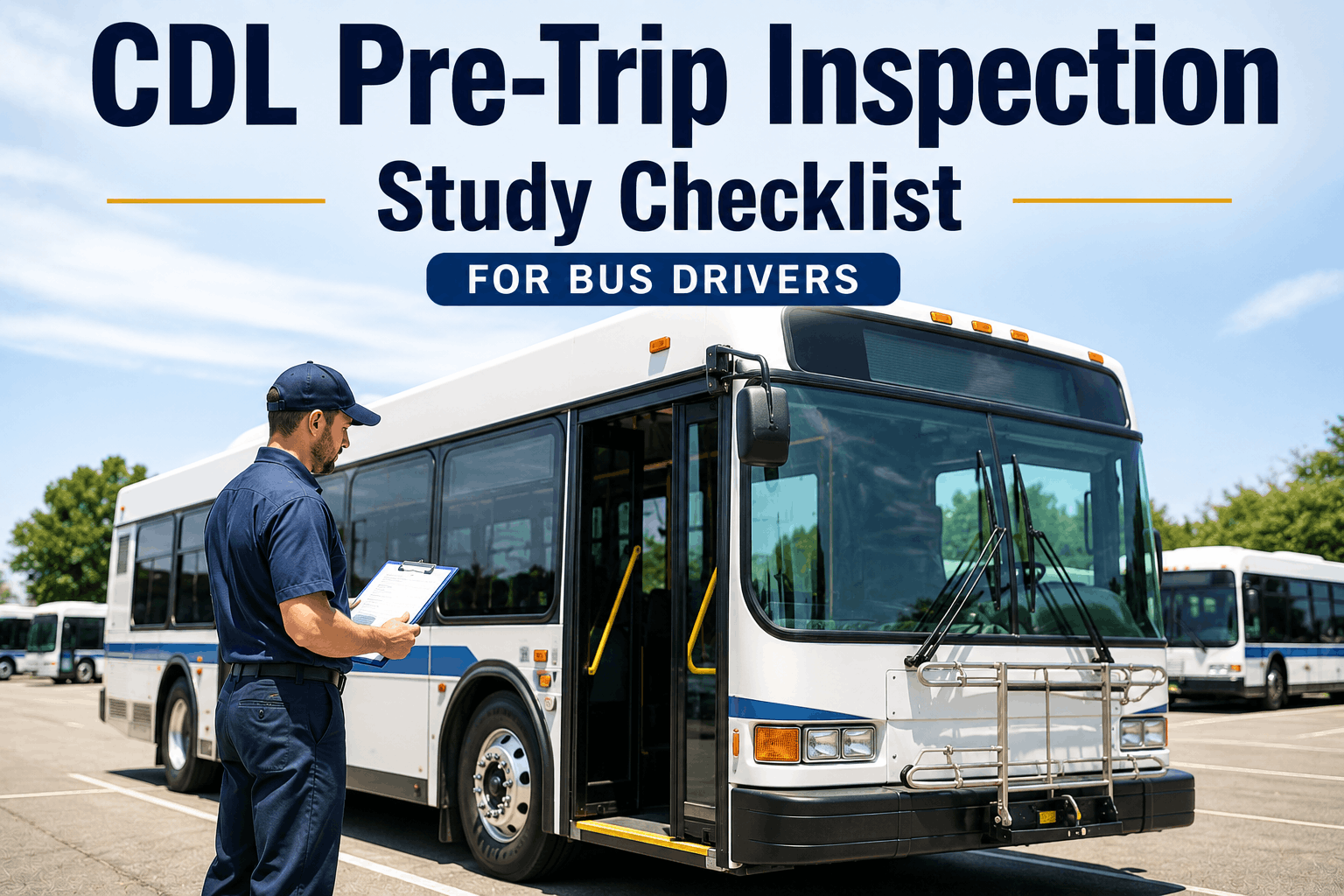
Passing the Commercial Driver’s License (CDL) pre-trip inspection exam requires more than just mechanical knowledge—it demands a flawless live verbal performance. During this high-stakes section of the skills test, examiners look closely at how systematically you analyze your vehicle, demanding that you point directly to components and articulate their exact physical condition. Simply saying a part "looks good" results in an immediate failure. You must explicitly verify that parts are "properly mounted and secure," "not cracked, bent, or broken," and show "no signs of leaks or audible air drops." For bus drivers, this challenge is doubled by the strict regulatory layers governing passenger-zone safety, including emergency escape pathways and specialized child-check electronics. This comprehensive 2026 study guide translates confusing federal testing standards into a structured, step-by-step checklist. Use the functional, interactive study modules below to track your test preparation, master the critical air-brake safety checks, and approach the examiner with absolute confidence.
Inspection Study Guide
CDL Pre-Trip Inspection Study Checklist for Bus Drivers
Ace your CDL pre-trip skills exam. This interactive study checklist walks through every single component and safety framework the examiner expects you to identify and verbalize.
The Examiner's Golden Rules: What You Must Verbalize
To earn points on the CDL skills exam, you must use precise phrases while physically checking each part. If you point to a component but fail to state its specific inspection criteria, the examiner will mark it as a miss.
Rule 1: Hard Parts (Steel, Metal, Mounts)
For every metal bracket, frame rail, rod, or casing, you must state: "Properly mounted and secure, not cracked, bent, or broken, with no missing nuts, bolts, or cotter pins."
Rule 2: Soft Parts (Hoses, Belts, Air Lines)
For rubber or flexible lines, you must state: "Properly mounted and secure, no abrasions, bulges, cuts, or tears (ABC), and no audible or visible leaks."
Rule 3: Fluid & Air-Driven Components
For components like pumps, gearboxes, and wheel seals, you must state: "Properly mounted and secure, not leaking from seals, gaskets, or connections."
Rule 4: Belt-Driven vs. Gear-Driven Auxiliaries
You must explicitly state whether the alternator, water pump, and air compressor are belt-driven or gear-driven, and verify that belts have no more than 3/4 inch of play.
Interactive Pre-Trip Study Modules
Use the interactive checkboxes below to track your mastery of each testing zone. Review each component, tap to mark it complete, and practice the verbal description out loud.
The Strategic Fix: Move from Paper Study Guides to App Automation
While studying for your commercial license requires memorization, managing a live transportation operation should not rely on guesswork. Transitioning your commercial fleet away from manual forms and onto a standardized, electronic inspection system ensures total safety compliance:
1
Build Standardized Mobile DVIR Workflows
Replace paper inspection books with guided mobile apps. Drivers tap through mandatory inspection zones, ensuring every critical component is verified before the bus leaves the lot.
2
Enforce Mandatory Inspection Photo Proofs
Require drivers to attach clear photos of critical safety areas, such as wheel hubs or emergency exit seals, directly to their digital pre-trip inspection logs.
3
Automate Real-Time Safety Defect Alerts
When a driver flags a safety defect (like a low-air warning issue or a fluid leak), the system instantly alerts the garage floor and converts the defect into an active work order.
4
Generate Instant DOT-Compliant History Logs
Store all your pre-trip and post-trip history securely in the cloud. When state or federal inspectors request documentation, export complete, organized history logs in seconds.
"During my first CDL pre-trip attempt, I failed because I panicked in front of the examiner and forgot to state that the air compressor was gear-driven and check the slack adjusters. For my second attempt, I used a structured layout to practice pointing and verbalizing the exact terms out loud. Breaking down the inspection into clear zones helped me pass easily. Now that I manage a school transit system, we build these exact step-by-step checks into our drivers' mobile apps. It keeps our drivers sharp, protects our vehicles, and ensures our pre-trip documentation is completely error-free."
— Safety Training Coordinator, Consolidated School District, Indiana
Upgrade Your Pre-Trip Routine to Automated Compliance
Take the stress out of daily pre-trip checks and audit preparation. Protect your fleet safety ratings and streamline safety reporting by deploying automated inspection checklists today.