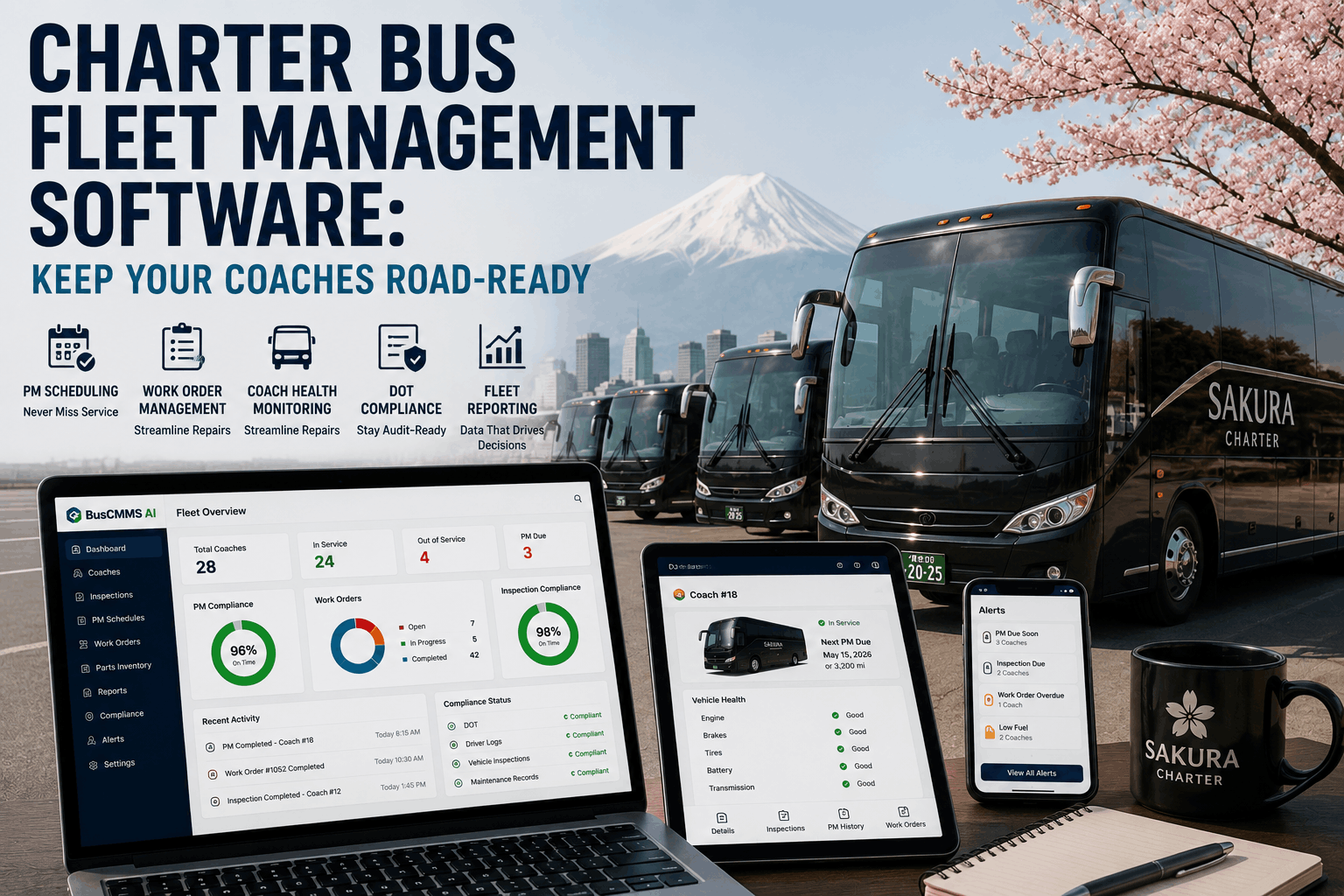
Charter bus operators face a unique business model: fleets must be road-ready on demand for spontaneous bookings, routes are unpredictable (one day serving a local sports team, next day a multi-state tour), coaches accumulate variable mileage depending on bookings, and downtime costs money directly (a coach out of service is revenue lost). Unlike school or transit buses operating fixed routes, charter coaches need flexibility in scheduling and rapid response to maintenance issues. A coach breakdown on a highway 200 miles from home creates operational chaos and angry customers. The economics are unforgiving: a 56-seat motorcoach generates $3,000-$5,000 revenue per day when operating, and costs $400-$600 per day in fuel and crew costs. When a coach is out of service for a week due to a preventable maintenance failure, that's $21,000-$35,000 in lost revenue. Charter bus operators therefore must be obsessively focused on prevention: keeping coaches mechanically sound, detecting problems before they become failures, and scheduling maintenance during slow periods rather than emergency downtime. A fleet management system designed for charter operations must account for this: flexible scheduling that accommodates variable usage patterns, rapid work order management for urgent repairs, mobile accessibility so mechanics can be reached immediately, cost tracking that shows how downtime impacts revenue, and predictive maintenance that prevents breakdowns before they happen. Here's how charter bus operators use modern fleet management software to keep coaches on the road and revenue flowing.
For Motorcoach Operators
Charter Bus Fleet Management Software
Built for motorcoach operators. Track PM due dates, manage urgent work orders, monitor coach health in real-time, and stay DOT audit-ready. Used by charter fleets of 5 to 200 coaches.
65%
Reduction in Emergency Repairs
$48K
Avg Annual Revenue Protected Per Coach
4 Days
Faster DOT Audit Preparation
The Charter Bus Downtime Problem
A charter bus operator's revenue is generated by moving coaches. When a coach is idle, it's not generating revenue—it's consuming operating costs. A breakdown requiring emergency repair costs money twice: the repair cost itself, plus the lost revenue during downtime. A transmission failure requiring 5-7 days of shop time costs $12,000 in repairs plus $20,000-$35,000 in lost revenue from that coach being unavailable. A preventive transmission service costing $800 and consuming 4 hours of shop time prevents that failure. The economics strongly favor prevention, yet many charter operators struggle with preventive maintenance scheduling due to unpredictable fleet utilization. A coach might be idle for 3 weeks, then booked solidly for 2 weeks, making it difficult to plan maintenance around operations.
The scheduling challenge: Charter operators need visibility into coach utilization 2-3 weeks ahead to schedule maintenance during gaps. A modern fleet management system provides this visibility: booking calendars show when each coach is scheduled for trips. Maintenance managers can identify maintenance windows and schedule services accordingly. Urgent maintenance needs can be prioritized based on trip schedule—if a coach is booked for the next 10 days, urgent issues are addressed immediately. If a coach has 8 days of downtime coming up, non-urgent preventive maintenance is scheduled then. This alignment between bookings and maintenance prevents both missed maintenance and unnecessary operational disruption.
Predictive maintenance for high-revenue coaches: Some coaches in a fleet are revenue stars—booked constantly for profitable long-distance routes. Other coaches sit idle for weeks. Maintenance resources should be prioritized toward high-utilization coaches to keep them on the road. A fleet management system tracking utilization reveals which coaches are revenue generators and deserve priority maintenance. A coach operating 2,000+ miles per week deserves more frequent preventive maintenance than a coach operating 300 miles per week. Data-driven allocation of maintenance resources maximizes fleet revenue.
Mobile Mechanics and Rapid Response
Real-time work order management: When a coach breaks down on the road, a driver contacts the dispatcher or maintenance manager. A responsive system immediately creates a work order, assesses severity, determines if the coach can continue to destination or needs immediate roadside assistance, and coordinates repairs. Mobile access to the work order system allows mechanics to see the repair request immediately, understand the problem, and coordinate with dispatch. This real-time communication reduces the lag time between problem detection and problem resolution.
Roadside assistance coordination: When a coach breaks down far from the home facility, a work order system should track: the breakdown location, parts needed, technician assigned, estimated repair time, and alternative transportation for passengers if needed. Integrating with roadside assistance providers (AAA, TravelCenters, national truck repair networks) allows dispatchers to send the closest available technician rather than waiting for company staff to travel hours. A system that coordinates with roadside networks reduces downtime for unexpected breakdowns.
Parts inventory optimized for high-utilization coaches: Certain parts fail frequently on charter coaches: air conditioning compressors (high-use air conditioning in summer), power steering pumps (responsive steering in mountain roads), transmission components (heavy loads, frequent acceleration), and engine cooling systems (extended operation at highway speeds). Maintaining inventory of high-failure parts allows mechanics to replace them immediately without ordering delays. A fleet management system tracking part consumption reveals which parts should be stocked based on your fleet's actual failure patterns rather than generic recommendations.
DOT Compliance for Commercial Operators
Motor Carrier Safety Regulations (FMCSA): Charter bus operators are commercial motor carriers subject to FMCSA regulations more rigorous than school buses. Charter coaches must maintain comprehensive driver qualification files, conduct annual vehicle inspections, document maintenance and repairs, track driver hours and rest periods, and comply with drug and alcohol testing programs. Unlike school buses (which have HOS exemptions), charter coaches and drivers are subject to federal Hours of Service regulations: drivers can work maximum 14 hours per day with 11 hours driving time, followed by minimum 10-hour off-duty rest period. Tracking compliance with these regulations is complex and requires systematic documentation.
Inspection and maintenance documentation: FMCSA requires documented evidence of vehicle inspections and maintenance. A vehicle that passes an annual state safety inspection is certified safe, but FMCSA also requires documentation of routine maintenance: oil changes, fluid checks, tire inspections, brake inspections. A fleet management system should track all maintenance performed, when it was performed, and by whom. During a DOT roadside inspection or an FMCSA audit, inspectors request maintenance records. A system that automatically generates maintenance reports for any date range answers audit requests in minutes rather than days.
Out-of-Service violations prevention: DOT inspectors can declare a coach out-of-service if safety violations are found: faulty brakes, steering problems, lighting failures, tire defects, or structural damage. An out-of-service coach cannot legally operate until violations are corrected and re-inspected. Preventive maintenance that catches issues before DOT inspection prevents out-of-service declarations and the associated downtime and lost revenue.
Real-World Charter Operator Experience
Case study: Regional charter operator (28 coaches, $8.2M annual revenue): A mid-size charter operator experienced chronic schedule disruptions due to unexpected breakdowns. Coaches would fail on routes, requiring towing and alternative transportation for passengers, delaying trips and damaging customer relationships. Annual maintenance was budgeted reactively based on what broke, not based on what was likely to fail. Driver qualification files were maintained manually in paper folders at the office—during a DOT audit, staff had to search through dozens of folders to find specific documents, taking days. After implementing a fleet management system designed for charter operations, the operator gained visibility into coach utilization 6 weeks out, allowing scheduling of preventive maintenance during known downtime windows. Mobile work order management meant mechanics received repair assignments instantly, reducing coordination lag time. Maintenance history became searchable and reportable, providing data on which coaches and components were problematic. DOT audit preparation became automated—compliance reports were generated from the system.
Results achieved: Emergency repairs decreased 62%, saving approximately $120,000 annually across the fleet. Mean distance between failures improved from 3,800 miles to 6,200 miles, meaning fewer unexpected breakdowns on routes. Customer complaint rate for schedule disruptions decreased 58%. DOT audit took 2 days to prepare instead of 5 days. Most importantly, revenue protection from reduced downtime was approximately $48,000 per coach annually (average across the fleet).
Competitive advantage from reliability: Charter customers judge operators on reliability and customer experience. Operators with high on-time performance and clean safety records can command premium pricing and secure repeat business. Reliable operations supported by good maintenance reduce liability from accidents and breakdowns. A fleet management system that keeps coaches mechanically sound creates a competitive advantage in the market.
Key Features for Charter Operators
Booking Integration
Calendar sync shows coach availability for maintenance planning
Mobile Work Orders
Mechanics receive and update work orders in real-time from the road
Urgent Repair Tracking
Prioritize breakdowns and coordinate rapid response
Revenue Impact Reporting
Quantify downtime costs and maintenance ROI
FMCSA Compliance
Driver files, vehicle inspections, audit-ready documentation
Parts Inventory
Track high-failure parts and maintain optimal stock levels
Charter Operator CMMS Questions
How does the system handle unpredictable booking schedules?
Calendar integration shows bookings weeks in advance. Maintenance managers identify gaps between bookings and schedule preventive maintenance in those windows. Urgent maintenance can be prioritized if a coach is booked imminently. The system provides the visibility needed to work around variable utilization.
Can mechanics access work orders from the road?
Yes. Mobile app allows mechanics to receive work orders, view coach history and previous repairs, document completed work with photos and notes, and communicate with dispatch. This real-time connectivity reduces coordination lag and speeds resolution.
How does the system track downtime costs?
Revenue reporting shows potential revenue generated by each coach based on booking history and average revenue per trip. When a coach is out of service for maintenance or repair, the system calculates lost revenue. This quantifies the financial impact of downtime and justifies prevention investment.
Is the system suitable for small charter operators (5-10 coaches)?
Yes. The system scales from small to large fleets. A 5-coach operator gets the same core functionality as a 200-coach operator, just with lower licensing cost. Small operators benefit from mobility features and compliance tracking as much as large operators.
What about multi-location charter operators?
The system supports multiple maintenance facilities. Coaches can be assigned to different facilities, maintenance can be coordinated across locations, and centralized reporting shows fleet-wide status. This is ideal for charter operators with depots in different cities.
How does this help with DOT compliance?
The system maintains comprehensive driver qualification files digitally, documents all vehicle maintenance and inspections, tracks compliance dates for certifications and inspections, and generates audit-ready reports. When DOT inspectors request documentation, the system produces it instantly rather than requiring manual searching.
Can it integrate with our existing dispatch or reservation system?
Yes. The system integrates with common charter dispatch and reservation systems through API or data sync. Calendar information pulls from your dispatch system so maintenance managers can see bookings. Integration eliminates manual data entry and keeps information synchronized.
Protect Your Revenue, Keep Coaches on the Road
Charter operators protect revenue by preventing breakdowns and keeping coaches mechanically sound. BusCMMS reduces emergency repairs, enables proactive maintenance scheduling, and keeps DOT compliance documentation audit-ready. See how other charter operators prevent downtime and protect bottom-line revenue.