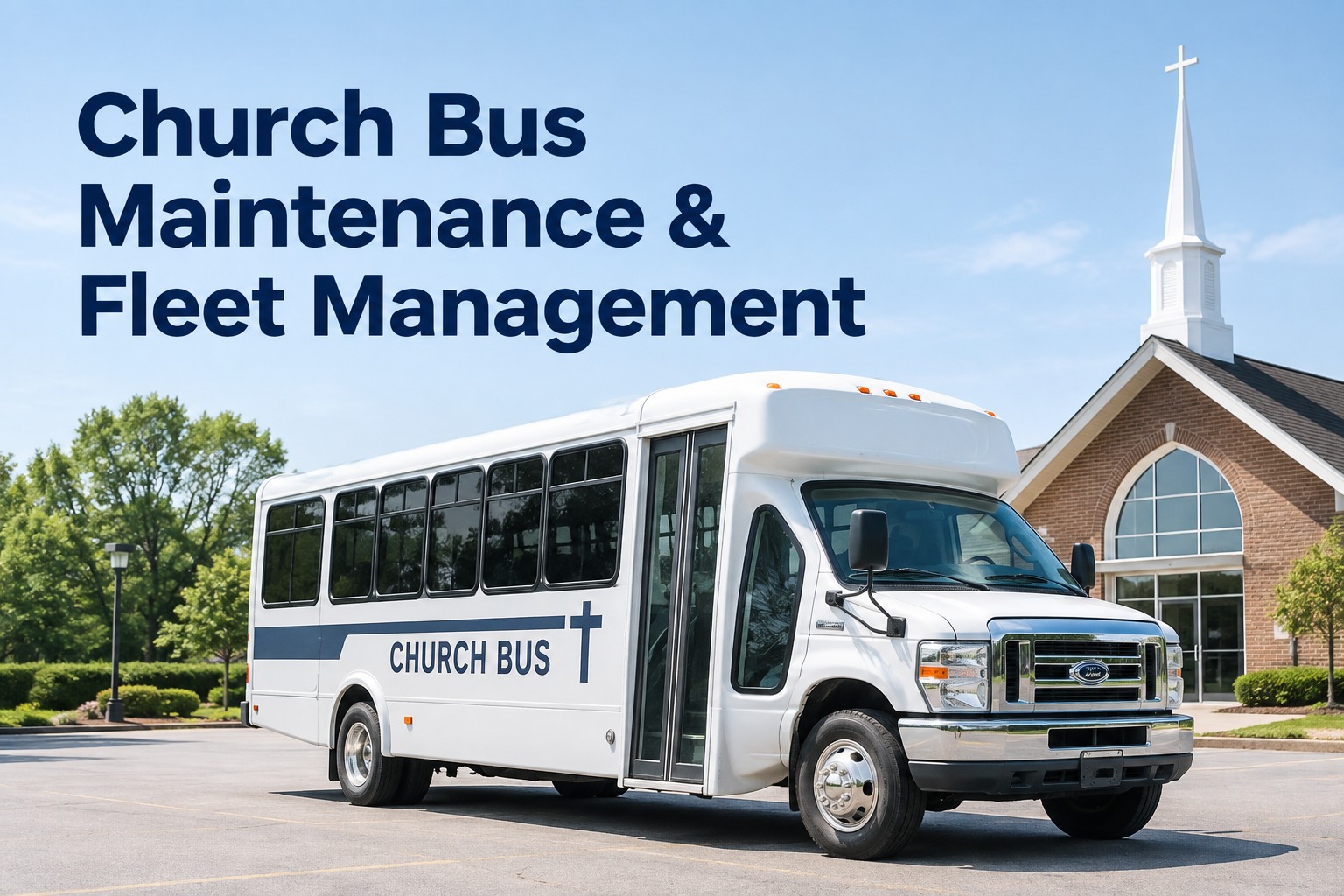
Here is the church bus maintenance trap nobody warns you about: the less a bus is driven, the more it can quietly fall apart. Your ministry bus might roll twice a week, sit in the lot the other five days, and still develop dry-rotted tires, a dead battery, seized brakes, and degraded fluids, none of which a mileage-based maintenance schedule will ever catch. This page is about keeping an occasional-use church bus genuinely ready, with time-based preventive maintenance, real inspections, volunteer driver records and defect tracking that does not live in one person's memory. See how BusCMMS keeps church bus maintenance and records in one place.
Updated September 2026 · CDL, endorsement, and inspection requirements depend on the vehicle, the use, and your state; verify your specifics before relying on any figure here
Church Bus Maintenance & Fleet Management
Why a low-mileage ministry bus needs more attention than the odometer suggests, and how to keep it ready, safe, and documented.
Why Low-Mileage Buses Break in Surprising Ways
Most maintenance advice assumes a vehicle that runs every day and racks up miles. A church bus is the opposite: it often sits far more than it drives. That changes what fails and when. Wear does not pause when the bus is parked; several systems degrade on a calendar, not an odometer, and a schedule built only around mileage will sail right past all of them.
The fix is not more mileage; it is a maintenance schedule that runs on time as well as distance. Oil and fluids on a calendar interval, batteries checked and tenders used during idle stretches, tires inspected for age and dry rot rather than just tread, and a real start-up-and-drive routine so problems surface in the lot instead of on the highway with a bus full of people. Book a demo to see time-based and mileage-based reminders on one schedule.
Does Your Church Bus Need a CDL Driver?
This is the first thing most ministries want answered, and the honest answer is: it depends on the vehicle and how you use it, not on the fact that you are a church. Nonprofit or volunteer status does not create an automatic exemption. The two things that most often drive the answer are passenger capacity and whether the operation is considered commercial, and your state can add its own rules on top.
A vehicle designed for 15 passengers or fewer generally does not trigger the federal CDL requirement, which is a big reason many churches deliberately choose this size so volunteers can drive.
A vehicle designed to carry 16 or more, or over 26,000 lb GVWR, generally requires a CDL with a Passenger endorsement, which narrows your driver pool considerably.
That capacity line is exactly why the buyer's-guide crowd often steers churches toward a 15-passenger-or-fewer bus, or even two smaller buses instead of one large one, so the volunteer driver pool stays wide. But capacity is not the whole story. How the bus is used, whether any form of compensation is involved, and state-specific rules all factor in, and CDL drivers carry additional obligations like a medical certificate and hours-of-service limits. Confirm your own situation rather than assuming the exemption. Book a demo to track which drivers are qualified for which vehicles. Or start free and set it up yourself.
Volunteer Drivers Still Need Real Records
Church buses run on volunteers, and that is where the paperwork tends to evaporate. When a driver is a longtime member giving their Saturday for free, it feels almost rude to ask for a license copy and a driving record. But a volunteer behind the wheel of a bus full of congregants carries the same real-world risk as a paid one, and if something goes wrong, the question will be what the church knew about that driver and when.
Good practice does not mean bureaucracy; it means a few basics kept current for every driver, paid or volunteer. A valid license for the vehicle type. A checked driving record. A minimum age and some form of behind-the-wheel check, many churches require a driver to be at least 25 and pass a short practical evaluation. And for CDL vehicles, the medical certificate that comes with the endorsement. The point is simply that "we trust Joe" is not a record. A short, documented driver file is. Book a demo to keep volunteer driver records current and in one place.
The Church Bus Readiness Check
Because a ministry bus sits between uses, the pre-trip inspection matters more here than almost anywhere. It is the moment you catch the flat-spotted tire or the weak battery before thirty people are counting on the bus. Keep it simple enough that a volunteer will actually do it every time, and documented enough that you can prove it was done.
- Lights, turn signals, and brake lights all working
- Tires: pressure, tread, and cracks or dry rot from sitting
- Brakes firm, no grinding or pulling after idle time
- Fluids at level; no fresh leaks under the bus
- Battery starts strong, not slow or jumped
- First-aid kit present and stocked; fire extinguisher charged
- Seats, belts, and emergency exits clear and functional
- Wheelchair lift or ramp tested if equipped
- Mirrors clean and adjusted; wipers and washer working
- Interior clean, no pests, no obstructions in the aisle
A defect found on this check should do one thing above all: stop the bus and start a repair. Too many church fleets note a problem, drive anyway because the trip is today, and forget it by next week. The strongest setup turns a flagged defect straight into a work order tied to that bus, and keeps the bus flagged until the repair is signed off, so nothing gets driven on a known problem and nothing gets forgotten. Book a demo to turn every flagged defect into a tracked repair.
A Sunday Trip That Almost Didn't Happen
Here is how the connected version plays out. A church owns one 14-passenger bus that runs a Sunday route and the occasional youth trip. It sat for eleven days between uses. Follow the Saturday-before readiness check.
The Saturday check
A volunteer runs the readiness check on a phone and finds a slow-cranking battery and a tire with sidewall cracking, both from sitting.
Defects become work orders
Each issue is logged against the bus as a work order, and the bus is flagged as not ready for Sunday until they are resolved.
Fixed with a day to spare
Because the check happened Saturday, not Sunday morning, the battery is replaced and the tire swapped before anyone boards.
Cleared and documented
The repairs are signed off, the bus is cleared, and the whole sequence stays on the bus's maintenance history.
Proof, if it is ever needed
Months later, the record shows the bus was checked, the defects were caught, and the repairs were done before the trip ran.
Without the Saturday check, that battery dies in the lot Sunday morning and the trip is scrambled or canceled, or worse, the cracked tire is ignored and fails on the road. With it, a quiet fifteen-minute routine turned two sitting-related defects into two closed work orders and a documented, ready bus. That is the entire value of treating a low-mileage church bus like the maintained asset it is. Book a demo to see readiness checks and work orders connected per bus.
When a Notebook Stops Being Enough
A single bus and one dedicated volunteer can run on a notebook for a while. The honest question is when that stops being safe or defensible. For most ministries, the tipping point comes with a second vehicle, a rotating set of volunteer drivers, or the simple realization that the person who tracked everything in their head is no longer around.
If those feel familiar, the notebook is no longer saving you effort; it is holding risk you cannot see. BusCMMS is an AI-native bus fleet operations platform that brings preventive maintenance, inspections, DVIRs, work orders, driver records, incidents, and video evidence into one operational record, with time-based reminders that fire for a bus that barely moves and the traceability to connect a defect to its repair and a driver to their record. It cuts the administrative load and gives a ministry a documented, defensible history, without pretending software alone makes a fleet safe or compliant. Book a demo to see whether your ministry fleet has outgrown the notebook.
Keeping a Ministry Bus Ready, Safe, and Documented
Church bus maintenance is a different discipline than fleet maintenance for a bus that runs all day. The enemy is not high mileage; it is time, neglect, and undocumented good intentions. A bus that sits still degrades on the calendar, so it needs time-based preventive maintenance, not just mileage triggers. Volunteer drivers still need real records. Every pre-trip defect should become a tracked repair, not a mental note. And whether a CDL applies depends on your vehicle, your use, and your state, so confirm it rather than assume. Do those things and your ministry bus is ready when it matters and documented if it ever has to be. You are likely already doing most of the work; the difference is whether it is on a schedule and on a record. See how BusCMMS keeps church bus maintenance and records in one place.
How often should a low-mileage church bus be maintained?
On a time-based schedule, not just a mileage one. A bus that drives only a few miles a week still needs calendar-interval service because oil, coolant, and brake fluid degrade and absorb moisture over time, batteries discharge when unused, and tires dry-rot with age regardless of tread. Follow the manufacturer's time and mileage intervals, whichever comes first, keep the battery maintained during idle stretches, and inspect tires for age and cracking rather than tread alone. The exact intervals depend on your vehicle, so use its maintenance schedule as the baseline.
Does a church bus driver need a CDL?
It depends on the vehicle and how it is used, not on being a church. Generally, a vehicle designed to carry 16 or more passengers including the driver, or over 26,000 lb GVWR, requires a commercial driver's license with a Passenger endorsement, while a vehicle for 15 or fewer often does not trigger the federal CDL requirement. But use matters too, and nonprofit or volunteer status does not create an automatic exemption, and states can impose their own rules. Because the answer turns on capacity, use, and state law, confirm your specific situation rather than assuming.
Do volunteer church bus drivers need records kept?
Yes. A volunteer driving a bus full of members carries the same real-world risk as a paid driver, and if an incident occurs, what the church documented about that driver will matter. Keep a short, current file for every driver regardless of pay status: a valid license for the vehicle type, a checked driving record, a minimum age and a short practical driving evaluation, and, for CDL vehicles, the required medical certificate. It is not bureaucracy, it is basic accountability, and it protects both the passengers and the ministry.
Is an annual inspection required for a church bus?
It depends on the vehicle, the use, and your state, so verify your specific requirements rather than assuming. In many states a formal DOT-style annual inspection is not legally required for private, non-commercial church use, but a documented annual safety inspection is still widely recommended. It catches age-related problems on a bus that sits, creates a maintenance record that demonstrates diligence, and provides valuable evidence if the bus is ever involved in an incident. Even where it is optional, treating it as standard practice is a low-cost way to reduce risk.
How can software help a small church fleet?
The biggest wins for a ministry fleet are time-based reminders and connected records. Instead of relying on one volunteer's memory, a platform like BusCMMS fires preventive-maintenance reminders on a calendar even when the mileage barely moves, keeps volunteer driver records current, turns a flagged pre-trip defect into a tracked work order, and holds inspections, repairs, incidents, and video evidence on one record per bus. That means a readiness question or an incident review is a quick lookup, and the ministry has a documented history, without claiming software alone makes the fleet safe or compliant.