You are speccing a new bus fleet and the Cummins engine options come down to three -- B6.7 (school bus standard), L9 (transit and heavy-duty school), and X15 (motorcoach and heavy transit). Choose wrong and you either underpower the fleet for its duty cycle or overspend by $15,000 per bus on displacement you never use. Cross the wrong engine with the wrong duty cycle and your PM budget takes a beating for the next 15 years. If you are comparing Cummins L9 vs X15 vs B6.7 for the 2026-2027 buying cycle, book a 20-minute demo to see how BusCMMS models engine-specific PM costs against your actual routes before the purchase order goes out.
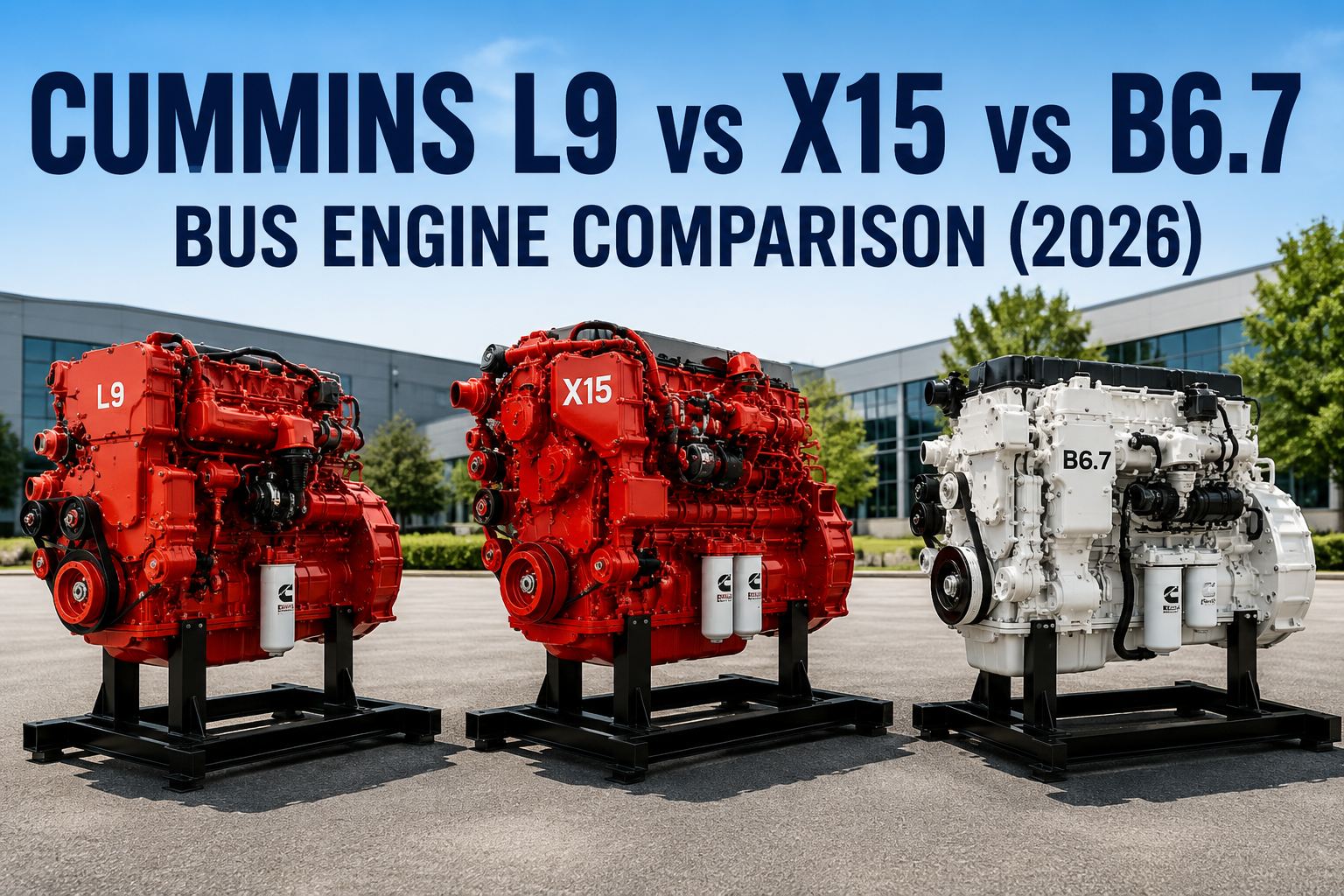
Cummins L9 vs X15 vs B6.7 Bus Engine Comparison (2026)
Specs, horsepower, torque, MPG, maintenance costs, and best-fit applications for school, transit, and coach fleets
- Displacement6.7L I-6
- Power (bus)200-325 hp
- Torqueup to 660 lb-ft
- Oil (severe)12K mi
- Best fitType C school bus
- Displacement8.9L I-6
- Power (bus)260-400 hp
- Torqueup to 1,250 lb-ft
- Oil (severe)15-20K mi
- Best fitType D + transit
- Displacement14.9L I-6
- Power (bus)400-605 hp
- Torqueup to 2,050 lb-ft
- Oil (highway)50-60K mi
- Best fitMotorcoach + heavy transit
Horsepower and Torque -- What Actually Moves the Bus
Power ratings tell you what the engine can do on paper. Torque tells you what it does at 6 AM on a cold hill with 71 kids on board.
Torque is the number that matters for a bus. A 71-passenger Type C on a 6% grade needs low-end grunt more than peak horsepower -- which is why Cummins itself recommends the L9 for stop-and-start heavy-duty school bus operations even though a B6.7 has enough peak power for the route. Underpowered engines running at redline all day have a way of finding oil bearing wear at 180,000 miles instead of 400,000. Book a demo to see how BusCMMS tracks engine load patterns per bus and flags routes running the wrong-size engine.
MPG Reality Across School, Transit, and Coach Duty
Displacement drives fuel consumption. Duty cycle drives the variance. A B6.7 on the wrong route can burn worse than an X15 on the right one.
B6.7 6.5-9 MPG
Best-in-class fuel economy for medium-duty diesel buses. Type C school bus duty typically lands 7-8 MPG. City stop-and-go can drop to 6.5. Highway-cycle shuttle applications hit 9+.
Annual fuel · ~$11,900/yr diesel Type CL9 5-7 MPG
Transit duty averages 4.5-5.5 MPG due to constant stop-and-start. Type D school bus duty runs 5.5-6.5 MPG. Coach applications with steady load can push toward 7.
Annual fuel · ~$14,500/yr transit dutyX15 6-8 MPG
X15 Efficiency Series on motorcoach highway duty runs 7-8 MPG at cruise. Performance Series on heavy pull duty averages 6-6.5. Steady-state operation is where the X15 wins fuel economy per ton-mile.
Annual fuel · ~$22,000/yr coach duty
The often-missed insight: an X15 on the right duty cycle can beat a B6.7 on the wrong one. A motorcoach cruising at 65 mph gets 7-8 MPG on the X15. A B6.7 running short shuttle loops between airport terminals with 4-minute average trip times can drop to 5.5 MPG -- worse per gallon than the X15 doing four times its work. Match displacement to duty, not to whichever engine has the biggest number on the brochure. Book a demo to see how BusCMMS calculates fuel cost per mile by engine and route.
PM Schedules That Actually Match Duty Cycle
Published intervals assume normal duty. Bus severe duty rewrites those numbers. Here is what each engine actually costs to maintain in the shop.
- MetricB6.7L9X15
- Oil interval (severe)12,000 mi15-20,000 mi30-40,000 mi
- Annual PM cost$4-6K/yr$6-9K/yr$8-12K/yr
- DPF service life150-250K mi250-400K mi400-600K mi
- AftertreatmentSingle ModuleModular (larger DPF)Modular HD
- Service life ceiling400K+ mi600K+ mi1M+ mi
The larger the engine, the longer the intervals but the higher the per-service dollar cost. An X15 at 30K-mile oil intervals sounds cheaper than a B6.7 at 12K -- until you price the oil, filters, and labor per event. Realistic comparison per operating year: a B6.7 in school bus severe duty costs $4,000-$6,000 in PM; an L9 in transit costs $6,000-$9,000; an X15 in coach duty costs $8,000-$12,000. Bigger engine, bigger PM bill, longer service life to amortize it. Book a demo to see how BusCMMS auto-sets duty-adjusted PM intervals per engine per bus.
Which Engine Wins Which Bus Segment
Cummins itself tells fleet buyers to match displacement to duty. Here is what that looks like in practice across every major bus segment in 2026.
B6.7 Wins
- Type C school buses -- Blue Bird Vision, IC Bus CE, Thomas Built C2
- Local shuttle buses -- Airport, hotel, university campus
- Cutaway commercial buses -- Small transit under 30 pax
- Suburban routes -- Under 100 miles per day, moderate stops
Where it beats: lightweight, EGR-free 2019+ builds, best-in-class fuel economy, lower purchase price on the chassis.
L9 Wins
- Type D school buses -- Blue Bird All American RE, IC Bus RE Series
- Urban transit buses -- New Flyer, Gillig, Nova heavy stop-start
- Heavy-duty school -- Long routes, mountainous terrain, 78+ pax
- L9N CNG variants -- Near-zero NOx transit applications
Where it wins: wet-sleeve HD architecture, larger modular DPF for severe duty, torque for full-loaded starts.
X15 Wins
- Motorcoaches -- MCI, Prevost, Van Hool intercity coaches
- Charter operations -- Long-haul multi-day trips
- Heavy transit -- Articulated buses, high-capacity routes
- Elevation and heavy load -- Mountain routes with full passenger load
Where it wins: best-in-class braking horsepower, million-mile service life, steady-state efficiency at cruise.
TCO Head-to-Head Across a 12-Year Service Life
Purchase price differences look big on the sticker. Over a 12-year fleet lifecycle, fuel and maintenance dwarf everything else -- and the ranking shifts.
The three engines look wildly different on the sticker -- a Type C with a B6.7 costs about a third of a motorcoach with an X15. Over 12 years, the ratios flatten. Purchase price lands at 34-38% of TCO across all three, fuel at 38-42%, maintenance at 22-25%. That means the engine choice that saves you $15K at the dealer can cost you $80K in extra fuel over a decade if you picked it for the wrong duty cycle. Book a demo to see 12-year TCO modeled per engine choice for your specific route profile.
Running B6.7 + L9 + X15 On One Yard
Most bus fleets do not run one engine. Districts have B6.7 school buses and L9 activity buses. Transit agencies run L9 buses and B6.7 shuttles. This is where fleet management gets hard fast.
- PM Schedules
Three engines mean three different oil intervals, three different fuel filter schedules, three different DPF service cycles. Spreadsheet tracking breaks fast.
- Parts Inventory
Cummins B6.7, L9, and X15 use different oil filters, air filters, fuel filters, and injectors. Wrong-part orders are the fastest way to double-order and blow the parts budget.
- Fluid Capacities
B6.7 takes ~19 quarts. L9 takes 26-28 quarts. X15 takes 44+ quarts. Ordering the same drum of oil for all three buses ignores the per-service delta on the L9 and X15.
- Fault Code Diagnosis
Same J1939 SPN can point to different components across engine families. SPN 3251 (DPF diff pressure) has different soot load thresholds on a B6.7 vs L9 vs X15.
- Technician Training
B6.7 in EGR-free 2019+ builds. L9 with wet-sleeve architecture. X15 with variable geometry turbo. Techs need to know which engine they are on before opening the hood.
- Warranty Windows
Cummins ships 5yr/100K on B6.7, 5yr/300K on L9, up to 5yr/500K on X15 depending on rating. Each bus has a different clock -- and each warranty claim needs the right PM documentation.
This is exactly the problem BusCMMS was built to solve. Every engine on your yard shows up with its own PM schedule, its own severity-adjusted intervals, its own parts kit, and its own fault code lookup -- pre-loaded on day one, no consultant, no six-week configuration. Whether you run 20 B6.7 school buses, 40 L9 transit coaches, or a mixed fleet with X15 motorcoaches thrown in, every bus lands on the right maintenance calendar the moment it hits the yard. Sign up free and load your first mixed-engine fleet in under an hour.
What is the main difference between Cummins B6.7, L9, and X15?
Displacement and duty class are the core differences. The B6.7 is a 6.7L medium-duty engine for Type C school buses, local shuttles, and lighter transit at 200-325 hp. The L9 is an 8.9L heavy-medium-duty engine for Type D school buses, urban transit, and heavier applications at 260-400 hp with up to 1,250 lb-ft of torque. The X15 is a 14.9L heavy-duty engine for motorcoaches, charter, and heavy transit at 400-605 hp with up to 2,050 lb-ft. Cummins' rule of thumb: L9 power ratings start where the B6.7 ends, and X15 starts where the L9 ends.
Which Cummins engine is best for school buses?
The B6.7 is the most common school bus engine and the right choice for most Type C conventional buses (Blue Bird Vision, IC Bus CE, Thomas Built C2). The L9 is the better fit for Type D transit-style school buses, heavy-duty district routes with mountainous terrain, or full 78-90 passenger loads. Cummins recommends the L9 for heavy-duty start-and-stop school bus operations because its low-end torque handles the load without pushing the engine to its power limit on every take-off.
How do maintenance costs compare between B6.7, L9, and X15?
Per year, the B6.7 costs roughly $4,000-$6,000 in PM under bus severe duty, the L9 costs $6,000-$9,000 in transit duty, and the X15 costs $8,000-$12,000 in motorcoach duty. The larger engines have longer oil intervals (B6.7 at 12K severe, L9 at 15-20K, X15 at 30-40K) but higher per-service costs due to larger oil capacity, larger DPFs, and heavier components. Over a 12-year service life, maintenance lands at 22-25% of total cost of ownership across all three engines.
Which Cummins bus engine gets the best fuel economy?
The B6.7 is best-in-class for medium-duty diesel buses at 6.5-9 MPG in bus applications. The L9 runs 5-7 MPG depending on duty cycle, and the X15 runs 6-8 MPG. But the practical answer depends heavily on duty cycle -- an X15 on a motorcoach cruising at 65 MPH can achieve better MPG than a B6.7 running short shuttle loops with 4-minute average trips. Match displacement to duty for the best fuel economy, not to whichever engine has the smallest displacement.
How long does each Cummins bus engine last?
With proper maintenance, the B6.7 comfortably reaches 400,000+ miles in school bus service. The L9 with its wet-sleeve heavy-duty architecture regularly hits 600,000+ miles in transit duty. The X15 is engineered for over 1,000,000 miles in motorcoach service. All three service life projections assume PM discipline, correct fluids and filters, aftertreatment care, and duty-cycle-appropriate intervals. Fleets that fall short almost always share the same failures: missed severe-duty oil intervals, ignored coolant chemistry, and untreated DPF issues.