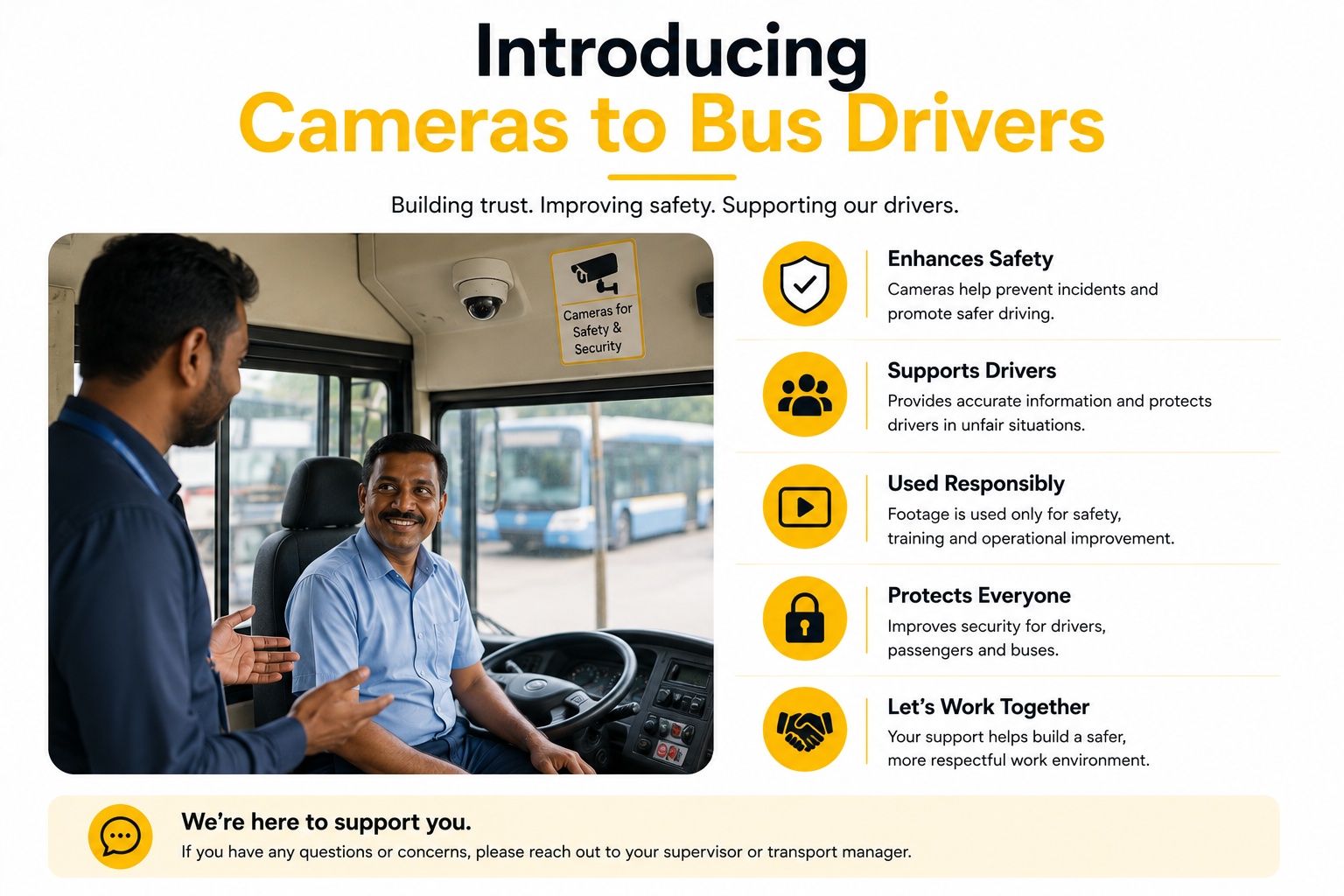
The single biggest predictor of whether a camera rollout generates a grievance isn't the hardware — it's whether drivers heard about it from management first, or from a coworker who noticed a new lens on someone else's bus. Introducing cameras to bus drivers in the right sequence, with the right specific language about cab-facing lenses and coaching, is what separates a smooth rollout from a defensive one. See BusCmms in action.
Introducing Cameras to Bus Drivers
The announcement sequence that avoids a grievance, exact language for cab-facing lenses, and the questions drivers actually ask once the meeting opens up.
Union or driver representatives, privately
Before any general announcement, brief representatives directly — showing them actual alert thresholds, not a sales pitch.
All-driver meeting, in person
A live meeting, not an email, where drivers can ask questions immediately rather than speculate afterward.
Written policy, distributed same day
The verbal explanation gets backed by a written document drivers can reference later, closing the gap where rumors fill in.
Install-day reminder, per bus
A short individual note to each driver the week their specific bus is scheduled, not a one-time fleet-wide announcement months earlier.
What to Say About the Cab-Facing Lens Specifically
This is the camera drivers have the most questions about, and vague language here does the most damage.
The safety motivation behind driver-facing cameras connects to 49 CFR 673.25, which requires large urbanized area transit providers and their safety committees to consider mitigations that reduce operator visibility impairments — a driver-facing camera is one of the concrete mitigations that requirement points toward. When explaining this to drivers, be specific rather than general: name the exact events detected (fatigue indicators, phone use, seatbelt status), state clearly whether footage is reviewed only when a threshold is crossed or reviewed as a matter of routine, and name the specific person who reviews escalated events. Vague language like "for safety purposes" invites drivers to assume the worst-case interpretation; precise language about what's detected and who sees it closes that gap.
How Coaching Will and Will Not Be Used
The single clearest way to build trust: state what a flagged event does not automatically trigger.
Drivers respond better to explicit boundaries than to reassurance alone. State plainly that a single flagged event does not automatically trigger discipline, that coaching conversations happen before any formal write-up, and that the system exists to catch a bad morning before it becomes a bad outcome — not to build a case against any individual driver. Where possible, commit this to writing as part of the same policy document distributed after the driver meeting, since a verbal assurance in a meeting carries less weight than the same statement documented and signed off on.
The Consent and Retention Questions Behind the Scenes
Drivers rarely ask about the legal framework directly, but the answer needs to be ready.
State wiretap and two-party consent statutes govern onboard audio recording, and a meaningful number of states require all parties in a recorded conversation to consent — which affects whether and how interior audio can be captured and disclosed. Separately, because students are present on the bus, FERPA considerations can apply to how video and any identifiable student information is stored, accessed, and shared. Your district's own video retention policy sets how long footage sits before it's purged, and this policy needs to be consistent with both state law and FERPA. None of this needs to become a legal lecture in a driver meeting, but having clear, accurate answers ready for the driver who does ask "how long is this kept, and who can request it" matters — a vague or contradictory answer here damages trust more than the question itself.
"Is someone watching me the whole time I'm driving?"
No — most systems review footage only when a threshold is crossed, not continuously in real time. Be specific about which events trigger a review.
"Can this be used to fire me over one mistake?"
State clearly whether a single flagged event triggers discipline or a coaching conversation first — and put that answer in writing.
"Who else can see this footage besides my supervisor?"
Name the specific access list — this connects directly to your district's FERPA and retention policy, not a vague "administration."
"Does it record audio too?"
Answer this directly against your specific state's consent law — don't leave it ambiguous or assume drivers won't ask.
A Scenario From a Real Bus Operation
Two rollouts, same hardware, very different reception.
A transit agency's first camera rollout attempt announced the program via a fleet-wide email, without briefing driver representatives beforehand. Three grievances were filed within the first month over perceived surveillance, and adoption stalled — several drivers covered lenses rather than trust a system nobody had explained directly. The agency paused, restarted with driver representatives briefed privately first, held an in-person all-driver meeting where the exact alert thresholds were shown rather than described abstractly, and distributed a written policy the same day committing to coaching-before-discipline in writing. The second rollout, using identical hardware, generated no grievances, and driver-reported trust in the system — measured through a follow-up survey — was markedly higher than after the first attempt.
Our first attempt was a company-wide email announcing cameras were going in. That was the whole mistake right there — drivers heard about it from a memo, not a person, and filled in every blank with the worst assumption. The second time, we sat down with driver reps first, showed them exactly what triggers a review, and put the coaching-not-discipline promise in writing. Same cameras. Completely different reaction.
Planning a driver rollout meeting soon? Getting the announcement sequence right matters more than the meeting content itself. Talk to the team about rollout communication →
Quick Spec Reference
Scannable on a phone before a driver meeting.
| Element | What to confirm before the meeting |
|---|---|
| Sequence order | Union reps first, then all-driver meeting, then written policy same day |
| Cab camera language | Name exact events detected and who reviews escalated cases |
| Coaching commitment | State and document that a single event doesn't trigger automatic discipline |
| Consent law answer | Confirm your state's specific audio consent requirement before the Q&A |
| Retention answer | Know the exact number of days, tied to FERPA and district policy |
| Written policy | Distributed same day as the meeting, not weeks later |
Frequently Asked Questions
What's the right sequence for announcing a camera rollout to drivers?
Union or driver representatives should be briefed privately first, shown actual alert thresholds rather than a general pitch. Next, an in-person all-driver meeting allows immediate questions. A written policy should be distributed the same day to reinforce what was said verbally. Finally, individual reminders should go out the week each specific bus is scheduled for install, rather than relying on a single fleet-wide announcement made months earlier.
What should be said specifically about a cab-facing camera?
Be specific rather than general: name the exact events detected, such as fatigue indicators, phone use, or seatbelt status, state clearly whether footage is reviewed only when a threshold is crossed or as routine practice, and name the specific person responsible for reviewing escalated events. This connects to the visibility-impairment mitigation considerations under 49 CFR 673.25 for large urbanized transit providers.
How should coaching versus discipline be explained to drivers?
State explicitly that a single flagged event does not automatically trigger discipline, and that coaching conversations happen before any formal write-up. Committing this to writing in the distributed policy document carries more weight with drivers than a verbal assurance alone during the meeting.
Is onboard audio recording something drivers need to be told about specifically?
Yes. State wiretap and two-party consent statutes govern onboard audio recording, and a number of states require all parties to consent to a recorded conversation. Drivers commonly ask whether audio is captured, and having a clear, accurate, state-specific answer ready prevents a vague response from damaging trust in the rest of the rollout communication.
What's the most common mistake that leads to a grievance during a camera rollout?
Skipping directly to a fleet-wide announcement without first briefing union or driver representatives privately is the single most common trigger for a grievance, even when the underlying camera policy itself is reasonable. Drivers who hear about a surveillance-adjacent change from a memo rather than a person tend to assume the worst-case interpretation.