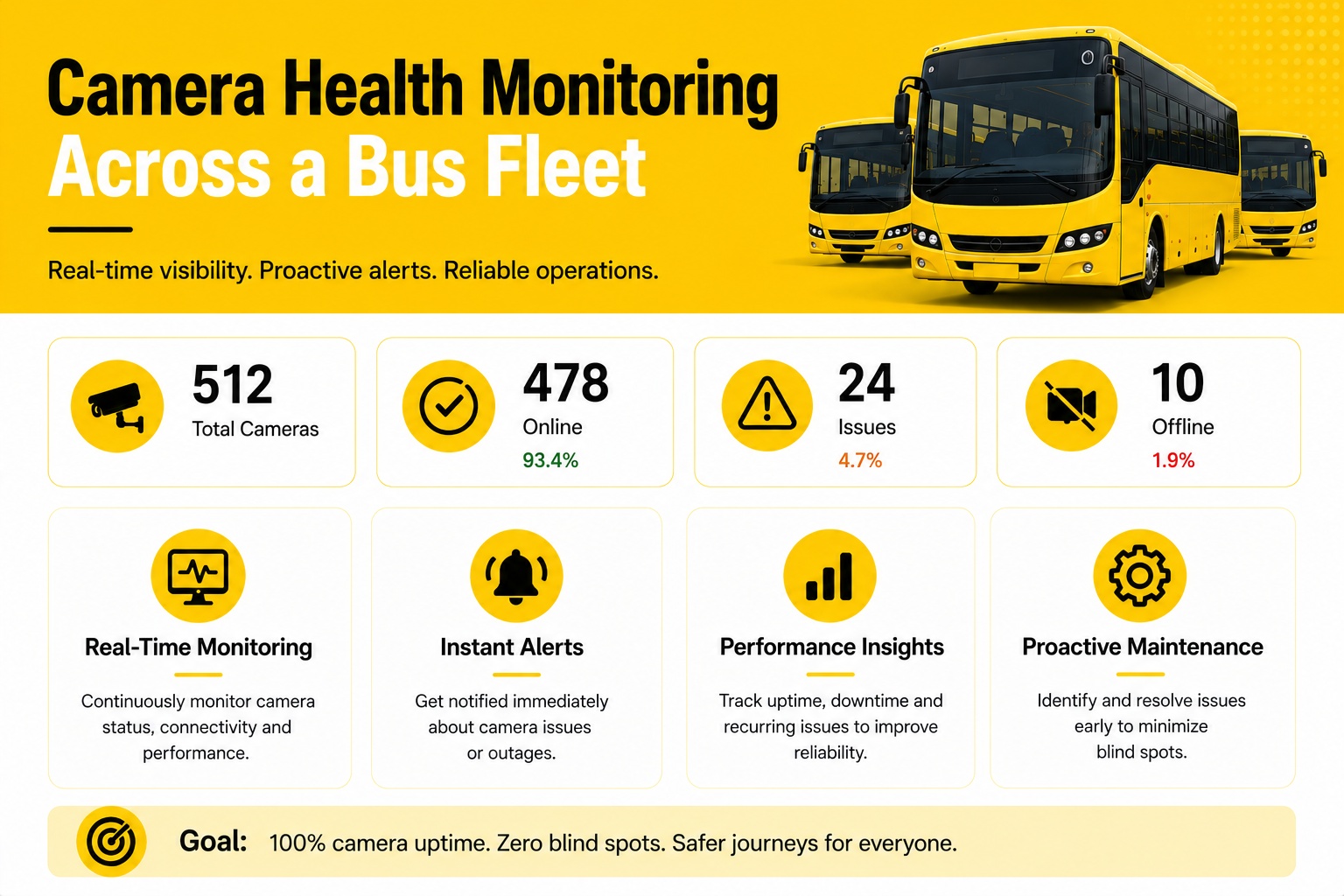
On a fleet without camera health monitoring, it's common to find roughly a third of buses recording nothing usable on any given day — not because the cameras broke dramatically, but because nobody's watching for the quiet failures: a full storage drive, an obstructed lens, a channel that silently stopped reporting. A daily heartbeat check across every camera on every bus is what turns that invisible gap into a dashboard you can act on before route, not after an incident. Start a free BusCMMS trial and connect your first bus.
Camera Health Monitoring Across a Bus Fleet
Channel-level status, storage-full and lens-obstruction flags, and the one dashboard view that tells you which buses left the yard this morning without a working camera.
Daily Heartbeat Checks: What Actually Gets Verified
A heartbeat check confirms the camera is alive, not just that it exists on an inventory list.
No single federal mandate governs camera health monitoring on buses; the compliance bar here is 49 CFR 396 maintenance record requirements and district policy, which leaves the entire monitoring framework up to each fleet's own practices. A daily heartbeat check is a lightweight, automated confirmation that each camera unit is powered, connected, and actively recording — run once per day at minimum, ideally before the bus leaves the yard rather than discovered after the route. This is distinct from a full diagnostic; it's a fast pass/fail signal designed to catch the obvious failures before route, with deeper investigation reserved for whatever the heartbeat flags as abnormal.
Channel-Level Status: Why "The Camera System Is Fine" Isn't Specific Enough
A bus can have five working cameras and one dead one, and a fleet-level summary can still say "operational."
Health monitoring needs to report at the individual channel level, not just a single pass/fail status for the whole bus. A six-camera bus with one failed unit — say, the loading door channel specifically — is not "healthy" in any meaningful sense, even though five of six channels are working fine. A monitoring system that only reports "camera system operational" at the bus level can mask exactly the kind of partial failure that matters most, since the one failed channel is often the one covering the highest-risk zone rather than a redundant angle.
Storage-Full and Lens-Obstruction Flags
Two of the most common silent failures, and both are detectable automatically if the system is designed to look for them.
A storage-full condition is one of the quietest failure modes in a camera system — the unit continues drawing power and appearing "on," but stops recording new footage once its drive reaches capacity and fails to cycle correctly. A storage-full flag, triggered before the drive is completely maxed out rather than after, gives a shop enough lead time to intervene before the gap starts. A lens-obstruction flag detects a covered or blocked lens the same way tamper detection does — watching for a sudden, sustained darkness or fixed frame inconsistent with normal conditions — and should fire the same day the obstruction occurs, not weeks later during an unrelated review.
The Dashboard That Lists Which Buses Left the Yard Without Working Cameras
The single most useful view a monitoring system can produce every morning.
Here's the objection worth naming directly: cameras get installed but never health-monitored, so a third of the fleet can be recording nothing on the day it matters, and nobody knows until an incident forces the question. The fix isn't complicated — it's a single dashboard view, checked every morning before buses leave, that lists exactly which units have an active flag: storage warning, obstruction, or a dead channel. This one list, reviewed for two minutes before departure, catches the gap while there's still time to swap a bus, assign a technician, or at minimum document the known limitation before that unit runs its route.
A Scenario From a Real Bus Operation
The morning dashboard check that caught what a monthly spot-check never would have.
A district running 62 buses previously relied on a monthly manual spot-check of a rotating sample of buses to gauge camera health — a reasonable-sounding process that, in practice, meant any given bus was actually inspected roughly once every five to six weeks. After implementing a daily heartbeat check with a morning dashboard review, the district found an average of two to three buses per week showing an active flag — mostly storage warnings and the occasional obstructed lens — that would have gone undetected for weeks under the old spot-check schedule. Over one semester, the district calculated that the daily check had caught camera failures an average of 18 days earlier than the previous monthly sampling approach would have, closing a meaningful window during which those buses would otherwise have been running routes with a real coverage gap.
We thought a monthly spot-check was reasonable until we actually did the math on how long a bus could be running blind before we'd catch it. Almost six weeks, worst case. Once we switched to a daily dashboard check, we started catching two or three flagged buses a week — storage, obstructions, a dead channel here and there. None of it was dramatic. All of it would have gone unnoticed under the old system for way too long.
Not sure how many of your buses left the yard this morning with a working camera on every channel? That's worth checking today. Talk to the team about a fleet health audit →
Quick Spec Reference
Scannable on a phone during a vendor evaluation.
| Feature | What to confirm |
|---|---|
| Heartbeat frequency | Daily minimum, ideally before each bus leaves the yard |
| Reporting granularity | Per-channel status, not a single bus-level pass/fail |
| Storage-full alert | Fires before the drive maxes out, not after recording stops |
| Obstruction detection | Same-day alert on sudden darkness or fixed-frame patterns |
| Morning dashboard | Single view listing all flagged buses before route departure |
| Regulation status | No federal mandate; governed by 49 CFR 396 records and district policy |
Frequently Asked Questions
What is a daily heartbeat check for bus cameras?
A daily heartbeat check is a lightweight, automated confirmation that each camera unit is powered, connected, and actively recording, run at minimum once per day and ideally before the bus leaves the yard. It's a fast pass/fail signal designed to catch obvious failures before route, distinct from a full diagnostic which is reserved for units the heartbeat flags as abnormal.
Why does camera health need to be reported at the channel level rather than the bus level?
A bus-level summary like "camera system operational" can mask a partial failure, such as one dead channel out of six working cameras. Since the failed channel is often the one covering the highest-risk zone rather than a redundant angle, reporting health status individually per channel is necessary to catch gaps that a whole-bus summary would hide.
What are storage-full and lens-obstruction flags?
A storage-full flag detects when a camera's drive is approaching capacity and at risk of failing to cycle correctly, ideally triggering before the drive is completely full to give time for intervention. A lens-obstruction flag detects a covered or blocked lens by watching for sudden, sustained darkness or a fixed frame inconsistent with normal conditions, and should fire the same day the obstruction occurs.
What's the most useful dashboard view for daily camera health monitoring?
A single view listing which specific buses have an active flag — storage warning, lens obstruction, or a dead channel — checked every morning before buses leave the yard. This two-minute review catches coverage gaps while there's still time to swap a bus, assign a technician, or document the limitation before that unit runs its route.
How much better is daily monitoring compared to periodic manual spot-checks?
A monthly spot-check on a rotating sample of buses can mean any individual bus is only actually inspected once every five to six weeks. Daily automated health checks can catch camera failures significantly earlier — in one documented case, an average of 18 days sooner than a previous monthly sampling approach — closing the window during which a bus runs routes with an undetected coverage gap.