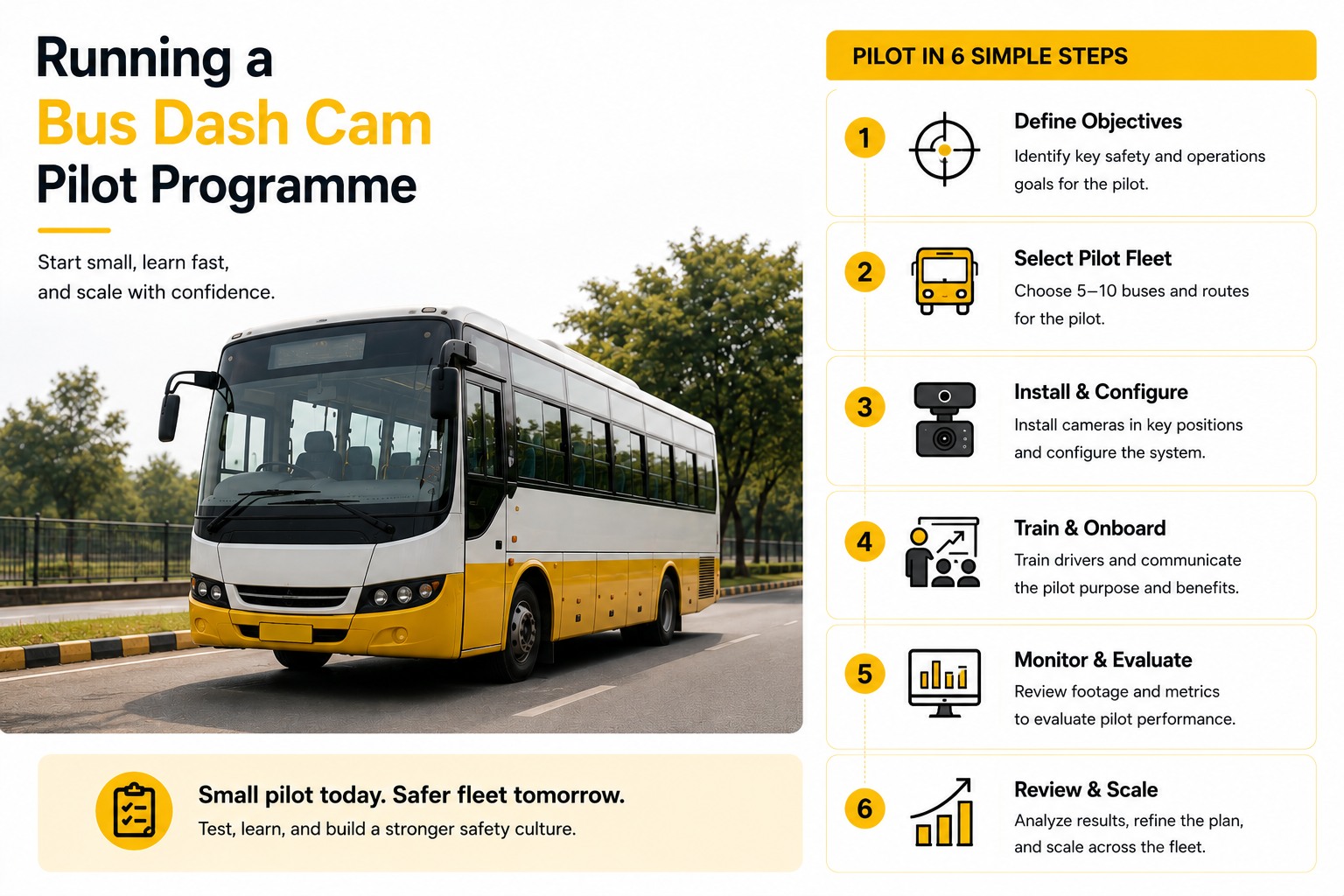
A ten-bus pilot that skips baselining incidents before install produces a number after eight weeks with nothing to compare it to — you'll know what happened, but not whether it's better than what would have happened anyway. Running a bus dash cam pilot properly means choosing representative buses and routes, measuring the "before" picture first, and setting go/no-go criteria before the pilot starts, not after the results come in. Book a walkthrough of the unified camera and maintenance record.
Running a Bus Dash Cam Pilot Programme
Choosing representative buses and routes, baselining incidents before install, what to measure for eight weeks, and the go/no-go criteria that make a fleet-wide decision defensible.
Choosing Ten Representative Buses and Routes
A pilot that picks the easiest buses proves nothing about the fleet's actual conditions.
No single federal mandate governs how a fleet structures a camera pilot; the compliance bar here is 49 CFR 396 maintenance record requirements and district policy, leaving pilot design entirely up to the fleet's own judgment. The single most common mistake is selecting buses purely for install convenience — the newest units, the shortest routes, the easiest depot access — which produces results that don't generalize to the harder conditions the rest of the fleet actually runs. A representative pilot deliberately includes a mix: at least one long rural route, one urban route with frequent stops, one older bus, one newer bus, and routes spanning both morning and afternoon lighting conditions, since those extremes are exactly where camera hardware tends to reveal its weaknesses.
Baselining Incidents Before Install
Without a "before" number, the "after" number is meaningless.
Before any camera goes on a bus, pull the incident and complaint history for the selected pilot buses and routes over a comparable prior period — the same eight weeks a year earlier, or the most recent eight weeks available. This baseline should include road calls, driver-behavior complaints, and any documented near-misses, even informal ones logged by dispatch. Without this step, a pilot that shows "zero major incidents in eight weeks" tells you nothing, since the same routes might have shown zero incidents in any random eight-week stretch regardless of cameras. The baseline is what turns a pilot's results from an anecdote into a comparison.
What to Measure for Eight Weeks
A fixed metric set decided before the pilot starts, not chosen after the results come in.
Flagged safety events by type (stop-arm, harsh brake, distraction)
Camera uptime and health status across the full pilot period
Footage quality in actual low-light and glare conditions encountered
Time from event detection to work order or coaching action
Driver feedback collected at the midpoint and end of the pilot
Any hardware failures or install issues requiring rework
Driver Briefing: Setting Up the Pilot for Honest Data
A driver who doesn't understand the pilot's purpose will behave differently than they normally would — and skew the results.
Drivers on the pilot buses need a clear, direct explanation before install: what the cameras detect, how footage is reviewed, who sees it, and why this specific group of buses was chosen. Skipping this step risks two failure modes. Some drivers, uncertain about the purpose, drive more cautiously than normal specifically because they know they're being watched, which artificially improves the pilot's safety numbers in a way that won't hold once the novelty wears off fleet-wide. Others, feeling surveilled without explanation, may become defensive or resistant, generating complaints that have nothing to do with the camera hardware itself and everything to do with how the rollout was communicated.
The Spec Mistake That Undermines Pilot Results
A pilot built around the wrong hardware spec produces a false negative, not a fair test.
Here's the objection worth naming directly: pilots are sometimes run with camera hardware specified around resolution alone, without checking low-light performance, vibration rating, or retention window against the pilot's actual route conditions. If the pilot hardware fails in ways unrelated to the underlying concept — footage that's unusable at dawn, a mount that loosens from vibration within weeks — the pilot can produce a false negative that kills a fleet-wide rollout for the wrong reason. Confirming the pilot hardware meets the same spec bar you'd expect from a full rollout, before the pilot starts, protects the results from being invalidated by a hardware problem rather than a genuine concept problem.
A Scenario From a Real Bus Operation
A pilot that almost got cancelled for the wrong reason.
A transit agency running a ten-bus pilot saw disappointing footage quality on two buses running early-morning routes, nearly concluding the entire camera concept wasn't worth pursuing fleet-wide. A closer review found the issue was isolated to those two units' low-light performance specifically, not a fundamental problem with the pilot concept — the other eight buses, running routes without the same dawn lighting challenge, performed well throughout. Rather than scrapping the rollout, the agency specified a camera with better low-light handling for the fleet-wide purchase, and the eventual rollout succeeded using data from the six buses that had run a fair test alongside a targeted spec fix for the lighting-sensitive routes.
We almost killed the whole camera program because two of our ten pilot buses had garbage footage every morning. Turned out it was a low-light spec problem on those two units specifically, not the idea itself. If we hadn't dug into why those two buses looked bad instead of the other eight, we'd have walked away from something that actually worked once we fixed the hardware.
Not sure how to set your own go/no-go thresholds? That's worth defining before your pilot starts, not after week eight. Talk to the team about pilot design →
Quick Spec Reference
Scannable on a phone during a planning meeting.
| Element | What to lock in before week one |
|---|---|
| Bus/route selection | Mix of route types, bus ages, and lighting conditions — not the easiest cases |
| Baseline period | Comparable prior eight-week incident and complaint history |
| Metrics tracked | Fixed set decided in advance, not chosen after results come in |
| Driver briefing | Completed before install, not left until drivers notice the hardware |
| Go/no-go thresholds | Numeric criteria set before the pilot starts |
| Hardware spec | Matches full-rollout spec bar, not a discounted pilot-only unit |
Frequently Asked Questions
How should buses and routes be selected for a dash cam pilot?
A representative pilot should include a mix of conditions rather than the easiest cases: at least one long rural route, one urban stop-heavy route, an older bus, a newer bus, and routes covering both morning and afternoon lighting. Selecting only the newest buses or shortest routes produces results that don't generalize to the harder conditions the rest of the fleet actually operates in.
Why is baselining incidents before install necessary?
Without a documented "before" period covering incidents, complaints, and near-misses over a comparable prior timeframe, a pilot's results have nothing to compare against. A pilot showing zero major incidents in eight weeks is meaningless without knowing whether the same routes would have shown zero incidents anyway during any random eight-week stretch.
What metrics should be tracked during an eight-week bus camera pilot?
A fixed set decided before the pilot begins should include flagged safety events by type, camera uptime and health status, footage quality in actual conditions encountered, time from event detection to action taken, driver feedback collected at multiple points, and any hardware failures requiring rework. Deciding these in advance prevents cherry-picking favorable metrics after results come in.
Why does driver briefing matter for pilot data accuracy?
Drivers who don't understand the pilot's purpose may drive more cautiously simply because they know they're being observed, artificially improving safety numbers in a way that won't hold once the novelty wears off fleet-wide. Others may become defensive without a clear explanation, generating complaints unrelated to the camera hardware itself. A clear briefing before install helps produce more representative data.
How should go/no-go criteria for a fleet-wide rollout be set?
Numeric thresholds should be defined before the pilot starts, covering camera uptime, footage usability in real conditions, event-to-action response time, driver feedback, and acceptable hardware failure rates. Setting these criteria in advance, rather than deciding after results come in, keeps the rollout decision defensible and prevents a hardware-specific problem from being mistaken for a failure of the overall concept.