You plug DDDL into a Thomas C2 with a Detroit DD8 that has been derating for a week, and the fault code list runs 14 deep across three ECUs. The Cascadia in the next bay has a DD15 throwing a DEF quality fault and stuck at 55 mph. Same tool, same protocol, wildly different engines -- and both are costing the fleet money for every hour they sit. If you diagnose Detroit-powered buses regularly, book a 20-minute demo to see how BusCMMS logs the full Detroit DTC history per bus so the DD-family patterns stop hiding across separate work orders.
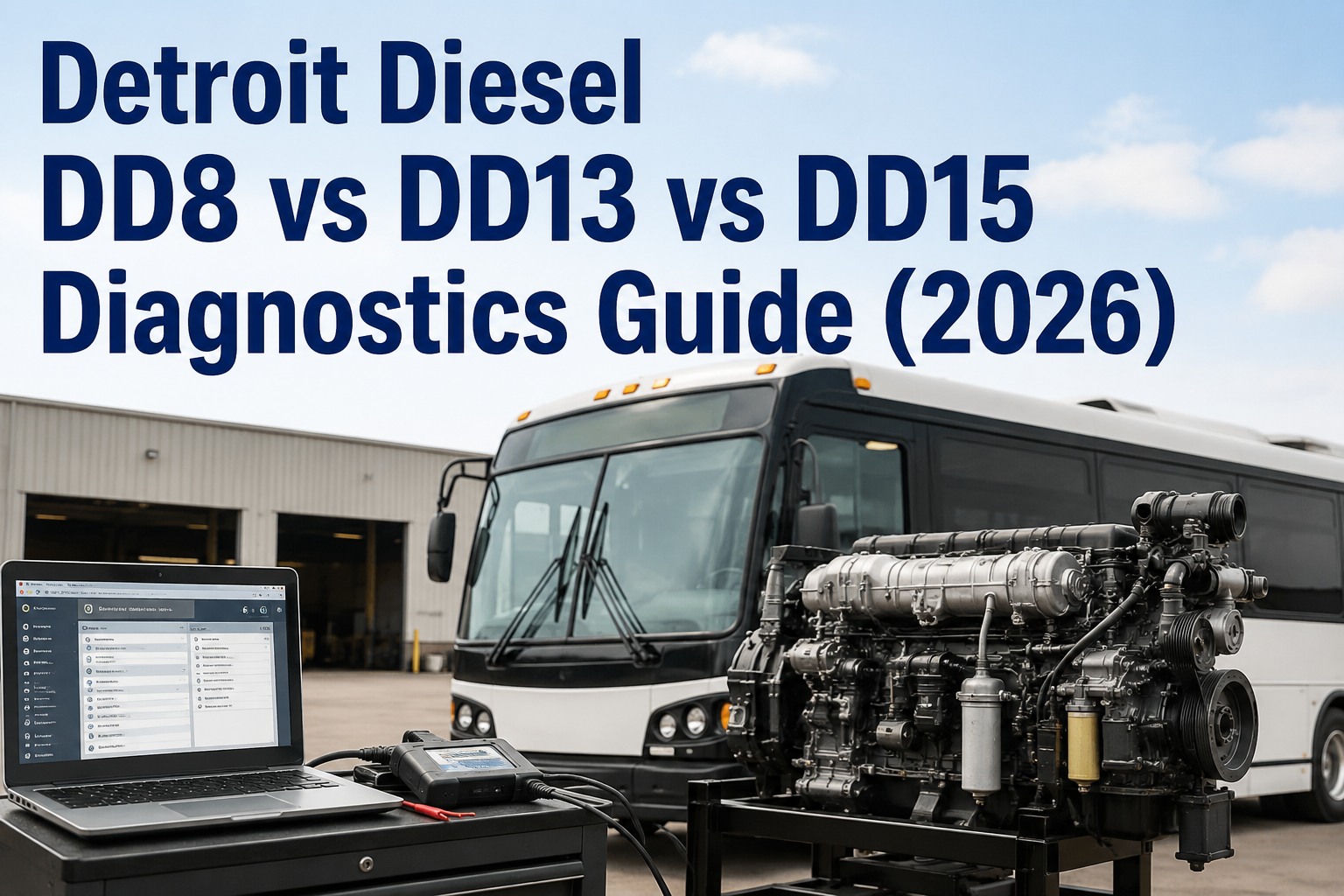
Detroit Diesel DD8 vs DD13 vs DD15 Diagnostics Guide (2026): Fault Codes, DDDL & Troubleshooting
Every DDDL routine, fault-code path, and engine-specific quirk a bus fleet mechanic needs to diagnose Detroit power in the shop
The Stakes: Detroit derates escalate fast -- SEL amber to 5 MPH final inducement can happen in a shift if the DPF or DEF system is ignored. Forced regen alone will not clear a derate once SPN 5246 or SPN 3712 fires. DDDL is required to reset the sequence, and knowing which sequence to run per engine is the difference between a 30-minute shop close and an overnight downtime event.
DD8 vs DD13 vs DD15 -- Three Engines, One Diagnostic Playbook
All three share DDDL, SPN/FMI fault architecture, and Detroit's five-step derate ladder. What changes is displacement, aftertreatment size, and where each fits in a bus fleet.
Displacement7.7L I-6
Power (bus)260-350 hp
Torqueup to 900 lb-ft
Best fitThomas Built, M2 106
DDDL version8.24
Diagnostic quirk: same DDDL panels as heavier siblings but with a compact single-canister aftertreatment. Regen intervals are shorter under school-bus duty cycle.
Displacement12.8L I-6
Power (bus)350-505 hp
Torqueup to 1,650 lb-ft
Best fitMotorcoach, heavy transit
DDDL version8.24
Diagnostic quirk: Amplified Common Rail Fuel System and Turbo Compounding on newer Gen 5 units add specific SPNs. Integrated Jacobs brake logic drops into DDDL as an add-on panel.
Displacement14.8L I-6
Power (bus)425-505 hp
Torque1,550-1,850 lb-ft
Best fitLong-haul coach, heavy pull
DDDL version8.24
Diagnostic quirk: frequent parked regens on the DD15 often trace back to a failing doser injector rather than a bad DPF. Check dosing rates first.
DiagnosticLink 8.24 -- The Only Tool That Reads All Three DD Engines
DDDL 8.24 (July 2026) is the current shipping version. It supports every Detroit engine from EPA07 forward and is the only software that can reset SCR and DPF derates on the DD family.
What DDDL Actually Does at the Shop Bench
- Read & clear DTCs across MCM, ACM, and CPC ECUs simultaneously
- Live sensor data for DPF pressure, DEF dosing rate, turbo boost, EGR flow
- Forced parked regeneration when soot load exceeds thresholds
- Injector cut-out test for isolating misfire and knock complaints
- Reset SCR / DPF derates after fault repair (parked regen required first)
- Parameter programming for governed speeds, PTO, engine idle shutdown
- Virtual Technician integration for telematics-based DTC monitoring
The critical DDDL rule most techs learn the hard way: a forced regen alone will not clear a Detroit derate. Once SPN 3712 (5 MPH final inducement) or SPN 5246 (SCR derate active) fires, DDDL must run the reset sequence and confirm the underlying fault has cleared before the bus can operate normally. Book a demo to see how BusCMMS logs derate events with the DDDL reset trail intact.
SPN, FMI, SA -- Reading a Detroit Code Without a Manual
Detroit engines report faults through the same J1939 SPN/FMI structure as every other on-highway engine. Learn the three parts and any code becomes readable.
Suspect Parameter Number
Identifies WHICH component or system. Range 0-524287. Detroit uses standard J1939 SPNs plus manufacturer-specific extensions above 200,000.
Failure Mode Identifier
Identifies HOW it failed. Range 0-31. Common: 0 = data too high, 1 = data too low, 16 = out of range high, 18 = out of range low, 5 = current below normal.
Source Address
Identifies WHICH ECU reported the fault. MCM = engine controller, ACM = aftertreatment, CPC = common powertrain. Same SPN from different SAs means different things.
Top 8 Detroit Fault Codes You Will See This Month
Techs who memorize just these eight codes close roughly 60% of DDDL sessions on the first pass. The rest are either engine-specific quirks (Amplified Common Rail on Gen 5 DD13, doser injector patterns on DD15) or the derate ladder having advanced far enough that the codes below are cascade symptoms, not root causes. Book a demo to see how BusCMMS auto-annotates DDDL fault codes with the likely root cause based on your fleet's Detroit history.
Detroit's Escalation Path -- From Warning Light to 5 MPH Limp Home
The DD family enforces emissions compliance through a five-step derate ladder. Each step is triggered by an uncleared fault code progressing further into the escalation window. Once you hit Step 5, only DDDL clears it.
- 01
SEL Amber Warning
Service Engine Light illuminates on dash. No performance impact yet. Driver has time to schedule shop visit. Ignore this and you move to Step 02 within 50 engine hours.
- 02
Torque Reduction
Engine drops to ~75% torque. Bus feels sluggish on hills. Fuel economy takes a hit. DEF quality faults and DPF pressure faults commonly trigger here.
- 03
65 MPH Speed Limit
Vehicle speed capped at 65 mph. Fleet operations disrupted. Driver often reports this as the first noticeable derate because the bus won't hold highway pace.
- 04
55 MPH Speed Limit
Vehicle speed capped at 55 mph. Bus is a rolling hazard on interstate routes. Route reassignment or immediate service required. Fault has been present too long.
- 05
5 MPH Final Inducement (SPN 3712)
Vehicle limited to 5 mph. Bus can only be driven to a repair location or shoulder. DDDL is now the only tool that can reset this after fault repair. Parked regen alone will not clear it.
The ladder is unforgiving but predictable. Fleets that catch SEL warnings within 24 hours almost never see Step 03 or beyond. Fleets that let the amber light run through a two-week route rotation are looking at a 55 mph tow-back and a DDDL bench session. Book a demo to see how BusCMMS auto-flags SEL events fleet-wide before they escalate.
DPF vs DEF -- Two Systems, Two Diagnostic Playbooks
Roughly 70% of Detroit fault tickets on modern DD engines trace to the aftertreatment. Half of those are DPF-side, half are DEF/SCR-side. The tests and repairs are different for each -- and DDDL runs both.
Diesel Particulate Filter
- Common failures: Soot load high (SPN 3251), ash load high (SPN 3480), DPF inlet pressure sensor
- Bus-fleet driver: Short-stop school and shuttle duty prevents auto-regen completion. Parked regens run more often than on highway trucks.
- DDDL test: Forced parked regen with soot load monitoring on live data. Watch inlet pressure trace during burn.
- Physical checks: Inspect ATD harness 10-pin, VIH 31-pin, MCM 120-pin connectors for corrosion.
- When to replace: Ash load above 250 grams. Cleaning can extend life but only when ash (not soot) is the driver.
Selective Catalytic Reduction
- Common failures: DEF quality (SPN 5246), DEF injection quantity (SPN 4353), NOx sensor upstream (SPN 3216)
- Bus-fleet driver: Contaminated or old DEF fluid is the top root cause. DEF has a shelf life of 12 months at 75°F, shorter in heat.
- DDDL test: Read live NOx sensor values upstream and downstream. Run doser injector test to verify spray pattern.
- Physical checks: DEF pump pressure, dose line clearance, crystallized DEF around injector tip.
- When to replace: Doser injector on any active DEF quantity fault. NOx sensors typically fail in pairs -- test both.
The most common Detroit misdiagnosis: replacing a DPF when the root cause was a bad doser injector or a NOx sensor. Detroit's fault code cascade points at DPF pressure symptoms first, but the actual chain often starts at the SCR. A DDDL forced regen with live sensor data almost always reveals which side is the real problem. Book a demo to see how BusCMMS ties aftertreatment DTCs to the underlying root cause for warranty documentation. Every Detroit fleet using BusCMMS logs both the DPF pressure trend and the DEF dosing history side-by-side per bus.
Detroit Fleet-Wide Diagnostics With BusCMMS
DDDL diagnoses one bus at a time. BusCMMS diagnoses your entire Detroit fleet -- correlating fault codes across VINs, tracking DDDL session history, and flagging patterns before they become road calls.
Per-VIN DTC History
Every DDDL session logged with SPN, FMI, freeze-frame, and reset trail. Six-month view surfaces patterns invisible in single-session diagnostics.
Cross-Fleet Code Correlation
Multiple buses throwing the same SPN 3251 in the same week? BusCMMS flags shared root causes -- diesel batch, route condition, or PM schedule miss.
SEL Warning Alerts
Amber SEL activation flagged the moment telematics captures it. Techs know before drivers report, before Step 02 torque reduction fires.
DDDL-Ready Work Orders
Fault-triggered work orders arrive pre-filled with SPN/FMI, likely component, and first-step DDDL routine to run.
Parked Regen Log
Every forced regen tracked per bus. Escalating regen frequency is an early sign of DPF ash load or doser injector drift, weeks before derate.
Aftertreatment Warranty Trail
Detroit aftertreatment components carry long warranty windows. BusCMMS keeps the full fault history intact for warranty claim documentation.
Whether you run five Thomas Built C2s with DD8 power on a rural school district route or forty motorcoaches with DD15s in intercity service, the diagnostic gap is not the DDDL laptop -- it is whether every fault your Detroit fleet generates lands on someone's dashboard, tied to a work order, with a fleet-wide history behind it. Sign up free and load your first Detroit fleet's DTC history in under an hour.
What is DDDL and what version do I need for Detroit DD engines?
DDDL (Detroit Diesel DiagnosticLink) is the OEM diagnostic software for every Detroit engine. The current shipping version as of mid-2026 is DDDL 8.24, which supports every DD-family engine including DD8, DD13, DD15, DD16 across EPA07, EPA10, GHG14, and GHG17 emissions eras. For pre-2007 Detroit engines (Series 60, MBE900, MBE4000, DDEC III/IV/V), you need the legacy DDDL 6.5. DDDL requires a Windows 10 or 11 PC (64-bit) with 4 GB of RAM and an RP1210A-compliant interface like Nexiq USB Link or DPA5.
What is the difference between DD8, DD13, and DD15?
Displacement and duty class. The DD8 is a 7.7L medium-duty engine used in Thomas Built school buses and Freightliner M2 106/108SD chassis, rated 260-350 hp for bus applications. The DD13 is a 12.8L heavy-medium engine used in motorcoaches and heavier transit, up to 505 hp on Gen 5 units. The DD15 is a 14.8L heavy-duty engine used in long-haul motorcoaches and heavy transit, 425-505 hp with up to 1,850 lb-ft of torque. All three share the same DDDL software, the same SPN/FMI fault code architecture, and the same five-step derate ladder.
How do I read Detroit Diesel fault codes?
Every Detroit fault has three parts: SPN identifies the component or system (e.g., 3251 = DPF pressure), FMI identifies how it failed (e.g., 16 = out of range high), and SA identifies which ECU reported it (MCM for engine, ACM for aftertreatment, CPC for common powertrain). Common bus-fleet codes to watch: SPN 3251 (DPF pressure), SPN 3480 (DPF ash load), SPN 4353 (DEF injection quantity), SPN 5246 (DEF quality / SCR derate), SPN 3712 (5 MPH final inducement), SPN 3216 (NOx sensor upstream). DDDL displays all three fields plus a plain-English description.
What causes a Detroit engine derate and how do I clear it?
Detroit uses a five-step derate ladder triggered by uncleared aftertreatment faults. Step 01 is an amber SEL warning, Step 02 drops torque to about 75%, Step 03 caps speed at 65 mph, Step 04 caps at 55 mph, and Step 05 (SPN 3712) limits the bus to 5 mph as final inducement. Once Step 05 fires, a forced regen alone will not clear it -- DDDL must run the reset sequence after the underlying fault has been repaired and a successful parked regen has completed. Common triggers include DPF soot or ash load, contaminated DEF fluid, failed NOx sensors, or a bad doser injector.
Can I do forced DPF regen without DDDL?
Some multi-brand scanners can trigger a forced regeneration on Detroit DD engines, but only DDDL (or a dealer-level tool with equivalent OEM licensing) can reset SCR derates, program parameters, or run the injector cut-out test. For a bus fleet that runs any Detroit power, DDDL access is functionally required -- multi-brand scanners get you through basic fault code reading and a forced regen, but any active derate above Step 02 will need DDDL to fully clear. Detroit also charges an event fee of approximately $300 per ECU programming update.