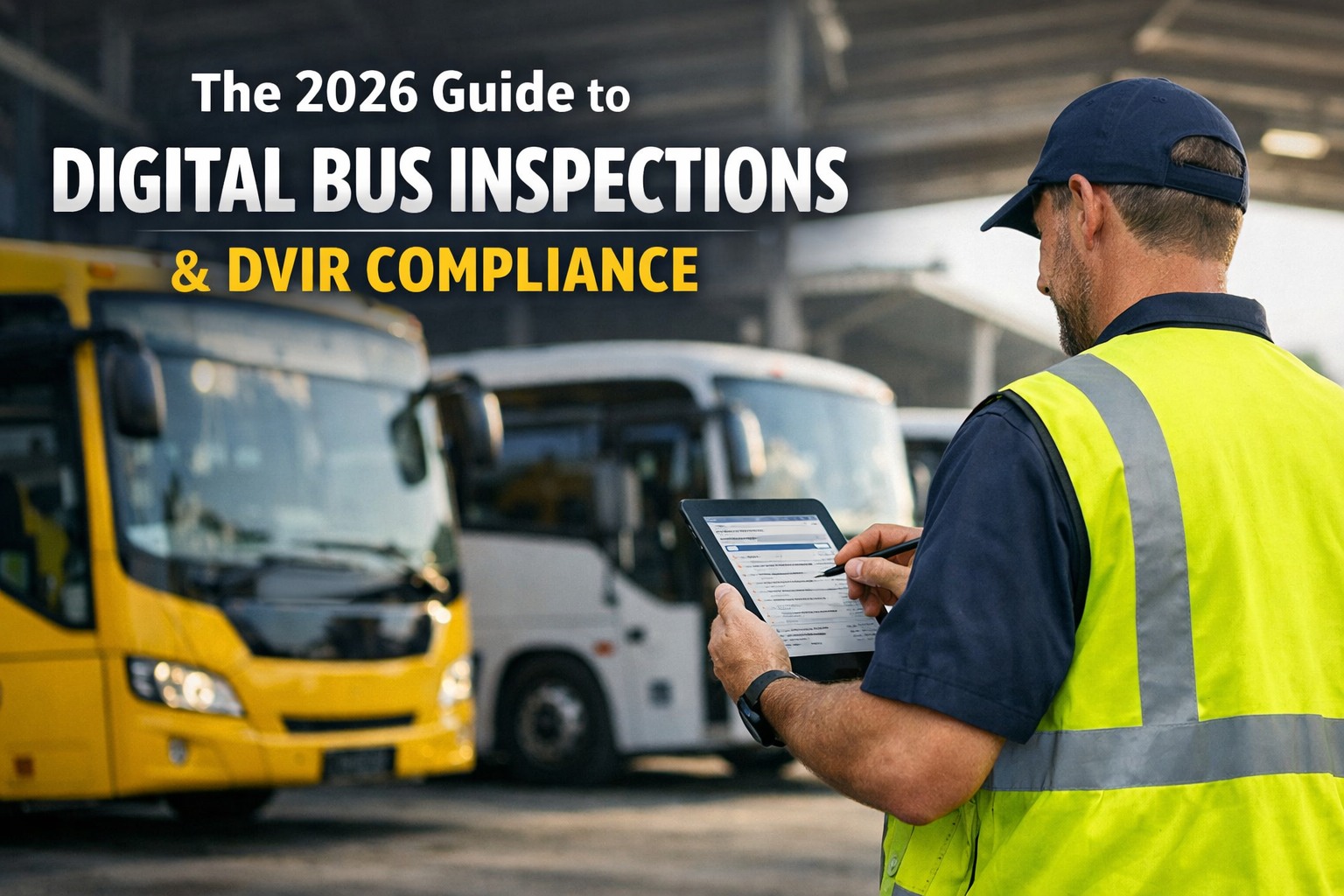
The FMCSA estimates that Driver Vehicle Inspection Reports help prevent approximately 14,000 accidents annually through early defect identification. Yet the traditional paper-based approach to inspections—prone to lost forms, illegible handwriting, delayed reporting and inconsistent executionoften undermines this safety mission before it begins.
Digital inspection technology solves these problems while delivering benefits that paper never could: real-time visibility into fleet condition, automated workflows from defect identification to repair verification, photo documentation that eliminates ambiguity, and audit-ready records accessible instantly. The question for bus fleets in 2026 isn't whether to digitize inspections—it's how to implement digital systems effectively and maximize their value.
This guide provides the comprehensive framework compliance heads need to modernize their inspection programs while maintaining full regulatory compliance.
14,000
Accidents prevented annually through DVIR early defect identification
40%
Reduction in inspection time with digital vs. paper processes
85%
Improvement in compliance accuracy with electronic systems
6-12 mo
Typical timeframe to achieve positive ROI from digital inspections
2026 Regulatory Framework: What's Changed
The regulatory landscape for bus fleet inspections continues to evolve. Understanding the current framework—and recent changes—is essential for compliance heads building or updating their inspection programs.
2025 FMCSA Clarification
Electronic DVIRs Explicitly Permitted
In May 2025, FMCSA proposed adding explicit language to §396.11 and §396.13 to clarify that DVIRs may be completed electronically. While electronic DVIRs were already permissible under existing regulations, this clarification encourages motor carriers and drivers to utilize electronic, cost-saving methods. The proposed rule allows drivers and employers to incorporate any existing electronic communication means already in use (such as texting or email) for DVIR purposes.
Core DVIR Requirements (Unchanged)
The fundamental DVIR requirements under 49 CFR 396.11 and 396.13 remain in effect. Drivers must inspect vehicles before and after each trip, document any defects affecting safety or operation, and motor carriers must ensure defects are corrected before dispatch.
No-Defect DVIR Exception
For property-carrying CMV drivers, no DVIR is required when no defects are found. However, passenger-carrying CMV drivers (including bus operators) must still complete DVIRs regardless of whether defects are found. Many carriers require DVIRs even when no defects are found as a best practice to document that inspections were conducted.
CSA Methodology Changes (February 2026)
The CSA Safety Measurement System is undergoing its most significant overhaul since 2010, with full enforcement beginning February 2026. Vehicle Maintenance is being split into two categories under the new scoring system, making inspection and maintenance documentation even more critical for carrier ratings.
Electronic DVIR Compliance Requirements
Whether using paper or digital, all DVIRs must meet these minimum requirements:
Required Information
Date, vehicle identification (unit number, license plate), driver signature, description of any defects found, mechanic/repair certification, subsequent driver acknowledgment
Minimum Inspection Points
Service brakes, parking brake, steering mechanism, lighting devices, tires, horn, windshield wipers, rear vision mirrors, coupling devices, wheels/rims, emergency equipment
Electronic Signatures
Must be legally valid under the Government Paperwork Elimination Act (GPEA) and Electronic Signatures in Global and National Commerce Act (E-SIGN)
Record Retention
DVIRs must be retained for 3 months from the date of the report. Electronic records must be producible for DOT audits and roadside inspections.
Routing Requirements
Reports must be routed to required recipients (motor carrier, maintenance personnel). Electronic systems should provide audit trails showing delivery.
Transfer Capability
Must be able to transfer records to inspectors during roadside inspections or audits—typically via display on mobile device or printout.
2025 DVIR Violation Penalties (2.598% Increase)
$1,584
Per day for failing to complete DVIR when required
$12,700+
For falsifying a DVIR to hide a safety defect
$15,420+
For failing to repair a reported safety defect
$17,870
For employers allowing operation during out-of-service period
Digital Inspection Technology: Core Capabilities
Modern digital inspection platforms have evolved far beyond simple electronic forms. Today's systems offer comprehensive capabilities that transform inspections from compliance checkboxes into proactive safety and maintenance tools.
Mobile-First Inspection Apps
Smartphone and tablet applications guide drivers through pre-trip and post-trip inspections with intuitive interfaces. The best apps work offline for areas without connectivity and sync automatically when connection is restored. Touch-based checklists, voice-to-text notes, and simple tap-to-complete workflows make inspections faster and more consistent than paper.
Photo & Video Documentation
Capture images of defects, damage, or wear patterns directly within the inspection report. Photo documentation eliminates ambiguity about defect severity, provides visual evidence for maintenance teams, and creates legal documentation for disputes. Some platforms support video capture and markup tools for annotating images.
GPS & Timestamp Verification
Automatic capture of location data and timestamps verifies that inspections are performed when and where required. This eliminates "pencil whipping" (rushing through or fabricating inspections) and provides proof of compliance for audits. Geofencing can ensure inspections occur at designated locations.
Customizable Checklists
Configure inspection templates for different vehicle types, routes, and operational requirements. Bus-specific checklists can include passenger safety equipment, wheelchair lifts, emergency exits, and other items beyond standard DVIR requirements. Templates ensure consistency while adapting to your fleet's specific needs.
Real-Time Defect Alerts
When a driver reports a defect, notifications instantly reach maintenance supervisors, fleet managers, and relevant personnel. No more waiting for paper forms to arrive or hoping someone checks a shared folder. Critical defects can trigger escalation protocols automatically.
Automated Work Order Generation
Failed inspection items automatically convert into maintenance work orders with all relevant context—photos, driver notes, vehicle history. This closed-loop workflow ensures reported defects translate into repair actions without manual intervention or data re-entry.
Repair Verification & Sign-Off
After repairs are completed, technicians document their work within the same system. The next driver sees repair status and acknowledges completion before taking the vehicle—exactly as regulations require, but with digital audit trail instead of paper signatures.
Analytics & Reporting
Comprehensive dashboards reveal inspection completion rates, common defect patterns, vehicle-specific issues, driver compliance trends, and repair turnaround times. Data-driven insights enable proactive maintenance and identify systemic problems before they cause failures.
Critical Integration Points
Maximum value from digital inspections requires integration with other fleet systems:
CMMS Integration
Defects flow directly into maintenance management software, creating work orders and updating vehicle service histories automatically.
ELD Integration
Many fleet management systems combine eDVIR with electronic logging devices, ensuring all FMCSA recordkeeping requirements are met in one platform.
Telematics Integration
Connect inspection data with vehicle telematics for complete visibility—fault codes, engine data, and driver-reported issues in one view.
Parts Inventory
Link inspection findings to parts availability, enabling accurate repair scheduling and preventing downtime from missing components.
Ready to see how digital inspections can transform your fleet's compliance and safety performance? Get a personalized demonstration of modern inspection technology.
Modernize Inspections — Request Demo Start Your Digital TransitionPaper vs. Digital: The Compliance Case
Understanding the specific limitations of paper-based inspections—and how digital systems address them—helps compliance heads build the business case for technology investment.
Paper-Based Inspections
Digital Inspections
Form Completion
Handwritten entries prone to illegibility, incomplete information, and inconsistent detail
Guided checklists with required fields ensure complete, consistent, readable data every time
Time to Complete
Variable; searching for forms, finding pens, manual data entry adds friction
40% faster on average; mobile apps streamline the process with tap-to-complete interfaces
Defect Communication
Delays until paper reaches maintenance; details often unclear or missing context
Instant notification with photos, notes, and vehicle history—no communication lag
Record Accessibility
Physical filing required; searching historical records is time-consuming
Searchable digital records accessible instantly from anywhere; easy audit preparation
Verification
Difficult to verify inspections were actually performed properly or at the right time
GPS, timestamps, and time-on-inspection metrics prove compliance objectively
Repair Tracking
Manual follow-up required; easy for defects to fall through cracks
Automated workflows ensure every defect is tracked to resolution
Audit Readiness
Scrambling to locate and organize paper records; risk of missing documentation
Complete audit trail instantly available; reports generated on demand
Data Analysis
Manual tabulation required; trend analysis is impractical or impossible
Automatic analytics reveal patterns, problem vehicles, training needs, and improvement opportunities
Eliminating "Pencil Whipping"
One of the most significant compliance risks with paper inspections is "pencil whipping"—drivers rushing through or fabricating inspection results without actually examining the vehicle. FMCSA estimates that 95% of DVIRs historically showed no defects, but this statistic likely reflects incomplete inspections rather than perfect vehicles.
Digital systems combat pencil whipping through multiple mechanisms: required photo documentation for specific items, time-on-inspection tracking that flags suspiciously fast completions, GPS verification that inspections occur at designated locations, and sequential checklists that must be completed in order. These features don't just improve compliance—they improve actual vehicle safety by ensuring inspections are genuinely performed.
Implementation Roadmap
Successfully transitioning from paper to digital inspections requires careful planning, stakeholder engagement, and phased execution. Most implementations take 4-12 weeks depending on fleet size and complexity.
Phase 1
Assessment & Planning
Weeks 1-2
Audit current inspection processes and identify gaps
Document vehicle types and unique inspection requirements
Evaluate platform options against your specific needs
Identify integration requirements (CMMS, ELD, telematics)
Build stakeholder buy-in from drivers, technicians, management
Define success metrics and baseline measurements
Phase 2
Configuration & Setup
Weeks 3-4
Configure inspection templates for each vehicle type
Set up user accounts, roles, and permissions
Establish notification rules and escalation procedures
Configure integrations with existing systems
Set up reporting dashboards and KPIs
Prepare training materials and documentation
Phase 3
Pilot Program
Weeks 5-8
Deploy to subset of fleet (10-20% of vehicles)
Train pilot group drivers and maintenance staff
Run parallel with paper for validation period
Gather feedback and identify workflow improvements
Refine templates and processes based on experience
Document quick wins for broader adoption messaging
Phase 4
Fleet-Wide Rollout
Weeks 9-12
Expand to remaining fleet in manageable waves
Complete training for all drivers and technicians
Phase out paper processes entirely
Monitor adoption rates and compliance metrics
Address edge cases and resistance
Establish ongoing support and continuous improvement
Critical Success Factors
Driver Buy-In
Drivers who understand the "why" behind digital inspections adopt faster. Emphasize time savings, easier defect reporting, and improved safety—not surveillance.
Training Quality
Hands-on training with actual devices is essential. Quick reference guides and ongoing support address questions that arise after initial training.
Management Support
Visible leadership commitment signals that digital inspections are the new standard, not optional. Hold teams accountable for adoption metrics.
Quick Wins
Demonstrate early benefits—faster inspections, defects fixed faster, audit prep simplified—to build momentum for full adoption.
Platform Selection Criteria
Not all digital inspection platforms are equal. Compliance heads should evaluate potential solutions against specific criteria that ensure regulatory compliance, operational effectiveness, and long-term value.
Regulatory Compliance
☐ Captures all required DVIR data elements
☐ Supports legally valid electronic signatures
☐ Provides 3-month+ record retention
☐ Records accessible for roadside inspection/audit
☐ Supports both pre-trip and post-trip inspections
☐ Tracks repair certification and driver acknowledgment
Usability
☐ Intuitive mobile interface drivers can learn quickly
☐ Works offline with automatic sync
☐ Supports photo/video capture
☐ Fast inspection completion (not slower than paper)
☐ Available on both iOS and Android
☐ Voice-to-text and annotation capabilities
Integration & Scalability
☐ Integrates with your CMMS/maintenance system
☐ Connects with ELD platform (if applicable)
☐ API available for custom integrations
☐ Scales from current fleet to future growth
☐ Multi-location support if needed
☐ Role-based access controls
Analytics & Reporting
☐ Real-time compliance dashboards
☐ Inspection completion rate tracking
☐ Defect trend analysis by vehicle/component
☐ Driver compliance reporting
☐ Exportable reports for audits
☐ Customizable reporting options
Workflow Automation
☐ Automatic defect alerts to maintenance
☐ Work order generation from failed items
☐ Repair tracking and verification workflow
☐ Configurable escalation rules
☐ Scheduled inspection reminders
☐ Out-of-service vehicle flagging
Support & Training
☐ Implementation support included
☐ Training resources and documentation
☐ Ongoing customer support availability
☐ Regular platform updates and improvements
☐ User community or knowledge base
☐ Data migration assistance (if needed)
ROI and Cost Justification
Digital inspection platforms require investment, but the return typically exceeds costs within 6-12 months through multiple value streams. Compliance heads need concrete numbers to justify investment to leadership.
Time Savings
40% reduction in inspection completion time
60-80% reduction in administrative processing
30-50% reduction in audit preparation time
Example: 100 drivers × 2 inspections/day × 5 minutes saved = 1,000 minutes/day = 16+ hours daily
Maintenance Cost Reduction
15-30% reduction in maintenance costs through earlier defect identification
25-35% reduction in emergency repair costs
45% improvement in vehicle uptime
Example: Catching a brake issue at inspection vs. roadside breakdown saves $6,000+ per incident
Compliance Cost Avoidance
85% improvement in compliance accuracy
100% audit-ready documentation
$0 target for DVIR-related violations
Single DVIR violation costs $1,584/day—preventing one multi-day violation justifies months of platform cost
Productivity Gains
20-30% improvement in maintenance team productivity
35 vehicles additional capacity managed by same team (120-vehicle fleet example)
Faster defect communication, reduced diagnostic time, and automated workflows free technician capacity
Typical ROI Timeline
Days 1-30
Reduced inspection time, improved completion rates, real-time visibility established
Days 31-90
Compliance scores improve, defect response time decreases, maintenance planning improves
Months 3-6
Maintenance cost reductions measurable, breakdown frequency decreases, audit confidence increases
Months 6-12
Positive cash flow achieved, full ROI typically realized, continuous improvement capabilities unlocked
Best Practices for Digital Inspection Success
Fleets that achieve the greatest value from digital inspections share common practices that go beyond basic technology implementation.
01
Require Photo Documentation for Critical Items
Configure your system to require photos for high-risk inspection points: tires, brake components, lights, and any item with previous defect history. Visual documentation eliminates ambiguity and proves inspection thoroughness.
02
Monitor Time-on-Inspection Metrics
Track how long drivers spend on inspections. Suspiciously fast completions (under 5 minutes for a thorough bus inspection) indicate potential pencil whipping. Use the data for coaching, not punishment, to improve actual inspection quality.
03
Close the Loop on Every Defect
Ensure your workflow requires repair verification and driver acknowledgment for every reported defect before the vehicle can be dispatched. The closed-loop process is both a regulatory requirement and an operational safeguard.
04
Review Analytics Weekly
Establish a routine for reviewing inspection data: completion rates by driver, common defect patterns, vehicles with recurring issues, repair turnaround times. Data insights only create value if someone acts on them.
05
Customize Checklists by Vehicle Type
School buses, transit buses, and charter coaches have different inspection requirements. Create vehicle-type-specific templates that include all relevant items without cluttering inspections with irrelevant checkpoints.
06
Integrate with Maintenance Scheduling
Connect inspection data to your preventive maintenance program. Inspection findings should inform PM schedules—if brakes consistently show wear at certain mileage intervals, adjust inspection focus and replacement timing accordingly.
07
Conduct Periodic Spot Audits
Randomly verify that digital inspection reports match actual vehicle condition. This quality assurance step maintains inspection integrity and identifies drivers who may need additional training or accountability.
08
Use Data for Driver Recognition
Recognize drivers who consistently complete thorough inspections and identify legitimate defects. Positive reinforcement builds an inspection culture where catching issues is celebrated, not penalized.
The Digital Inspection Imperative
Digital inspections are no longer an emerging technology—they're the standard for fleets serious about compliance, safety, and operational excellence. With FMCSA explicitly clarifying electronic DVIR permissions and CSA methodology changes increasing the stakes for inspection documentation, the case for digital transformation has never been stronger.
The fleets that thrive in 2026 and beyond will be those that leverage digital inspection technology not just for compliance, but as a foundation for proactive maintenance, continuous improvement, and data-driven decision making. The implementation path is well-established, the ROI is proven, and the technology is mature. The only remaining question is when your fleet will make the transition.
Ready to modernize your inspection program? See how leading bus fleets are achieving compliance excellence with digital inspection technology.
Modernize Inspections — Request Demo Start Your Digital TransitionFrequently Asked Questions
Q: Are electronic DVIRs officially permitted by FMCSA regulations?
A: Yes. Electronic DVIRs have been permissible under existing regulations, and in May 2025 FMCSA proposed explicit language to make this clear in §396.11 and §396.13. The proposed rule encourages motor carriers to utilize electronic, cost-saving methods when completing DVIRs. Electronic signatures are legally valid under the Government Paperwork Elimination Act and E-SIGN Act.
Q: What information must electronic DVIRs contain to be compliant?
A: Electronic DVIRs must contain all the same information as paper forms: date, vehicle identification, driver signature, description of any defects found, mechanic/repair certification, and subsequent driver acknowledgment. Records must be retained for 3 months, routed to required recipients, and be producible for DOT audits or roadside inspections.
Q: How quickly can we expect ROI from implementing digital inspections?
A: Most fleets see initial benefits within 30-60 days, including reduced inspection time (40% average) and improved compliance scores (85% improvement in accuracy). Significant ROI typically occurs within 6-12 months through reduced maintenance costs (15-30%), improved vehicle uptime (45%), and avoided compliance penalties.
Q: Do bus operators have different DVIR requirements than trucking?
A: Yes. Unlike property-carrying CMV drivers who don't need DVIRs when no defects are found, passenger-carrying CMV drivers (including bus operators) must still complete DVIRs regardless of whether defects are found. This requirement applies to all bus fleets—school, transit, and charter—making digital systems especially valuable for managing the higher documentation volume.
Q: What happens during a DOT audit if we use electronic DVIRs?
A: Electronic DVIRs must be producible for DOT audits just like paper records. Most digital platforms provide instant access to searchable records, exportable reports, and audit-ready documentation. In practice, digital systems make audits easier—records are complete, organized, and accessible immediately rather than requiring manual file searches.