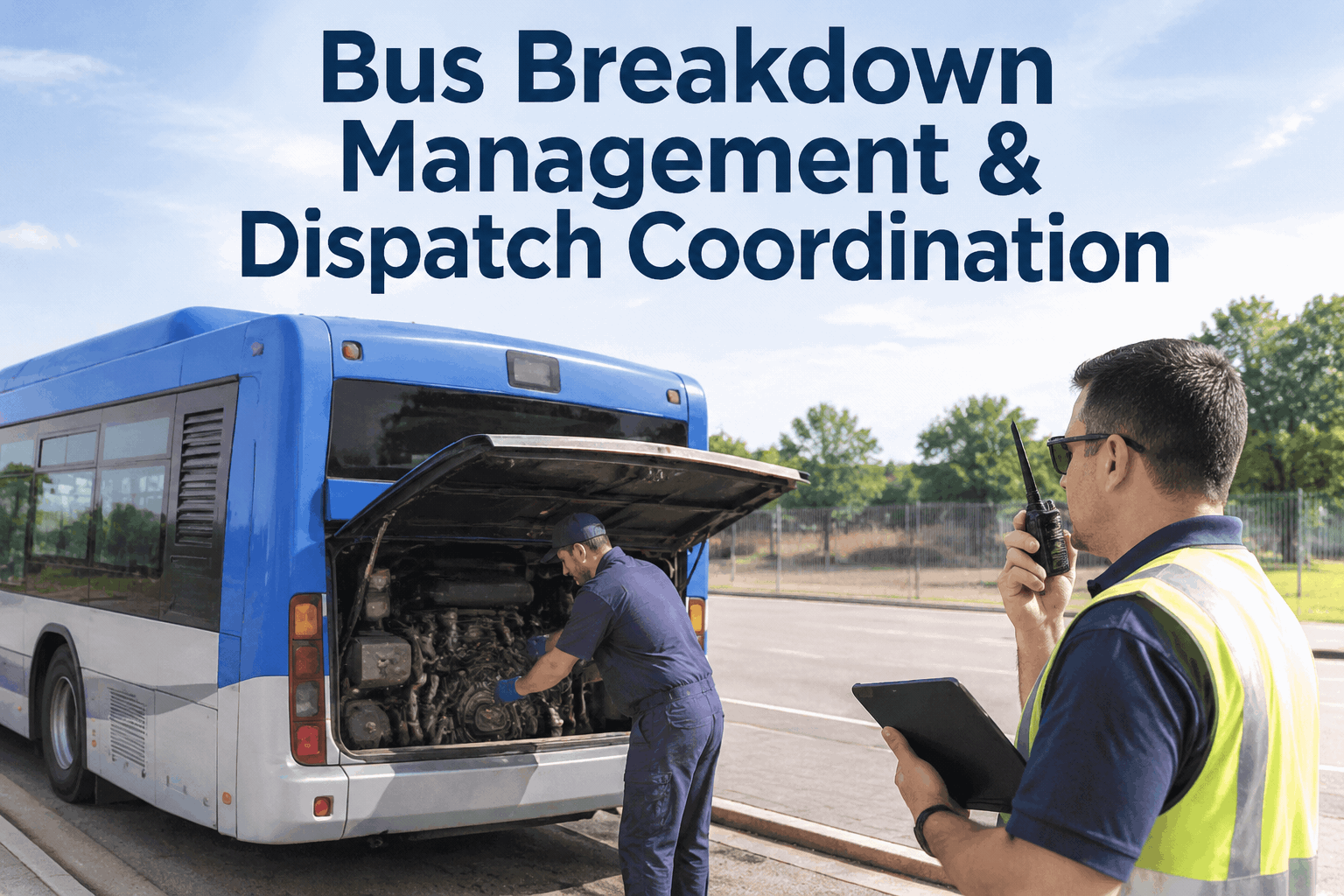
A bus loses air pressure on the busiest corridor of the morning, forty riders aboard. The driver radios it in, dispatch scribbles a note, and the shop hears a half-version twenty minutes later — missing the fault, the location, the mileage. Bus breakdown management is not really about the breakdown; it is about the dispatch-to-shop handoff, and that is where the downtime hides. You can see a cleaner dispatch-to-shop handoff in a demo.
Bus Breakdown Management & Dispatch Coordination
When a bus fails mid-route, four handoffs decide how long it stays down — driver to dispatch, dispatch to shop, shop back to the road. One weak link in that chain is where most of the downtime lives.
Three of the four handoffs are easy. The dispatch-to-shop link is the one that runs on phone calls and memory — and the one that decides whether the bus is down for one hour or four.
Where the Dispatch-to-Maintenance Handoff Breaks
When a breakdown lives in a phone call and a sticky note, three things go missing between dispatch and the shop. Each one adds minutes the bus did not have to lose, and none of them shows up until the next time someone needs the record.
The visibility gap
Dispatch cannot see what the shop is doing, and the shop cannot see the full fault. Each side works from half the picture and fills the rest with phone tag.
The status gap
Once the bus is towed in, dispatch keeps asking "is it ready yet?" because there is no live status — so planning the swap and the route is pure guesswork.
The record gap
When it is over, there is no clean record — cause, parts, downtime, cost. The same failure repeats, and an audit or warranty claim has nothing to stand on.
All three gaps close the same way: the breakdown becomes one shared record the moment it is reported, so dispatch and the shop read from the same page instead of relaying it by voice.
Closing those gaps does not take more people, just one place for the record to live. You can sign up free and log your next breakdown on one shared ticket.
The Handoff Is the Downtime
Time-to-repair is not just wrench time. A big share of it is the relay — the minutes lost getting the right information to the right mechanic. Tighten the handoff and you cut the clock, often before anyone touches a tool.
Ranges are industry-reported and illustrative. The gap between the bars is mostly handoff time, not harder repairs — and a heavy-duty tow on top of it runs into four figures.
That difference is a bus back on a route by lunch instead of parked all day. You can walk through the breakdown-to-repair flow in a demo and see where your own clock is leaking.
The Mid-Route Breakdown Playbook
When a bus goes down with passengers aboard, the order of operations is fixed — safety first, then the handoff that gets it fixed. Run this every time, and make the CRITICAL items reflexes. If a step lives only in someone's head, it is a step that gets skipped under pressure.
- Secure passengers and the scene firstDriver makes the bus safe, accounts for riders, and reports position before anything else happens.CRITICAL
- Open one breakdown work order immediatelyLog fault, location, unit number, and mileage on a single record — not a note that gets re-told.CRITICAL
- Pull the bus's recent history and fault codesCheck open defects and prior repairs so the shop knows if this is a repeat before the tow arrives.CRITICAL
- Decide tow or roadside repair, on the recordPick the faster safe path and note it, so the shop stages the right parts and people either way.DECIDE
- Dispatch a ready spare and cover the routePull the next cleared bus so riders move while the repair runs — coverage and fix in parallel.DECIDE
- Close the ticket with cause, cost, and downtimeCapture what failed and how long it was down, so the next one is faster and the pattern is visible.CLOSE
Written down it is a checklist; built into the system it runs itself from the first report. You can sign up free and put this playbook behind every breakdown.
How BusCMMS Closes the Gap Between Dispatch and the Shop
A breakdown is a communication problem with a mechanical trigger. BusCMMS keeps the whole relay on one record, so the information moves at the speed of the fault, not the speed of a return phone call.
One work order, fault to fixed
Driver report, fault code, parts, labor, and sign-off live on a single ticket — dispatch and the shop read the same record, never a retelling.
Live repair status for dispatch
Dispatch sees in-shop, in-progress, or ready without calling the bay — so the swap and the route are planned on real timing.
Fault codes that create work orders
Telematics faults can open a work order on their own, so the shop often knows the problem before the tow truck is even rolling.
A full record every time
Cause, cost, and downtime close with the ticket — feeding repeat-failure tracking, warranty claims, and audit-ready history.
That is a breakdown that costs you one bus for one morning, not a whole day and a scramble — and it keeps your passenger transit operations audit-ready in the same motion. To set it up, book a demo and walk through your worst recent road call.
A Maintenance Supervisor's Take
Key Takeaways on Breakdown Management
A breakdown you cannot prevent, you can still manage well. Four things decide whether it costs you an hour or a day.
- 1
The handoff is the downtime
Most lost time is the relay from dispatch to shop, not the wrench work itself.
- 2
One record, not a retelling
Fault, location, and mileage on one work order both teams see closes every gap.
- 3
Live status beats phone tag
Dispatch planning the swap on real repair timing keeps routes covered.
- 4
Close with cause and cost
A full record makes the next breakdown faster and the pattern visible.
Treat bus breakdown management as a handoff problem, not just a repair problem — one shared work order from the first radio call to the final sign-off — and the mid-route failure that used to swallow a morning becomes a tracked, hour-long event. You cannot stop every breakdown, but you can stop losing the first hour of every one to the telephone.