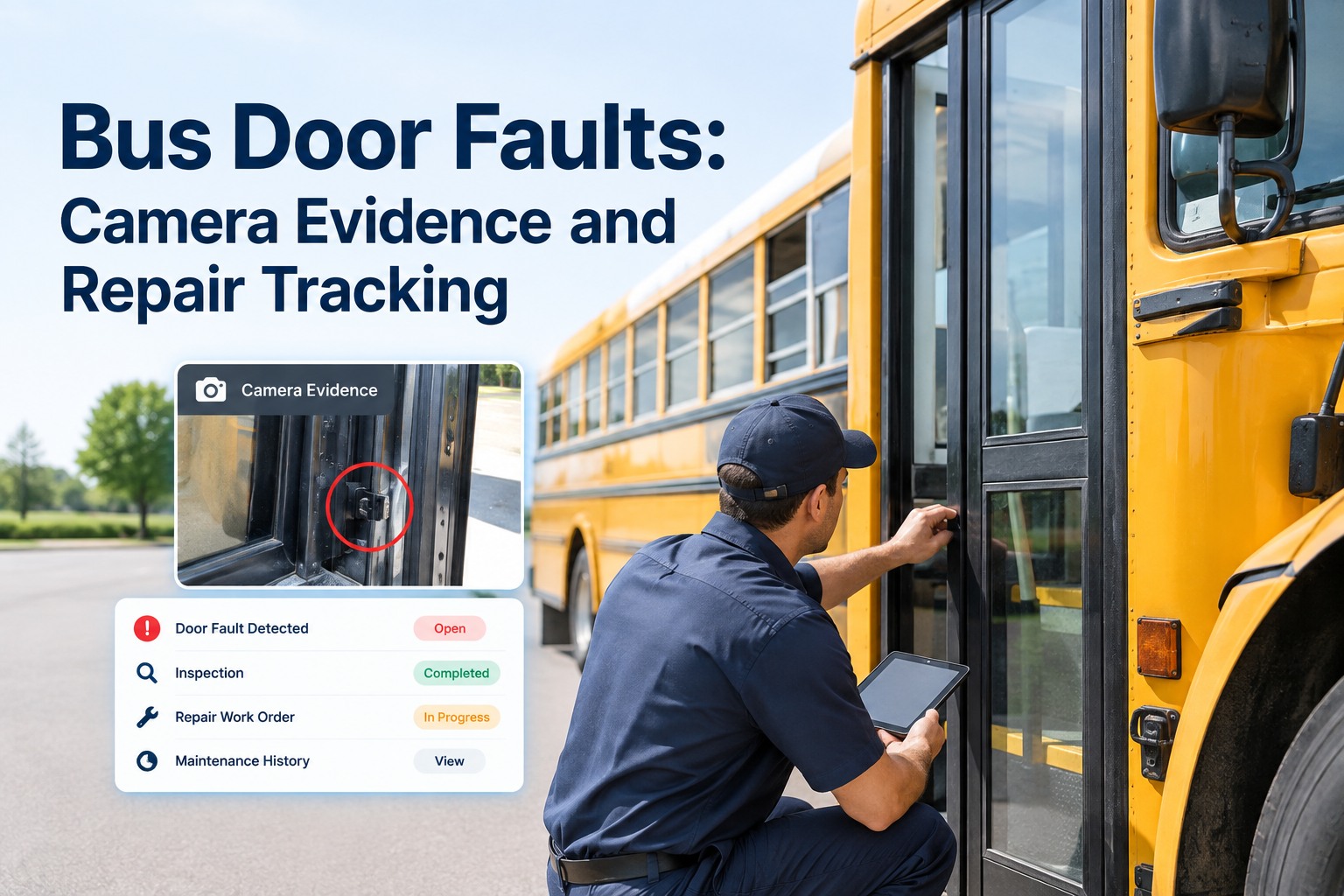
A bus door fault is one of the hardest problems to fix because it so often refuses to happen twice: the door sticks or fails to seal on a morning run, the driver reports it, and by the time a technician checks it in the yard the door cycles perfectly. Camera evidence changes that — a clip of the door misbehaving on an actual run turns an unreproducible complaint into a diagnosable fault, and connected tracking makes sure the repair and its history stay on the bus.
Bus Door Faults: Camera Evidence and Repair Tracking
Door faults are the ghosts of the fleet — real on the route, gone in the shop. Catch them on camera and you can finally diagnose what you cannot reproduce.
Updated September 2026 · A practical guide, not legal advice; door service requirements vary by manufacturer, vehicle, and jurisdiction.Every fleet has that one bus with a door nobody can pin down. It works fine most of the time, then hesitates, sticks, or fails to seal at the worst moment — and the fault never shows up when the tech has time to look. That gap between the failure and the diagnosis is where door problems live, and it is exactly what tracking and camera evidence are built to close.
The intermittent fault problem, solved by evidence
Doors are uniquely frustrating because the fault and the inspection almost never coincide. A driver reports a door that stuck on a crowded morning run; hours later in the yard it cycles flawlessly, so the ticket closes as "no fault found" — and the door sticks again next week. Camera evidence breaks that loop by capturing the fault where it actually happens.
The clip does more than confirm the driver is not imagining it. It shows the conditions — a full load, a cold start, a specific point in the cycle — that a static shop test never recreates, and those conditions are usually the clue to the root cause. That is how an intermittent fault stops being a mystery and becomes a repair. Book a demo to diagnose door faults from real-run evidence
Where door faults come from
Door problems cluster in a handful of subsystems. Knowing them turns "the door is acting up" into a specific place to look — especially once a clip has shown you when and how it fails.
A sensor or interlock reading wrong can make a door refuse to open, close on a delay, or lock out entirely — classic intermittent behavior.
A tiring motor, pneumatic actuator, or air leak causes slow, weak, or hesitant operation that worsens under load or cold.
Worn tracks, dry rollers, or debris make a door bind or stick partway — often only at certain points in the cycle.
Worn seals or a door out of alignment let it fail to close fully or seal, which shows up as drafts, noise, or a warning.
Faulty switches, controls, or intermittent wiring produce erratic behavior that comes and goes with vibration or temperature.
On stepwell doors, a worn step edge, loose tread, or lighting fault is a safety issue tied to the same door system.
Several of these are, by nature, intermittent — they depend on load, temperature, vibration, or a specific point in the door's travel. That is precisely why footage of the fault in the act is worth more than any number of clean shop cycles. Start free and tie door faults to the subsystem at fault
From reported fault to verified fix: the loop
A door fault only gets solved for good when it moves through a clear sequence — report, see it, diagnose, fix, and verify — instead of bouncing between the route and a shop that cannot reproduce it. A connected loop, anchored by the camera clip, closes it.
Reported
A driver flags the door fault; the report ties to the bus and the run.
See it on camera
The relevant clip is pulled, showing the fault and the conditions it happened in.
Diagnose
The behavior in the clip points to the subsystem — sensor, actuator, track, or wiring.
Work order
A repair work order opens against the bus, with the clip and diagnosis attached.
Repair & verify
The fix is completed and the door is cycled — ideally under the conditions that triggered it.
Record
The fault, the clip, and the repair stay on the door's history on that bus.
The clip is the hinge of the whole loop: it is what lets the diagnosis happen at all when the shop cannot reproduce the fault, and it is what a later technician can revisit if the problem comes back. Without it, step three is a guess. Book a demo to see the door fault-to-fix loop on one record
Catching the repeat: door faults as a pattern
The other thing tracking reveals is repetition. A door that has been "fixed" three times is not fixed — it has an underlying problem the point repairs keep missing. When every door fault lands on the bus's history, that pattern becomes visible instead of hiding behind separate closed tickets.
See that bus 8's front door has faulted three times in a month, so it gets a root-cause diagnosis rather than a fourth quick fix.
Clips across the incidents may share a trigger — cold mornings, full loads — that points straight at the cause.
Prior repairs and their evidence are on the record, so the next tech builds on what was tried instead of starting over.
An intermittent fault is really a pattern waiting to be seen. Connected history plus the clips is what makes the pattern legible — and a legible pattern is a fixable one. Start free and surface repeat door faults
Why door faults keep coming back: the evidence is split
The recurring failure is structural: the camera captured the door sticking, but that footage lives in the vendor portal, while door inspections and repairs are tracked in a separate maintenance system. So the technician diagnosing the fault never sees the clip, the ticket closes without a root cause, and the door faults again — with no single record connecting the evidence to the repair.
BusCMMS is an AI-native, hardware-agnostic bus fleet operations platform that closes that gap. It connects door-fault events from the MDVR or AI camera systems you already run — no rip-and-replace — to bus asset records, incidents, and maintenance work orders. A fault links to the bus and door, the clip attaches to the incident, a work order tracks the repair, and the whole history stays on one record — so an intermittent fault can be diagnosed from evidence and a repeat pattern is caught before it becomes chronic. Book a demo to connect door clips to the repair record
What the regulations require
A brief, non-legal note on the backdrop: the rules require you to keep the door system safe and inspected and to document it — but they do not hand you a door-fault diagnosis process.
Requires systematic inspection, repair, and maintenance of applicable commercial motor vehicles and the records to show it — which covers keeping the door system in safe operating condition and documenting service.
Covers periodic inspection requirements, which include examining the vehicle on a regular basis. Door-fault follow-up complements those periodic checks between them.
Neither rule prescribes a specific door-fault detection or diagnosis workflow, and specific bus door inspection and service requirements may also depend on vehicle specifications, manufacturer guidance, state requirements, and district policy. This page is a practical guide, not legal advice — follow your manufacturer's guidance and confirm your obligations with the appropriate authorities. Start free and keep door inspections documented and current
See how a door fault becomes a closed work order in BusCMMS
Watch a door-fault clip link to the right bus and door, open a work order with the evidence attached, and close as a diagnosed, verified repair — with the whole history on one record so repeats are caught early. Uses your existing MDVR or AI camera events. Hardware-agnostic, no rip-and-replace.
Hardware-agnostic · Works with your existing cameras · One record per bus
Frequently asked questions
What causes a bus door fault?
Bus door faults usually trace to one of a few subsystems: sensors and interlocks reading incorrectly, a tiring motor or pneumatic actuator or air leak, worn tracks and rollers that cause binding, worn seals or misalignment that stop the door sealing, faulty switches, controls, or intermittent wiring, or on stepwell doors a worn step edge or lighting fault. Many of these are intermittent by nature — they depend on load, temperature, vibration, or a specific point in the door's travel — which is why a door can fail on a route and then cycle perfectly in the shop. Identifying the responsible subsystem is far easier when there is footage of the fault happening under real conditions.
How do you diagnose an intermittent door fault?
The key is capturing the fault where it actually happens, because intermittent door faults rarely reproduce on demand in the shop. Camera footage of the door misbehaving on a real run shows both the behavior and the conditions — a full load, a cold start, a specific point in the cycle — that a static shop test cannot recreate, and those conditions are usually the clue to the root cause. From there the behavior in the clip points to the subsystem at fault, a work order captures the diagnosis and repair, and the door is ideally verified under conditions similar to the ones that triggered it. Without evidence, an unreproducible fault typically closes as "no fault found" and simply recurs.
Why does the same door keep failing after it was repaired?
Usually because the repairs addressed a symptom without reaching the underlying cause — common with intermittent faults that never showed up during the fix. A door "fixed" several times is not fixed; it has a root problem the point repairs keep missing. When every door fault is recorded on the bus's history with its evidence, the recurrence becomes visible, and clips across the incidents often share a trigger — cold mornings, heavy loads — that points at the real cause. That connected history also lets the next technician build on what was already tried instead of starting over, which is how a chronic door finally gets a root-cause diagnosis rather than another quick fix.
Do the regulations require door-fault tracking?
Not a specific process. 49 CFR 396.3 requires systematic inspection, repair, and maintenance of applicable commercial motor vehicles and the records to show it, and 49 CFR 396.17 covers periodic inspection requirements — both of which relate to keeping the door system in safe operating condition and documented. A door-fault follow-up supports those duties, but neither rule prescribes a specific door-fault detection or diagnosis workflow. Beyond the federal baseline, specific bus door inspection and service requirements may also depend on vehicle specifications, manufacturer guidance, state requirements, and district policy, so confirm what applies to your operation. This page is a practical guide and does not provide legal advice.
Do we need new cameras to capture door faults?
No. BusCMMS is hardware-agnostic and is designed to connect door-fault events from the MDVR or AI camera systems you already operate to bus asset records, incidents, and maintenance work orders, without a rip-and-replace deployment. A fault links to the correct bus and door, the relevant clip attaches to the incident, a work order tracks the repair, and the whole history stays on one record. The aim is to connect the footage you already capture with the door's inspection and repair workflow, using your current hardware, so an intermittent fault can be diagnosed from evidence and a repeat pattern is caught before it becomes chronic.