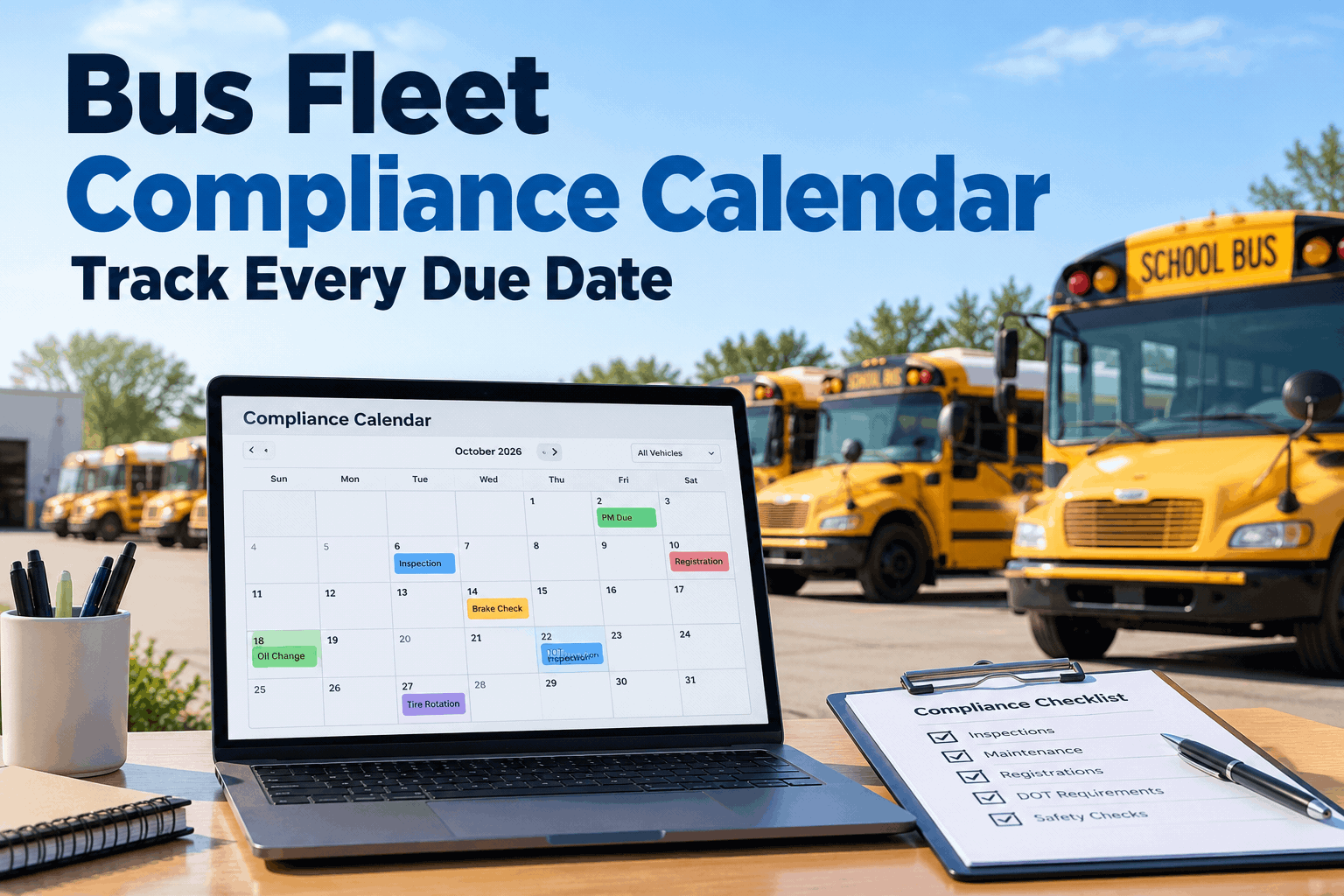
Only 7% of commercial carriers pass Department of Transportation compliance audits without findings. For bus operators, this statistic is troubling. A failed audit can result in fines ranging from $5,000 to $23,048 per violation depending on violation severity. A typical failed audit identifies 5-15 violations, resulting in $25,000-$345,000 in penalties. Beyond fines, failed audits damage insurance ratings, affect customer confidence, and can result in operational restrictions. Some carriers are placed in intensive monitoring after failed audits, requiring more frequent inspections and tighter compliance tracking. The financial and operational impact of failed audits is severe. Yet many failures are preventable. The violations most commonly cited during audits are documented maintenance gaps, incomplete driver files, missing inspection records, and procedural failures that could have been prevented through proper documentation and organization. A bus fleet manager should treat DOT audit preparation as continuous, not as a cramped effort in the weeks before a scheduled audit. Maintaining organized records, complete documentation, and systematic procedures throughout the year ensures readiness for audits at any time. Here's a comprehensive guide to DOT audit preparation for bus fleets including audit process, common violations, and a detailed preparation checklist.
Only 7% of carriers pass DOT audits clean. Use this 2026 bus fleet audit prep checklist to organize records and avoid $23,048-per-violation fines.
Why DOT conducts audits: The Department of Transportation, through the Federal Motor Carrier Safety Administration (FMCSA), conducts compliance audits of commercial motor carriers to verify adherence to federal safety regulations. An audit is a comprehensive review of a carrier's operations, maintenance, safety, and record-keeping. The goal is to identify non-compliance with regulations and require correction. Audits protect public safety by ensuring carriers are operating safely and maintaining vehicles properly.
Audit notification and timing: Most audits are announced in advance—a DOT inspector or FMCSA official notifies the carrier that an audit is scheduled and provides the date. The carrier typically has weeks or months to prepare. Some audits are unannounced, conducted without advance notice, testing whether the carrier is constantly compliant or only compliant during audits. Announced audits allow preparation time; unannounced audits reveal actual operations.
What auditors review: During an audit, inspectors review: driver qualification files (ensuring all drivers meet federal requirements), vehicle maintenance and inspection records, hours of service compliance (if applicable), drug and alcohol testing program documentation, accident and incident reports, maintenance logs and repair records, safety inspection procedures and completion, compliance with vehicle safety standards, and operational procedures and policies. The scope is comprehensive.
Audit duration and process: An audit typically takes 2-5 business days depending on fleet size. Auditors meet with management, review documents, may observe operations, and interview staff. At conclusion, auditors conduct an exit meeting discussing preliminary findings. Final audit report is issued weeks later with detailed findings and required corrective actions.
Driver qualification file deficiencies: Incomplete or missing driver qualification files are the most common audit finding. Files should contain: current commercial driver's license copy, medical certificate, proof of training, driving record verification, and employment history. A file missing any of these items is a violation. Some audits find files that have never been reviewed by management, indicating they were not properly maintained. Ensuring complete files for every driver is the single most important audit preparation step.
Vehicle maintenance record gaps: Incomplete maintenance records are frequently cited. Auditors look for documentation showing: routine maintenance services (oil changes, tire inspections, brake service), repair work completed, parts replaced, and dates of all services. Missing records for any 30-day period are violations. A bus going 6 months without documented maintenance is a major finding. Maintenance must be documented as it occurs or the record is incomplete.
Inspection report deficiencies: Missing or incomplete vehicle inspection reports are common violations. Drivers must complete inspections (pre-trip, post-trip, or routine), documenting vehicle condition and any defects. Missing inspection reports for any vehicle for any 30-day period are violations. A fleet without documented inspections for a month has multiple violations. Inspection procedures must be systematic and documented.
Hours of Service (HOS) violations: For charter and transit buses subject to HOS regulations, violations include: drivers operating beyond 11-hour daily limits, weekly hour violations, missing rest periods, or inadequate documentation of hours worked. Paper logs must be accurate and completed daily. ELDs (electronic logging devices) must be properly configured. HOS violations are serious and result in high fines.
Drug and alcohol testing program gaps: Carriers required to maintain drug and alcohol testing programs must document: pre-employment testing of all drivers, random testing of required percentage of drivers, reasonable-suspicion testing procedures, post-accident testing, and results of all tests. Missing or incomplete testing documentation is violations. A driver never tested is evidence of program failure.
Safety equipment violations: Buses must have functional safety equipment: fire extinguishers, first aid kits, emergency exits with proper signage, warning triangles, and other equipment per FMCSA standards. Equipment missing, expired, or non-functional is violation. A bus with missing first aid kit is an immediate violation.
Vehicle defect corrections: When vehicle inspections or roadside inspections discover defects, documentation must show the defect was reported and corrected. Auditors look for evidence that defects were addressed promptly. A defect reported in January but not corrected until May is a violation—defects should be corrected within reasonable timeframe (typically 10 days unless critical).
Classification of violations: FMCSA classifies violations into categories affecting penalty amounts: Critical violations (pose immediate safety risk), Major violations (significant non-compliance with regulations), Minor violations (technical non-compliance with limited safety impact). A missing driver qualification file is a critical violation. A vehicle with no documented maintenance for 2 months is a major violation. Missing paperwork for one vehicle for one month is a minor violation. Violation severity affects penalty amounts.
Penalty ranges by severity: Critical violations carry penalties up to $23,048 per violation. Major violations carry penalties up to $10,000 per violation. Minor violations carry penalties up to $1,000 per violation. A typical failed audit with 5 violations might include: 1 critical violation ($23,048), 3 major violations ($30,000), and 1 minor violation ($1,000), totaling $54,048 in fines.
Multiplier effect for recurring violations: If the same violation is found across multiple vehicles or drivers, each instance is a separate violation. A missing medical certificate on 3 drivers is 3 critical violations, totaling $69,144 in fines. A fleet without documented maintenance on 10 buses is 10 major violations, totaling $100,000 in fines. Violations multiply with fleet size.
Appeal process and negotiation: Carriers can appeal audit findings, contesting violations they believe are unjust. Appeals must demonstrate the violation either did not occur or has been corrected. The appeal process is lengthy and uncertain. Penalties may be negotiated if a carrier demonstrates commitment to correction and compliance. Best strategy is to prevent violations rather than relying on appeals.
Operational consequences beyond fines: Failed audits result in consequences beyond monetary penalties: insurance rates increase (carriers with failed audits pay significantly higher premiums), carriers may be subject to intensive monitoring (additional inspections, increased compliance requirements), operating authority may be restricted, and customer confidence is damaged (some customers will not contract with carriers with recent audit failures).
Driver qualification files: For every driver, verify the file contains: current valid commercial driver's license (original or certified copy), valid medical certificate (not expired), proof of successful training completion, verification of prior employment (written documentation from previous employers), and verification of clean driving record (copies of prior driving records for past 3 years). Files must be organized, complete, and readily accessible. Auditors will spot-check multiple driver files. If any required document is missing from any file, that is a violation.
Vehicle maintenance documentation: Maintain documented records of all maintenance performed on every vehicle: routine maintenance (oil changes, tire rotations, fluid checks) with dates and mileage, repair work with description of repairs and completion dates, parts replaced with part descriptions, and invoices or work orders documenting all services. Records should be organized by vehicle with chronological documentation. Gaps of more than 30 days without any documented maintenance indicate inadequate documentation. Maintain records for at least 1 year.
Vehicle inspection procedures and records: Establish documented inspection procedures for pre-trip, post-trip, or routine inspections depending on fleet operations. Ensure every driver is trained on inspection procedures. Maintain records showing inspections were completed: completed inspection forms, defect reports, and documentation of corrective actions. Spot-check multiple inspection records during audit period to verify completeness. Missing inspection records for any vehicle for any 30-day period is a violation.
Hours of Service documentation (if applicable): For fleets subject to HOS regulations, maintain accurate records: driver logs (paper or electronic) showing hours worked, off-duty time, vehicle operation time, and compliance with HOS limits. All logs must be signed by drivers and reviewed by management. Electronic logs must be properly configured and validated. Auditors will review logs for compliance with 11-hour daily limits and 60-hour weekly limits. Missing or inaccurate logs are violations.
Drug and alcohol testing program documentation: Maintain records of: pre-employment drug testing of all new drivers with results, random testing program documentation showing frequency (if applicable), reasonable-suspicion testing procedures and documentation when testing occurs, post-accident testing when involved in reportable accidents, and results of all testing (without violating driver privacy). Program policies must be documented. Testing must be conducted by certified labs. Records must be retained and accessible for audit.
Safety equipment maintenance: Document inventory and maintenance of all safety equipment: fire extinguishers (checked and charged per schedule), first aid kits (supplied and available on all buses), emergency exit signage and functionality, warning triangles or flares (available and functional), seat belt systems (checked for functionality). Equipment should be routinely inspected and defects corrected immediately. Maintain checklists showing equipment was inspected and is functional.
Accident and incident reporting: Maintain documented records of all accidents and incidents: accident reports including date, time, location, vehicles/people involved, and damage assessment, investigation reports documenting cause and corrective action, injury reports if applicable, and evidence of follow-up actions. Accidents should trigger post-accident testing if required by regulations. Patterns of accidents should trigger investigation of root causes and corrective actions.
Safety policies and procedures: Document written safety policies covering: vehicle maintenance requirements, driver safety expectations, inspection procedures, accident reporting, drug and alcohol testing, hours of service compliance (if applicable), and discipline for violations. Policies should be distributed to all staff and maintained on file. Training records should document that all drivers received copies and understood policies. Documented policies demonstrate formal commitment to safety.