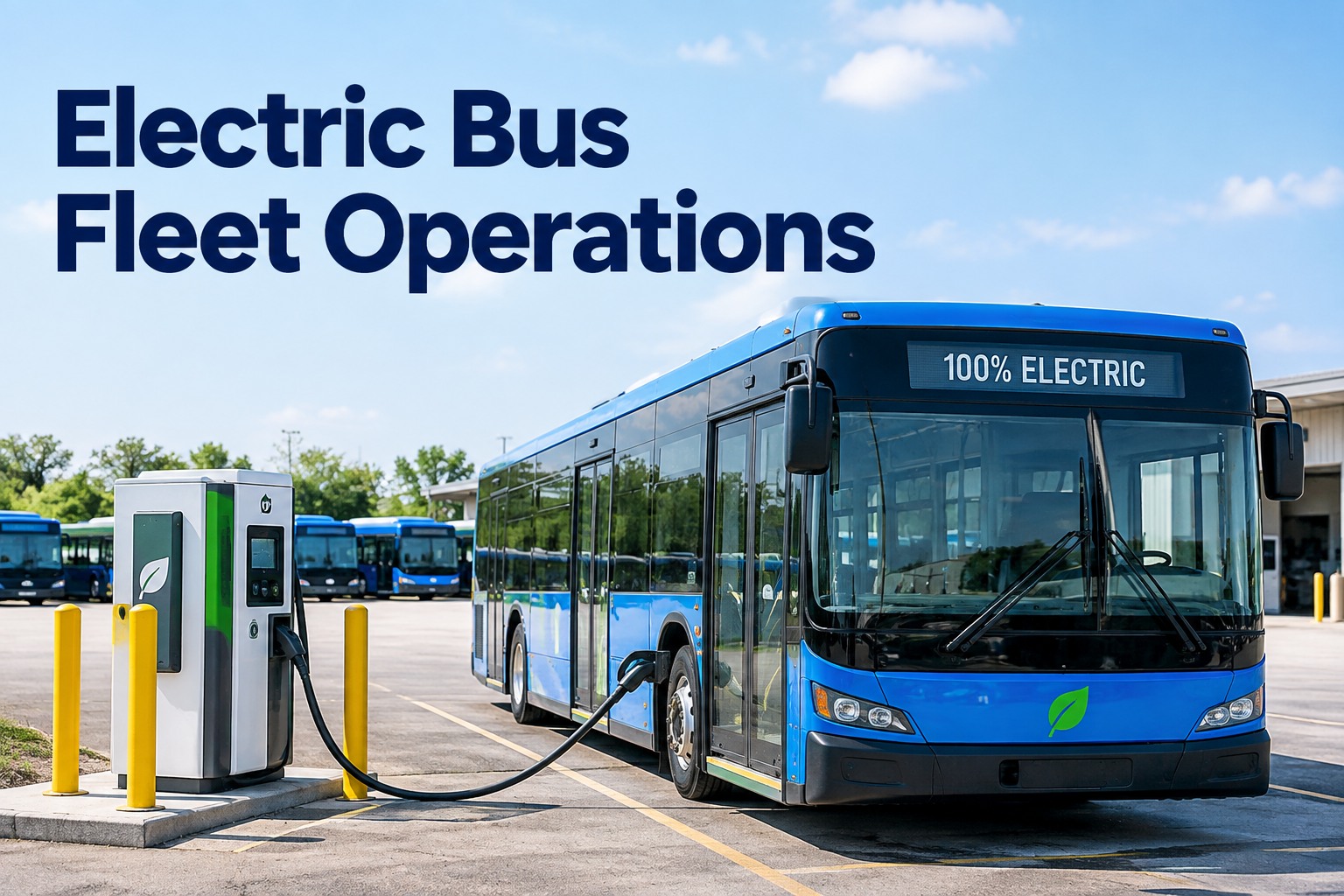
With a diesel bus, "route-ready" means running and fueled. With an electric bus, it hides three new questions: is it charged, is the battery healthy enough for today's range, and is its charger even working? Electric bus fleet management — and the software behind it — keeps all three answered "yes" every morning, so a bus that looks fine never strands mid-route with a dead battery.
Electric Bus Fleet Operations
Managing charging, battery health, range, and maintenance in one platform — so every electric bus is actually route-ready
- ChargeA new daily dependency
- BatteryHealth & state of charge
- RangePlanned per route
- ChargedState of charge for the route
- Battery healthyState of health holds range
- Charger workingIts charger passed uptime
- Maintenance clearNo open safety defect
What Electric Bus Fleet Management Actually Requires
Electric bus fleet management is the coordination of everything it takes to keep a battery-electric bus fleet in service: charging infrastructure, battery health, range planning, energy use, and maintenance — managed together rather than in separate spreadsheets. The reason it needs its own discipline is that an electric bus introduces dependencies a diesel bus never had. A diesel bus fuels in minutes anywhere; an electric bus depends on a specific charger being available and working, a battery holding enough charge for a specific route, and a maintenance program that understands high-voltage systems.
That's why fleet management software matters more here, not less. The moving parts — routes, chargers, battery states, workshop capacity — are interdependent in a way that overwhelms a whiteboard fast. When a charger goes down overnight, you need to know instantly which buses were assigned to it, whether they have enough charge to run anyway, and which routes are now at risk. For a school district or transit agency, that's the difference between catching it at 5 a.m. and discovering it when a bus doesn't show. You can book a walkthrough to see electric buses, chargers, inspections, and maintenance in one platform.
How Electric Bus Operations Differ From Diesel
If you're running an electric fleet with habits built for diesel, the gaps show up fast. The differences aren't cosmetic — they change what "ready for service" even means.
Diesel Bus
- Refuels in minutes, almost anywhere
- Range is predictable and stable
- Fuel is a running cost, not a dependency
- Maintenance built around the engine
- A pump outage rarely strands a route
Electric Bus
- Charging takes hours and needs a working charger
- Range shifts with weather, load, and battery age
- Charging is a hard daily dependency
- Maintenance built around high-voltage & battery
- A charger outage can idle every bus assigned to it
The right column is why electric fleets live or die on coordination. Range isn't a fixed number — heating in winter and air conditioning in summer draw real energy, so a route that's comfortable in spring can outrun the battery in January. Charging isn't instant, so a bus that comes back low can't just turn around. And a single depot charger failing overnight doesn't inconvenience one bus — it can idle every bus that was queued on it. Managing that web is exactly what an electric bus fleet platform is for.
Charging Infrastructure Is an Operational Asset — Treat It Like One
Here's the mindset shift most fleets miss: your chargers are fleet assets, as critical as the buses themselves. A depot slow-charger or a terminal fast-charger that fails is not an IT problem or a facilities footnote — it's a route at risk. Charger failures, connector wear, and grid faults have become a leading cause of electric fleet downtime, rivaling mechanical failures. Yet many fleets inspect and maintain their buses religiously and never once inspect a charger until it dies.
Charger inspections
Connectors, cables, and units get scheduled inspections like any asset — catching wear before it strands a bus.
Charger uptime
Track which chargers are up, degraded, or down — because an assigned-but-dead charger is a hidden route failure.
Charging schedules
Coordinate which bus charges where and when, so overnight depot slots and terminal fast-charges line up with routes.
Charging completion
Confirm buses actually reached target charge overnight — a session that silently failed is a bus short on range at dawn.
When chargers live in your fleet platform as maintainable assets — with inspection schedules, uptime tracking, and work orders when they fail — a charger fault becomes a ticket the same day instead of a surprise at pull-out. That single change quietly removes one of the biggest sources of electric-fleet downtime. Fleets that want charger and bus health on the same screen tend to start free and add their chargers as assets.
Battery Health, State of Charge, and Range Planning
The battery is your single most expensive asset on each bus, and it's the one that quietly determines whether a route is even feasible. Two numbers do the heavy lifting: state of charge (how full it is right now) and state of health (how much capacity it has left as it ages). Confuse them or ignore either and you get stranded buses or a battery that degrades faster than it should.
Today's fuel gauge. Plan each route so the assigned bus starts with enough charge to finish it — with margin for winter heating or summer AC load.
The battery's long-term capacity. As it declines, a bus's usable range shrinks — so an aging battery may no longer fit the route it ran two years ago.
Match buses to routes by real available range, not nameplate spec. The longest routes go to the healthiest batteries, not whichever bus is nearest.
Track consumption to spot a bus drawing more than its peers — often an early sign of a battery, HVAC, or drivetrain issue worth a work order.
Range planning is where these come together. Because a battery's usable range changes with age and weather, matching buses to routes is a live calculation, not a set-and-forget assignment. A platform that knows each bus's current charge, battery health, and typical energy per mile can flag "this bus can't safely cover Route 12 today" before the bus leaves — not after it strands. Battery-related issues also generate their own maintenance stream, which is why battery work orders belong on the same record as everything else. You can book a demo to see battery health drive route readiness.
High-Voltage Maintenance and Preventive Care
Electric buses don't need oil changes or exhaust work — but that "less maintenance" story is misleading. It's not less; it's different, and some of it is genuinely hazardous. High-voltage battery packs and systems require technicians with specific qualifications and tools that a diesel mechanic doesn't carry. Getting this wrong isn't a warranty issue — it's a safety one.
High-voltage qualifications
Only qualified technicians should work on HV systems. Track who's certified for what, so an HV task is never assigned to someone who isn't cleared for it.
EV-specific preventive maintenance
PM schedules built for battery, thermal management, and regenerative braking — not a diesel PM template with the oil change crossed out.
Battery-related work orders
Thermal faults, cell issues, and degradation each generate work orders that need to sit on the bus's record alongside its charging and inspection history.
Roadside & charging issues
A bus that can't charge or faults on-route needs a fast, documented response — and a record so a recurring fault gets caught, not repeated.
The through-line is that electric-bus maintenance is a discipline of its own, and it has to connect to everything else — charging, inspections, route assignments. A battery fault caught on a pre-trip inspection should flow into a work order assigned to a qualified HV technician, and that bus should drop out of route readiness until it's cleared. When those pieces live in separate systems, the fault falls through the cracks; when they live together, the fleet protects itself.
Why Generic Fleet Software Fails an Electric Bus Fleet
This is where a lot of electric fleets waste a year: they buy generic fleet or trucking software, assume "a vehicle is a vehicle," and discover it has no concept of the things that actually run a bus operation. Adding electric on top of that gap just doubles the mismatch.
No routes, stops, or schedules. Trucking software tracks trips A-to-B, not fixed routes with stops and bell times that a bus must actually complete.
No bus inspection workflows. No pre-trip eDVIRs, no stop-arm or wheelchair-lift items — the bus-specific safety checks that feed maintenance.
No chargers as assets. Generic tools have no place to inspect, track uptime, or work-order a charger — the very thing electric fleets fail on.
No route-readiness link. Nothing ties battery health and charge state to whether a specific route can run today — the core electric-bus question.
The fix isn't a generic tool with an "EV module" bolted on. It's a platform built for bus operations from the ground up — routes, stops, inspections, and maintenance — that also understands chargers, batteries, and range. That combination is rare, and it's exactly what an electric bus fleet needs to stop losing buses to gaps generic software can't even see — a platform built for buses, not retrofitted from trucking.
The Metrics That Run an Electric Fleet
You can't manage what you don't measure, and electric fleets have their own scorecard. Six numbers tell you whether the operation is healthy — and where tomorrow's problem is forming.
These six only work if they come from the same operational data instead of six disconnected sources. When your availability number already accounts for charge state, battery health, charger uptime, and open work orders, it tells the truth — and that's the number your board actually needs. That single-source view is exactly what a purpose-built platform provides.
One Data Set, Three Different Views
An electric fleet is run by different people who need different things from the same facts. Role-based visibility means each of them sees what matters to their job — drawn from one operational data set, so nobody's working off a stale copy.
Transportation Director
Route readiness and fleet availability at a glance: which buses can run today, which routes are at risk, and why. The board-facing picture.
Maintenance Team
Open work orders, battery faults, charger issues, and HV tasks assigned to qualified techs — the shop-floor detail behind availability.
Management
Energy costs, downtime trends, charger uptime, and battery health across the fleet — the strategic view for budgets and planning.
The value is that these aren't three separate systems that disagree. When the director's availability number, the shop's work orders, and management's downtime trend all come from the same source, the whole organization is looking at one truth. That's what BusCMMS provides — role-based visibility for directors, maintenance teams, and management from the same operational data, so a battery fault the shop is fixing is already reflected in the director's route plan.
A Worked Scenario: A Charger Fails Overnight
Here's how the whole system earns its keep on the morning something goes wrong — the exact situation that strands buses at fleets without it.
Depot fast-charger #3 faults mid-session. The three buses queued on it stop charging — two are only at 40% state of charge.
The transportation director opens BusCMMS and immediately sees charger #3 down, a work order auto-opened for it, and the two under-charged buses flagged as not route-ready for their long routes.
Using battery health and current charge, the director reassigns the two long routes to fully charged buses with healthy batteries, and moves the low buses to short routes they can complete.
The maintenance team already has the charger #3 work order, assigned to a qualified tech. Every route runs. Nobody got stranded — because the failure surfaced as data, not a no-show.
That's electric bus fleet management working as intended: a charger failure at 2 a.m. became a solved reassignment by 6 a.m., because charging, battery health, route readiness, and maintenance all lived in one place. At a fleet running four disconnected systems, that same failure is discovered when a bus doesn't show and a route full of kids or commuters is left waiting. The difference is entirely in whether the data is connected. You can book a walkthrough to see this scenario on your own fleet.
Electric Bus Fleet Management at a Glance
A quick side-by-side of managing an electric fleet with disconnected tools versus one platform.
| Chargers | Facilities' problem, unmonitored → assets with inspections & uptime tracking |
|---|---|
| Route readiness | Assumed if the bus runs → calculated from charge, battery health & work orders |
| Battery health | Invisible until it fails → tracked and tied to route assignment |
| HV maintenance | Any available tech → assigned to qualified HV technicians |
| A charger outage | Discovered at pull-out → surfaced overnight with a reassignment path |
| Metrics | Six disconnected sources → one operational data set, role-based views |
Where BusCMMS Fits — and Getting Started
Electrifying a bus fleet is a big operational change, and the software under it decides whether that change is smooth or painful. A few implementation considerations matter: get your chargers into the system as assets from day one, track battery health and state of charge per bus, build EV-specific PM schedules rather than reusing diesel ones, and record which technicians are qualified for high-voltage work before you assign it.
That's the role BusCMMS plays. BusCMMS is the AI-native bus fleet operations platform that manages electric buses, chargers, battery health, inspections, and maintenance on one operational record — with role-based visibility for directors, maintenance teams, and management from the same data. Chargers are maintainable assets, battery health and charge state drive route readiness, HV work goes to qualified techs, and a charger failure surfaces as a solvable problem instead of a stranded route. No federal regulation universally requires a specific electric-bus fleet-management platform; this is about running an electric fleet reliably rather than checking a box. If you'd like to see it on your own operation, book a BusCMMS walkthrough to see electric buses, chargers, inspections, and maintenance managed in one platform.
What is electric bus fleet management?
Electric bus fleet management is the coordination of everything needed to keep a battery-electric bus fleet in service: charging infrastructure, battery health, state of charge, range planning, energy use, and maintenance, managed together rather than in separate spreadsheets. It exists as its own discipline because electric buses introduce dependencies diesel buses never had, like needing a specific working charger and a battery holding enough charge for a specific route. Fleet management software supports it by tying routes, chargers, battery states, and workshop capacity into one view so you know which buses are actually route-ready.
How is managing an electric bus fleet different from diesel?
The biggest differences are charging dependencies, battery-related maintenance, and range constraints. A diesel bus refuels in minutes almost anywhere and has stable, predictable range; an electric bus needs hours on a working charger, and its range shifts with weather, load, and battery age. Charging becomes a hard daily dependency, maintenance centers on high-voltage and battery systems instead of the engine, and a single charger outage can idle every bus assigned to it. That makes coordination between routes, chargers, and workshop capacity far more critical than on a diesel fleet.
Why are chargers considered fleet assets?
Because a failed charger is a route at risk, not just a facilities issue. Charger failures, connector wear, and grid faults have become a leading cause of electric fleet downtime, rivaling mechanical failures. Treating chargers as assets means giving them scheduled inspections, tracking their uptime, and opening work orders when they fault, just like you would for a bus. When chargers live in your fleet platform this way, a charger fault becomes a same-day ticket instead of a surprise discovered at pull-out when buses can't reach their target charge.
Can't I just use my existing fleet or trucking software?
Usually not effectively. Generic fleet and trucking software typically lacks bus routes, stops, and schedules, has no bus-specific inspection workflows like pre-trip eDVIRs or stop-arm checks, and has no place to manage chargers as assets. Adding electric buses on top of those gaps makes the mismatch worse, because nothing ties battery health and charge state to whether a specific route can run today. What an electric bus fleet needs is a platform built for bus operations from the ground up that also understands chargers, batteries, and range, rather than a trucking tool with an EV module bolted on.
What metrics matter most for an electric bus fleet?
Six metrics run an electric fleet: vehicle availability (the share of buses ready for service), energy consumption per mile (which flags battery, HVAC, or drivetrain issues early), charging completion (whether buses reached target charge overnight), charger uptime (a leading, controllable driver of downtime), maintenance downtime (how long buses sit out of service), and battery-related work orders (an early read on fleet-wide battery health). These only tell the truth when they come from the same operational data, so your availability number already accounts for charge state, battery health, charger uptime, and open work orders.