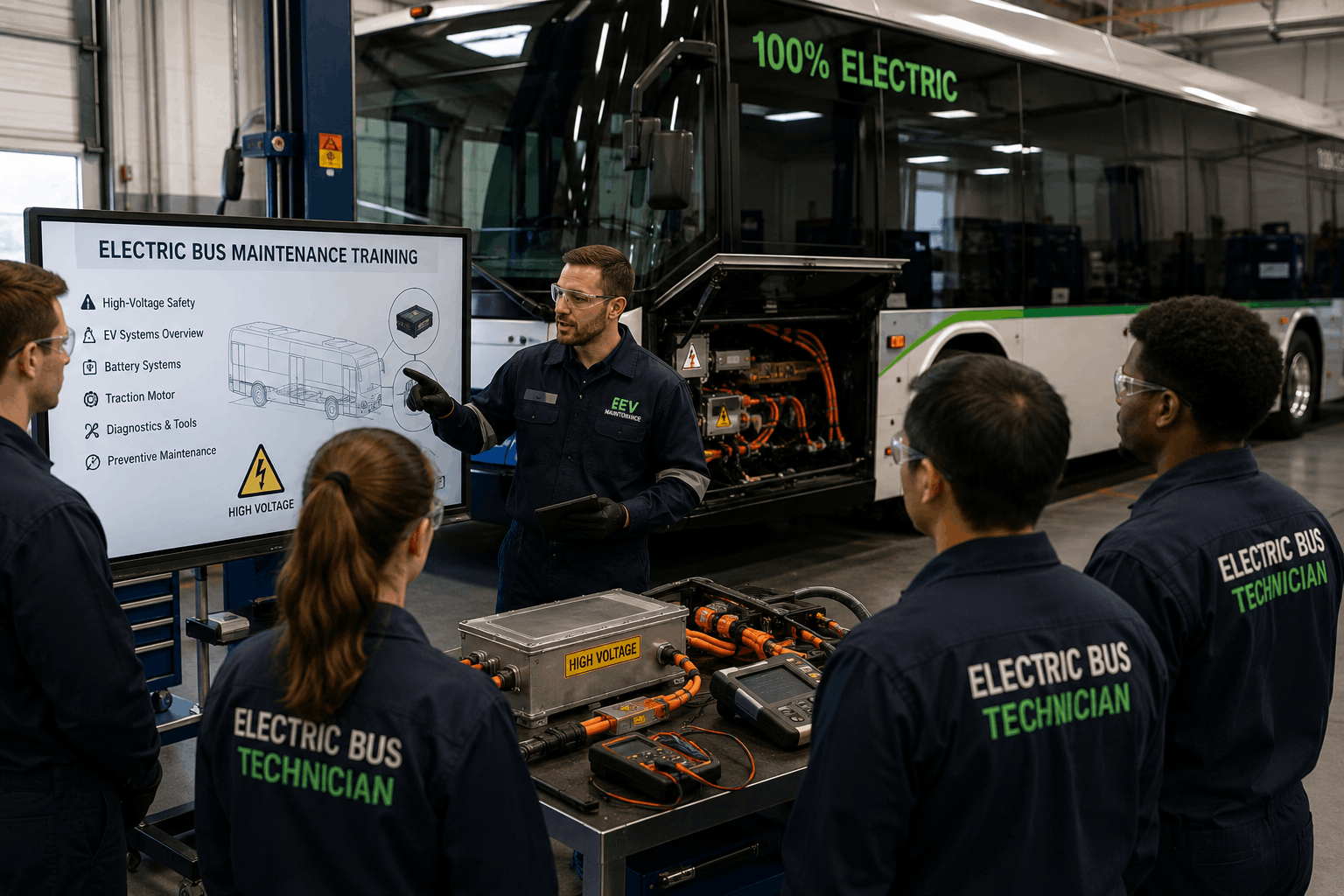
The transition from diesel buses to electric buses is fundamentally changing fleet maintenance. A diesel bus mechanic troubleshoots fuel systems, injectors, and diesel engines. An electric bus mechanic diagnoses high-voltage electrical systems, battery management systems, and electric drivetrains. These are entirely different skill sets. A technician trained on diesel engines will struggle with electric powertrains. A technician with electrical knowledge might be out of their depth with battery safety or high-voltage diagnostics. For bus fleet managers planning electrification, technician training is as important as vehicle procurement. Without qualified technicians, electric buses cannot be maintained reliably. Electric bus breakdowns strand vehicles and disrupt service. Unqualified work on high-voltage systems creates safety hazards including electrocution, fires, and battery failures. The industry is experiencing critical shortage of electric bus technicians because the training pathways are new and not yet widely available. Fleet managers who invest in technician training now gain competitive advantage—they can maintain electric buses reliably while competitors struggle to find qualified technicians. Here's a comprehensive roadmap for upskilling your fleet maintenance team for electric bus operations in 2026 and beyond.
Upskill your team for electric bus maintenance in 2026 with high-voltage safety, EV diagnostics training, and certification pathways. Strategic training roadmap for fleet electrification.
Fundamental differences between diesel and electric powertrains: A diesel bus mechanic understands internal combustion engines: fuel injection, compression ignition, exhaust systems, mechanical transmissions. These are mechanical systems with moving parts, fluid dynamics, and combustion processes. An electric bus has no engine. Power comes from batteries storing electrical energy that drives electric motors. The drivetrain is fundamentally different—no transmission, no gear shifting, different braking systems (regenerative braking). Maintenance requirements are different: no oil changes, no fuel filters, no emission systems. A mechanic trained on diesel systems lacks foundational knowledge of electric systems.
High-voltage safety hazards: Electric buses operate at 300-600+ volts. This is lethal voltage. A mechanic accustomed to 12-volt automotive systems may underestimate high-voltage hazards and create safety risks. High-voltage work requires specialized training, lockout-tagout procedures, insulated tools, and protective equipment. Improper high-voltage work can result in electrocution, fires, or catastrophic battery failures. Technicians working on electric buses must be trained to respect and safely manage high-voltage systems before they can work on them.
Battery management system complexity: Electric bus batteries are complex systems with battery management systems (BMS) that monitor temperature, voltage, current, and state of charge. The BMS prevents overcharging, manages charging speed, balances cell voltages, and protects battery health. BMS diagnostics require understanding both electrical systems and software. A traditional mechanic lacks this background.
Diagnostic equipment differences: Diesel bus diagnostics use traditional code readers that interpret engine trouble codes. Electric bus diagnostics require oscilloscopes, high-voltage multimeters, battery analyzers, and specialized software. These are unfamiliar tools for traditional mechanics. Training on these tools and how to interpret results is necessary.
Prerequisite level training: Before any technician works on electric buses, they must complete high-voltage safety training. This is non-negotiable. High-voltage safety training covers: electrical theory basics (voltage, current, resistance, power), recognizing high-voltage hazards, understanding three-phase power systems, safe work practices around high-voltage equipment, lockout-tagout procedures specific to electric vehicle systems, personal protective equipment requirements, and emergency procedures for high-voltage incidents.
Training providers and certification: High-voltage safety training is offered by various providers: industry associations (ASE—Automotive Service Excellence), manufacturer training programs (Proterra, Temsa, Van Hool, and other electric bus manufacturers), vocational schools and community colleges, and specialized EV training companies. Most training is 40-80 hours and results in certification demonstrating the technician has completed high-voltage safety training. Costs range from $1,500-$3,500 per technician. Certifications are typically valid for 3-5 years, with refresher training required periodically.
Manufacturer-specific high-voltage training: Each electric bus manufacturer has slightly different electrical architectures, battery configurations, and safety procedures. After completing general high-voltage safety training, technicians should complete manufacturer-specific training for the buses your fleet operates. A fleet operating Proterra buses should have technicians trained on Proterra systems. A fleet with multiple manufacturers should train technicians on each manufacturer's systems. Manufacturer training typically runs 40-80 hours and is provided by the manufacturer or authorized training partners.
Internal safety program development: Fleets should develop internal high-voltage safety programs documenting: approved high-voltage work procedures, required personal protective equipment, tool requirements (insulated tools for high-voltage work), incident response procedures, supervisor oversight of high-voltage work, and ongoing safety training. Documentation of your safety program demonstrates compliance with OSHA regulations and provides evidence of good safety practices if incidents occur.
Electric drivetrain fundamentals: Core training should cover electric motor operation (how motors convert electrical power to mechanical motion), motor controllers (how vehicles regulate power delivery), transmission systems in electric buses (some buses have single-speed transmissions, others multi-speed), regenerative braking systems (how vehicles recover energy during braking), and power distribution architecture (how electrical power flows from batteries to motors). Understanding drivetrain operation is fundamental to diagnosing electric bus problems.
Battery chemistry and management: Training should cover battery chemistry (most electric buses use lithium-ion batteries), battery cell construction, series-parallel configuration of battery packs, battery management systems and their functions, charging systems and protocols, state of charge measurement, thermal management (battery heating and cooling), and battery safety systems. Technicians should understand how to interpret battery diagnostics, identify failing cells, and understand battery replacement procedures.
Charging infrastructure and onboard chargers: Electric buses require charging systems. Training should cover AC charging systems (wall chargers at depots), DC fast charging (pantograph or plug chargers for rapid charging), onboard chargers that convert AC to DC for battery charging, charging protocols and connectors, power delivery systems, and fault diagnosis in charging systems. Fleet technicians should understand charging system operation and be able to diagnose charging problems.
Hands-on technical training duration: Comprehensive electric drivetrain and battery system training typically requires 120-200 hours of instruction. This can be delivered as intensive training (3-4 weeks full-time) or as part-time training over several months. Training should include classroom instruction, hands-on lab work with actual electric bus components (if possible), simulation training using cutaway vehicles, and supervised real-world diagnostic practice on your fleet's buses.
Diagnostic equipment training: Technicians must be trained on specialized diagnostic tools: digital multimeters capable of measuring high voltages, clamp meters for current measurement, oscilloscopes for analyzing electrical signals, battery diagnostic equipment for measuring internal resistance and state of health, thermal imaging for identifying overheating components, and manufacturer-specific diagnostic software. Hands-on training with these tools ensures technicians can use them correctly and interpret results accurately.
Troubleshooting methodology for electric systems: Troubleshooting electric buses requires different methodology than diesel vehicles. Training should cover: reading and interpreting fault codes from battery management systems and motor controllers, using diagnostic flowcharts for electric system problems, understanding voltage drop testing and power measurements, identifying electrical faults (shorts, opens, high resistance), and systematic problem isolation. Technicians should practice troubleshooting on simulated problems and gradually progress to real diagnostic cases.
Common electric bus failure modes: Training should cover the most frequent electric bus failures and their diagnosis: battery cell failure or imbalance, motor controller faults, high-voltage contactor failures (relays that connect/disconnect high-voltage circuits), charging system faults, thermal management system failures, and software/firmware issues. Understanding common failure patterns helps technicians identify problems quickly rather than extensive diagnostic time.
Real-time data and telemetry interpretation: Modern electric buses transmit operational data: battery state of charge, motor temperatures, power draw, charging history, fault codes. Training should cover how to access and interpret this data, using it to identify emerging problems before failures occur, and how fleet management systems can present this data to technicians for predictive maintenance.
High-voltage safety training: 40-80 hours external training, certification completion
Electrical fundamentals: 20-30 hours covering basic electrical theory, circuit analysis, three-phase power
Estimated cost: $2,000-$4,000 per technician
Battery systems and BMS: 40-60 hours hands-on training on battery operation, diagnostics, and management
Electric drivetrain: 40-60 hours on motors, controllers, regenerative braking, transmission systems
Manufacturer-specific training: 40-80 hours covering your fleet's bus models and systems
Estimated cost: $3,000-$6,000 per technician
Diagnostic equipment and tools: 20-30 hours training on oscilloscopes, multimeters, diagnostic software
Advanced troubleshooting: 30-50 hours practicing problem diagnosis on vehicles and simulators
Certification exams: Optional manufacturer or ASE certification exams to validate skills
Estimated cost: $1,500-$3,000 per technician
ASE certification for electric vehicles: The Automotive Service Excellence (ASE) organization offers certification tests for electric vehicle technicians. ASE certification validates technician knowledge and is recognized across the industry. Preparing for and obtaining ASE certification demonstrates professional competency and provides portable credentials if technicians change employers. ASE certification typically requires passing written exams covering specific topics (high-voltage systems, EV powertrains, battery systems, etc.).
Manufacturer certifications: Electric bus manufacturers often offer certification programs validating technicians have completed their training and demonstrated competency. Proterra, Temsa, New Flyer Industries, and other manufacturers provide technician certification. These certifications are valuable for your fleet because they demonstrate your technicians are trained on your specific bus models.
Ongoing training requirements: Electric bus technology is evolving rapidly. Technicians should participate in continuing education as new battery technologies, motor designs, and diagnostic tools emerge. Allocate budget for annual refresher training and advanced training covering new technologies. Staying current with technology ensures your technicians maintain expertise.
Knowledge transfer within your fleet: After technicians complete training, they should document what they learned and share with other mechanics. Internal training sessions where newly trained technicians teach colleagues accelerate the team's capability development. Creating internal technical documentation and procedures ensures knowledge is retained even if individual technicians leave.
Staffing for electric bus maintenance: A fleet transitioning to electric buses needs a mix of diesel mechanics and electric-trained technicians during the transition. As the fleet converts, the ratio shifts toward electric-trained staff. Some mechanics may be capable of cross-training from diesel to electric systems; others may retire or transition to other roles. Plan staffing carefully to ensure adequate coverage of both diesel (for remaining diesel buses) and electric systems (for new electric buses) during the transition.
Facility and equipment investments: Electric bus maintenance requires different tools and facilities. High-voltage work requires insulated tools, voltage testers, and specialized equipment. Charging infrastructure at your facility allows diagnosis of charging issues. Battery diagnostic equipment adds to facility capability. Budget for equipment investments to support electric bus maintenance. These investments are ongoing—as technology evolves, new diagnostic tools become available.
Safety culture and procedures: Establish safety procedures specific to electric bus maintenance. High-voltage work requires different precautions than diesel maintenance. Technicians must follow lockout-tagout procedures, use appropriate PPE, and follow manufacturer procedures. Safety training should be ongoing, and safety should be monitored and enforced. A single safety incident involving high-voltage systems can result in serious injury or fatality—safety culture is non-negotiable.
Predictive maintenance for electric buses: Electric buses generate more diagnostic data than diesel buses. Battery management systems, motor controllers, and thermal systems continuously monitor components. This data enables predictive maintenance: identifying components that are degrading and need replacement before they fail. A CMMS integrated with telemetry data from buses can alert technicians to maintenance needs proactively rather than waiting for failures.