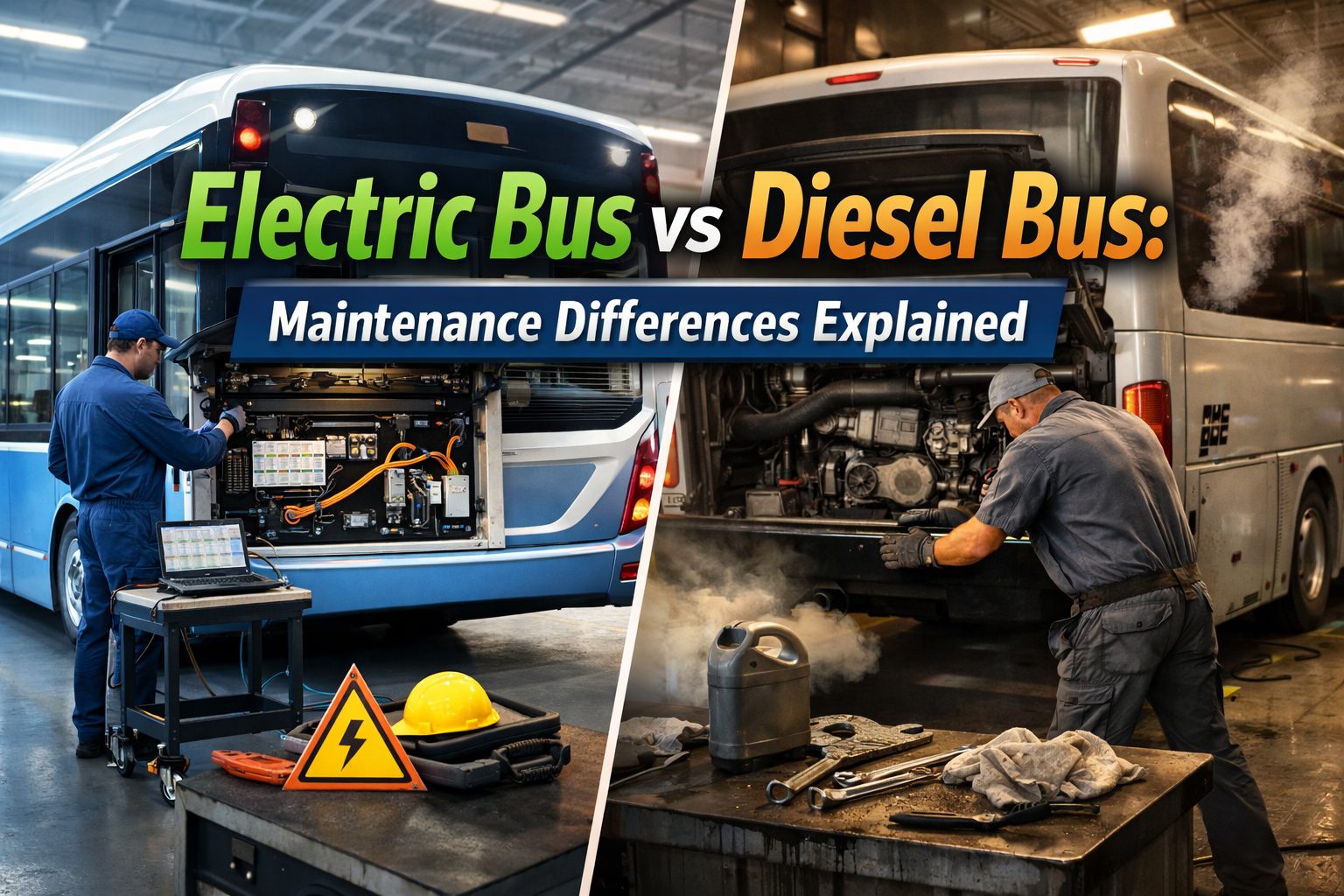
As electric buses move from pilot programs to mainstream adoption, fleet managers face a fundamental question: how does maintaining an electric bus differ from the diesel buses they've managed for decades? The short answer—electric buses require significantly less maintenance. The longer answer involves understanding exactly what changes, what stays the same, and what new skills and equipment your maintenance program needs.
The maintenance differences between electric and diesel buses go far beyond simply swapping oil changes for battery checks. Electric buses eliminate entire categories of maintenanceengine overhauls, transmission repairs, exhaust aftertreatment—while introducing new requirements around high-voltage systems, thermal management, and charging infrastructure. Understanding these differences is essential for any fleet evaluating electrification.
This guide breaks down the maintenance reality for both technologies: what each requires, how costs compare, and what the transition means for your fleet maintenance program.
Why Electric Buses Require Less Maintenance
The fundamental difference comes down to mechanical complexity. A diesel powertrain contains thousands of moving parts that wear, require lubrication, and eventually fail. An electric powertrain has roughly 20 moving parts. This simplicity translates directly into reduced maintenance requirements.
Electric Bus Powertrain
Electric motor, battery pack, power electronics, single-speed transmission (or direct drive). Minimal moving parts, sealed components, no combustion byproducts.
Diesel Bus Powertrain
Internal combustion engine with pistons, crankshaft, camshaft, valves, turbocharger, multi-speed transmission, exhaust aftertreatment (DOC, DPF, SCR). Thousands of moving parts, fluids, filters, and wear components.
According to the National Renewable Energy Laboratory (NREL), electric buses achieve fuel economy five times higher than diesel buses on equivalent routes. This efficiency extends to maintenance: the U.S. Department of Energy notes that electric vehicles require less maintenance because the battery, motor, and associated electronics require little or no regular maintenance, there are fewer fluids requiring service, and brake wear is significantly reduced due to regenerative braking.
Complete Maintenance Comparison: Electric vs. Diesel
Let's examine each major maintenance category and how requirements differ between the two technologies.
Engine/Motor Maintenance
Diesel Engine
Oil changes every 10,000-15,000 miles
Oil filter replacement
Fuel filter replacement
Air filter service
Coolant system maintenance
Fuel injector inspection/replacement
Turbocharger service
Valve adjustments
Engine overhaul at 150,000-200,000 miles
Electric Motor
No oil changes required
No fuel filters
No air filters for combustion
Coolant system for motor/battery
Periodic inspection only
No overhauls—motors last 15-20 years
Electric motors have an estimated lifespan of 15-20 years under normal conditions with minimal maintenance.
Transmission
Diesel Transmission
Automatic transmission with multiple gears
Transmission fluid changes
Filter replacement
Clutch wear (if manual)
Potential rebuild/replacement
Electric Gearbox
Single-speed or direct drive
Gearbox fluid change at 80,000-120,000 miles
No clutch
Minimal wear components
Without a transmission, there is no hill hold feature—drivers transition from brake to accelerator within 3-5 seconds to avoid rollback.
Exhaust & Emissions Systems
Diesel Aftertreatment
Diesel Oxidation Catalyst (DOC) maintenance
Diesel Particulate Filter (DPF) cleaning every 350,000-400,000 miles
DPF replacement ($2,000-$8,000) at end of life
Selective Catalytic Reduction (SCR) service
Diesel Exhaust Fluid (DEF) refilling
NOx sensor monitoring
EGR valve cleaning
Regeneration management
Aftertreatment repairs account for approximately 13% of total Class 8 truck maintenance costs. A single SCR failure can cost $10,000+.
Electric Emissions
No exhaust system
No aftertreatment
No DEF
No emissions sensors
Zero tailpipe emissions
Electric buses completely eliminate the most complex and failure-prone maintenance category in modern diesel vehicles.
Braking System
Diesel Friction Brakes
Brake pad replacement every 25,000-50,000 miles
Rotor/drum resurfacing or replacement
Caliper service
Air brake system maintenance (if equipped)
Brake fluid changes
Heat-related wear from friction braking
Regenerative + Friction Brakes
Regenerative braking handles most deceleration
Friction brakes used 5x less often
Brake pads can last 100,000+ miles
Less heat, less fade, longer component life
Periodic use of friction brakes to prevent rust
Regenerative braking captures kinetic energy to recharge batteries while reducing mechanical brake wear by up to 90% under ideal conditions.
Battery/Fuel System
Diesel Fuel System
Fuel tank maintenance
Fuel line inspection
Fuel pump service
Injector cleaning/replacement
Water separator service
12V starter battery replacement
High-Voltage Battery System
Battery pack thermal management
Battery Management System (BMS) monitoring
Cell balancing verification
Coolant system for battery temperature
Battery replacement at 7-10 years ($50,000-$100,000)
12V auxiliary battery (same as diesel)
Battery health depends on proper charging practices, temperature management, and avoiding deep discharge cycles. Most manufacturers offer 8-12 year warranties.
Whether you're managing diesel, electric, or a mixed fleet, tracking maintenance costs by vehicle type is essential for making data-driven decisions. See how fleet management software provides complete visibility into your operations.
Getting StartedBook a Demo
What Stays the Same: Common Maintenance Requirements
While electric buses eliminate many diesel-specific maintenance tasks, both vehicle types share common maintenance requirements that remain unchanged.
Tires
Both require tire rotation, alignment, pressure monitoring, and replacement. Note: Electric bus tires may wear 20% faster due to increased vehicle weight and torque. Average life: 20,000-40,000 miles.
Suspension
Shocks, struts, bushings, and air suspension components require regular inspection and replacement on both vehicle types.
Steering
Power steering systems, tie rods, ball joints, and steering components need periodic service regardless of propulsion type.
HVAC Systems
Heating and cooling systems require filter changes, refrigerant service, and component maintenance. Electric bus HVAC draws from the main battery, affecting range.
Body & Interior
Doors, windows, seats, flooring, lighting, and passenger amenities need regular maintenance on all buses.
12V Auxiliary Systems
Both use 12-volt batteries for auxiliary systems. If the bus batteries die after storage, both need a jump-start.
Safety Equipment
Emergency exits, fire extinguishers, first aid kits, and safety signage require identical inspection and maintenance.
Daily Inspections
Pre-trip and post-trip inspections remain mandatory. The checklist items may differ slightly, but the process is the same.
New Maintenance Requirements for Electric Buses
While electric buses eliminate many diesel maintenance tasks, they introduce new requirements that maintenance teams must learn to manage effectively.
1
High-Voltage Battery Management
The battery pack is the most critical component in an electric bus, typically representing 30-40% of the vehicle's cost. Proper maintenance includes:
Monitor state of charge and state of health through the Battery Management System (BMS)
Maintain proper thermal management—store batteries between 40-86°F when possible
Avoid deep discharge cycles that accelerate degradation
Track charging patterns and cell balancing
Plan for battery replacement at 7-10 years (current cost: $50,000-$100,000, declining rapidly)
2
Charging Infrastructure
Electric buses require charging equipment that becomes part of your maintenance responsibility:
Charger inspection and cleaning
Cable and connector maintenance
Software updates for charging systems
Electrical infrastructure monitoring
Smart charging optimization to manage grid demand
3
Thermal Management Systems
Electric buses use liquid cooling to maintain safe operating temperatures for batteries and motors:
Coolant level and condition monitoring (considered the most important fluid in EVs)
Cooling fan and pump inspection
Heat exchanger maintenance
Temperature sensor verification
4
High-Voltage Safety Procedures
Working on electric buses requires specialized safety training and equipment:
High-voltage lockout/tagout procedures
Insulated tools and personal protective equipment
Battery isolation before repairs
Fire department coordination for high-voltage incidents
Technician certification requirements
5
Software and Electronics
Electric buses rely heavily on software systems that require ongoing attention:
Vehicle control software updates
Diagnostic trouble code monitoring
Telematics and fleet management integration
Driver performance tracking for energy efficiency
Maintenance Cost Comparison: Real-World Data
Multiple studies and fleet deployments have documented the maintenance cost differences between electric and diesel buses. The savings are significant and consistent across different operating environments.
Metric
Diesel Bus
Electric Bus
Savings
Maintenance Cost per Mile
$1.00 - $1.53
$0.55 - $0.82
30-50%
Annual Maintenance (Transit)
$8,000 - $12,000
$4,000 - $7,000
$4,000-$5,000/year
Lifetime Savings (12-15 years)
Baseline
$50,000 - $125,000
Per bus
Brake Component Life
25,000 - 50,000 miles
100,000+ miles
3-4x longer
Source: Comparative analysis data from American Public Power Association, National Renewable Energy Laboratory, and transit agency pilot programs including Seattle, Chicago, and Twin Rivers (CA).
Real Fleet Results
Transit Agency Comparison
Maintenance costs: $0.55/mile (electric) vs. $1.53/mile (diesel). Fuel efficiency: 16.5 MPGe (electric) vs. 3.8 MPG (diesel).
Seattle Battery-Electric Buses
44.1% reduction in maintenance costs per mile compared to diesel counterparts.
VG Mobility (UK)
Electric bus maintenance costs fell by almost 50% vs. diesel buses across their fleet.
Training and Workforce Considerations
Transitioning to electric buses requires investment in technician training and potentially new hiring. The skills needed are different, not necessarily more difficult—but they are essential for safe and effective maintenance.
New Skills Required
High-voltage system safety certification
Battery diagnostics and management
Electric motor/inverter troubleshooting
Charging infrastructure maintenance
Vehicle-specific software and diagnostics
Skills That Transfer
Brake system maintenance (still needed)
Suspension and steering service
HVAC systems
Body and interior repairs
General electrical troubleshooting
12V auxiliary systems
Training Resources
OEM manufacturer training programs
Federal grants (5% of Low-No Bus grants)
Registered apprenticeship programs
On-site manufacturer support during warranty
Community college EV technician programs
Technicians report that electric buses are often easier to work on because components are easier to access, there are fewer components to service, and the working environment is cleaner without diesel exhaust and oil. However, the learning curve for new technology requires upfront investment in training.
Practical Tips for Each Technology
Diesel Bus Best Practices
Use Low-Ash Oil (CJ-4 or CK-4)
Reduces ash buildup in the DPF, extending cleaning intervals and preventing premature failure.
Monitor DPF Regeneration
More than one active regen per day is a red flag. Track regen frequency to catch problems early.
Track Oil Consumption
Excessive oil consumption leads to DPF ash accumulation. Keep a log of oil added between changes.
Clean EGR System Regularly
Dirty EGR valves spike soot production. Inspect and clean during every DPF service.
Use Only Certified DEF
Contaminated DEF causes SCR crystallization and system failures. Keep DEF tanks clean.
Electric Bus Best Practices
Train Drivers on Regenerative Braking
Avoiding hard braking maximizes regeneration—can add 20+ miles to range. Smooth driving extends battery life.
Store in Climate-Controlled Environment
Keep batteries between 40-86°F when possible. Extreme temperatures accelerate degradation.
Use Friction Brakes Periodically
Underused friction brakes can develop rust. Periodic use keeps them responsive and prevents noise.
Monitor Battery Health Data
Track state of charge, cell balancing, and temperature trends to catch degradation early.
Check Wheel Alignment Frequently
Misalignment causes brake drag, which draws battery power and reduces range. Keep tires properly aligned.
Managing maintenance across diesel, electric, or mixed fleets requires visibility into all your data. Discover how modern CMMS technology tracks costs by vehicle type to support your electrification decisions.
Getting StartedBook a Demo
The Bottom Line: Different, Not More Difficult
Electric buses require 30-50% less maintenance than diesel buses, primarily by eliminating engine overhauls, transmission repairs, and exhaust aftertreatment—the most complex and failure-prone systems on modern diesel vehicles. Brake wear drops dramatically thanks to regenerative braking, and the electric motor itself requires minimal attention over its 15-20 year lifespan.
What electric buses add is different, not harder: battery management, high-voltage safety protocols, and charging infrastructure. These require new skills and training, but the overall maintenance burden is substantially lower. Fleets consistently report maintenance cost savings of 30-50%, translating to $50,000-$125,000 per bus over a 12-15 year service life.
For fleets evaluating electrification, the maintenance picture is clear: lower costs, simpler systems, and different—but manageable—new requirements. The key is investing in technician training and tracking maintenance data to optimize both technologies during the transition.
Frequently Asked Questions
Q: How much less maintenance do electric buses require compared to diesel?
A: Electric buses require 30-50% less maintenance than diesel buses. This translates to maintenance costs of $0.55-$0.82 per mile (electric) vs. $1.00-$1.53 per mile (diesel). Over a 12-15 year service life, electric buses save $50,000-$125,000 in maintenance costs per vehicle. The savings come from eliminating oil changes, transmission repairs, exhaust aftertreatment, and reduced brake wear due to regenerative braking.
Q: What maintenance does an electric bus still need?
A: Electric buses still require maintenance for tires (may wear 20% faster), suspension, steering, HVAC, body/interior, 12V auxiliary systems, and safety equipment. New requirements include battery thermal management, charging infrastructure service, high-voltage system inspections, and coolant system maintenance. Brake service is still needed but at much longer intervals due to regenerative braking.
Q: How long do electric bus batteries last, and what does replacement cost?
A: Electric bus batteries typically last 7-10 years, with most manufacturers offering 8-12 year warranties. Battery replacement currently costs $50,000-$100,000, but prices have dropped 72% since 2015 and continue declining. Proper thermal management, avoiding deep discharge cycles, and optimized charging practices can extend battery life. Some data suggests EV powertrains could last up to 500,000 miles.
Q: Do technicians need special training for electric bus maintenance?
A: Yes, technicians need training in high-voltage safety, battery diagnostics, electric motor/inverter systems, and charging infrastructure. However, many skills transfer—brake, suspension, steering, HVAC, and body repair remain similar. The 2021 Infrastructure Investment and Jobs Act requires 5% of Low-No Bus grants be used for workforce development. Most manufacturers provide extensive training during the warranty period.
Q: Why do electric buses have longer brake life?
A: Electric buses use regenerative braking, which converts kinetic energy back to electricity to recharge the battery. This system handles most deceleration, reducing friction brake use by up to 90% under ideal conditions. As a result, brake pads that last 25,000-50,000 miles on diesel buses can last 100,000+ miles on electric buses. Regenerative braking also reduces heat, brake fade, and particulate emissions from brake dust.