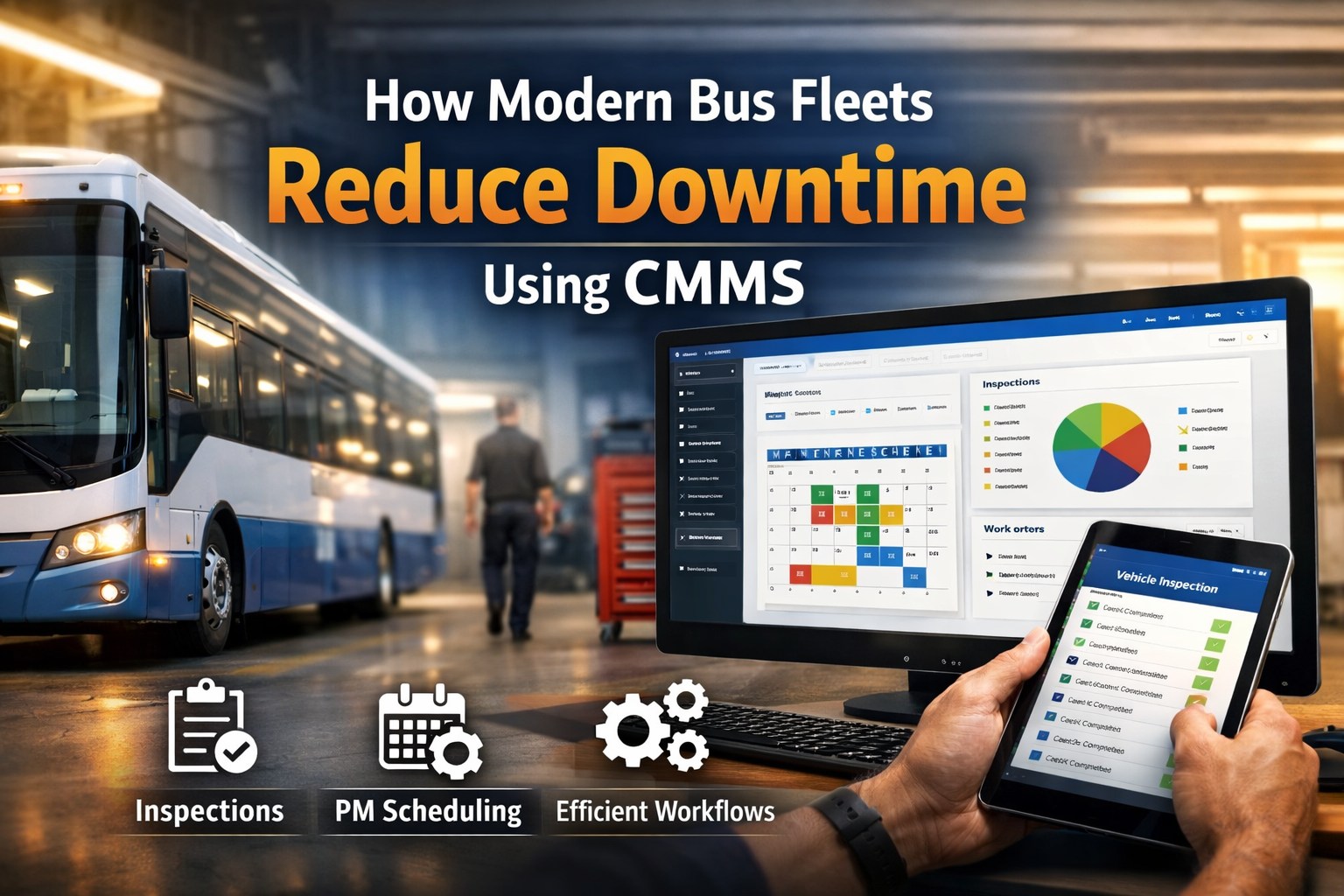
Every fleet manager knows the feeling: a bus breaks down mid-route, stranding passengers and derailing the day's operations. What many don't realize is that this single incident represents just the visible tip of a much larger problem. According to the American Transportation Research Institute (ATRI), costs associated with downtime for commercial heavy-duty vehicles in the United States total more than $74 billion annually.
But here's what separates struggling fleets from thriving ones: the proactive adoption of Computerized Maintenance Management Systems (CMMS). According to UpKeep's 2024 State of Maintenance Report, 65% of companies now use a CMMS to manage maintenance activities and optimize costs. These fleets aren't just keeping up—they're gaining competitive advantages that reactive operations simply cannot match.
The data tells a compelling story. Fleets implementing comprehensive CMMS solutions typically report 25-30% reductions in maintenance costs, 40-50% decreases in emergency repairs, and 20-35% improvements in vehicle availability within the first year. One school district in Texas saved $127,000 in their first year after implementing a structured preventive maintenance program supported by CMMS technology.
The True Cost of Bus Fleet Downtime
Before exploring how CMMS reduces downtime, it's essential to understand what downtime actually costs your operation. The visible repair bill is just the beginning—the hidden costs often multiply the true impact by 3-4 times.
The Downtime Cost Equation
Direct Repair Costs
Emergency labor rates (often 1.5-2x standard), expedited parts shipping ($50-$200+ per order), towing and roadside assistance ($350-$700 per call), rental or substitute vehicle costs (up to $3,000/month). These visible expenses typically represent only 30-40% of total breakdown costs.
Operational Disruption
Lost revenue averages $448 per hour of downtime. Route disruptions cascade through the system, affecting multiple runs. Substitute transportation arrangements consume management time. Daily downtime costs range from $488 to $760 per vehicle, averaging $624.
Administrative Overhead
Staff time diverted from planned work to crisis management. Dispatchers scramble to reassign routes. Mechanics interrupt scheduled repairs to handle emergencies. Supervisors field complaint calls instead of improving operations.
Reputation and Trust
When buses consistently break down, stakeholders notice. Employees lose faith in shuttle services. Parents pull children from bus routes. Transit riders switch to alternatives. Once earned, a reputation for unreliability takes years to rebuild.
A single unplanned breakdown averages $8,500 when you factor in towing, emergency repairs, route disruptions, substitute transportation, and lost service hours. For a 50-bus fleet experiencing just 10 unplanned breakdowns annually, that's $85,000 in avoidable costs—money that could fund technology investments, driver training, or fleet expansion.
How CMMS Eliminates Downtime: The Core Capabilities
Modern CMMS platforms address downtime at multiple levels—preventing problems before they occur, catching issues before they escalate, and accelerating resolution when repairs are needed. Here's how each capability contributes to improved uptime:
1
Preventive Maintenance Scheduling
The foundation of any downtime reduction strategy is shifting from reactive to preventive maintenance. CMMS automates scheduling based on time, mileage, or engine hours—ensuring no service falls through the cracks.
Automated Service Reminders
System triggers alerts before maintenance comes due, with configurable "due soon" thresholds that give you time to plan.
Usage-Based Triggers
Service reminders triggered by actual odometer or hour meter data ensure maintenance reflects how vehicles are actually being used.
OEM Integration
Bulk edit service programs across all related assets, ensuring consistent standards aligned with manufacturer guidelines.
Compliance Tracking
Never miss DOT inspections, emissions testing, or regulatory requirements that could sideline vehicles.
Downtime Impact
80% of industrial facilities use preventative maintenance. Preventive maintenance saves 12-18% compared to reactive maintenance. Fleets with strong PM programs experience 40% fewer breakdowns.
2
Digital Vehicle Inspections
Routine inspections catch problems before they become breakdowns. Digital inspection tools eliminate paper-based delays and ensure consistent, thorough checks across your entire fleet.
Mobile Inspection Apps
Drivers complete pre-trip and post-trip inspections on mobile devices, with photo documentation for defects.
Customizable Checklists
Create step-by-step inspection forms tailored to each vehicle type, ensuring nothing gets missed.
Instant Issue Escalation
Flagged defects automatically generate work orders, routing issues to technicians immediately.
Compliance Documentation
Digital records satisfy DVIR requirements while eliminating "pencil whipping" that hides real problems.
Downtime Impact
82% of companies have experienced at least one unplanned downtime incident in the last two years. Digital inspections catch issues before they escalate, turning potential breakdowns into scheduled repairs.
3
Work Order Management
When issues arise, speed matters. CMMS streamlines the entire repair workflow—from initial report through completion—reducing the time vehicles spend in the shop.
Instant Work Order Creation
Generate work orders from inspection failures, driver reports, or diagnostic alerts with a single click.
Automatic Assignment
Route work orders to the best-fit technician based on skills, availability, and current workload.
Priority Tracking
Visual calendars show what's scheduled, what's coming due, and which repairs need immediate attention.
Labor Tracking
Record actual repair times to identify inefficiencies and ensure accurate cost allocation.
Downtime Impact
Teams evolving their maintenance strategy increase work order completion rate by 53%. Digital work orders eliminate the delays and errors of paper-based systems.
4
Parts Inventory Integration
Nothing extends downtime like waiting for parts. CMMS integrates inventory management with maintenance workflows, ensuring parts are available when technicians need them.
Real-Time Inventory Tracking
Know exactly what's in stock, where it's located, and when reorder points are approaching.
Work Order Integration
Parts automatically deduct from inventory when used on repairs. System alerts if required parts aren't available.
PM Parts Staging
System orders parts needed for upcoming preventive maintenance before technicians arrive.
Vendor Management
Track supplier performance, compare pricing, and maintain backup sources for critical components.
Downtime Impact
59% of teams reduced costs by improving parts inventory management. Proper tracking reduces carrying costs by up to 50% while eliminating parts-related delays.
5
Asset History and Analytics
Understanding patterns is essential for preventing future problems. CMMS maintains complete vehicle histories and provides analytics that reveal optimization opportunities.
Complete Service History
Every inspection, repair, and maintenance task is recorded and accessible—no more hunting through paper files.
Problem Vehicle Identification
Surface the "problem children" in your fleet that consume disproportionate maintenance resources.
Maintenance Trend Analysis
Categorize maintenance data to see planned vs. unplanned repairs, identifying where breakdowns originate.
Replacement Decisions
Know exactly when an asset has outlived its value, supporting data-driven fleet replacement planning.
Downtime Impact
Aging equipment is the primary source of unplanned downtime, accounting for 44% of all such events. Analytics help identify and address aging asset issues before they cause failures.
Ready to reduce unplanned downtime and improve fleet reliability? See how modern CMMS technology transforms maintenance from reactive firefighting to proactive prevention.
Getting Started Book a DemoThe Shift from Reactive to Proactive Maintenance
The fundamental value of CMMS lies in enabling a shift from reactive to proactive maintenance strategies. This isn't just about fixing things before they break—it's about transforming how your entire operation approaches vehicle care.
Reactive Maintenance
Wait for breakdowns to occur
Emergency repairs at premium rates
Expedited parts shipping costs
Unpredictable maintenance budgets
Frequent route disruptions
Technicians constantly in crisis mode
Paper-based records (if any)
No visibility into fleet health
Result:
40-45% higher maintenance costs
Proactive Maintenance with CMMS
Prevent failures before they happen
Scheduled repairs at standard rates
Parts staged ahead of need
Predictable, controllable budgets
Consistent route reliability
Planned, efficient shop workflows
Complete digital records
Real-time fleet health visibility
Result:
25-30% lower maintenance costs
The U.S. Department of Energy found that preventive maintenance programs save 12-18% compared to reactive maintenance, with each dollar invested saving an average of $5 later. For bus fleets, this translates directly into reduced emergency calls, fewer stranded passengers, and more reliable service.
Measuring CMMS Impact: Key Performance Indicators
Successful CMMS implementation requires tracking specific metrics that reveal both maintenance efficiency and uptime improvement. These KPIs help you identify areas for improvement and demonstrate the value of your technology investments.
Vehicle Uptime Percentage
(Available Hours ÷ Total Hours) × 100
Target: 95%+
The primary measure of maintenance success. World-class fleets maintain 95%+ availability. Below 90% indicates significant reliability problems requiring immediate attention.
Mean Time Between Failures (MTBF)
Total Operational Time ÷ Number of Failures
Target: 3-5x improvement
Measures reliability improvement over time. Coca-Cola Consolidated increased MTBF from 4.5 days to 28 days—a 522% improvement—after implementing predictive maintenance.
Planned vs. Unplanned Ratio
(Planned Work Orders ÷ Total) × 100
Target: 80/20 planned-to-reactive
Indicates how effectively you're preventing problems. Fleets below 60% planned maintenance operate in constant firefighting mode.
Work Order Completion Rate
(Completed on Time ÷ Total Scheduled) × 100
Target: 90%+
Measures PM program execution. Teams evolving their maintenance strategy see 53% improvement in work order completion rates.
Emergency Repair Frequency
Emergency Repairs ÷ Total Repairs × 100
Target: Below 10%
CMMS implementations typically achieve 20-35% reduction in emergency repairs within the first year, with some fleets seeing 40-50% decreases.
Maintenance Cost per Vehicle
Total Maintenance Costs ÷ Fleet Size
Target: 15-25% reduction
Well-managed bus fleets achieve $3,500-$4,500 per vehicle annually. Poorly-managed fleets often exceed $8,000. CMMS helps identify where costs originate.
Real-World CMMS Results
The documented benefits of CMMS implementation extend across multiple operational dimensions. Here's what fleets consistently report after deploying comprehensive maintenance management systems:
32%
Reduction in unplanned downtime
MaintainX 2024 State of Industrial Maintenance Report
35%
Reduction in vehicle downtime
Fleet CMMS implementation benchmarks
30%
Reduction in maintenance costs
Modern fleet software with IoT integration
250 hrs
Annual efficiency gain per team
Teams that evolve maintenance strategy
53%
Improvement in work order completion
MaintainX implementation data
$127K
First-year savings (Texas school district)
CMMS-supported PM program
One major fleet customer, Coca-Cola Consolidated, saw a 33% increase in uptime and extended mean time between failures from 4.5 days to 28 days after implementing predictive maintenance tools. For bus fleets operating on tight schedules with high reliability expectations, these improvements translate directly into better service and reduced costs.
Implementation: Getting Started with CMMS
Successful CMMS implementation requires strategic planning, stakeholder engagement, and a systematic approach that ensures user adoption. Here's how to maximize return on investment from day one:
Phase 1
Planning and Setup (Weeks 1-4)
Define clear objectives: If your biggest worry is unplanned downtime, your objective could be introducing a proactive maintenance strategy for your most at-risk equipment. Tie objectives to clearly-defined KPIs like PM completion rates and equipment failures.
Build your asset inventory: Create a centralized list including all vehicles and equipment requiring regular maintenance—VIN/serial numbers, make/model/year, acquisition dates, and warranty status.
Establish service programs: Define maintenance intervals based on OEM recommendations, historical performance, and operational demands. Set up automated reminders based on actual mileage or runtime.
Phase 2
Data Migration and Integration (Weeks 5-8)
Transfer existing data: Work with your vendor to import historical maintenance records, parts inventory, and vendor information. Quality data migration is essential for accurate reporting from day one.
Connect systems: A CMMS becomes more powerful when connected to ERP software, fuel management systems, telematics platforms, and accounting tools. Integration eliminates duplicate data entry and provides unified visibility.
Configure workflows: Build approval chains, notification rules, and escalation procedures that match your operational requirements.
Phase 3
Training and Adoption (Weeks 9-12)
Train your team: A robust training plan and user adoption strategy is your best bet. Everyone should be aligned on maintenance goals and procedures. Provide training for drivers, technicians, fleet managers, and planners.
Start with pilot vehicles: Test AI and CMMS effectiveness on a subset of vehicles before expanding fleet-wide. This minimizes risk and builds confidence.
Establish accountability: Set milestones like "completing 100% of work orders through the CMMS." Track compliance and address adoption barriers quickly.
Phase 4
Optimization and Scaling (Ongoing)
Monitor KPIs: Regularly review metrics—downtime hours, repair costs, service delays—and adjust strategy accordingly. Use data to identify inefficiencies and improvement opportunities.
Encourage feedback: Your maintenance team works with vehicles daily. Their insights on process improvements and system enhancements should drive continuous optimization.
Expand capabilities: As your team gains proficiency, explore advanced features like predictive maintenance, IoT integration, and AI-powered analytics.
Implementation Timeline
Implementation timelines range from 2-4 months for basic deployments to 6-12 months for complex enterprise installations. Factors affecting duration include data migration complexity, integration requirements, customization needs, and training scope. Most fleets see measurable improvements within 30-60 days of launch.
Stop letting downtime drain your budget and disrupt your operations. Discover how modern CMMS technology can transform your fleet from reactive to proactive—saving thousands while improving reliability.
Getting Started Book a DemoThe Downtime-Free Fleet: Within Reach
The competitive gap between proactive and reactive fleets is widening. Organizations that embrace CMMS-driven maintenance strategies are gaining edges that compound over time—every prevented breakdown, every avoided emergency repair, every hour of improved uptime contributes to operational excellence that competitors cannot match.
The technology is proven. The ROI is documented. The implementation path is clear. With 65% of companies now using CMMS to manage maintenance, the question isn't whether to adopt these tools—it's how quickly you can implement them before downtime costs continue to drain your budget.
Modern bus fleets don't just manage maintenance—they prevent problems, optimize resources, and deliver the reliability their stakeholders expect. CMMS makes this possible by transforming maintenance from a cost center into a strategic advantage.
Frequently Asked Questions
Q: How much can CMMS reduce bus fleet downtime?
A: Documented results show CMMS implementations achieve 32-35% reduction in unplanned downtime, 40-50% decrease in emergency repairs, and 15-25% improvement in vehicle availability. One fleet extended mean time between failures from 4.5 days to 28 days—a 522% improvement. Results depend on current maintenance practices, but most fleets see measurable improvements within 30-60 days.
Q: What is the true cost of an unplanned bus breakdown?
A: A single unplanned breakdown averages $8,500 when factoring in towing ($350-$700), emergency repairs, route disruptions, substitute transportation, and lost service hours. Daily downtime costs range from $488 to $760 per vehicle. Hidden costs including reputation damage and administrative overhead often multiply visible repair costs by 3-4 times.
Q: Which CMMS features most directly reduce downtime?
A: The five core capabilities are: (1) Preventive maintenance scheduling with automated reminders, (2) Digital vehicle inspections that catch problems early, (3) Work order management that accelerates repairs, (4) Parts inventory integration that eliminates waiting for components, and (5) Asset analytics that identify problem vehicles and inform replacement decisions.
Q: How long does CMMS implementation take?
A: Implementation timelines range from 2-4 months for basic deployments to 6-12 months for complex enterprise installations. Factors include data migration complexity, integration requirements, customization needs, and training scope. Most fleets see measurable improvements within 30-60 days of go-live, with full ROI typically achieved within 6-12 months.
Q: What ROI can bus fleets expect from CMMS?
A: Manufacturing companies commonly report 20-35% reduction in emergency repairs, 15-25% improvement in vehicle availability, and 10-20% decrease in overall maintenance costs within the first year. One Texas school district saved $127,000 in their first year. The U.S. Department of Energy found preventive maintenance saves 12-18% compared to reactive approaches, with each dollar invested saving $5 later.