Every bus fleet operator knows maintenance isn't cheap. But here's what many don't realize: understanding exactly where your money goes is the first step toward spending less of it. Maintenance typically represents 20-60% of total bus fleet operating expenses, yet most fleet managers can't pinpoint which categories are draining their budgets or why costs keep climbing year after year.
The numbers tell a sobering story. Average maintenance and repair costs increased 4.9% in Q1 2025 compared to 2024, following an even steeper 11.3% jump the year before. For a 50-bus fleet, that's thousands of additional dollars disappearing into maintenance every single year. But here's the good news: fleets that truly understand their cost breakdown consistently find opportunities to reduce spending by 20-30% while actually improving reliability.
This guide breaks down exactly where bus maintenance dollars go, why certain categories balloon out of control, and what you can do about it. Whether you're managing school buses, transit operations, or charter fleets, understanding these cost dynamics is essential for protecting your bottom line.
The Complete Maintenance Cost Breakdown
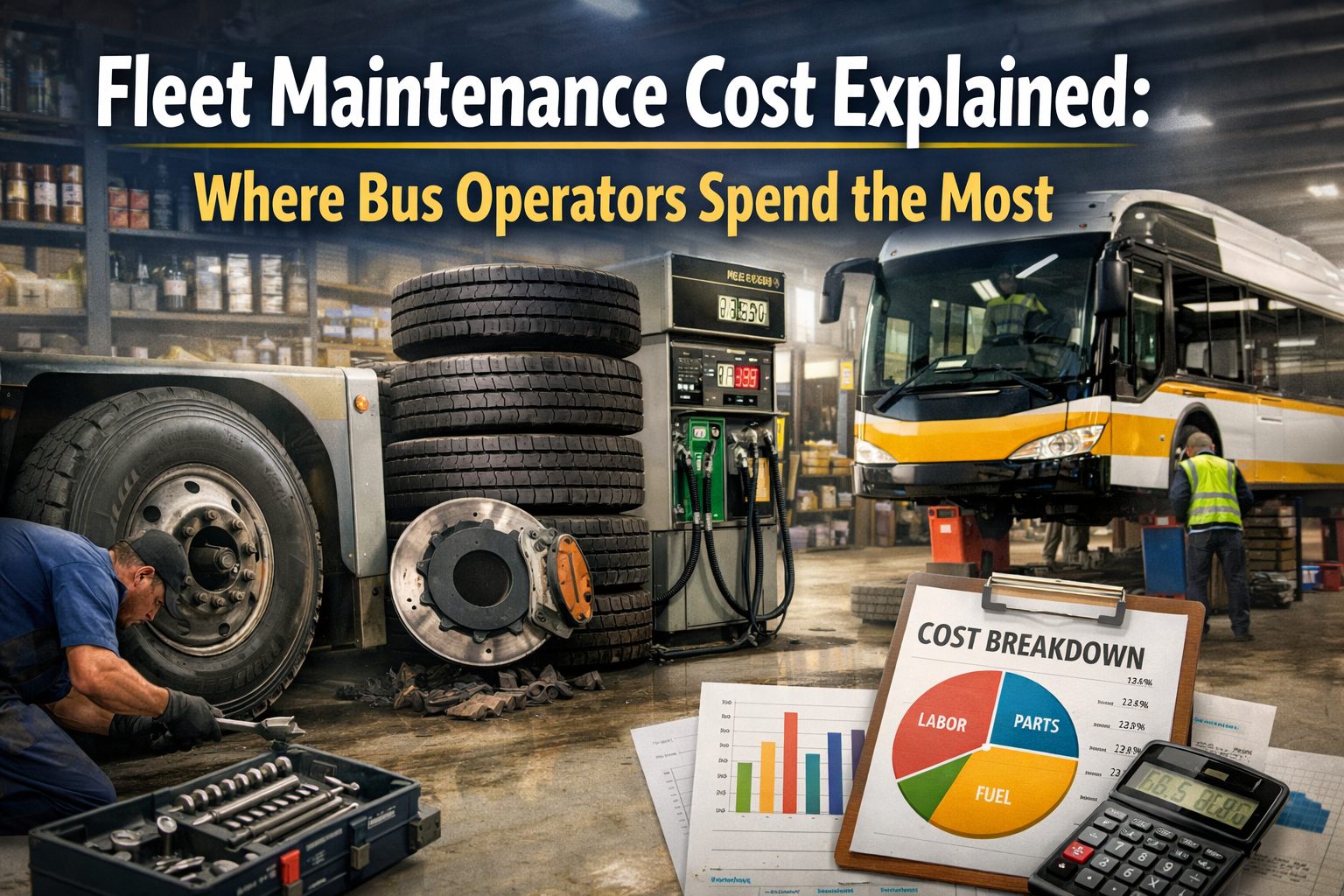
Before you can control costs, you need to see exactly where the money goes. Bus fleet maintenance budgets typically divide into six major categories, each with distinct cost drivers and optimization opportunities. Understanding these percentages helps identify which areas offer the greatest savings potential for your specific operation.
Technician wages, benefits, overtime premiums, and contractor services. This category is highly susceptible to inefficiency—when technicians spend time searching for work orders, hunting for parts, or diagnosing problems without vehicle history, billable hours expand without productive work.
Replacement parts, filters, belts, brake components, and all physical materials required for repairs. Parts costs have increased 15-25% since 2022 due to supply chain disruptions and inflation, making inventory management more critical than ever.
Work sent to external shops, specialized repairs, and services beyond in-house capabilities. This includes transmission rebuilds, engine overhauls, ADAS recalibrations, and specialized diagnostic work requiring OEM-certified technicians.
This is pure overspending—costs that wouldn't exist with proper preventive maintenance. Includes emergency labor rates (1.5-2x standard), expedited shipping, towing fees, substitute transportation, and administrative chaos from unplanned breakdowns.
Tire replacement, rotation, and repair services. The average fleet spends approximately $1,000 per vehicle annually on replacement tires alone. Tire costs have risen 8.5% over the past year, driven by transportation costs and raw material prices.
Engine oil, transmission fluid, coolant, DEF (diesel exhaust fluid), brake fluid, and other regularly replaced items. While individual costs seem small, they add up across a fleet and over time.
Want to see exactly where your maintenance dollars are going? BusCMMS tracks every part, every labor hour, and every outside service linked to specific vehicles—giving you the visibility needed to stop overspending.
Get Started Free Book a DemoThe Biggest Cost Drains: Where Fleets Overspend
Not all maintenance spending is equal. Some costs are unavoidable—buses need parts, fluids, and labor to operate. But certain cost categories consistently balloon beyond what's necessary, driven by poor visibility, reactive practices, and inefficient processes. Here's where the money leaks:
Reactive Breakdown Maintenance
This is the single largest source of maintenance overspending. When a bus breaks down unexpectedly, costs multiply across every dimension: emergency labor rates, expedited parts shipping, towing fees, substitute transportation, route disruptions, and administrative chaos.
For a 50-bus fleet experiencing just 10 unplanned breakdowns annually, that's $85,000 in avoidable costs.
Aftertreatment System Failures
Modern diesel buses rely on complex emissions systems including DPF (Diesel Particulate Filter), SCR (Selective Catalytic Reduction), and DOC (Diesel Oxidation Catalyst). These systems account for roughly 13% of total maintenance costs for diesel vehicles and are a top fleet concern heading into 2025.
SCR repairs can easily top $10,000. Factor in labor, towing, and downtime, and a single failure can cost $15,000-$20,000 or more.
Parts Inventory Mismanagement
Fleets without inventory visibility face a lose-lose situation: either overstock parts (tying up capital in components that may never be used) or understock (forcing expensive emergency orders and extended downtime while waiting for shipments).
Capital tied up in unused parts, storage space requirements, parts obsolescence when vehicles are replaced, and opportunity cost of cash not working elsewhere.
Aging Fleet Vehicles
Major components (engines, transmissions) typically begin failing between 150,000-200,000 miles. At this point, repair costs often exceed remaining vehicle value. Without cost-per-vehicle tracking, fleets continue pouring money into buses that should be replaced.
Maintenance costs typically increase 12-18% annually after the third year of service, with acceleration beyond year seven.
Labor Inefficiency
When technicians spend time searching for work orders, hunting for parts, or diagnosing problems without vehicle history, billable hours expand without additional productive work. Paper-based systems are the primary culprit.
Digital work orders, complete vehicle history, and mobile access can improve technician productivity by 20-30%.
Over-Maintenance
While under-maintenance gets most attention, over-maintenance quietly drains budgets too. Servicing vehicles on rigid time-based schedules regardless of actual usage leads to unnecessary oil changes, premature part replacements, and wasted labor hours.
A bus running 8,000 miles annually shouldn't follow the same PM schedule as one running 16,000 miles.
Why Maintenance Costs Keep Increasing
Understanding the forces driving costs higher helps fleet managers anticipate budget pressures and develop proactive strategies. Five major factors have contributed to double-digit price increases in recent years, and most show no signs of reversing soon.
Technician Shortage Crisis
North America has a critical shortage of qualified technicians that continues to impact maintenance costs profoundly. As the number of technicians declines and demand grows, maintenance vendors increase wages to hire or retain technicians, driving labor rates significantly higher.
- Competition for technicians spans dealerships, public fleets, and independent shops
- Retiring baby boomers aren't being replaced fast enough
- Technician replacement rate needs to be 4x higher than current trajectory
- Labor rates peaked in January 2023 but continue climbing
Parts Price Inflation
Parts costs have increased 15-25% since 2022 due to supply chain disruptions, inflation in raw materials, and ongoing availability challenges. While some relief has appeared, costs remain elevated compared to pre-pandemic levels.
- Supply chain disruptions continue affecting availability and pricing
- Parts delays remain a challenge with body shops taking longer to acquire components
- Emergency parts orders carry premium pricing ($50-$200+ shipping fees)
- Tariff impacts are introducing new cost uncertainties for 2025
Extended Vehicle Lifecycles
Limited new vehicle availability forced fleets to keep buses in service longer than planned. Repairs late in a vehicle's lifecycle are significantly more costly—engine replacements, transmissions, and major component failures become common after 150,000 miles.
- Number of extended service life vehicles continues to outpace new acquisitions
- Older vehicles require more frequent unscheduled maintenance
- Major component repairs often cost more than remaining vehicle value
- Fleet age is now the biggest cost driver according to industry analysts
Increasing Vehicle Complexity
Modern buses include sophisticated technology—ADAS systems, complex emissions equipment, advanced electronics—that requires specialized training, expensive diagnostic tools, and longer repair times.
- ADAS-equipped vehicles have significantly higher repair costs (windshield replacement + recalibration)
- Aftertreatment systems (DPF, SCR, DOC) require specialized maintenance
- Computer diagnostics are replacing traditional mechanical troubleshooting
- Many repairs now require OEM-certified technicians
Downtime Multiplier Effect
When a bus is out of service, the costs extend far beyond the repair itself. Fleets lose $448-$760 per day per vehicle in combined direct and indirect costs, and downtime is expected to increase 20-25% through 2026.
- Lost revenue from missed routes or service disruptions
- Substitute transportation or rental vehicle costs
- Administrative time managing the disruption
- Technician shortages are extending average repair times
The combination of these factors means operating costs have surged more than 20% since 2020. Fleet managers who understand these pressures can budget more accurately and prioritize strategies that address the root causes rather than just the symptoms.
Industry Insight
"Even with inflation cooling and interest rates dipping slightly, operating costs have surged more than 20% since 2020. Budgeting is a clear area of focus for 2025 for virtually all fleet operators."
— Ed Powell, Director of Consulting Services, HolmanCost Per Mile: The Essential Metric
Cost per mile (CPM) provides the clearest picture of maintenance efficiency because it normalizes costs against actual vehicle usage. This metric helps compare performance across different vehicles, routes, and time periods, revealing which buses are money pits and which are operating efficiently.
| Cost Category | Typical Range | Industry Average |
|---|---|---|
| Total Bus Maintenance | $0.75 - $1.41/mile | $1.00/mile |
| Repair & Maintenance (Commercial) | $0.19 - $0.22/mile | $0.198/mile (2024) |
| Tires | $0.04 - $0.05/mile | $0.047/mile |
| Fuel (Diesel) | $0.30 - $0.48/mile | $0.36/mile |
| Fuel (Electric) | $0.14 - $0.22/mile | $0.18/mile |
| Total Operating Cost | $1.67 - $2.27/mile | $2.26/mile (2024) |
Tracking cost per mile for each vehicle in your fleet reveals outliers that warrant attention. When a specific bus consistently exceeds the fleet average by 20% or more, it's time to investigate whether repairs are worth continuing or replacement makes more financial sense.
BusCMMS automatically calculates cost per mile for every vehicle, making it easy to identify which buses are draining your budget and when vehicles cross the replacement threshold.
Start Tracking Costs See How It WorksStrategies That Actually Reduce Costs
Understanding where money goes is only valuable if it leads to action. These proven strategies help bus operators reduce maintenance spending while maintaining—or even improving—fleet reliability and safety.
Shift from Reactive to Preventive
Operations achieving 80-85% planned maintenance typically spend 25-35% less than those with 50-60% reactive maintenance, while also achieving better reliability outcomes. The key is moving from calendar-only scheduling to mileage-based or combined triggers.
Implement Digital Tracking
CMMS platforms eliminate paper searches, provide instant access to complete vehicle history, show parts location and availability before starting work, and enable mobile access so technicians don't waste time walking back to the office.
Optimize Parts Inventory
Right-sized inventory based on actual usage patterns reduces carrying costs while eliminating emergency orders. Track what you use, set automated reorder points, and eliminate duplicate ordering across locations.
Track Per-Vehicle Costs
Every part, every labor hour, every outside service linked to specific vehicles enables the per-vehicle cost analysis that drives replacement decisions. Stop investing in buses that should be retired; extend life of buses with favorable economics.
Build In-House Capabilities
Fleets with in-house maintenance programs generally have lower per-mile repair costs. Less-than-truckload carriers doing 78% in-house maintenance see significant savings compared to those relying heavily on outside shops.
Leverage Predictive Technology
Telematics and predictive maintenance platforms monitor engine health, parts wear, and vehicle performance in real time. AI-driven algorithms highlight potential issues before they become costly repairs.
Building Your Maintenance Budget
Effective budgeting requires accounting for both direct and indirect maintenance costs. Direct costs (parts, labor, outside services) typically represent only 60-70% of total maintenance-related expenses. The remaining 30-40% consists of indirect costs often overlooked in planning.
Budget Allocation Guidelines
Organizations implementing systematic budget development processes achieve 85-95% budget accuracy while identifying optimization opportunities worth 15-25% of total maintenance spending. Manufacturing fleets typically spend $15,000-25,000 annually per vehicle, but actual costs can vary 40-60% based on operational factors including vehicle type, utilization patterns, and fleet age.
Budget Planning Tip
Include downtime costs (often the largest hidden expense), administrative overhead (8-12% of direct costs), facility and equipment costs, and training expenses. Track these separately to understand total cost of maintenance and identify optimization opportunities.
The Bottom Line
Fleet maintenance costs aren't mysterious—they follow predictable patterns that can be understood, tracked, and controlled. The fleets that consistently outperform on cost metrics share common characteristics: they understand their cost breakdown, track expenses at the vehicle level, prioritize preventive over reactive maintenance, and use data to drive decisions.
With maintenance costs continuing to rise and budget pressures intensifying, visibility into where money actually goes has never been more valuable. The six major cost categories—labor, parts, outside services, emergency premiums, tires, and fluids—each offer distinct optimization opportunities. The fleets that succeed in 2025 and beyond will be those that stop guessing and start measuring.
Cost control is ongoing, not one-time. Monthly cost reviews identify emerging problems and validate that changes are working. The question isn't whether you can afford to implement better cost tracking—it's whether you can afford not to.
Ready to See Where Your Money Actually Goes?
BusCMMS provides instant visibility into every maintenance dollar with automated tracking, real-time reporting, and the analytics you need to stop overspending. Most fleets see measurable savings within the first 90 days.
Start Your Free Trial Schedule a DemoFrequently Asked Questions
What is the average bus maintenance cost per year?
Average school bus maintenance costs range from $5,500-$6,000 per bus annually for fleets with over 100 vehicles, including parts and labor. Transit buses typically run higher at $0.75-$1.41 per mile, which translates to $7,500-$14,100 annually for a bus running 10,000 miles per year. Actual costs vary significantly based on fleet age, operating conditions, and maintenance practices.
What percentage of fleet costs goes to maintenance?
Maintenance typically represents 20-60% of total bus fleet operating expenses, depending on fleet age and operating conditions. Within maintenance budgets, labor accounts for 28-35%, parts and components 25-32%, tires 8-12%, fluids 6-10%, outside services 10-18%, and emergency/downtime premiums 8-15%. Reducing the emergency/downtime component through preventive maintenance provides the largest savings opportunity.
Why have maintenance costs increased so much recently?
Five factors have driven double-digit price increases: technician shortages pushing up labor rates, parts inflation (15-25% since 2022), extended vehicle lifecycles requiring more repairs, increasing vehicle complexity (ADAS, emissions systems), and supply chain disruptions. Maintenance costs increased 11.3% in 2024 versus 2023 and another 4.9% in Q1 2025. Operating costs have surged more than 20% since 2020.
How much does vehicle downtime really cost?
Fleet vehicle downtime costs an average of $448-$760 per day per vehicle when accounting for both direct costs (repairs, towing) and indirect costs (lost revenue, substitute transportation, administrative time). A single unplanned breakdown averages $8,500 when factoring in emergency labor rates, expedited parts, route disruptions, and lost service hours. For a 50-bus fleet with 10 unplanned breakdowns annually, that's $85,000 in avoidable costs.
What's the best way to reduce fleet maintenance costs?
The most effective strategies include shifting from reactive to preventive maintenance (achieving 80-85% planned maintenance reduces costs 25-35%), implementing digital tracking systems (improving technician productivity 20-30%), optimizing parts inventory (reducing parts expenses 15-25%), and tracking per-vehicle costs to make data-driven replacement decisions. Fleets with in-house maintenance programs also generally have lower per-mile repair costs.