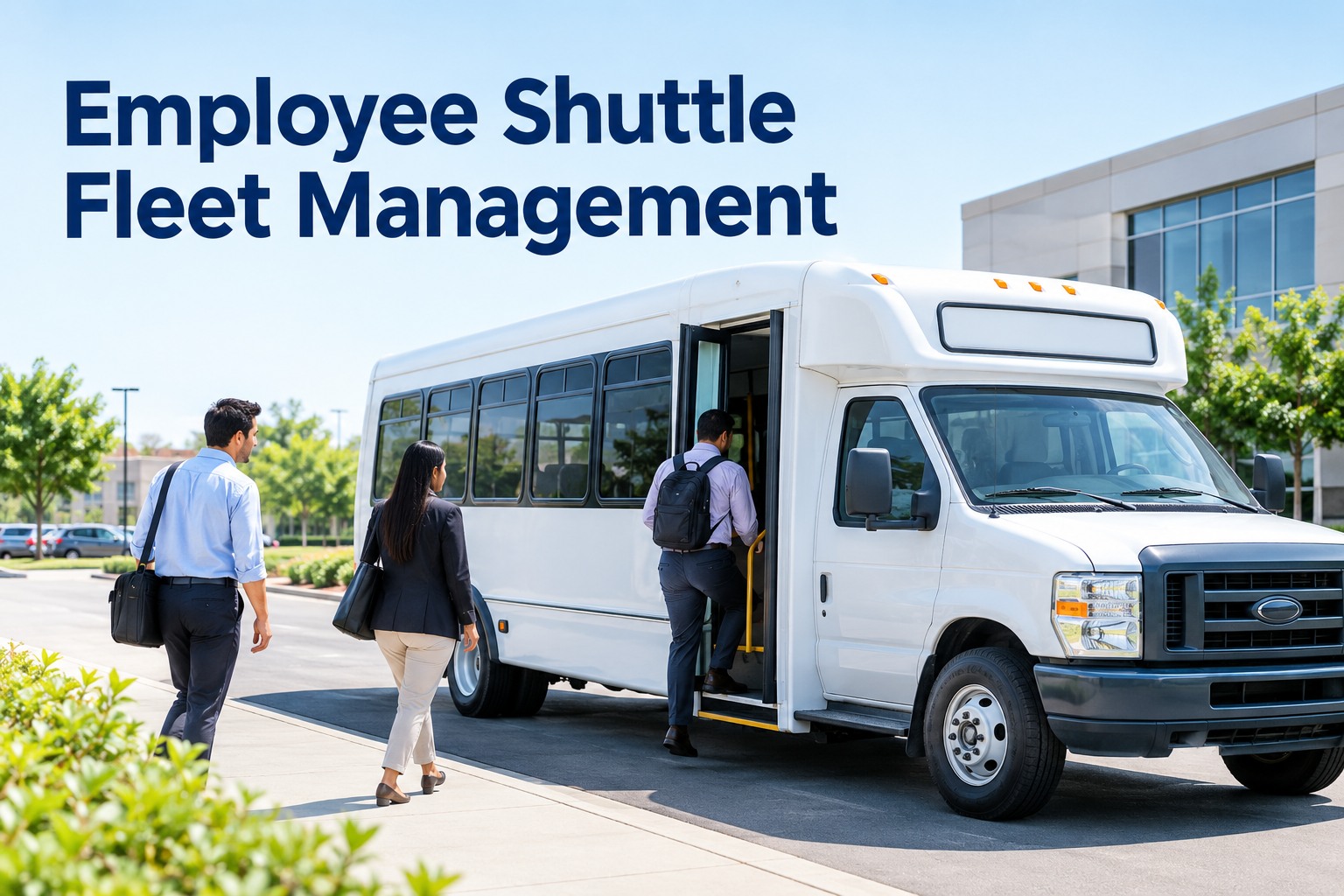
Your riders keep one number in their heads, even if they never say it out loud: did the shuttle show up on time this week. That single number decides whether a commuter program feels dependable or unreliable — and when the rider is an employee and the client is HR or a corporate contract, it decides whether the program gets renewed. Everything else in an employee shuttle fleet, the maintenance, the inspections, the driver files, exists to protect that one number. This page is a working playbook for keeping it high and being able to prove it. See how BusCMMS keeps the score for you
Updated September 2026 · Applicable vehicle, driver, safety and maintenance requirements vary by jurisdiction and operation; verify your specifics before relying on any figure.
Employee Shuttle Fleet Management
A commuter shuttle program is judged like a service contract, not a garage. Here is the operating playbook for running one you can stand behind.
There is no single trick to a reliable shuttle program. There is a short set of operating plays that, run consistently, keep the scorecard high — and a set of failure modes that quietly pull it down. Here are the plays, each one a rule you can actually hold a shift to.
Fix it in the yard, never on the route
A defect caught at 5:40am in the depot is a two-minute vehicle swap. The same defect at 6:20am on the road is a stranded shuttle, a short-staffed shift, and a complaint by 7am. Proactive maintenance and a documented daily pre-trip are not paperwork — they are the difference between a quiet morning and a business incident.
Keep a ready spare in the math
A fleet sized so every vehicle must run every route has no room for reality. One shuttle down should mean the spare rolls, not a route missed. Build enough slack that a single failure is invisible to riders, and your on-time number stops swinging every time a bus goes in for service.
Turn every flagged defect into a closed loop
A defect mentioned to a supervisor and forgotten is a failure waiting for a schedule. A defect that becomes a work order, flags the vehicle out of service, and closes with a signed repair is a problem that ends. The loop, not the mention, is what keeps the same issue from stranding a run next week.
Whoever drives, keep the records
Owned fleet or contracted operator, the outcome your employees experience is yours to answer for. Driver qualifications, inspections, and maintenance have to be visible to you, not buried in a partner's systems. If you cannot see it, you cannot vouch for it when the client asks.
Capture the proof as you go, not at review time
On-time, availability, and incident history should fall out of daily operations automatically. The programs that survive budget season are not the ones that scramble to build a report the night before — they are the ones that export it, because every run, defect, and repair already landed on one record.
Run those five and the scorecard takes care of itself. Skip any one and it shows up on the client's number within a week. Book a demo to run all five plays from one platform
Anatomy of a missed run
When the scorecard drops, it is almost never one big failure. It is a small thing that was allowed to travel. Here is the same defect on two mornings — caught, and missed — laid side by side so you can see exactly where a program wins or loses the day.
Pre-trip flags a soft brake on shuttle 3
Work order opens; vehicle marked not-ready
Spare rolls on the route instead
Shift starts full — nobody noticed
No documented pre-trip; bus rolls as-is
Brake fails on the route; shuttle stranded
A shuttle-load of riders stuck, no spare staged
Shift opens short; HR fielding complaints
Same defect. Same vehicle. The only variable was whether a documented check happened in the yard and fed straight into a decision. That is the entire game, repeated every morning across every route. Start free and put a documented pre-trip in front of every driver
Promise vs. reality: the ledger a client keeps
A corporate client is not tracking your effort; they are tracking the gap between what the program promised and what riders actually got. That gap is a ledger, and it is being kept whether or not you see it. The winning move is to keep the same ledger yourself, in the open, so there are no surprises at review time.
Every promise on the left is only as good as the record on the right. When those records live on one platform, the ledger is something you hand over confidently instead of something the client assembles against you. Book a demo to keep the promise-and-proof ledger in one place
Where is your program on the climb?
Shuttle programs tend to mature in rungs, not leaps. Most start on a spreadsheet and a group chat, which works right up until it does not. Find the rung you are on honestly — the jump that matters is the one from reacting to complaints to seeing problems first.
You learn a shuttle was late from rider complaints. Records live in spreadsheets and phones. A client question means a scramble.
Maintenance and inspections are logged, but in separate places. You can answer questions, slowly, by pulling from a few systems.
Inspections, defects, work orders, driver records, and incidents sit on one record per vehicle. A defect becomes a work order automatically.
On-time and availability report themselves. You see problems before riders do, and the client review is an export, not a project.
If you are honestly on rung 1 or 2 and adding routes, shifts, or a contracted operator, the gap between where you are and where a client expects you to be is exactly where programs lose contracts. BusCMMS is an AI-native bus fleet platform that moves a program up the climb: it connects preventive maintenance, inspections, driver records, work orders, incidents, and video evidence on one record per vehicle, so uptime is managed, reliability is visible, and the report is a click — for fleets you own and operators you contract, without pretending software alone runs the routes.
Move your shuttle program up a rung
BusCMMS keeps employee shuttle fleets available with proactive maintenance, turns every pre-trip defect into a tracked repair, and rolls on-time, availability, and incident data into client-ready reporting — across vehicles you own and operators you contract. Start a free trial or book a demo and see it on your own routes. Built for commuter, campus, and corporate shuttle programs.
No credit card · Availability and on-time tracking · Client-ready reports from day one
Frequently asked questions
What is employee shuttle fleet management?
It is the operational discipline of keeping a commuter shuttle program reliable, safe, and accountable to the people and organizations that depend on it. In practice that means preventive maintenance and inspections that keep vehicles available, driver records and qualifications, defect-to-repair workflows, incident documentation, and the on-time and availability reporting corporate clients and internal stakeholders expect. Because a shuttle failure strands employees and shows up immediately as missed shifts, the discipline centers on preventing breakdowns before a route runs and on being able to prove service reliability with data, whether the fleet is owned in-house or run by a contracted operator.
Why does uptime matter so much for a corporate shuttle?
Because a shuttle carries a full load of employees to a scheduled start time, a single breakdown cascades far beyond the vehicle: riders are stranded, shifts start short-staffed, HR and operations field complaints quickly, and repeated failures put the program's budget or contract in question. Unlike a delivery vehicle, a shuttle's failure is instantly visible to the client. That is why proactive maintenance, documented daily pre-trip checks, fast defect turnaround, and a ready spare in the fleet math matter so much — they protect availability, the metric that determines whether the program is seen as reliable. Catching a defect in the yard prevents the entire downstream cascade.
How do you oversee a contracted shuttle operator?
Through shared visibility, not just an invoice. Many employers hire a third-party operator to supply vehicles and drivers, which is a valid model, but it risks losing insight into how those vehicles are maintained and how safety is handled. Effective oversight means a shared operational record so inspections, defects, work orders, and incidents are visible to both the employer and the operator, rather than the employer finding out about problems only when employees complain. You still own the outcome your employees experience even when a partner runs the vehicles, so build reporting and record visibility into the arrangement from the start rather than requesting it after something goes wrong.
What reporting should a shuttle program provide?
The most useful metrics answer whether the service was reliable and safe: on-time performance by route, fleet availability (the share of scheduled runs served on a ready vehicle), open defects and how quickly they clear, and incidents logged with the vehicle, driver, and any evidence attached. Utilization and cost per trip are also common for justifying budget. The key point is that none of these require extra busywork if the underlying operations — inspections, maintenance, dispatch, and incident logging — are captured on one platform. When they are, the client report becomes an export rather than a reconstruction, which is what protects the program at budget or contract-review time.
How can software help a small shuttle fleet?
The biggest gains are connected records and early visibility. Instead of maintenance in one system, driver files in another, and video on a third, a platform like BusCMMS keeps inspections, work orders, driver records, incidents, and video evidence on one record per vehicle. That means a flagged defect becomes a tracked repair before the next run, a downed vehicle is known before riders complain, and on-time and availability numbers are ready when a client asks. It reduces administrative work, improves accountability across owned and contracted vehicles, and produces a defensible service history — without claiming software alone keeps the routes running.