Your school district has a 12-year-old diesel fleet, rising fuel costs, and a board that just asked whether federal grant money can offset the next bus order. The EPA Clean School Bus Program has roughly $2.3 billion of the original $5 billion still to distribute, but the rules changed dramatically in February 2026 -- the 2024 rebate round was cancelled, fuel eligibility expanded far beyond electric, and the new round is competitive rather than lottery-based. If you plan to apply for Clean School Bus Program funding this cycle, book a 20-minute demo to see how BusCMMS packages your fleet data into the precise per-bus maintenance history that winning applications document down to the VIN.
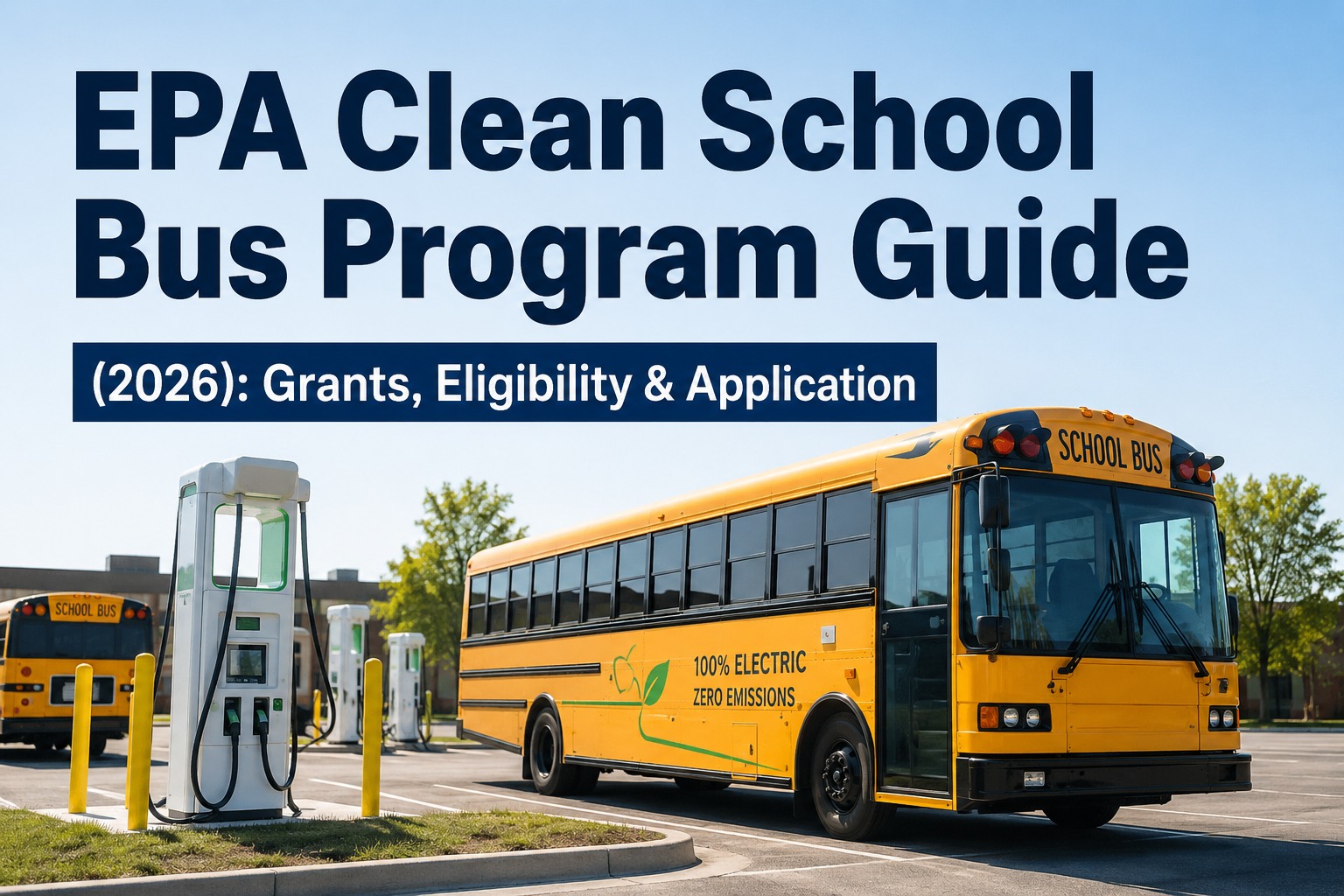
EPA Clean School Bus Program Guide (2026): Grants, Eligibility & Application
Everything a school district transportation director needs to qualify, apply, and win Clean School Bus funding in the revamped 2026 program
The 2026 Reality: EPA announced a complete overhaul of the $5B program on Feb 19, 2026. The 2024 rebate round -- with over $900 million in submitted applications -- was voided. The new round expands eligibility beyond electric to CNG, LNG, propane, hydrogen, and biofuels. Scoring is competitive, oversight is tighter, and precise fleet data is now the deciding factor between funded and rejected.
The 2026 EPA Clean School Bus Program in Six Facts
Before the fleet spreadsheets, the fuel-type debate, or the SAM.gov account -- these six facts frame what the 2026 CSB Program looks like and how the February 2026 revamp changed the game.
Total funding authorized under the 2021 Bipartisan Infrastructure Law across FY22 through FY26 for school bus replacement.
Estimated remaining after ~$2.7B was awarded across three previous rounds (2022 rebates, 2023 grants, 2023 rebates).
EPA announced on Feb 19, 2026 that no awards would be issued for the 2024 rebate program. Applicants must reapply under the new round.
Electric, propane, CNG, LNG, hydrogen, and biofuels are all eligible in the 2026 round -- a major expansion from prior rounds that favored electric.
Federal law requires at least 50% of funds go to zero-emission buses (currently only battery-electric qualifies). This cannot be changed administratively.
The Notice of Funding Opportunity for the new 2026 round is expected later this year. Districts should register on SAM.gov and Grants.gov now.
The pattern from three previous rounds is clear: districts that had SAM.gov and Grants.gov accounts active before the NOFO opened, with 60-90 days of clean fleet data ready to attach, submitted within the first two weeks. Every district that waited for the NOFO to start their prep either missed the window or filed a rushed application that scored poorly. Book a demo to see how BusCMMS builds the 60-90 days of fleet documentation the winning applications rely on.
How Much You Can Get Per Bus in the 2026 Round
Previous rounds set clear per-bus funding caps that will likely carry into the 2026 NOFO. These are the numbers to size your application against -- and to justify the fuel type you choose.
Electric
Per bus, including charging infrastructure. The largest per-bus cap. Best fit for districts with route lengths under 100 miles and charging depot capability.
Propane
Per bus. Established fueling infrastructure, cold-weather reliable, lower upfront cost. Widely used in Texas, Ohio, and Midwest districts.
CNG
Per bus. Requires district CNG fueling station or nearby access. Best fit for large urban districts with concentrated depot operations.
LNG
New category for 2026. Suited for long-route rural districts with established LNG supply chains. Actual cap set by 2026 NOFO.
Hydrogen
New category for 2026. Suited for districts near hydrogen production or refueling hubs. Counts toward zero-emission set-aside.
Biofuels
New category for 2026. Renewable diesel and B100 biodiesel eligible. Lowest infrastructure barrier -- runs in most existing diesel platforms.
The trap districts fall into is choosing the fuel type with the highest per-bus dollar amount rather than the fuel type that actually matches their routes, climate, and depot capability. A $375,000 electric bus that only completes 60% of its routes because charging cannot cycle fast enough scores lower than a $65,000 propane bus that runs 100% of scheduled routes. Match displacement to duty. Book a demo to see how BusCMMS surfaces the route and duty-cycle data that justifies your fuel-type choice in the application.
From Registration to Award -- The Full 2026 Application Path
Every prior CSB round followed this same skeleton timeline. The 2026 round will too. Start Steps 01 through 03 now so you can hit "submit" the day the NOFO opens.
- 01
SAM.gov Registration
Get a Unique Entity ID (UEI) through SAM.gov. Registration takes 3-6 weeks the first time. Renewals every 12 months. Districts without an active SAM.gov account cannot apply for federal funds -- period.
- 02
Grants.gov Account & Workspace
Create your Grants.gov organization account. Set up authorized representatives. Configure the Grants.gov Workspace where your application will live. Do this now so it exists when the NOFO opens.
- 03
Fleet Data Documentation (60-90 Days)
Build precise per-bus records: VIN, model year, mileage, annual maintenance spend, out-of-service days, route type. Winning applications have this in a CMMS. Losing applications reconstruct it from paper the week before submission.
- 04
NOFO Publication
EPA publishes the Notice of Funding Opportunity on Grants.gov. Read every page. Note the priority scoring criteria -- rural, tribal, low-income, and high-need districts typically get scoring boosts.
- 05
Application Submission
Submit through Grants.gov Workspace. Attach fleet data, fuel-type justification, infrastructure plan, and workforce development narrative. Late submissions are auto-rejected regardless of quality.
- 06
Selection & Notification
EPA review typically runs 3-6 months. Selected applicants receive a Selectee Letter with the awarded bus count and funding amount. Not-selected letters include scoring feedback for future rounds.
- 07
Purchase Order & Payment
Submit purchase order documentation. EPA disburses payment after bus delivery and existing bus replacement is documented. Actual disbursement may be lower than the cap if actual costs are lower.
- 08
Close-Out Documentation
Submit the Close Out Form documenting old bus scrappage, new bus delivery, and any charging or fueling infrastructure installation. Required for the file to close and the district to remain eligible for future rounds.
Districts new to federal grants often miss that Steps 01, 02, and 03 all happen BEFORE the NOFO is published. Waiting until the NOFO opens to start registration means missing the submission window by weeks. Book a demo to see how BusCMMS gets Step 03 (fleet data documentation) done in one afternoon rather than three months.
The Pattern From Three Rounds of Awarded Applications
EPA reviewers score applications against specific criteria. After 8,500+ buses funded across the first three rounds, the pattern separating winners from losers is not subtle.
- Precise fleet data: "Bus #47, 2009 diesel, 187K miles, $14,200 in maintenance last year, out of service 23 days" -- documented per VIN
- Fuel type matched to route: Electric for sub-100-mile depot routes with charging capability, propane for cold-weather or long-route districts
- Priority district status: Rural, tribal, low-income, or high-need designation clearly documented with supporting data
- Infrastructure plan: Charging depot or fueling station specifics, timeline, capital match
- Workforce development plan: Technician training pathway documented for new fuel type
- 60-90 days of clean records: Fleet CMMS data attached with per-bus history, not narrative estimates
- Vague fleet claims: "We have a lot of old buses" without VIN-level documentation
- Fuel type mismatch: Electric for a 130-mile route in a district without charging infrastructure or capital match
- Missed submission window: Started SAM.gov registration after the NOFO opened -- disqualified
- Missing infrastructure plan: Bus request without a plan for charging, fueling, or maintenance for the new fuel
- No workforce plan: Zero acknowledgment that current technicians need retraining for new fuel platforms
- Reconstructed data: Fleet history assembled from paper the week before submission, with gaps and inconsistencies EPA reviewers flag immediately
The gap is not opinion or luck. EPA publishes scoring criteria in every NOFO. Reviewers apply them consistently. And the districts that document precisely, match fuel to duty, and start prep months before the NOFO opens are the districts that walk away with awarded funding. Book a demo to see how BusCMMS produces the per-VIN maintenance history that winning applications attach.
How BusCMMS Turns Fleet Records Into a Winning CSB Application
The 2026 CSB Program is a data application. Fleet CMMS records are the closest thing to a submission-ready format. Here is exactly what BusCMMS gives you for the application file.
Per-VIN Maintenance History
Every bus in your fleet with model year, mileage, annual maintenance spend, and repair-day history documented to the VIN level. Submission-ready.
Out-of-Service Day Tracking
Precise counts of how many days each bus was in the shop vs on route. EPA scoring rewards documented reliability problems on old fleet.
Fuel Cost Per Bus
Annual diesel spend per VIN. Critical for justifying the ROI of a fuel-type switch and documenting the district's current cost baseline.
Route & Duty Cycle Data
Daily miles, route type, terrain, climate zone -- all logged. Enables precise fuel-type justification (why electric fits this route, why propane fits that one).
Cost-Per-Mile Reporting
Total cost of ownership per bus, per mile. The single most compelling data point for board buy-in and grant application scoring.
Bulk Data Export
Export the whole fleet's data as a formatted spreadsheet for the CSB application attachments. No paper reconstruction, no gaps.
Whether your district runs 15 Type C buses on rural routes or 200 buses across a metro system, the 2026 CSB Program will reward the district whose fleet is documented, whose fuel-type choice is defensible, and whose application submits the day the NOFO opens. That is exactly the state BusCMMS gets you into. Sign up free and load your fleet's data in under an hour.
What is the EPA Clean School Bus Program?
The EPA Clean School Bus Program is a federal grant and rebate program funded by the 2021 Bipartisan Infrastructure Law, authorizing $5 billion over five fiscal years (FY22-FY26) to replace existing school buses with zero-emission and low-emission alternatives. As of February 2026, approximately $2.3 billion remains available. EPA announced a complete revamp on Feb 19, 2026 -- expanding fuel eligibility beyond electric to include CNG, LNG, propane, hydrogen, and biofuels, cancelling the 2024 rebate round, and shifting to a more competitive scoring process.
Am I eligible to apply for Clean School Bus Program funding?
Eligible applicants under the CSB Program include public school districts, state and local governments responsible for school bus service, public charter school districts, tribal organizations and Indian schools, and contractors that provide school bus service to at least one public school system. Priority scoring boosts typically go to rural districts, tribal applicants, low-income areas, and high-need designations. The 2026 NOFO will publish full eligibility criteria and scoring priorities when it opens later this year.
How much funding can I get per bus?
Based on previous CSB rounds and expected 2026 caps: electric buses receive up to $375,000 per bus (including charging infrastructure), and propane or CNG buses receive up to $65,000 per bus. LNG, hydrogen, and biofuel amounts are new categories for 2026 and will be set by the upcoming NOFO. Actual disbursement is based on the true cost of the bus and associated infrastructure, capped at these maximums. Federal law requires at least 50% of funds go to zero-emission buses, which currently means battery-electric.
When will the 2026 CSB application open?
EPA has not yet announced the exact NOFO publication date for the 2026 round. The public comment RFI period ran Feb 19 through April 5, 2026, and the informational webinar took place March 3, 2026. EPA has stated the new NOFO will publish "in the near future" using lessons learned from prior rounds. Districts should register on SAM.gov and Grants.gov now -- registration takes 3-6 weeks first time -- so accounts are active when the NOFO drops. Sign up for EPA email updates at epa.gov/cleanschoolbus to be notified the day it publishes.
What documents do I need to submit a CSB application?
A complete CSB application typically requires: active SAM.gov Unique Entity ID, Grants.gov account and Workspace access, precise fleet data by VIN (model year, mileage, annual maintenance spend, out-of-service days, route type), fuel-type justification narrative, infrastructure plan (charging depot or fueling station specifics), workforce development plan for technician training on new fuel, cost baseline documentation, and priority-district designation supporting data (rural, tribal, low-income, high-need). Districts running a fleet CMMS have most of this ready as an export -- districts without one usually spend weeks reconstructing it from paper.